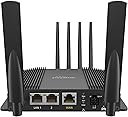
I picked up one of these for testing; our standard is the Peplink MBX Mini. I was curious to see if this could be a budget-friendly option when the full MBX solution wasn't necessary and affordable. Everything you love about the MBX is in this unit. It's equipped with the new Qualcomm X62 chipset, so cellular speeds are impressive. All the features we appreciate in the MBX series, like Speedfusion connection bonding, are also included. The unit can hold two SIM cards but only one can be active at a time. Switching from one to the other takes about a minute while the radio resets (this was from AT&T to Verizon, so it might be a longer switch process). Performance on 5G is the fastest among our cellular router devices, thanks to the new chipset and carrier aggregation. Two things worth mentioning that made me really like this device: First, it has two LAN ports and one WAN port on the back. You can connect an external cellular router (I'm using an InseeGo with T-Mobile) and combine it with your onboard 5G, giving you two carriers bonded with Speedfusion. Fantastic! Second, there's the Virtual WAN option. You can turn one of those LAN ports into a WAN port. Add another external cellular router (like an AT&T Netgear 5G), and now you have three cellular radios bonded into one Speedfusion connection. This is what we typically do with the MBX Mini—two onboard radios and one external. With the BR1, we have one onboard and two externals. Wow! The catch is that when using an encrypted Speedfusion tunnel, the maximum you can achieve, even with your own private cloud servers as we do, is 200 Mbit. That’s probably sufficient for many users. With the MBX Mini and private cloud, I’ve been able to peak at 800 Mbit, and maintaining 500 Mbit all day is no problem. The device doesn't get nearly as hot as the MBX Mini, which could fry eggs—maybe even sear a steak. Another great feature is its compact size and light weight. We need to put the MBX in a small Pelican case to transport it, but the BR1 can easily fit into your laptop bag without you even noticing it’s there. I’m much more likely to carry this around because it can be in your bag and is almost forgettable. Taking the MBX with you is a conscious decision. A few things I learned: I don't think the Wi-Fi is super strong. It works well, but even on "MAX," it doesn't seem to have the reach of some consumer home Wi-Fi gateways. It's not terrible, but don’t expect it to cover an entire house. If you select the "US" regulatory domain, you only get a limited number of channels, not the full list of legal channels in the US. In today’s world of saturated 5GHz, you want options. If you switch your regulatory domain to "Canada," you gain access to all the US legal channels at the right power levels, making it much easier to find open, quiet channels that are completely legal in the US. This might be a bug; I've noticed it across their entire line. Hopefully, it gets fixed. The annual maintenance fee for Speedfusion bonding and inControl access (which I think is crucial) is under $200 a year, compared to $1,100 for the MBX Mini. All in all, it’s a fantastic little router that was a surprise. I can't recommend it enough.