We remain fully operational. Our teams are working around the clock to ensure your deliveries continue safely.

DOWNLOAD THE APP


Customer Services
Copyright © 2025 Desertcart Holdings Limited
DOWNLOAD THE APP

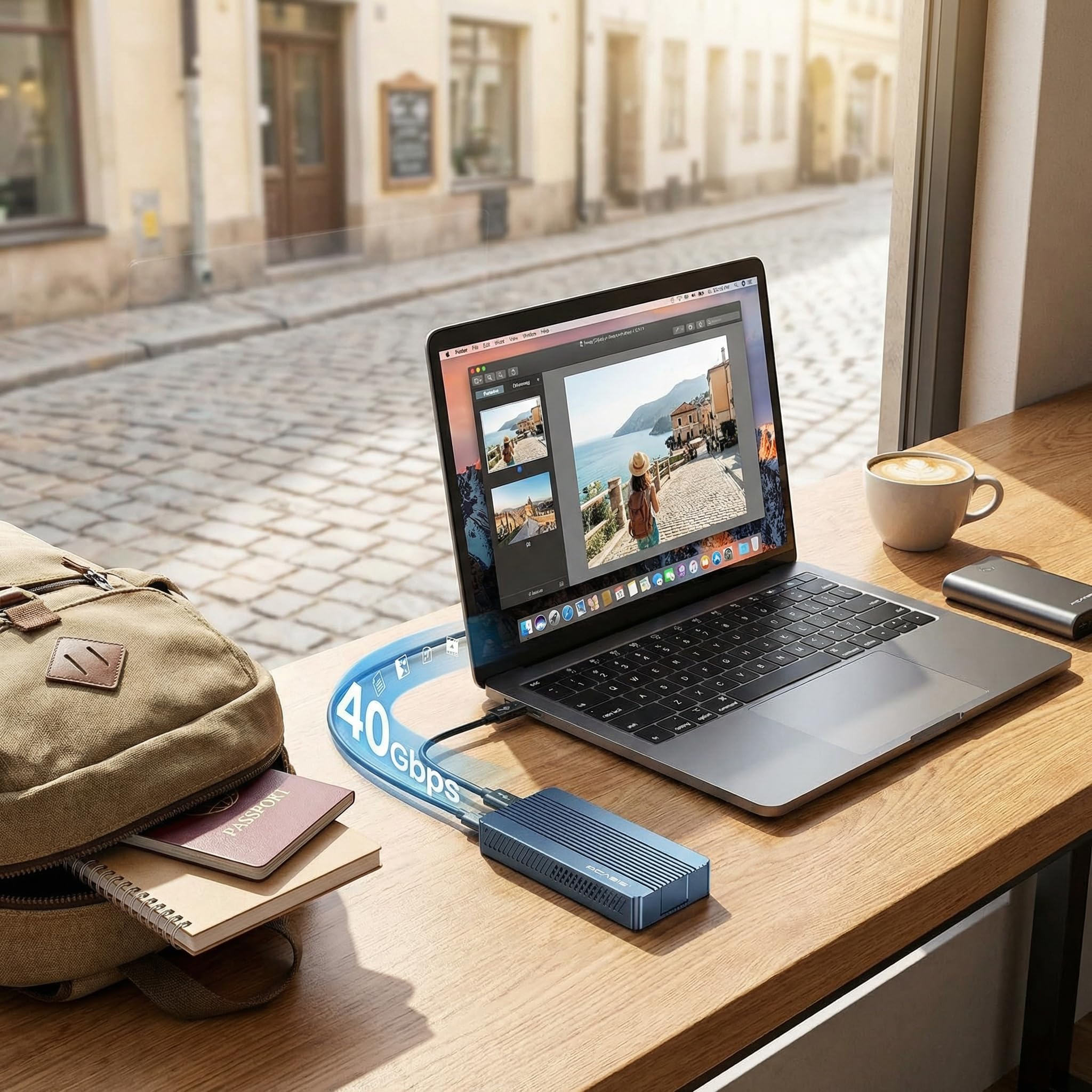


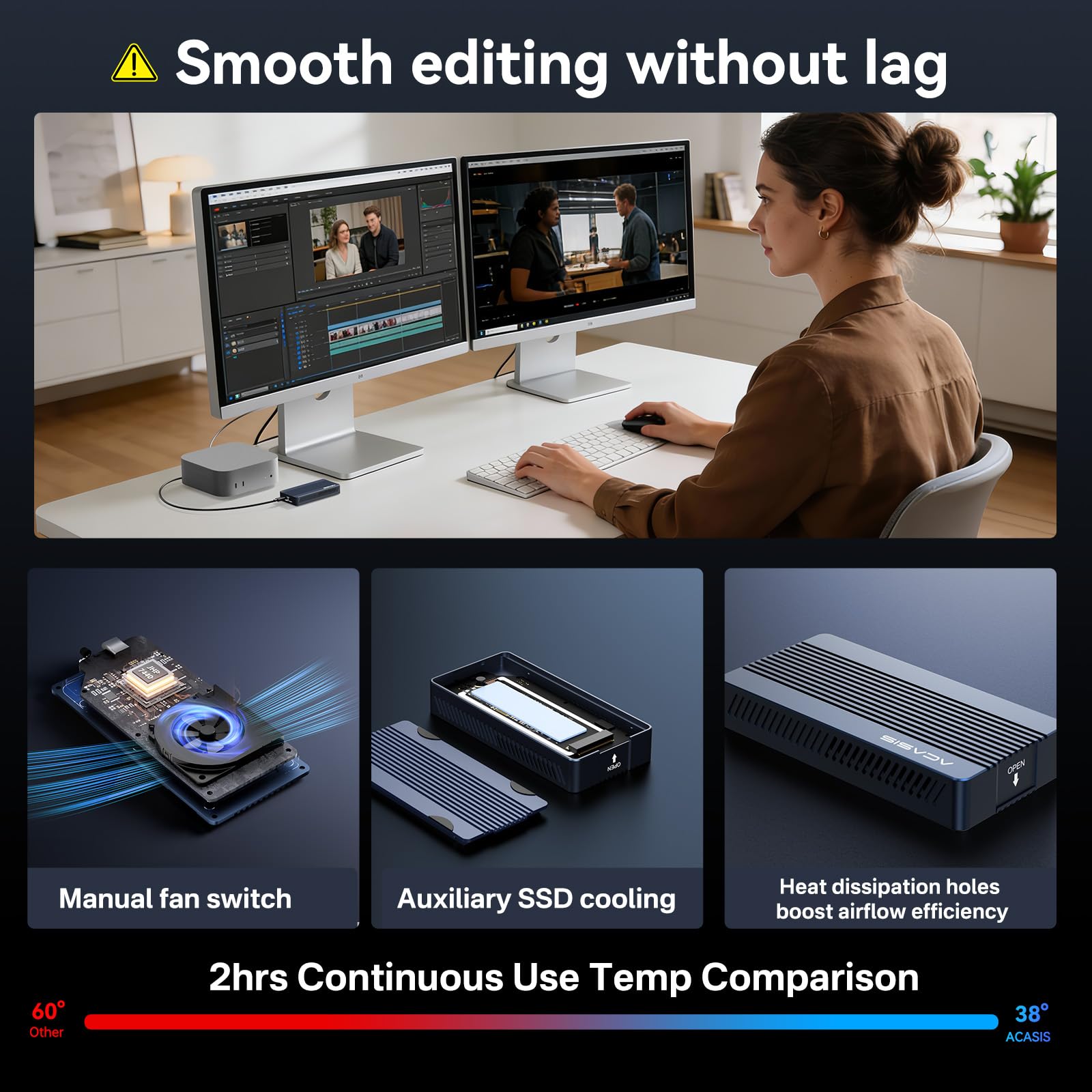
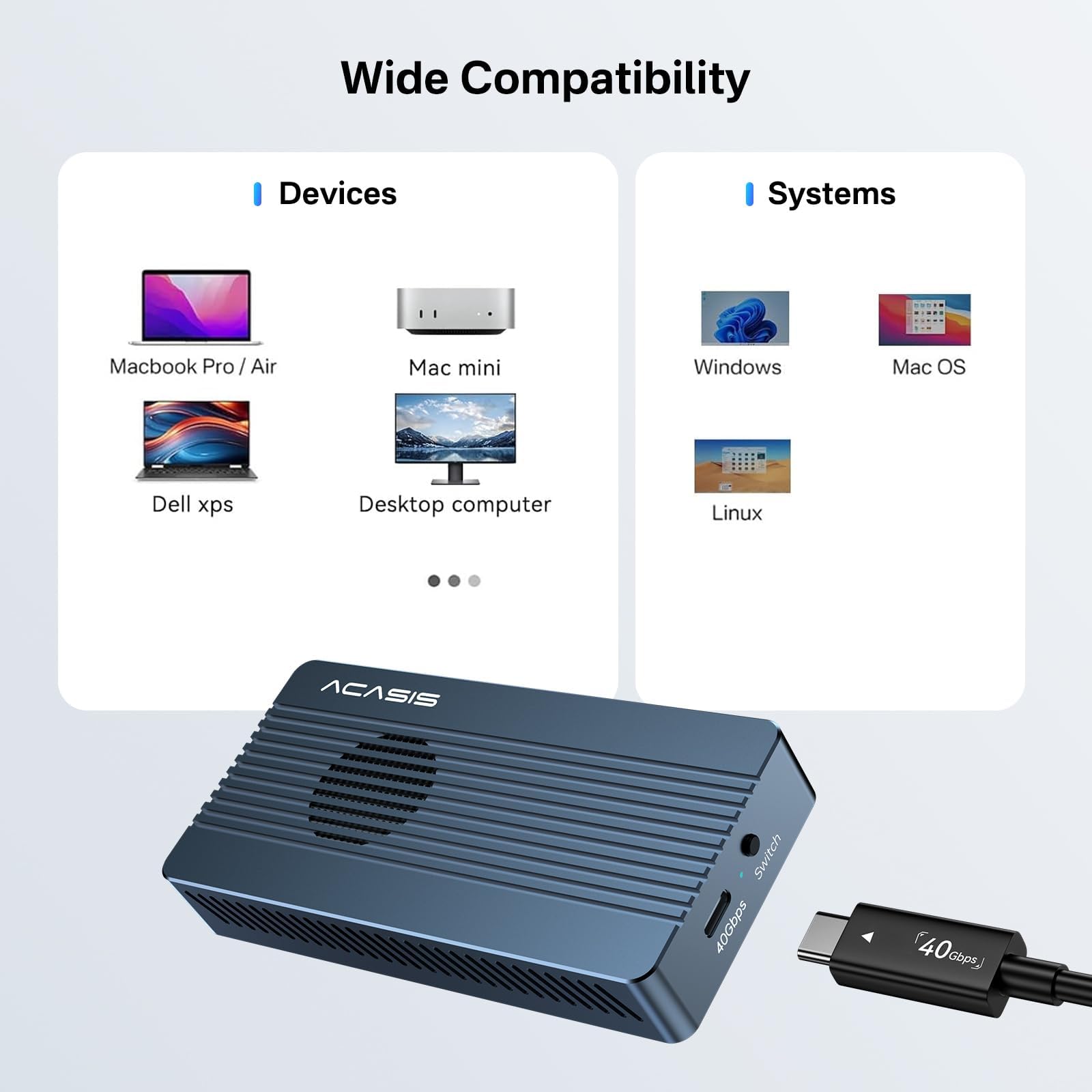
⚡ Unlock pro-level speed & cool reliability — your SSD’s new power move!
The ACASIS TBU405 Pro is a premium 40Gbps M.2 NVMe SSD enclosure featuring an active cooling fan and aluminum body for superior heat dissipation. Powered by the Intel JHL7440 chipset, it supports Thunderbolt 4/3 and USB4/3.2/3.1/3.0/2.0, delivering tested read/write speeds up to 2805/2734 MB/s. Compatible with M1/M2/M3 MacBook Pro/Max, iPad Pro, Windows, and Linux, it supports multiple M.2 sizes (2280/2260/2242/2230). Designed for professionals needing fast, reliable, and portable external storage, it ensures stable performance during heavy data transfers and creative workflows.


| ASIN | B0C8CZB5S7 |
| Best Sellers Rank | #28 in Enclosures |
| Brand | FREEGENE |
| Built-In Media | enclosure |
| Color | Black |
| Compatible Devices | M1 Pro/Max Mac devices, iPad Pro |
| Customer Reviews | 4.3 out of 5 stars 1,113 Reviews |
| Data Transfer Rate | 4.25 Gigabits Per Second |
| Enclosure Material | Aluminum |
| Hard Disk Form Factor | 22 Millimeters |
| Hardware Interface | Solid State Drive, Thunderbolt |
| Hardware Platform | Windows |
| Item Weight | 0.3 Kilograms |
| Manufacturer | ACASIS |
| Material | Aluminum |
| Memory Storage Capacity | 8 TB |
| Supported Devices Quantity | 1 |
| Warranty Description | 2 YEAR |
A**B
A Thorough Testing Reveals that This Is A Thunderbolt 3/4 Drive with 3,000 MB/s Speeds - WHAM!
Wow! What a few weeks it has been. For some, my initial review was blunt and critical. I had a unit arrive that initially worked, albeit slowly and not as expected. Soon after, the unit stopped responding and wouldn't mount a drive. I thought this product was garbage. However, I did some very thorough research. The product I received had been used before, and I unknowingly thought it was a new product. To summarize a very long story, the prior user did not insert the SSD in correctly, damaging the connector component and cracking (a few at least) solder joints that was making it work initially, but then as heat was applied the cracks became more apparent through thermal expansion, and BAM! The unit was dead. I initially thought this was a product malfunction, but this turns out to be on Amazon's side by returning used products and placing them as new. I had a lengthy conversation with the seller, and they are working with Amazon to ensure these things don't happen again. I agreed with them, that when you buy a new product, you should expect a new product, and not something that has been used before only for Amazon to throw it back on the shelf. This has apparently increased in frequency with Amazon, and thus this places blame squarely on them. Therefore, my review is below as I returned the defective unit, and bought a brand new one that I was able to test out. Like many of you, NVMe Enclosures are not a completely new idea, but they have remarkably increased in performance in the last year or two. This is because NVMe rely on the PCIe bus which typically is attached to a motherboard, offering the very best and top speeds that the motherboard is capable of handling. When you start moving toward enclosures, they are not "directly" attached to the motherboard, and thus are limited by the cable, receiver technology, and enclosure itself. Whereas USB (and Thunderbolt, for that matter) have promised to simplify this technology, it instead has increased its complexity to confuse all of us! First, you are looking for an enclosure. No surprise you already have a 2280 (think size, 22cm by 80cm SSD "stick", and NOT a SATA stick, don't bother with those anymore) SSD that you want to use, but either don't want to put it into a computer or you have a spare one on hand. That's where these enclosures come in handy; they can utilize the SSD attached to the computer as a "mega USB thumb stick" to increase storage and a whole benefit of other factors. Now, as we discuss speeds, USB sticks are actually surprisingly slow. Even some of the best, expensive ones are only able to pump out 100-200 MB/s write speeds (reading is almost always faster and easier than write). Since you are looking for an enclosure, you should have at least a 3,500 MB/s NVMe SSD that can benefit from a fast enclosure. Simply hook this up to a computer, and you'll get fast read/write speeds. This benefits from large file transfers such as videos, or a database of something like music (I myself have about 300 GB of personal music collection, not streamed). So the usefulness of a 1TB to 2TB SSD attached to the computer helps out your storage, while also performing well for the computer to carry out tasks that is within the extra storage space you are using. Enter ACASIS Thunderbolt enclosure. You'll see that it has the (not latest, but best) Intel JHL 7440 Chipset. You want this chipset because it is capable of Thunderbolt 3 (and Thunderbolt 4 for a Mac, a bit more about that difference in a second). This chipset gives you the capability to read and translate that data on the SSD to be sent to the computer. Next, you need the proper cable. Not just any cable with USB-C connections on each end. You need a cable that is capable of transferring that data from the enclosure to the computer. Any old "charging USB-C" cable won't do, they are for charging and NOT necessarily for data transfer. The cable that comes with this unit is meant for Thunderbolt 3/4, so this cable is good (and spendy). If you need a longer one, they don't make super long ones simply because the longer cable that you use, more interference is introduced and drastically reduces the speeds. Best to keep your cables short! Once you have the SSD, the enclosure, and the cable, you can now connect it to your computer or your laptop. The best benefits will be realized by a laptop as this enclosure is easy to carry around, does not weigh much, and performs WAY BETTER than any kind of mechanical drive that you plug into a laptop. This gives you the extra storage space you are looking for. Maybe for video editing, carrying around your music or photo collection, or even a backup that will be quick to backup any files that you need. This enclosure gives you that flexibility to use at your will, and giving performance similar to another SSD that is plugged into your motherboard. I installed both a 2TB WD SN850X and a 2TB Samsung 980 PRO (both are very good SSD's with fast read/write speeds) to test out the capability of these enclosures. I used a new Mac Mini M2 Pro and used a hard drive speed test software. Speeds were about the same between both SSD's, so the enclosure is pulling the best that it can from each SSD's. Even though these SSD's are capable of over 7,000 MB/s, the limiting factor is what Thunderbolt can do, and that is a theoretical rate of 40Gbps. But I'm going to clarify some negative reviews here with some technical know-how: First, remember that speeds are theoretical bandwidth speeds, and almost never reach those speeds. Think USB 2.0 and how everyone thought it was mega-fast at 480 Mbps, but it never got close to that. Know why? Because everyone kept trying to use mechanical drives, and they simply just can't perform like an SSD could back in the day, so speeds were still seemingly slow (still way better than USB 1.1!). Second, Thunderbolt (and USB 4.0) still have to have bandwidth reserved for display output. That means that the 40Gbps capable speeds still has about 16Gbps of reserved bandwidth for display carry-through. So yes, 40Gbps would yield over 5,000 MB/s, but you're not going to get that no matter what you do. So the best you can get is about 24Gbps, which is about 3,000 MB/s and that's exactly what this unit can do. I have not seen any other enclosure that can beat the performance of this one, simply as the best chipset right now is the JHL 7440 which will cap out data transfers at about 24Gbps (surprise!). Still, 3,000 MB/s is still VERY good, and you HAVE to remember that this is not directly connected to the motherboard, so you're not going to see 7,500 MB/s transfer speeds simply because you are not directly connected to the fastest bus on the computer. External connections are never really going to be faster than internal circuitry, so stop believing that somehow, magically, you can. Just isn't reality. So with that in mind, the enclosure can get warm with TONS of data transfers (how often are you going to transfer TB's of information back and forth? Yea, not much), so the heat dissipation is good. I found out that the hottest my unit could get was about 110 degrees F after moving 4TB of data back and forth, which is not bad at all. I also keep the heat down because it sits on top of the aluminum body of the Mac Mini, which helps pull heat out of the unit. The enclosure is a well machined block of aluminum alloy, so it is capable of heat transfer if you give it a medium to do that. Air is not exactly the best conductor, so sitting on top of a towel will not dissipate as much heat as you would if you placed it on a thick, solid metal surface, or even a cold, flat desk that can help pull some heat from the unit. To be fair though, it will only get hot with a LOT of work, and even then I noticed that it cools down fairly quickly, so heat is not really an issue with this unit. Lastly, I went beyond and wired up two of these units to give a real-world demonstration of a RAID setup (Google RAID if you need to learn about it, you'll want to if you haven't heard of it, RAID can be awesome). Using the same Mac Mini, I took two SSD's and two of these ACASIS enclosures, and set them up as a RAID 0 drive using Stripe. Now, I've taken two 2TB drives and created one single 4TB drive. As one transmits info, the other is getting ready to transmit, so they both work in harmony that essentially doubles your bandwidth. Behold, my 3,000 MB/s speed tests now turned into 6,000 MB/s speeds! That's the WOW factor that is needed. Overall, for about $100, this enclosure will beat the socks off of any of those "other" $20 or $40 enclosures. The JHL 7440 chip itself is expensive, not to mention the cable that is actually capable of full data transfer is not cheap either. Hence, the price is getting something worth paying for. You think USB 3.0 speeds are fast at 5Gbps? Try transferring a 30GB file and see the difference. Personally, I used a 30GB Photos library, which is a good test because it has hundreds of thousands of files, plus a large 30GB data chunk size, that is perfect to test a transfer rate. I moved 30GB in less than 30 seconds. Yes, half a minute. You read that right. How? Because I used my internal Mac Mini SSD with speeds of 3,500 MB/s and my RAID drive capable of 6,000 MB/s, and it transferred a large 30GB file that quickly. Just. Screamin'. Fast. So, to realize the full potential of this, you need to ensure that you have the right SSD, the right enclosure (this one), and the right cable (comes included). Now you are ready to play with power! Pic 1: Speeds of the enclosure using Samsung 980 PRO Pic 2: Detailed breakdown of Thunderbolt connection, 40 Gbps Pic 3: Box unit arrived it Pic 4: Internal Mac SSD, notice the speeds of ACASIS enclosure is near internal SSD speeds! Pic 5: Buy two of these, use RAID to combine the SSD's together for a whopping 6,000 MB/s!!!!
E**D
So Far So Good
I bought this ACASIS 40Gbps M.2 NVMe SSD Enclosure to install a 4TB Crucial NVMe SSD, and I’ve been using it intensively for video editing (4K, 6K RAW) and professional photography workflows. After more than two years of regular use, it has been very reliable. The enclosure delivers excellent speeds, fully taking advantage of the NVMe SSD. I work directly from the drive with large RAW video files and high-resolution photo libraries, and performance has been consistently smooth and stable. The cooling fan works well and does its job. I haven’t experienced overheating, throttling, disconnects, or system crashes. The fan is noticeable but not problematic, especially considering the workload and sustained transfers. Build quality feels solid, installation was straightforward, and overall it has proven to be a dependable tool for demanding creative work. So far, no issues at all.
B**N
Easy to install. Run cool (when you turn on the included fan).
All of the data on my Mac Studio now resides on SSD, including Time Machine backups. This may sound like overkill (and it is, sort of), but one thing I hate is waiting for a sleeping hard drive to SPIN UP. No more waiting. I have 3 Acasis SSD enclosures, housing a total of 16TB worth a SSD storage. Plus the built in SDD inside the Mac Studio. All of my data and backups reside on the external SSDs hosted in Acasis exclosures. The only things on the Mac SSD are: Mac-OS, Applications, and the Downloads folder. My data is mine, and I keep it outside of the Mac. I have the smallest SSD you can get on a Mac Studio (0.5 TB) which is currently about half used. The Acasis enclosures have built-in fans, and they run cool all the time. The cost to populate the SSD farm was about the same as I paid for the Mac Studio itself, but well worth it. When I hit the ESC key to wake up the computer, there is no sound. The computer wakes up and is ready to go in less than 5 sec. And that's with two screens that need waking. The Acasis enclosures are TB4 instead of TB5. This is because TB4 is plenty fast enough for random access I/O. The stats quoted for TB5 are mostly for sequential I/O for large files. Unfortunately, most of the computing tasks that 99% of people run 99% of the time, have nothing at all to do with sequential I/O for large files. Anyways, the Acasis SSD enclosures are top notch, easy to install, and they run cool and trouble free. Would recommend. Would buy again, no question.
J**W
Ideal for Mac M2 Studio Max external boot drive.
Product worked as advertised for a Mac M2 Studio Max achieving 3600 MB per second thunderbolt 4 speeds using Samsung - 990 PRO 4TB Internal SSD PCle Gen 4x4 NVMe. Allowed full installation of macOS on external drive and full boot support. Initially tried using lower cost Crucial - P310 4TB Internal SSD PCIe Gen 4 x4 NVMe M.2 drive but for some reason that is not compatible with the ACASIS device. Failed a copy after about one terabyte it would time out by slowing down to 100 MB per second and then eventually 0 MB and then the Mac would eject the drive and remount and you’d have to start over again. Thought maybe it was a thermal issue but as soon as it failed I open the unit and checked and it was still cool to the touch so it was more of a compatibility issue than a thermal issue. The ACASIS device has a LED light and I noticed with the P310 the LED light would blink on and off twice a second which I thought was normal but when using the Samsung you get rapid fire LED blinking so there might be some type of timing or syncing issue. Using the Samsung I haven’t noticed any thermal problems either, it seems cool to the touch even after transferring terabytes of data. Built-in super quiet fan probably helps. Using thunderbolt 4 the speeds are still not as fast as the internal storage which achieve speeds nearly 6000 MB a second, when I used to beat up with that before the monitor would turn on it was already at the login prompt but now with the ACASIS device you can still see a little bit of the Apple screen and the login screen when turning on the computer. The devices achieving the maximum speed of thunderbolt 4 so there’s nothing wrong with the device that’s just the limitation of Apple technology. I know there was some firmware issues with the newer thunderbolt 5 version but that’s not compatible with my Mac and I don’t always like using the bleeding edge technology. This year-old version is solid and works well. Product is well built aluminum enclosure with built-in fan and included thunderbolt for cable with backwards compatibility with USBC 3.2 And older devices. Includes two different thickness thermal pads in which I used both of them to make sure SSD was getting complete coverage and thermal cooling onto aluminum cover which snapped in tightly. No tools needed to secure the SSD, included spacers and pins secure it well enough for desktop usage, maybe not ideal for mobile users unless secured with some type of elastic band to keep the door from opening if it’s dropped. Transferred over 2 terabytes of data to new external drive using migration assistant from previous Apple internal and external Samsung T7 rugged drive. Wanted to move off that T7 drive because of Mac compatibility issues with USB-C 3.2 non-trim support. Also was running home on external drive with the main OS on the internal which made it really fast but had weird issues like non-permissions full data access and Time Machine quirks because of data residing into locations, much better now that everything resides on one ssd me and Time Machine is backing up just one drive now. Already performed several da Vinci resolve projects and had no issues of disconnects or 4K slow speeds and performed several Time Machine backups and offsite data copies using CCC.
M**E
Great TB4 enclosure!
This enclosure is great for both PC and Mac. The installation was super easy and tool less function make it easy to change out the NVME. The speed was excellent when paired with a WD Black 850X NVME.
J**.
ZERO STARS. Junk should not be deserving of one star. Don't spend your money on this brand of JUNK.
I bought 1 of these in July of 2024. It worked for a LITTLE while then started dropping from my Mac as I started to transfer larger files. I tried all sorts of different ways to see if I could resolve the problem and then kinda gave up on it and it became too late to return it within the 30 day window. I tried to contact the manufacture/Acasis through this site I bought it through. A few days past and they replied with "contact the seller" which is Acasis Direct US through this site but they didn't offer any help with the warranty as I requested. Then this site only sent me a survey to ask me if the seller resolved my problem. To which I replied no, and that was pretty much it. NO HELP AT ALL. Just pass the buck. So I decided to try another unit just to see if maybe I received a defective unit. The day I received the new case, I tried straight away to transfer some LARGE files and guess what? DON'T WASTE YOUR MONEY. Right out of the box, the new one wasn't working. It would light up then about a minute into the transfer it would drop and stop transferring. I would get a message saying the drive was ejected without ejecting just like the first one. In Less Than 24 Hours, I Requested the return and shipped it back by drop off at the local department store. I put the 4TB 990 Pro SSD in two other PC's and a different enclosure with the same $150.00 APPLE cable on my Mac and tried to transfer the same files and no problem with my SSD THANK GOD. I wish I could leave NO STARS because no one did anything to help and JUNK should not be deserving of 1 star. Sadly, I'm still out $100.00 for the 1st one. I HAD SOME OTHER ACASIS ITEMS ON MY SHOPPING LIST AND GUESS WHO IS NOT BUYING ACASIS EVER AGAIN. I'LL SEND MY 1000 BUCKS SOMEWHERE ELSE.
M**Y
Excellent TB3/4 NVMe enclosure a bit on the pricier side.
This is an excellent NVMe enclosure. I chose the TBU405, as I feel it may have better heat dissipation than the TBU401, due to the corrugated outer casing. I honestly don't know what the difference is between the two otherwise. I have used the Samsung 980 Pro 2TB and WD Black SN 850x 2TB in the enclosure with nearly identical results on a 2023 16" M2Pro MBP with ThunderBolt 4 /USB4 ports. TEMPERATURE This enclosure gets warm. At a room temp of 21℃/70℉, (at idle) the temp of the casing is 38℃/100℉, while resting on a cork mat, (to see what temp it will idle at) which does not conduct much heat from the casing to the surface its laying on. This matters, because the only heat transfer is to ambient air around it. If I were to rest this on the MacBook Pro chassis to the right or left of the track pad or any other temp conducting surface, the temp would plummet on the ACASIS enclosure because it would transfer the heat to whatever its laying on. Any surface that readily absorbs heat from the enclosure makes an enormous difference. I don't think it's much of a concern otherwise, as NVMe SSD's can operate well up to roughly 70℃. SPEED This is about the best external solution for transferring large files. This is roughly 3x faster than nearly all NVMe external drives sold by the major SSD manufacturers due to the Thunderbolt interface. (Most of them are USB 3.x and are restricted by the 10GB/sec interface speed. You will not get max speeds on USB 3.x. Currently using with a Samsung 980 Pro 2TB with latest firmware (as recommended by ACASIS) and also tested with a WD Black SN850x 2TB (latest firmware). I thought I remember seeing ACASIS say that the latest firmware for the SN850x works with this enclosure but I don't remember where I came across that info. So take that with a grain of salt. I formatted the drive and ran some speed tests with no issue. I didn't conduct any large file transfers. Performance of these PCIe Gen 4 SSD in this enclosure wielded excellent results. I reach around 3000 MB/s on large seq. read and writes on Amorphous Diskmark. Using the included TB3 cable wielded the same results as using a brand new OWC TB4 cable. No speed issues for me with included cable. Also, no disconnects, no hiccups after transferring a little over 1TB performing backup of an old spinner. This process took around 5 hours, due to the slow conventional HD and the amount of files I transferred. This ACASIS enclosure would have been able to read/write in a minute what took the other drive over an hour to transfer. NOT KIDDING!!! FORMATTING Originally, I had formatted the Samsung 980 pro to APFS (case sensitive/Encrypted) and it wielded performance results in RND 4K QD64 Read/ lower than expected. (See Pics) (763MB vs. 1385MB) While I was somewhat disappointed in that result, I learned it was due to formatting that way. When I reformatted to just APFS, results were as expected (1385MB). Nearly double in that one metric. I thought originally that the issue might have been the SSD, not the ACASIS enclosure. Turns out it was the formatting. *Another note, is that you will not see top speeds when formatting to exFAT. It will affect your benchmarks considerably. All in all, this is an excellent solution if you need top tier performance from an external drive. I would definitely recommend. Being these Gen4 NVMe drives are capable of over 7000MB/sec I would love to see an updated enclosure. I am not sure if the bottle neck is interface speed (TB3/4 @ 40GB/sec.) or if this enclosure is using a PCIe Gen3, either way its currently the best solution for those that require as little wait time as possible using an external enclosure.
T**S
Fantastic SSD enclosure!
I am blown away by the speeds that this SSD enclosure can deliver. I've got mine paired with a Samsung 990 PRO 4TB SSD and plugged into the Thunderbolt port of my Mac Studio. I'm seeing read/write speeds in the 2700 MB/s and 2600 MB/s range, which is so much faster than my previous 10 Gbps enclosure (which was achieving roughly 600-700 MB/s speeds). And this is with the SSD about 45% full. I use my system for video editing 4K content, and the scrubbing speed on my timeline has become instantaneous. I can quickly scrub through the timeline or jump to different parts of the video with ease... no lag anymore! Installation was super easy... just open the fully aluminum case, insert the SSD and rubber mounting plug, then push the SSD into the enclosure (no screws or screwdrivers needed). Close the cover and you're done. My Mac recognized the drive immediately. The enclosure can get warm (to slightly hot) when I'm rendering a long duration video, but that's expected of any SSD or hard drive. To keep the enclosure (and SSD) cooler, I keep the enclosure on top of my Mac Studio (which has an aluminum shell)..... this helps to dissipate heat a little better than if I were to place it on my wood desk surface. The enclosure looks great; it's sleek and minimalistic with cleanly milled heat-sink grooves. And the all-aluminum design is very-nicely machined and matches the design language of my Mac, awesome! I don't have a PC, but this is fully compatible on my Mac Studio running the latest MacOS.
Trustpilot
1 month ago
2 weeks ago