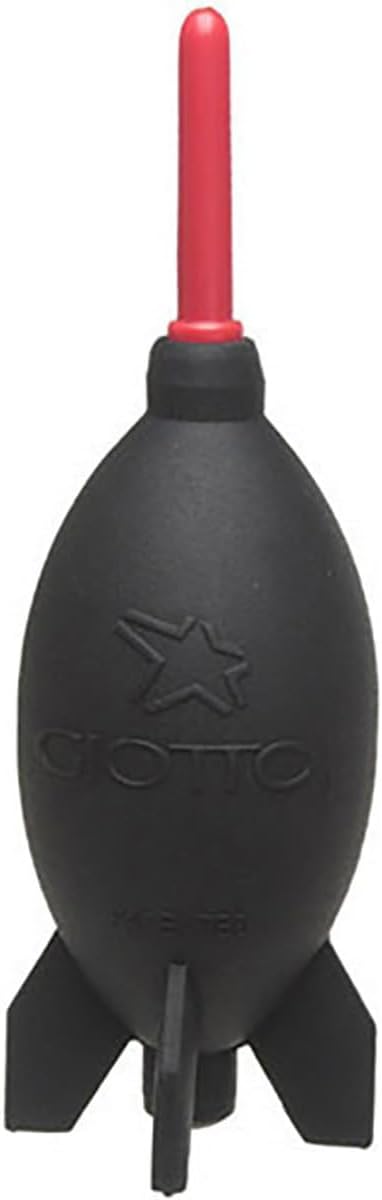
இ Fuzzy Wuzzy's Summary: ѾѾѾѾѾ Highly recommended with warm fuzzies! Several years ago, I purchased two of these medium-sized Rocket Airs and two of the large-sized Giottos AA1900 Rocket Air Blaster Large (Black) . There is also the more compact Giottos AA1920 Rocket Air Blaster Small (Black) , but I find the larger and more forceful volume of air that is blown by the Medium-sized and Large-sized Rocket Airs to be more useful, requiring fewer blasts of air to get the job done. These are the best air blowers on the market! My Rocket Airs are still going strong after several years of near-daily usage, so I recommend this highly for both effectiveness and durability. Don't just settle for the tiny blowers that come in the camera cleaning kits; those tiny blowers are far more compact and easy to carry, but they cannot do much to dislodge stubborn electrostatically-charged dust. After I decide upon what I am packing, traveling with, or what camera bag or backpack I am carrying, I then decide whether to take my medium or large Rocket Air for the outing. And one of my large Rocket Airs always stays at home for a variety of non-camera uses too. I usually travel with the medium-sized Rocket Air because it is more compact. For cleaning camera sensors on my three Canon dSLRs, I use the large-sized Rocket Air because I want a good blast of air without inserting the Blaster's nozzle into the camera body. I do not want to get the Rocket Air's nozzle too close to my camera's sensor for fear of bumping the plastic nozzle tip onto the sensor. These are indispensable not just for cleaning off camera lenses and sensors, but I also use them to blow out dust and debris that may collect on computer keyboards and laptops, every time I open up a desktop computer case to change the computer's internal configuration, and various other uses where I need to blow dust off of electronic components. For cleaning keyboards and laptops at home, where I have access to a vacuum cleaner with crevice tool available, the vacuum crevice tool is more effective than this air blower. But while I am at the office or on the road, I use the Rocket Air on keyboards and laptops. Another awesome use for my Rocket Air is for blowing dust off of computer and electronic components. In particular, it is important to periodically blow dust off of the heat sinks of electronics such as CPU heat sinks and heat sinks inside stereo amplifiers/receivers. Heat sinks that have heavy amounts of accumulated dust can lead to ineffective heat dissipation, resulting in the overheating of your CPU and electronics, possibly leading to premature component failure. Even if I have not upgraded my desktop computers within a year, I like to open up the cases of all of my desktop computers once a year and blow out the dust that accumulates on the CPU heat sink, the motherboard, all internal computer fans, and I point the Rocket Air's nozzle into the slots of my computer's power supply to blow dust out of it too. As with cleaning digital camera sensors, you should not get the Rocket Air's nozzle too close to the motherboard to avoid risking the nozzle getting bumped into sensitive components. If you have a desktop computer and you have not opened up the computer case in years, you may be surprised at just how much dust, pet fur, and debris has accumulated on its motherboard, CPU, components, power supply, fan blades, etc. It only takes a few minutes to open up the computer case, take the Rocket Air, and blow all that dust out of the motherboard, power supply, and fans. You may also want to have a vacuum cleaner nearby to suck up the cloud of dust that comes floating out. You should also periodically clean the vent openings on your laptop. These vent openings consist of fan intake vents and vents where warm air from inside your laptop is blown out. These vent openings may be positioned around the sides of the laptop and also underneath the laptop. Dust and lint can be pulled into the interior of a laptop, causing ineffective heat dissipation and overheating. And compared to the interior of a desktop computer, a laptop's interior is far more crowded. When I have access to a vacuum cleaner's crevice tool, I find that holding the vacuum crevice tool up against a laptop's intake vents and fan output vent is the best way to suck out the dust from inside a laptop. But when I am at the office or traveling, I point this Rocket Air's nozzle up against each of the laptop's vent openings and give each vent opening several good blasts of air. By cleaning the interior of your desktop computers and laptops, your computer runs more efficiently to cool itself and you may even notice that your computer's fans run quieter because they do not have to try as hard to cool the computer when the interior is not all covered with dust and lint. For years now, I no longer buy any of the cannister "air duster" products anymore. And despite being referred to as "canned air", these "air" cannisters all consist of fluorocarbons that are compressed into liquid form, and fluorocarbons are toxic, noxious, and flammable. And if you do not hold and use the "air duster" cans correctly, they can spray liquid fluorocarbons onto your camera's sensor or electronic components. A common fluorocarbon used in "canned air" is difluoroethane. Prolonged exposure to difluoroethane has been linked in humans to the development of coronary heart-disease and angina; the chemical can also cause lower abdominal cramps. Many fluorocarbons are very potent greenhouse gases that can affect the environment, and if some fluorocarbons are inhaled/ingested, like pesticides, they can accumulate and be stored in your body to have toxic effects on your liver and endocrine and immune systems. So these canned air products, which are really canned fluorocarbons, are all nasty stuff... both for you and the environment. Along with being more healthy for you by not breathing fluorocarbons into your lungs when you use canned air products, your hand muscles also get a little exercise by squeezing this Rocket Air :) Although canned air duster products will produce a more forceful blast than this Rocket Air and you may need numerous squeezes of this Rocket Air to dislodge and blow out dust wedged inside tight places, I think that the health and environmental consequences of using canned fluorocarbons is a bad tradeoff just for the sake of getting a stronger blast of air. The large Rocket Air also comes in a red color if you prefer that color. As an added bonus, I love the Rocket Air design, looking like a Buck Rogers spacecraft, with its four rocket fins cleverly keeping the blower free-standing upright on a table. Visitors to your house might initially think that this Rocket Air device is some kind of proctologist tool or kinky sex toy, but that adds to its charm! If you have a dog, keep your Rocket Air away from them, as some dogs find this to be a pretty nice chew toy! :-)