
DOWNLOAD THE APP


Customer Services
Copyright © 2025 Desertcart Holdings Limited
DOWNLOAD THE APP
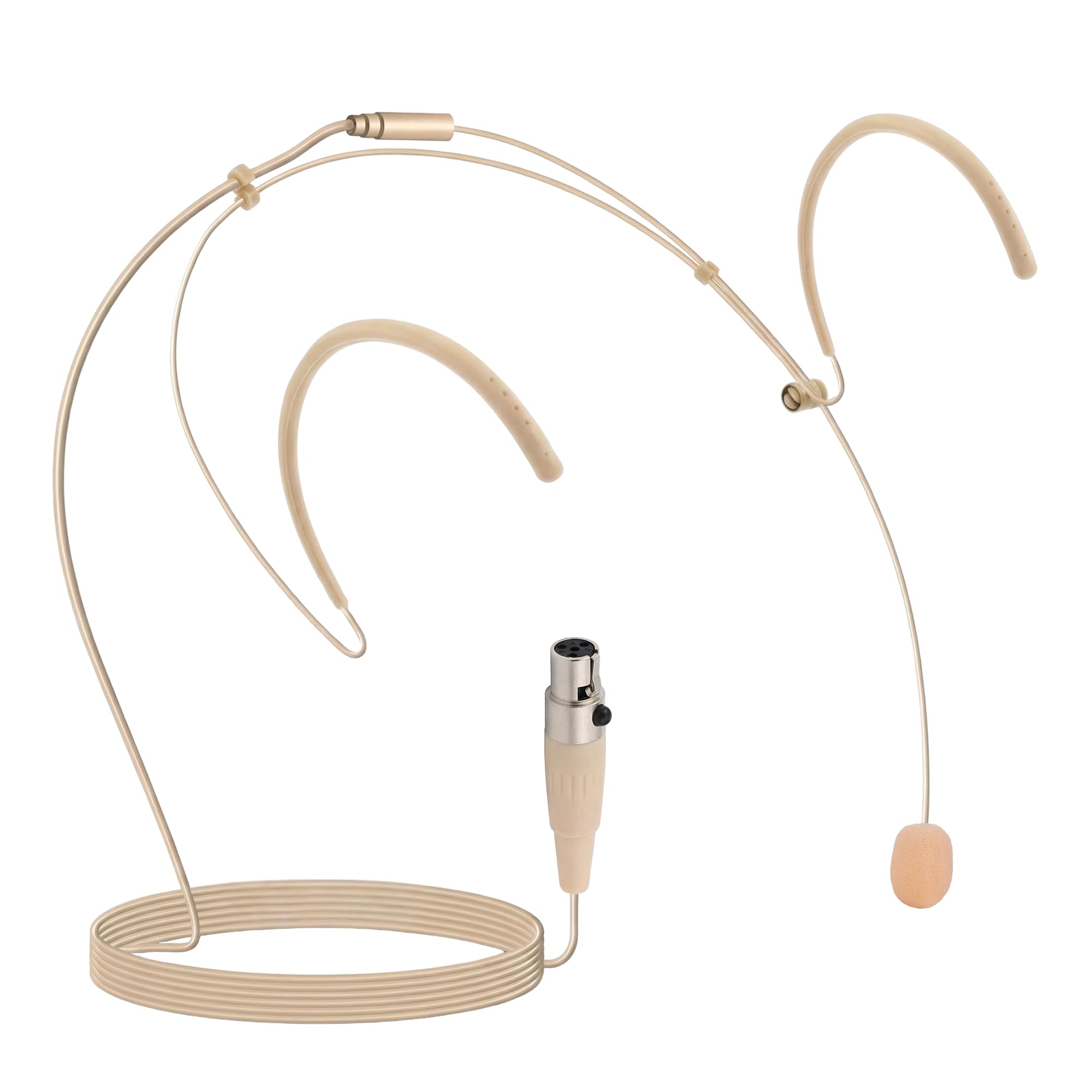
🎙️ Elevate your voice, stay hands-free, and own the spotlight with pro sound that’s almost invisible.
The Pyle Pro PMHMS20 is a professional dual over-ear headset microphone featuring an omnidirectional condenser element with a full 20Hz-20kHz frequency response. It offers a secure 4-pin Mini XLR connection compatible with wireless belt packs and studio mixers. Designed for comfort and discretion, its beige metal frame fits glasses and hats while blending with skin tones. Lightweight and durable, it includes two foam windscreens to reduce wind and plosive noise, making it ideal for presentations, performances, and broadcasting. With a competitive price point, it delivers reliable, clear audio for extended use in professional environments.


| ASIN | B003D2VT2K |
| Additional Features | Microphone Included |
| Age Range Description | Adult |
| Antenna Location | Calling, Disc Jockey Use, Office Meetings, Recording, Singing |
| Audio Driver Type | Balanced Armature Driver |
| Best Sellers Rank | #1,533 in Musical Instruments ( See Top 100 in Musical Instruments ) #12 in Wireless Headset Microphones & Systems |
| Brand | Pyle |
| Brand Name | Pyle |
| Built-In Media | 2 Foam Windscreens, Headband, Microphone, User Manual |
| Cable Features | Tangle Free |
| Color | Beige/Matches Various Skin Types |
| Compatible Devices | Desktops, Laptops, Music Production Equipment, Smart Speaker, Television |
| Connectivity Technology | Wired |
| Control Method | Remote |
| Control Type | Volume Control |
| Customer Package Type | Standard Packaging |
| Customer Reviews | 4.3 out of 5 stars 965 Reviews |
| Ear Placement | Over Ear |
| Earpiece Shape | Hook |
| Enclosure Material | Metal, Plastic |
| Form Factor | Over Ear |
| Frequency Range | 20 hz - 20 khz |
| Frequency Response | 20 KHz |
| Global Trade Identification Number | 00068888904254 |
| Headphone Folding Features | Over Ear |
| Headphone Jack | 4 pin Mini XLR |
| Headphones Ear Placement | Over Ear |
| Impedance | 2000 Ohms |
| Is Autographed | No |
| Item Type Name | Pyle pro - Microphone (PMHMS20) |
| Item Weight | 0.11 Kilograms |
| Manufacturer | Sound Around |
| Model Name | PMHMS20 |
| Model Number | PMHMS20 |
| Noise Control | None |
| Number of Items | 1 |
| Sensitivity | 3 dB |
| Specific Uses For Product | Fitness, Professional, School |
| Style Name | Headset |
| UPC | 807031757640 182682351066 804066807067 068888904254 701988345502 |
| Unit Count | 1.0 Count |
| Warranty Description | 1-YEAR |
| Water Resistance Level | Not Water Resistant |
J**N
Use for Theatre Productions
*SEE UPDATES FOLLOWING THE ORIGINAL REVIEW* I work in a performing arts center where we use 24 wireless microphone systems primarily for theatrical productions by high school, middle school and community theatre groups. I expect to mic actors for 38 rehearsals and 54 performances this year. Although we have $300 microphones for " talking heads" applications, there's no way I'm risking a $300 AT or Countryman earset mic on a student. Quite a few mics fail with various kinds of damage over the course of a year, so I am always on the lookout for an unobtrusive and inexpensive mic. I'm hoping I've found one in the Pyle-Pro PMHMS20 Wired Headset Boom Mini XLR Omni-Directional Microphone. I initially purchased two of the Pyle PMHMS20 headset models and have since purchased another along with the Pyle-Pro PMEMS10 In Ear Mini XLR Omni-Directional Microphone (For Shure System) "earset" style mic. These "mini XLR" models are terminated with a TA4F connector required by Shure wireless belt pack transmitters. They also fit the Line 6 XD-V70L wireless belt packs. So far, I've only used the first two headsets in a community theatre production of three rehearsals and four performances. They performed better than expected and sound quality was excellent. They sound better than the MM Audio MM-PSM earset and at least as good, if not better, than a well-placed Shure WL-93. They are not a sonic match for the Audio Technica Microset Omni Condenser Headworn Microphone in Beige or Countryman E6, but they currently cost roughly 1/15th of the AT price listed on Amazon. I didn't measure the cable length, but it is adequate to reach just beyond waist level for typical adults. It will take some time to determine long-term durability, so I'll update this review after I've had time for evaluation. These headsets offer some size adjustment, but I don't believe they can be adequately adjusted for children. Even when adjusted to the smallest size, they were still a bit loose on a petite actress and had to be secured with a small strip of medical tape. The boom is very long, so a fair amount of bending may be required for smaller faces. Even with the mic element right at the corner of the mouth, I did not pick up pops or breath sounds. They do come with two foam wind screens, if needed. The most recent PMHMS20 headset I ordered arrived last week. When I opened the Amazon box, I immediately noticed I received the PMHM2 model with a 3.5mm plug, rather than the TA4F "mini XLR". I checked the packing slip to see that I had in fact ordered the "mini' XLR" version. I then checked the headset packaging, which was incorrectly labeled as the PMHMS20, but contained the PMHM2 version with a 3.5mm connector. I don't consider Amazon to be at fault, since the problem obviously originated with the manufacturer. I don't expect to have any trouble with Amazon exchanging this for the correct model. One other note; the product package (not Amazon) states that the mic is available in both beige and black. Unable to find a black model on Amazon or anywhere else, I called Pyle Pro. They confirmed that the package was mislabeled and no black model is available. ----------------------------------------------------- June 2012 Update - I've just ordered seven more of these mics when I found the price had dropped closer to what I originally paid. I continue to be pleased with the sound quality and have been surprised at how well they've held up. So far, I've used them 30-40 times on seven theatrical productions and a half-dozen "talking heads" programs. Most of the plays were musicals, including a dance-heavy production of "Hairspray". I broke the wiring inside one of the earset versions attempting to re-sculpt it for a better fit, but I've only had two minor problems with the headset version reviewed here, and those don't affect function. The clear plastic sheath covering the metal earpiece got stretched out on one mic and the end cap covering the tip of the earpiece was lost from another; again, nothing that harms function. I've had no problems with cables breaking or connector issues (on this headset version). Continued use has proven that these work best on large heads. No amount of adjustment will provide a stable fit on a petite actress or child. I've only had one instance where I had to use a foam windscreen to tame pops. I still wish these were also available in black and/or brown for African-American skin tones. ----------------------------------------------------- March 2013 Update - I now have 24 of these and am in the middle of another season of high school & community theatre musicals. Since my last update, these have been used in about 72 rehearsals or performances and I'll have another 25 rehearsals/performances between now & the end of April. To date, I've had three Pyle-Pro PMHMS20 Wired Headset Boom Mini XLR Omni-Directional Microphone "break" & all three have the same cable issue. The cable has a clip that attaches it to the back of the headband very near where the cable enters the headband structure. The band slides to lengthen or shorten the boom and fit head size. The problem occurs because the cable clip does not slide on its own during adjustment & that leads to pinching and excessive stress on the cable between the clip and entrance to the headband (I'll post a photo). The result is an audible "thump" as the internal wiring makes or breaks contact, along with momentary loss of audio. It usually happens as the actor turns his head or the mic cable gets a tug. It is not something I would consider end-user repairable. It can be avoided by always taking care to adjust the clip as you adjust the headband, but that often doesn't happen during the chaos preceding a production, especially if you have a large cast and even more especially if they are responsible to placing and adjusting the mic themselves. Given the use and abuse they endure versus the cost, I absolutely consider this problem and the number of mics I've lost due to it, perfectly within acceptable limits. Most of these productions involve the mic being on someone's head for four to five hours from beginning to end, so I'm talking about several hundred hours of total use for some of these mics, just in the last year. If you are buying a couple for the pastor to use a couple of hours a week and you take care to adjust the cable clip, you should get plenty of use before replacement is necessary. Pyle offers a one-year warranty that covers the usual "manufacturers defects". I've not looked into it, but plan to see if this problem might be covered. I''ll post the outcome when I get an answer. I am still very happy with the audio quality for speech and singing. I do minor EQ on them, but I generally EQ most other mics I use too; probably more a factor of room acoustics or speakers than the microphones. I will comment on pricing. The price of this mic varies as much as the stock market. I've watched it range from just over $11 to nearly $29 in the last year. Compared to similar mics, it is a great value at even the high price range. If you think it's too much, check back often, because it will fluctuate. All my stock was purchased when prices ranged between $14 & $19 (and with free Prime two-day shipping), so I'm thrilled to get this type product for this price. I'll be back with another update at the end of April. -------------------------------------------------------------- January 2014 Update - I've had 9 of these to fail as described above. I've posted a photo showing the point of failure. About the best preventative I can suggest is to train your users to take care when adjusting the headband. Also leave slack in the cable between the entry point to the boom and the clip to allow for sufficient adjustment without overly flexing the cable. Perhaps the best resolution is just to remove the clip all together. Doing so avoids the immediate problem with headband/boom adjustments, but there's no strain relief at all if the cable gets a good yank. With the amount of use these get in my facility, I still think they are a great value. Stuff breaks and it's just the cost of doing business. At least you're not out $300 when one of these breaks. Regarding the possible warranty replacement, I never bothered pursuing it. The packaging indicates a required handling fee for warranty issues that when combined with shipping cost, exceeds the cost of replacement with a new mic from Amazon. By the way as others have pointed out, the Amazon photo of the headset is upside down. The curved part of the earpieces go over your ears, not under. ------------------------------------------------------------- July 2014 Update - Total failures to date is around 28 since I started using them in October 2011. That sounds like a lot, but they are used well over 100 times a year. Without exception, each headset failed due to a wire break where the cable enters the headset boom. I've detailed this issue in previous updates and posted a photo showing the point of failure. Why then, did I recently purchase 30 more? (1) The price. Compared to any similar headset mic compatible with Shure wireless systems, the price makes this headset a steal. At the current price of under $14, it's a disposable commodity. (2) Sound. As I've said, this is no sonic match for a Countryman, Audio-Technica, DPA or other headset mic that will cost anywhere from $300-900 each, but for what I do (musical theatre with high school and middle school students & talking head events, it's way past good enough). With a little care in adjustment and unclipping the cable from the boom, the wiring problem can be avoided or minimized. I couldn't afford to own 30 Countryman E6 single ear headsets (currently $349 each on Amazon) or the H6 dual earpiece model most similar to this model Pyle (currently $470 each). Really, that's $10,470 for the E6 and $14,100 for the H6! I could buy over 1,000 Pyle headsets for the cost of 30 H6's. If you only need one or two mics for a pastor and they will be used carefully in a controlled environment, or if you are on Broadway with a gigantic budget and cannot entertain the possibility of a single failure, then the high dollar mics should be your choice. If you've got a lot of people who need a relatively inconspicuous headset mic that sounds reasonably decent, I will continue to recommend the Pyle PMHMS20.
S**M
Value of the century.....
Excellent. Not a sonic replacement for an E6 or a WL-93, but pretty darn close especially for the price. For 13.99 you can buy 30 of these instead of an E6. Having been in audio for 3 decades I was helping with a meagerly budgeted sound design for a high school musical. There was some investigation into name brand gear before I got involved. With students we needed a low cost solution to get as as many kids miced as possible. At this price the mics are almost disposable - and indeed during two dress rehearsals and a 3 night run the kids managed to toast at least 6 of the 30 mics I bought. After having been through 2 musicals with students my suggestion would be to buy these and immediately remove and throw away the ear hooks. The wire design where it clips onto the ear hook at the back of the neck was the problem. Kids hastily adjusting the mic would slide the metal frame back from the end of the mic and put strain on the clip holding the wire the the frame. This would cause rapid failure - sometimes only after one use as the strain breaks the wire. The best solution is to lose the ear hooks altogether which leaves you with the mic only on the end of a gently bent stiff wire that is perfect length to run through the hair emerging above the forehead as a head mic. Clip it into the hair discretely with small hair clips or bobby pins and you have an almost invisible mic! Plus it sounds better than the mic at the side of the mouth. I compared several of these and indeed most of the mud, woof and resonance from the chest/neck is gone when the mic is at the hairline. Plus with it lying against the skull my guess is that you are getting a bit of sub 100hz bone conduction that helps define the voice. I turned several of the ear hook mics into head mics after they started to show signs of impending failure - I reinforced each one with heat shrink tubing where the wire meets the frame - not a single one failed after that! Also no mic got torn off during quick costume changes. Some of the guys wanted to keep the mics as earhook booms. The headset mics sounded better and didn't get ripped off their heads. The gain did have to be a bit higher on the head mics, but I didn't have any feedback problems. The only feedback I had was consistently at 253 and 6.4k and that was during high volume checks and ringing out the system. Not a single feedback problem was had during the shows. In summary: buy these, lose the wire frame, heat shrink and reinforce the connections and strain points. Get some moleskin tape & tape the wire well to the back of the neck with enough slack. Then you will have a mic for every kid - every one has their own mic and you only have to swap body packs during scene changes Trust me - If you try to skimp on the number of mics you purchase & try to pass the mics back and forth you will destroy them quickly. You will save more in the long run by using the head mic method. Also the connectors are XLR 4 pin and work with Shure systems. There were 5 Shure UGX pack already there that worked perfectly. In addition I purchased 2 GTD audio UHF G747L systems (these are 3 pin and will require you to swap XLR connectors from 4 to 3). I am completely blown away by these. I got them through another source other than amazon, but you can find them on amazon for $325. The range on these is incredible - better than the Shure UGX. Upon further investigation these are chinese knock-offs of the Shure SGX series. I can't believe they are allowed to be sold and Shure hasn't gone after them. Why? They have the same LCD screen, the same functions - even the manual uses the same terminology. They are total counterfeits - and they perform brilliantly. So throw in a couple Behringer quad expander/compressor units, a five space rack bag and I was able to outfit the school with 8 extra wireless channels (for a total of 13 channels) and a total of 30+ mics for $1300. Every kid (who didn't trash their mic) could be heard. Not bad for $1300 when the going rate for good UHF diversity is $500+ a channel.....
C**R
Hard to beat functionality for price. Order some spares.
I have ordered these many times. I use them for theater productions. They are a little large for small children's heads but work well for tweens on up. They headset is bendable so I can still get them to stay on children. A small piece of mic tape holding it to the cheek helps keep it in place. These are not high end units. However, you get 80% of the quality at a fraction of the cost. Most audience members will never know the difference between this and a countryman. You do have to treat these as semi-disposable items as they can break when not handled properly. A few things I have done to help them last a little longer: 1- I unclip the mic from the headset and place a piece of heat shrink tubing over the connection between the cable and the mic. This is a weak spot and it seems to help reduce stress at that point. 2- these will come with small plastic clips holding the mic to the headset. One of these clips will be on the cable. Remove this clip and relocated it to the stiff mic portion of the unit. Leaving this clip on the cable often causes the cable to break internally at that point. Always have a couple of spares on hand and teach users how to place and treat them well. At this price point, I don't have to get upset if one or two break each event that I do. I have started also using some other units that have a removable cable (Jk audio) but they are at least twice the price and I like the headset piece on these Pyle Pro units more.
N**H
Amazing microphone for an amazing price.
I am a recording Engineer, Producer, Singer performer. I have been giving concerts Solo (15 years), Trio with two others (10 years) and Duet concerts (1 year) . . . All three are concurrent and ongoing. I have recorded and mixed and mastered three CDs. I use Bruel and Kjaer 4011, Bruel and Kjaer 4006, and AKG Perception microphones for recording. I have designed an amazing compact PA system that I assembled from components purchased that has outperformed all commercial PA systems costing 10 times more. The system fits into my Toyota car and puts out 800 watts per channel with a frequency response that extends from 20 Hz to 35 KHz!! I use Shure Handheld condenser Wireless Beta 87A as well as the AKG digital wireless microphones for routine concert use. Occasionally I pull out my $600 Countryman wireless. I decided to try this because it was so inexpensive with a double ear "suspension" I was simply amazed at the sound quality... yes, perhaps not the same quality as my countryman but pretty close to it!! And if any one is picky but has a good ear, you can easily fine tune this mic to match the frequency response of the Countryman. As Bob Carver, my Audio mentor and friend has often told me, as long as one starts with a good quality microphone, you can make it sound like any other microphone with the proper EQ!! This microphone does the job splendidly... so much so, I have purchased a total of 8 of these at $15 each. I use this exclusively for all my live concerts. I have also recommended this to quite a few musician friends. The only problem I found is that this company does not make a carrying case for this. It is awkward to transport. So I had to buy a Pelican case 1170 for $37 in which I can carry 4 or 6 six of them.
G**N
Our Little Secret
*** UPDATE *** So here we are a few years later and I am still astounded at how well this work. Ours are used for guest speakers or Baptisms. Senior Pastor uses a DPA which costs 30 times what the Pyle costs. Really, the difference is easily adjusted with EQ. While the single ear Pyle does not hold on like the DPA, the dual ear model works fine. Just buy one and try it. END OF UPDATE --------------------------------------------------------------------------- I have been using the Pyle P series mics for years in a church environment, alongside Countryman and DPA Flex microphones which cost 35 times more. With this much experience, I am in a position to compare in a real world environment. First point: Does it sound just like microphones costing hundreds of dollars more? No. But.... it is close enough. I am able to tweak the EQ to where these are quite good. They are surprisingly consistent from unit to unit. And most importantly, they do not sound muddy or tinny. Second point: How much noise? These have very low noise. Wow, that shocked me. Electronic noise, hiss, is not a problem. In fact, these have a higher output level than most other mics, allowing you to roll back the transmitter gain and overcomes some cable noise. The Pyles also have chip capacitors inside the connector to keep RF from entering the transmitter. Third point: Fit. Will it cling to the head? Compared to the flex DPAs, the single Pyle does not, but the dual-ear does hold on tight, and is comfortable. It is comparable to Countryman in that you may bend to fit. Fourth point: Is it durable? Used twice a week, the dual ear Pyle microphones generally last about 18 months before the connection at the headwire begins to break up. At that point, they are tossed and we break out a spare. I suppose you could say that they go about 150 uses before failure. That works out to just under 15¢ for each use. In comparison, the expensive DPAs typically break at the MicroDot connector after about 2 years of bi-weekly service. I then replace the MicroDot with a mini TA4 and resistor for under $10 and we are back in business. The Pyle is not repairable due to a miniature circuit inside the connector. The Countryman mics gave us trouble at the coaxial headset connector. This happened often. We sprayed with DeOxit which helped. By now you are saying "Seems too good to be true. What is the catch?" Well, after a few months, the cable turned from tan to green on some people but the color did not rub off. Also, they tend to be more sensitive to plosives. I highly recommend using the included wind screen which works quite well. Wish they had the option for a darker color. And it would be nice if the cable was a bit longer. You do not get a case at this price point and they provide no cable clip. I was able to buy 50 clips for under $10 by searching for "Headset Earphone Cable Clip". In summary, we no longer use Countryman mics because the Pyle does the job so well. We still have our senior pastor on the DPA, but everyone else either uses a handheld or the Pyle. If it gets wet during a Baptism then I shrug and get out the spare. When a young speaker decides to make a coathanger out of the headwire, I shrug and break out the spare. And most importantly, we do not tell the speaker how much it costs. Let that be our little secret.
S**S
Good Quality for Price
Great quality for the price! I use these in situations where I don’t care what damage may occur, such as water damage or untrained staff handling them. Sound quality is decent, and they’re easy to adjust. Perfect for low-budget theater or skits.
R**Z
Hermoso
Muy útil pero toca chequear las anteadas porque no me sirvo para la conexión
J**N
will eventually break...but at the cost, who cares
This is a great product. we use several of them in our church for a variety of purposes...mainly for those preaching and leading the service. the sound is decent (no complaints from congregation). My only two issues are that they tend to slip off of the ears (never sure how adjust the tightness) and that the cords will break. I had this happen this past week and this is the second one that has had a cord break, thus causing a great deal of noise. However...i am buy a couple of new ones for the simple reason that at this price i can afford to replace them on a regular basis. The actual Sure one is almost $300. I can but ten years worth of these for that cost. So, good product, but will not last you forever
Trustpilot
1 month ago
1 week ago