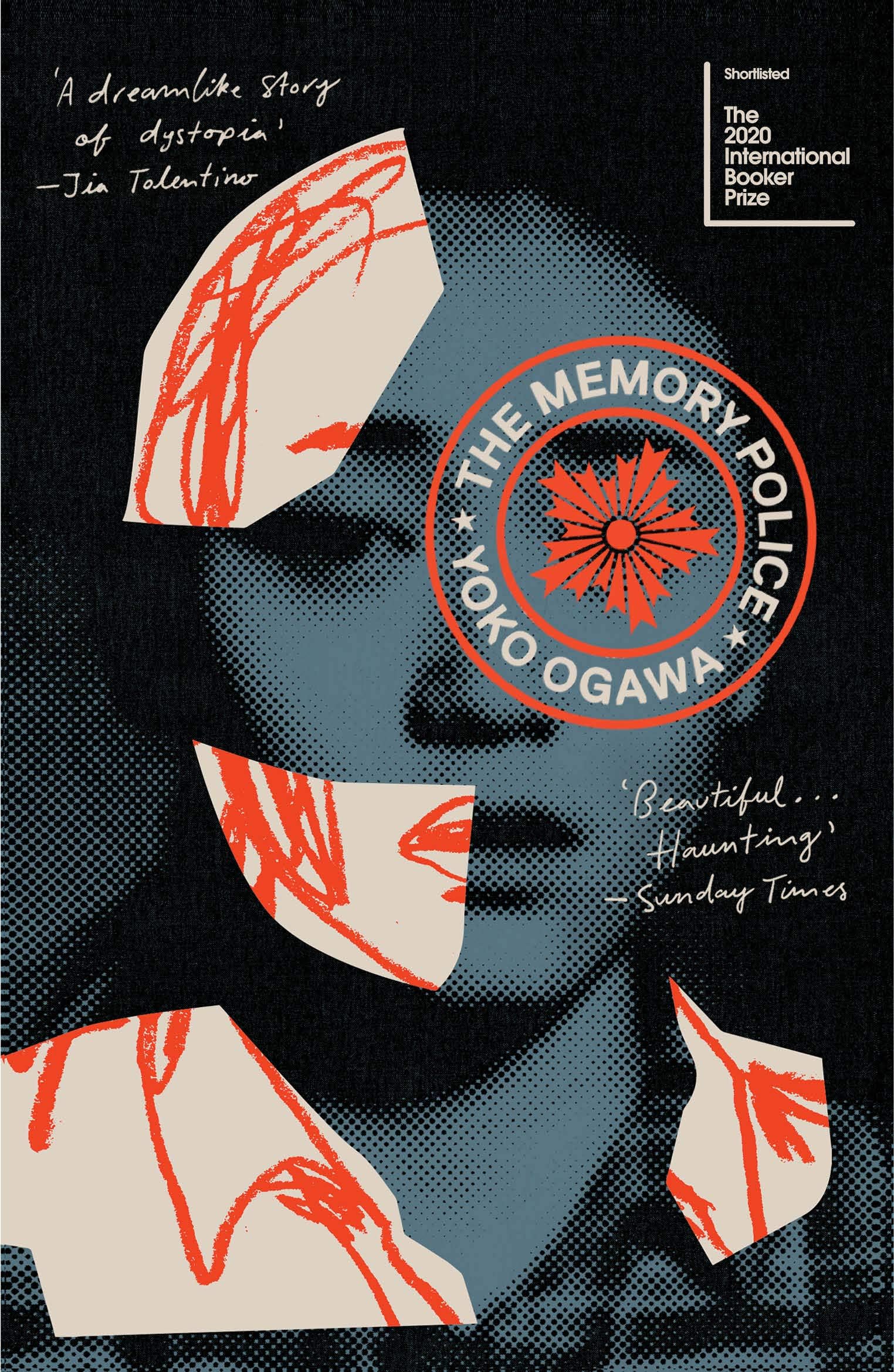


Memory Police, The : Yoko Ogawa: desertcart.in: Books Review: Breathtakingly beautiful. - BOOK REVIEW THE MEMORY POLICE BY~ YOKO OGAWA ⭐⭐⭐⭐⭐ ______________________ 🍂The memory Police written by Yoko Ogawa and translated by Stephen Snyder is an exemplary work of translated fiction. The text was haunting, heavy-hearted, thought-provoking & beautiful. I'm grateful to the people who took the initiative to make this amazing piece of work available to us in the English language. 🍂I could care less about the plot as the writing itself had all my attention. But our protagonist here is A writer. Her memories are hindered by the losses of things that have disappeared from the island. And those who are in charge of making the disappearances possible were 'the memory police', robot-like people with measured & sure movements. After losing her parents to this plague, she didn't care much about the frequent unannounced visits and summons from the memory police, until she decides to do something to save the few people left in her life whom she loved and was her only mean to cling to any kind of hope so that her heart doesn't forget the things that no more exist. even though the meaning and emotions attached to them were long gone from her memory. Review: Nice but not that amazing! - Nice book but somehow a little dragged within the pages. The story has a good beginning and the end, but in the middle it could not invoke strong thrill or emotions. May be not as per my expectations. Come what may, it can be picked up.


| Best Sellers Rank | #6,024 in Books ( See Top 100 in Books ) #10 in Dystopian Fiction #103 in Thrillers and Suspense #158 in Action & Adventure (Books) |
| Country of Origin | United Kingdom |
| Customer Reviews | 4.4 4.4 out of 5 stars (8,867) |
| Dimensions | 12.9 x 12.9 x 19.8 cm |
| Generic Name | Books |
| ISBN-10 | 1784700444 |
| ISBN-13 | 978-1784700447 |
| Importer | Penguin Random House |
| Item Weight | 205 g |
| Language | English |
| Net Quantity | 500.00 Grams |
| Packer | Penguin Random House |
| Paperback | 288 pages |
| Publisher | Vintage (6 August 2020); Penguin Random House |
P**B
Breathtakingly beautiful.
BOOK REVIEW THE MEMORY POLICE BY~ YOKO OGAWA ⭐⭐⭐⭐⭐ ______________________ 🍂The memory Police written by Yoko Ogawa and translated by Stephen Snyder is an exemplary work of translated fiction. The text was haunting, heavy-hearted, thought-provoking & beautiful. I'm grateful to the people who took the initiative to make this amazing piece of work available to us in the English language. 🍂I could care less about the plot as the writing itself had all my attention. But our protagonist here is A writer. Her memories are hindered by the losses of things that have disappeared from the island. And those who are in charge of making the disappearances possible were 'the memory police', robot-like people with measured & sure movements. After losing her parents to this plague, she didn't care much about the frequent unannounced visits and summons from the memory police, until she decides to do something to save the few people left in her life whom she loved and was her only mean to cling to any kind of hope so that her heart doesn't forget the things that no more exist. even though the meaning and emotions attached to them were long gone from her memory.
S**A
Nice but not that amazing!
Nice book but somehow a little dragged within the pages. The story has a good beginning and the end, but in the middle it could not invoke strong thrill or emotions. May be not as per my expectations. Come what may, it can be picked up.
M**N
Thought proviking
As if written for current times
S**R
A dystopian done right.
To be very brief,it follows the life of three people in an isolated island that are ruled by 'memory police'that can make things,memories, living or non-living disappear from time to time .The protagonist is a young girl who is dealing with this constant loss of things and her attachment to those ,the old man who has seen a lot of disappearances and has taken it as a way of life and the last but not least,the editor (R) who does'nt forget anything at all.The pacing might be slow but hold on till the end because it's worth your read.I really enjoyed it.It shows the complexities of society that a single power head can bring and horrors of not losong your memory as the process follows.
P**I
Understated
Our narrator is a nameless young woman who lives on a nameless island in a dystopian world controlled by the Memory Police where objects keep disappearing. The course of disappearance is random and with it the associated memories also disappear. People recalibrate their lives to this loss. The narrator was born to a sculpture artist and an ornithologist, both of whom are no longer around, is working on a novel. R is her editor. There is also a nameless old man who was a friend of the narrator’s parents. With the cascading events, these three come together and form an intimate bond. The narrator’s mother was among the few who could retain her memories. Later, we come to know that before the Memory Police had detained her, she hid certain seemingly 'disappeared' items in a secret chest of drawers and some in her sculptures too. Like her mother, R was also someone who could remember things. Finding this out, the narrator and the old man take it as an imperative to hide him from the Police. They build a secret arrangement for him in the narrator’s house and try their best to maintain a semblance of normalcy. Things keep disappearing, language is punctured as words lose meaning and existence. Many professions also become expendable. The Memory Police keeps sniffing and raiding. It raids the narrator’s house and in a highly dramatic stroke of luck, they don’t find R. ‘Novels’ also disappear and with it, the narrator's memory of her own manuscript. People collectively burn books. The narrator and the old man too. R has saved a few books he considers important in his secret chamber. He implores her not to burn the manuscript and she agrees even though for her, uttering the world ‘novel’ becomes difficult. The narrator and the old man try to keep R connected to his family. They act as secret messengers. The kindness which this trio displays in whatever possible ways, is exemplary especially when kindness has become dispensable. R keeps urging the narrator and the old man to hold onto their memory. His life is an act of defiance. He believes in the resilience of memories. He pushes the narrator to work on her manuscript, to give shape to her story about the typist who has lost her voice. She forces herself to remember but writing appears almost impossible. The meta story, which she was working on, unfolds. She has been able to retrieve her lost string of thoughts and with great difficulty, completes it. The meta story, on the surface, does not contribute much to the main narrative, but it echoes the same feelings of control, fear, alienation and voicelessness. I liked the juxtaposition where the narrator is reclaiming her voice as she finishes writing about her voiceless protagonist. Eventually, body parts too begin to disappear. They disappear figuratively leaving just the weight of a cavity. The person forgets its function. The narrator has lost her limbs but R assures her that they are still intact. The world keeps crumbling and there seems no end to this. The book which first came out in 1994 translated much later, has garnered attention ever since. It is compared with Orwell’s 1984 and Huxley’s Brave New World but I feel thats an overestimation. Ogawa’s book perhaps intentionally leaves certain inconsistencies and doesn’t tell the backstories that have led to her dystopia. We don’t know how the Police rose into power, what keeps their mechanism at place and their ultimate purpose. Certain things needed explaining, the lack of which makes the world building brittle while 1984 and BNW are known for their extremely detailed worlds. On second thoughts, given that the story is more allegorical, certain explanations do not feel necessary. More than believability, this book asks questions about memory. Questions like whether memory is integral or corruptible, how much of memory is reliable, what happens when collective memory is erased and whether its loss is indeed unfortunate, whether one regrets or fights its loss or moves on recalibrating themselves, whether the loss is filled by apathy, whether there ever can be complete erasure of memory, how does memory constitute one's identity. The book is gloomy for the most part and a little monotonous too. A ray of hope shines only in few sections. When the narrator expresses her silent resistance overcoming the foisted handicap. Second, the three characters choosing kindness over all adversities. Such moments are heartwarming. Third, when they discover the narrator’s mother’s hidden objects, which are quite commonplace and insignificant. The objects don’t lead to revealing information. They were just thoughtfully preserved to help the discoverer rekindle memories of tenderness, a bridge to a fogged but not a distant past. Ogawa tells the immensity of the difficulty in beaing and creating in an extremely unfavourable world. The story stokes some visceral feelings but it did feel dragged. I am also assuming the translation is not upto the mark which may have dimmed the story’s intent but it is certainly worth a read.
M**I
Go for it!!!
I was stuck to the book like a glue. You wouldn't be able to keep it down after a point. One of the top tier dystopian books out there.
E**E
Great novel
J**U
I'm travelling to Japan in a few weeks and have been trying to read a few popular Japanese novels to try to find some of the cultural references. This book appears in many of the recommendation lists so I thought I would try it. 274 pages split into 28 chapters, this book was published in Japan during 1994 then as an English translation in 2019. The unusual concept if the first thing I noticed. Gradually objects were being "disappeared" in some sort of thought control exercise reminiscent of 1984. This is a definite dystopian idea with the level of control being physical and psychological. Secondly the language stands out as being beautifully descriptive - even more impressive than normal as this is a translation. I had to read this slowly to appreciate the wonderful writing - e.g. "eyes as still as a lovely swamp deep in the woods" - very atmospheric..... I found myself quickly fascinated by the idea of items being removed permanently from the world and memories of them being taken at the same time. The mechanics of the removals are curious - sometimes a natural process yet some disappearances are much more forced. The story considers how different people deal with their memories - some clinging on and others happy to get rid of them. The novel encourages the reader to think and I found some very modern issues to consider. Physical photographs are uncommon in our modern society but digital photos are at almost epidemic levels - how does this effect the memory of the actual event? This is something that is explored in the novel. The main character is a writer and her novels are a reflection of her world, thinking about the relationship between imagination and memory - which feeds which? Her novel seems to allow her to voice feelings that she is unable to articulate in her "real world". As well as comparisons to George Orwell novels, I also thought about Margaret Attwood books - particularly thinking about the Memory Police with their long coats and big boots. So many elements of the plot are scary, with one of the most terrifying seeing how easily people accept what they are told to think. Again, parallels to our society today. Spooky that this book will sit next to 1984 in my bookshelf (obviously I store books alphabetically by author......).
H**A
It is actually great ,twisted storyline
S**A
I enjoy dystopian novels, and I also love discovering Japanese authors, so for those two reasons, I picked up The Memory Police by Yōko Ogawa. The story intrigued me right away — it’s set on an unnamed island where objects begin to “disappear.” But these aren’t just physical disappearances; they vanish from memory too. Birds, perfume, photographs, hats — once something is declared gone, it becomes meaningless. The island’s residents forget what the object even was. The Memory Police enforce this forgetting, ensuring all remaining traces are destroyed, and punishing those who resist or remember. The unnamed narrator is a young novelist who continues to write even as the world around her slowly erodes. When she discovers that her editor, R, still remembers the disappeared things, she hides him in a secret room in her home to protect him. I won’t say much more about the plot — I think it’s better experienced than explained. I noticed that around 70% of reviews give it four stars or higher, while about 30% rate it lower. I can understand both sides. As for me, I appreciated the themes: the slow erosion of freedom and identity, the effects of individual and collective amnesia, the systematic erasure of culture and society and how memory preserves meaning and love. It’s a quiet kind of dystopia, more emotional than action-driven. Some say the pacing is slow — and it is — but I think it works. Totalitarianism doesn’t always arrive with a bang; it creeps in quietly, and that’s the kind of tension this story captures. The translation reads well, and the writing builds the necessary atmosphere that draws us into the world that the narrator lives in. Overall, I found it enjoyable and also unsettling too — if enjoyed is the right word for something so dystopian. 5/5 for me
C**N
Thought provoking and unique story about memory, nostalgia, and loss. I wonder if the negative reviews come from people expecting a police procedural, or a Hunger Games style dystopia. Which this is not.
Trustpilot
4 days ago
3 weeks ago