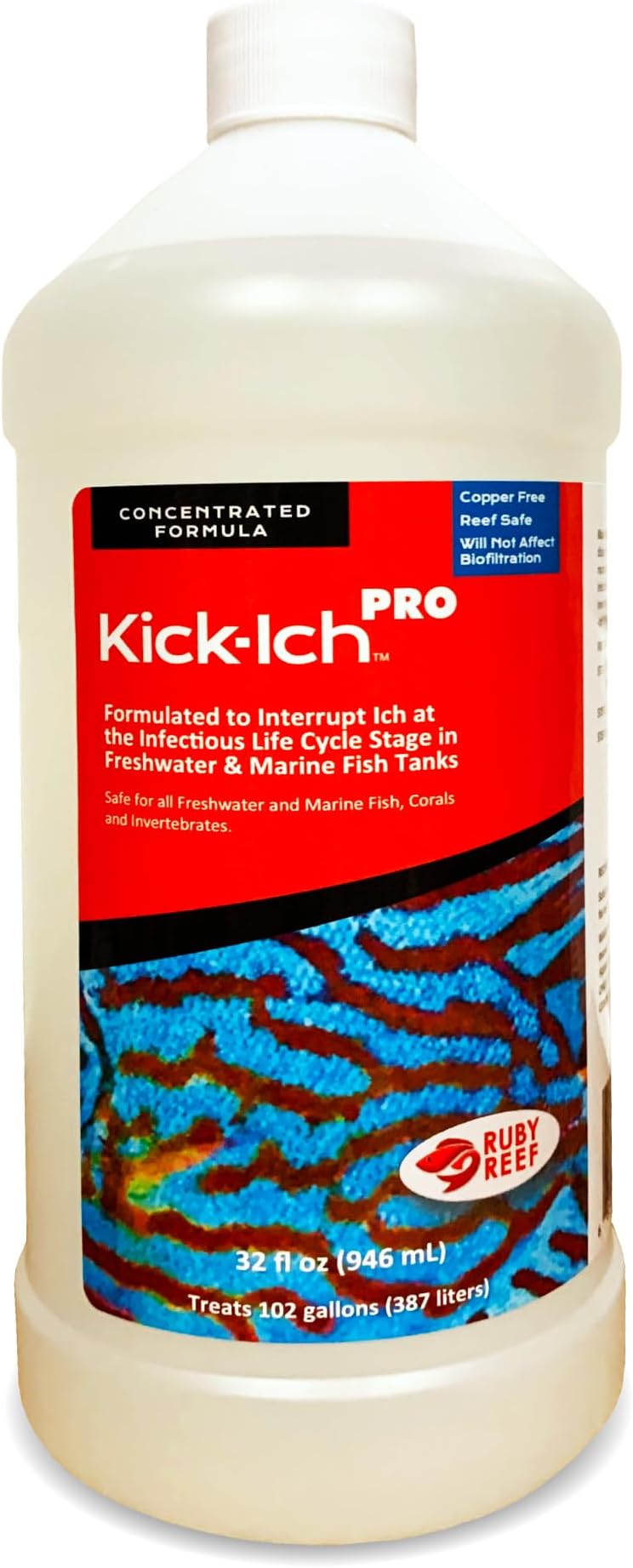


🐟 Defend your reef kingdom—Ich doesn’t stand a chance!
Ruby Reef Kick Ich Pro (32 oz) is a reef-safe ich treatment designed for large aquariums, offering a potent formula that supports flexible, long-term dosing to control ich and secondary infections without harming corals or beneficial tank life.
| Customer Reviews | 3.8 out of 5 stars 206 Reviews |
M**E
Use with Rally
My First use of Kick-Ick and Rally I have a 120 gallon that was setup for two months when it was struck by disease. I’d added 2 blue-green chromis, a yellow mimic tang, a flame angel, and two ocellaris clownfish. Things had started well, with macro algae growing well in the sump refugium. The fish acclimated beautifully and were very active and interactive with each other and me. I only fed frozen food and their appetite was excellent. Then one day, I noticed that the flame angel was not eating. Upon closer inspection, I could see a fairly advanced case of ick or something that was causing less well-defined cloudy coverage than the classic salt-sized grains of ick. The other fish were infected as well, but less severely. I had seen this more than once with other setups and had suffered whole tank wipeouts within days. I didn’t have the means to quarantine so many fish at once, so I had to treat the 120. I wished not to use copper for treatment because I planned to use the setup for coral. Kick-Ick and Rally had been recommended by a store employee and I had already purchased a twin pack to be prepared. I immediately dosed the 120 with both Kick Ick and Rally. Checking to see how bad things had become 24 hours later, I was pleased to find that things had not gotten worse. I expected to see the flame angel gasping for breath, but its appetite had somewhat returned. On this second day, I only dosed with Rally. On the third day, I noticed a slight improvement and dosed with both products. On the fourth day, I did not dose with either. Use of Rally may be stopped at this point or not, depending on the condition of the fish. The improvement was more marked, and the infection was mostly limited to individual Ick grains that I could easily count. I would have expected all of the fish to be dead or near to by this time if I had not treated. My first impression of the Kick-Ich/Rally treatment regimen was most positive. I did not dose on the fifth day, and all fish but one clown fish was free of disease. I was very pleased to see that there were no signs of ick or any other disease on the sixth day. It is recommended that treatment continue for two weeks after all spot are gone, so I dosed again with Kick-Ich on the sixth day and planned to dose every third day thereafter for two weeks. On the seventh day, I noticed the flame angel had an ich spot or two and a hint of cloudy fins and eyes. Because of this possible secondary infection, I dosed with Rally again. On the eighth day, the flame angel was about the same, but I noticed faint cloudiness and a few ich spots on the other fish as well. As this may have qualified as a persistent infection possibly including more than one pathogen, I chose to dose every day with Rally and Kick-Ich going forward. On the ninth day, most of the fish looked better, except for the flame angel. It then looked worse than it had up to that point. I believed that the cloudiness was a secondary infection that would only be affected by Rally, and that I had stopped dosing with Rally on the third day gave this pathogen a chance to rebound. It also occurred to me that the flame angel could have some issue the other fish did not have because it was the first to show signs of disease and the first to host its recurrence. This is possible despite the facts that it had always showed great color, vigor, and appetite (perhaps cyanide poisoning?). It thought that I should quarantine the flame angel and would make a decision the following day. This was based on concern for the other fish because the flame angel’s vulnerability to disease had made it a breeding ground for pathogens that could overwhelm the defenses of the other fish. Also, the yellow mimic tang was increasing its harassment of the weakened flame angel. The interplay between the two had been more playful than aggressive and the flame angel had seemed unconcerned. This was nature picking on the weak. Another thing that occurred to me at the time was that the green coloration caused by Rally faded more quickly when the light was on. I came to believe that some of the ingredients are photoactive and that I should dose right after the light goes out for the night to help prolong the effectiveness of Rally. This could also apply to a refugium light. I dosed with Rally on the evening of the ninth with all lights out. The following morning, I was saddened to see the flame angel at the final stage of dying. Offsetting the disappointment and frustration was the hopefulness the near-healthy state of the other fish justified. I concluded at that point that the Kick-Ich and Rally treatment was very effective in this case and that the issue was with the flame angel. It is sad but true that one unhealthy fish can bring all of its tankmates. On the tenth day, I observed that the yellow mimic tang had taken to swimming into the current of a return nozzle almost constantly. It did eat a little, at which time I noticed cloudiness over one eye. One clownfish is fairly covered in ick and cloudiness, but otherwise behaved normally. The other clownfish was fine, as were the two blue-green chromis. I dosed with Kick-Ich around noon and with rally at lights out. What reveals something about the individuality of immune systems is that both clownfish were tank-raised and were purchased from the same tank. They were buddies and seemed equally healthy before the infection, yet they reacted differently to the onslaught. On the twelfth day, the yellow mimic tang was behaving more normally and eating well and seemed less cloudy. The clownfish which was sick had also improved. The other fish were looking well. The tank was not out of the woods yet, but I had more reasons to be hopeful. The cloudiness was gone on the thirteenth day but a fair amount of ich was still present on the tang and one clownfish. Their behavior was normal with good appetite. The fish improved further on the fourteenth day and I thought it more likely than not that all of the fish, aside from the demised flame angel, would survive this tank pandemic. The fifteenth day only revealed a patch or two of cloudiness and faint ich on the mimic tang, and it was behaving almost normally. The four other fish looked healthy. There was no change on day sixteen. The tang appeared to have improved on the seventeenth day. I only saw cloudiness on the pectoral fins of the tang and a spot or two of ick on the tail of one of the chromis on the eighteenth day. I decided to alternate days for dosing the two products on the eighteenth day so that each would be used every other day. Dosing of both medicines was done at lights out. The tang gradually improved through day twenty-two and looked just about cured. Surprisingly, the clownfish that was healthy traded places with his buddy and became the sick one. It’s as if they must develop an immunity. As with antibiotics, the medicine assists in the job of an immune system and cannot cure a patient by itself. I saw no signs of disease on the nineteenth day. With the Kick Ick/Rally treatment, I had cured my fish twice over while losing one of six fish. The tab for treatment was mounting but I wanted to continue treatment for two weeks after seeing no signs of disease. It could be cost effective to purchase these products by the gallon when treating a good-sized tank. Whether or not the Kick-Ich/Rally treatment is worth the money versus other products, I cannot answer. However, it has proven its effectiveness twice over despite the setback. Another advantage is that there is apparently no need to change water during or after treatment. I did plan to replace most of the water over several changes to be sure that any possible accumulating toxins or a deficiency of some kind was weakening the fish would be addressed.
R**N
Seems to work for what I needed. Don't expect a miracle to save your badly infected fish
I know I had Ich in all my tanks. It started with the early days and I kept getting more aquariums. I didn't want to just quarantine fish for the new tanks as I share a lot of the same tools and move corals between the tanks. The existing fish were fine as they developed an immunity but pretty much any new fish I added would break out within a day or two with Ich. Some would survive others would not. Those that survived built a minor immunity to Ich and would be fine later. I always did a maintenance (UV, selcron/garlic dosed with food etc) to keep Ich in check and the fish healthy for better immunity. Only other way to get rid of Ich was to get a ton of cheap bins to quarantine and catch and treat all the fish with medication like copper. Then leave my tanks fallow for 2.5 months. I had a difficult time to get my tangs to cooperate so I didn't want to mess with the established pecking order. I also have two foxface rabbits living in peace in one of my tanks which I think was a miracle so didn't want to move them. It would have been a maintenance nightmare along with massive stress on fish living in storage bins for that long. If they were badly infected I wouldn't hesitate to catch and treat them in a hospital tank with copper. I dosed Kick Ich for a month. The last new fishes I added all seem great. I quarantined for 2 weeks and when I released into the display tanks I didn't see any spots on them. What I did was dosed every 3 days for a month (Kich Ich is suppose to become inert after 3-5 days). I would run the skimmers and carbon a few hours before my weekly water change. Make sure to vacuum everything you can. I did this during the day as Ich will try to find fish at night when they are sleeping. You want to make sure Kich Ich is in your system when that happens. None of my corals or fish died. Some of my SPS looked a little upset as their polyps didn't come as much but they all survived. My opinion is that it works great when there isn't a massive ich infestation. It's not suppose to kill ich but stop it from attaching to the fish. If you want to kill ich use copper or hypo but not in your display tanks. I thought about treating for 76 days (as that's the maximum ich lifecycle) but this stuff is expensive. Between all my tanks I needed to treat almost 500 gallons every 3 days. So to clarify again those that have fish that are badly infested with Ich need to be taken out and treated in a hospital tank ASAP. Kick ich won't save the fish when it's all ready infected badly as it doesn't kill or remove the parasite from the fish. Also since you can't run the skimmer or chemical filtration you need to monitor your water parameters and do water changes when needed. I left my macro algae refugium and they all survived which I think helped with my nitrates and phosphates not sky rocketing. Worth it? Maybe. I just know that my new fish now don't get spots. It didn't seem to hurt anything. Some of my fish were very expensive (looking at you gem tang) but it's the lost of life that's even more sad no matter the price. If Ich does come back I may try doing the full 76 days.
H**T
this is trash, and didnt do what it claimed
didnt do a dam thing. ... i gave it a try to see if it could control until my full time QT got up and going. sand and rock for a good leave it up qt. lost 3 fish trying to give my qt time. this didnt do anything
N**N
Works
Let me start by saying that ich is in my tank and has been for years. If you ever had it, it is always present unless you have the tank fallow for some weeks. It will be come active on my blue tang when he gets super stressed and apparently adding two new fish and some fresh sand did it this time. As soon as I saw the spots I started adding extreme garlic and garlic nori as this usually knocks it back. He kept getting worse so I opted for this. Pretty sure I used it several years back as well. Followed the instructions and he got better after about a week and stopped the crazy behavior. I have a 90gal mixed reef and it did no harm to to any softies or LPS, I have no SPS.
M**A
It clear up ich in my 29 gallon freshwater aquarium
It did take two rounds of this ich med, but it cleared up the outbreak of ich in my 29 gallon freshwater aquarium. I did have to look up instructions for dosage of this brand for smaller freshwater tanks because I think the instructions on the package were intended for larger tanks. A word of advice, ALWAYS quarantene your new fish and plants for about a month and treat them if you see any sign of concern. Don't add them to your community tank until you're sure they're healthy for at least a couple weeks after treatment. I did not follow my own advice and the ich outbreak in my precious fish friends was the result. I should have quarantened like I usually do because I've been keeping fish since the 90's and I knew better than to be impatient. I got complacent and lazy and my poor fish suffered for it. Thankfully I didn't lose any fish, and lesson learned (again). Ich can still infect your fish despite your best efforts so it's always good to keep aquarium meds at the ready so you can act quickly. I highly recommend aquarium co-ops advice for which meds to keep and how to use them. I wont put a link here, just do a web search for "How to use the quarantine medication trio - Aquarium Co-Op" and you'll find it. This ich med is just as good as far as I can tell. I think they're interchangeable but this one is definitely more geared for large tanks.
H**Y
Two weeks in ..
Tank is still infected with Ich. Using with Rally Pro. Powder Blue Tang (aka Ich Magnet), and Black Stripe Clowns are still doing well. Cleaner Wrasse died. Cleaner Shrimp, Fighting Conches, Snails and Hermits still doing well. Time will tell if this "kicks" Ich. Ich seems to be reducing in numbers, but still have had three outbreaks now, in the two weeks. Repeating Tally Pro dosing regimen as well. Will update when Tank sized Product is exhausted.
S**L
Doesnt seem to be working
Ive been treating my 40 gallon marine tank for two months now at the recommended dosage amount and interval. Im still getting cycles of more white spots every few days. Im honestly surprised the fish have held on for this long. So far I have lost three out of the four fish. The best I could say about this product is that it has not harmed the couple soft coral I have (toadstool and hairy mushroom) nor the invertebrates. I do not have a quarantine tank, so my choices for treatment that wouldnt outright kill them were very limited. Maybe I just brought home a very resistant parasite strain. Im not sure. If things improve and treatment can finally stop I'll update this review. Update- Treated the tank for approx. three months. I still have the ocellaris clownfish whom seems to be immune to the ich somehow as Ive not seen any spots these last few weeks after the last fish died from the parasite while treatment has continued. It seems that adding other fish just makes makes the parasite increase in population again. Planning to end treatment once the bottle of Kick Ich is used up as the recommended time period with no spots to stop dosing has passed. I'll just wait a few months to add any more fish and hope the parasite dies out on it's own. I did use Rally Pro a few times as per recommendation while treating with Kick Ich. I cant say if that helped or not given the persistence of the Ich. It didnt seem to make it worse at least. Also, I dosed the tank with these medicines right after light off. I think some components of Rally are photosensitive. Rally makes the water look green, and I noticed that the green would fade a lot faster if I dosed it in the morning or during the day while the light was on.
Z**6
Be aware, it does harm your coral
Long term use( over a week) does harm some of the SPS, make them losing color. But LPS were all fine, and invertebrates also will get influenced. ( my 2 sexy shrimp died and a mint shrimp died) But it works to control the white spots
Trustpilot
3 weeks ago
2 months ago