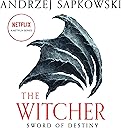

desertcart.com: Sword of Destiny (Audible Audio Edition): Andrzej Sapkowski, David French - translator, Peter Kenny, Hachette Audio: Audible Books & Originals Review: Destiny is unavoidable and amazing - Review 5 stars I’m attempting to remain chronological in reading and reviewing Andrzej Sapkowski's absorbing books about Geralt of Rivia, although I first met the White Wolf in The Witcher 3: The Wild Hunt video game. I also know that there are some shorts that might not fit this chronology. However, the six short stories in this second collection are on the one hand standalone but on the other, there are strong threads linking them – not least the White Wolf himself, Geralt of Rivia. Some see him as emotionless and ruthless, but his potion-subdued emotions emerge, and he is torn by his heart and by his destiny. Sapkowski creates an evolving and complex character who has a code, relationships, habits, quirks, dreams, nightmares…and destiny. That destiny unfolds in the stories – and I know in later books. However, the author doesn’t use a linear style for the plot, weaving the threads with flashback memories, nightmares and encounters. Some readers might find this approach confusing, but when the pieces fall into place, I sat back and admired the craft, grinning with pleasure. Each story deals with an event in Geralt’s journey, introducing both new characters and old ones, like Dandelion, the bard and Yennefer, the sorceress. From the opening story, The Bounds of Reason, when we encounter the mysterious Borch Three Jackdaws, we realise that this is neither a black-and-white world nor classical fantasy, but a multi-faceted and richly-visualised world of many hues, some grey and muddy, some earthy and verdant, and some red as blood or purple as lilacs. Each character in this and the other stories has levels of complexity, none more so than the child called Ciri in the last two stories – The Sword of Destiny and Something More. I could write about all six stories, but other reviewers can do that better. Do I focus instead on Yennefer’s devious attractions or Dandelion’s humorous escapades? Not this time – even if they are both play memorable character-driven episodes. Ciri is the person who fascinated me most, watching her cope with events as a child, her raw emotions and reactions, seeing her encounter Geralt and struggle together with Destiny. The whole plot comes together in their story, with seeds sown in one of the key stories within The Last Wish collection and continued in the novels (and games). Everything takes place in a world that mirrors issues that our society still struggles with, like prejudice and racial segregation. Pogroms directed against elves and dwarves echo the horrors that the Jews suffered, totally – and witch burnings were for real. And the persecution of ‘minorities’ continues. People even dislike Witchers so abuse and exploit them – so why not send all Moslems back where they belong. Geralt's world is filled with monsters, and sometimes the human ones are the worst – as in ours. Sapkowski takes folklore and cleverly twists it, posing dilemmas. What side do you stand with, Order or Chaos? Are all dragons evil because a knight-errant must rescue maidens in distress? Sapkowski also raises topical issues, such as the struggle to preserve the natural world, vanishing species struggling to survive. Do we have a right to their land? I have just taken a few enjoyable steps exploring Sapkowski’s creation, even if I’ve visited the world others built from his imagination. Playing the Witcher 3 game and reading the early books creates moments of ‘understanding’ about this complex world. The depth originates in Sapkowski’s mind, so I must keep reading. Story – five stars Setting/World-building – five stars Authenticity – five stars Characters – five stars Structure – five stars Readability – five stars Editing – five stars Review: “It’s hard to call an accident destiny.” - While the stories contained in “Sword of Destiny” are undeniably part of the Witcher continuum and undeniably awesome, they also undeniably take second place to those in “The Last Wish.” Qualifier: nothing in “Sword of Destiny” is bad. Quite the contrary: it’s a great read and worth every one of its five stars. Each story in this anthology is entertaining, well told, has a message and is very much worth reading. Compared to the absolutely top-shelf quality and originality of every story in “The Last Wish,” however, “Sword of Destiny” can’t help but feel a bit wanting. Part of this is successor syndrome (i.e., the preceding installment was JUST SO GOOD the sequel can’t really compare), part of it is Sapkowski finding his voice and dialing in his style. There are two very notable exceptions: “Little Sacrifice” and “Something More.” Those two stories rank among the very best of the Witcher short stories contained in either of the aforementioned collections. Holy wow do those stories hit the reader right in the feelz. Geralt of Rivia returns for another foray into Sapkowski’s brilliant fantasy world; a world as vibrant and real as our own, full of metaphor, allegory and relativism, where everything exists only in some wonderful shade of gray. Are dragons inherently evil and what exactly does that mean? What do you do with a creature that clones a person, but only copies said person’s good behaviors? What precisely constitutes a little sacrifice? How do you define destiny or if it even exists? The Witcher series is making fairy tales relevant again, but with grown-ups as the audience. With “The Last Wish” (Witcher #1) and “Sword of Destiny” (Witcher #2) finished, time to move onto the novels. “Blood of Elves” (Witcher #3) is already on this reviewer’s short list. “The Witcher nodded. Not for the first time, the criteria by which women judged the attractiveness of men remained a mystery to him.” - - - - - - “It’s not worth worrying about storytellers. If they don’t have enough material they’ll make things up anyway. And if they do have authentic material at their disposal, they’ll distort it.” - - - - - - “The Sword of Destiny has two blades… You are one of them.” - - - - - - “She stood before him and Geralt regretted it was her and not the fish-eyed creature with a sword who had been hidden beneath the water. He had stood a chance against that creature. But against her he had none.” - - - - - - “Aha,” he said calmly. “Essi Daven, also known as Little Eye. The alluring little eye of Little Eye fixed its gaze on the Witcher and caused confusion in the Witcher. The Witcher behaved like a little schoolboy before a queen. And rather than blame himself he is blaming her and searching for her dark side.” - - - - - - “For me,” Dandelion fantasized, “a palliasse without a girl isn’t a palliasse. It’s incomplete happiness, and what is incomplete happiness?” - - - - - - “You’re sensitive,” she said softly. “Deep in your angst-filled soul. Your stony face and cold voice don’t deceive me. You are sensitive, and your sensitivity makes you fear that whatever you are going to face with sword in hand may have its own arguments, may have the moral advantage over you…”
R**E
Destiny is unavoidable and amazing
Review 5 stars I’m attempting to remain chronological in reading and reviewing Andrzej Sapkowski's absorbing books about Geralt of Rivia, although I first met the White Wolf in The Witcher 3: The Wild Hunt video game. I also know that there are some shorts that might not fit this chronology. However, the six short stories in this second collection are on the one hand standalone but on the other, there are strong threads linking them – not least the White Wolf himself, Geralt of Rivia. Some see him as emotionless and ruthless, but his potion-subdued emotions emerge, and he is torn by his heart and by his destiny. Sapkowski creates an evolving and complex character who has a code, relationships, habits, quirks, dreams, nightmares…and destiny. That destiny unfolds in the stories – and I know in later books. However, the author doesn’t use a linear style for the plot, weaving the threads with flashback memories, nightmares and encounters. Some readers might find this approach confusing, but when the pieces fall into place, I sat back and admired the craft, grinning with pleasure. Each story deals with an event in Geralt’s journey, introducing both new characters and old ones, like Dandelion, the bard and Yennefer, the sorceress. From the opening story, The Bounds of Reason, when we encounter the mysterious Borch Three Jackdaws, we realise that this is neither a black-and-white world nor classical fantasy, but a multi-faceted and richly-visualised world of many hues, some grey and muddy, some earthy and verdant, and some red as blood or purple as lilacs. Each character in this and the other stories has levels of complexity, none more so than the child called Ciri in the last two stories – The Sword of Destiny and Something More. I could write about all six stories, but other reviewers can do that better. Do I focus instead on Yennefer’s devious attractions or Dandelion’s humorous escapades? Not this time – even if they are both play memorable character-driven episodes. Ciri is the person who fascinated me most, watching her cope with events as a child, her raw emotions and reactions, seeing her encounter Geralt and struggle together with Destiny. The whole plot comes together in their story, with seeds sown in one of the key stories within The Last Wish collection and continued in the novels (and games). Everything takes place in a world that mirrors issues that our society still struggles with, like prejudice and racial segregation. Pogroms directed against elves and dwarves echo the horrors that the Jews suffered, totally – and witch burnings were for real. And the persecution of ‘minorities’ continues. People even dislike Witchers so abuse and exploit them – so why not send all Moslems back where they belong. Geralt's world is filled with monsters, and sometimes the human ones are the worst – as in ours. Sapkowski takes folklore and cleverly twists it, posing dilemmas. What side do you stand with, Order or Chaos? Are all dragons evil because a knight-errant must rescue maidens in distress? Sapkowski also raises topical issues, such as the struggle to preserve the natural world, vanishing species struggling to survive. Do we have a right to their land? I have just taken a few enjoyable steps exploring Sapkowski’s creation, even if I’ve visited the world others built from his imagination. Playing the Witcher 3 game and reading the early books creates moments of ‘understanding’ about this complex world. The depth originates in Sapkowski’s mind, so I must keep reading. Story – five stars Setting/World-building – five stars Authenticity – five stars Characters – five stars Structure – five stars Readability – five stars Editing – five stars
P**R
“It’s hard to call an accident destiny.”
While the stories contained in “Sword of Destiny” are undeniably part of the Witcher continuum and undeniably awesome, they also undeniably take second place to those in “The Last Wish.” Qualifier: nothing in “Sword of Destiny” is bad. Quite the contrary: it’s a great read and worth every one of its five stars. Each story in this anthology is entertaining, well told, has a message and is very much worth reading. Compared to the absolutely top-shelf quality and originality of every story in “The Last Wish,” however, “Sword of Destiny” can’t help but feel a bit wanting. Part of this is successor syndrome (i.e., the preceding installment was JUST SO GOOD the sequel can’t really compare), part of it is Sapkowski finding his voice and dialing in his style. There are two very notable exceptions: “Little Sacrifice” and “Something More.” Those two stories rank among the very best of the Witcher short stories contained in either of the aforementioned collections. Holy wow do those stories hit the reader right in the feelz. Geralt of Rivia returns for another foray into Sapkowski’s brilliant fantasy world; a world as vibrant and real as our own, full of metaphor, allegory and relativism, where everything exists only in some wonderful shade of gray. Are dragons inherently evil and what exactly does that mean? What do you do with a creature that clones a person, but only copies said person’s good behaviors? What precisely constitutes a little sacrifice? How do you define destiny or if it even exists? The Witcher series is making fairy tales relevant again, but with grown-ups as the audience. With “The Last Wish” (Witcher #1) and “Sword of Destiny” (Witcher #2) finished, time to move onto the novels. “Blood of Elves” (Witcher #3) is already on this reviewer’s short list. “The Witcher nodded. Not for the first time, the criteria by which women judged the attractiveness of men remained a mystery to him.” - - - - - - “It’s not worth worrying about storytellers. If they don’t have enough material they’ll make things up anyway. And if they do have authentic material at their disposal, they’ll distort it.” - - - - - - “The Sword of Destiny has two blades… You are one of them.” - - - - - - “She stood before him and Geralt regretted it was her and not the fish-eyed creature with a sword who had been hidden beneath the water. He had stood a chance against that creature. But against her he had none.” - - - - - - “Aha,” he said calmly. “Essi Daven, also known as Little Eye. The alluring little eye of Little Eye fixed its gaze on the Witcher and caused confusion in the Witcher. The Witcher behaved like a little schoolboy before a queen. And rather than blame himself he is blaming her and searching for her dark side.” - - - - - - “For me,” Dandelion fantasized, “a palliasse without a girl isn’t a palliasse. It’s incomplete happiness, and what is incomplete happiness?” - - - - - - “You’re sensitive,” she said softly. “Deep in your angst-filled soul. Your stony face and cold voice don’t deceive me. You are sensitive, and your sensitivity makes you fear that whatever you are going to face with sword in hand may have its own arguments, may have the moral advantage over you…”
S**E
Secondo libro di short stories nella saga di Geralt, successivo a the last wish e che precede blood of elves, che è il primo romanzo. Fortemente consigliato a tutti gli amanti dell'heroic fantasy. Geralt ha più di qualcosa in comune con Elric di Melniboné, il che è un gran complimento. Decisamente atipico e fuori dai canoni del fantasy tradizionale. Sono storie brevi slegate tra di loro, ma nella loro successione seguono un filo logico e cronologico; la figura di Geralt viene delineata non attraverso decrizioni ma tramite il racconto diretto degli accadimenti. E' un espediente interessante. Ne viene fuori un quadro a tratti scarno ma sicuramente vivo e potente. L'ultimo racconto è meraviglioso. Che altro dire, va letto.
J**H
Very good book, book 1 and 2 have been great. I can’t wait to read book 3. Would recommend this to anyone
C**H
Je continue ma lecture de cette série de livres pour avoir au moins atteint le tome 1 correspondant à la sérié télé qui va sortir et toujours autant de plaisir: on retrouve tous nos personnages, avec leurs défauts qui s'affichent au grand jour, et on s'approche petit à petit de l'intrigue principale qui va ressortir. On retrouve moins les rapports aux contes de fées du précédent tome et on attaque directement avec beaucoup de personnages autour de l'attaque d'un dragon, le temps pour l'auteur de se moquer de certains tropes classiques de ces personnages. On retrouve aussi beaucoup de dialogues, personnellement j'ai trouvé ces parties très drôles. On en apprend un peu plus sur les witchers et un peu tous les personnages. Le seul qui m'agace est Dandelion, trop caricatural sans doute. La fin nous prépare au roman suivant qui commence la trilogie associant Geralt et Ciri. Et j'ai déjà commencé ce premier tome qui nous en apprend encore un peu plus sur qui sont les witchers. Bref, je recommande sans hésiter pour les amateurs de fantasy grim dark et qui attendent un peu d'humour en prime autour.
G**A
Gran libro, apasiona hasta el final , y sobre todo a mi joven hijo , espero continuar comprando lis que faltan pronto
J**.
I am absolutely in love with this fantasy series. I devoured the first book (The Last Wish) and now also this one. I loved the stories. The language and style of writing is so good and smooth, I only want to read as fast and as much as I can. I only wish some stories were told a bit more chronologically, because like this, I had to google out some events and facts to make sure I am following the story properly and correctly. But apart from that, I love everything about this book.
Trustpilot
2 weeks ago
1 month ago