Buy anything from 5,000+ international stores. One checkout price. No surprise fees. Join 2M+ shoppers on Desertcart.
Desertcart purchases this item on your behalf and handles shipping, customs, and support to Colombia.
๐ง Thread your way to perfection with precision and style!
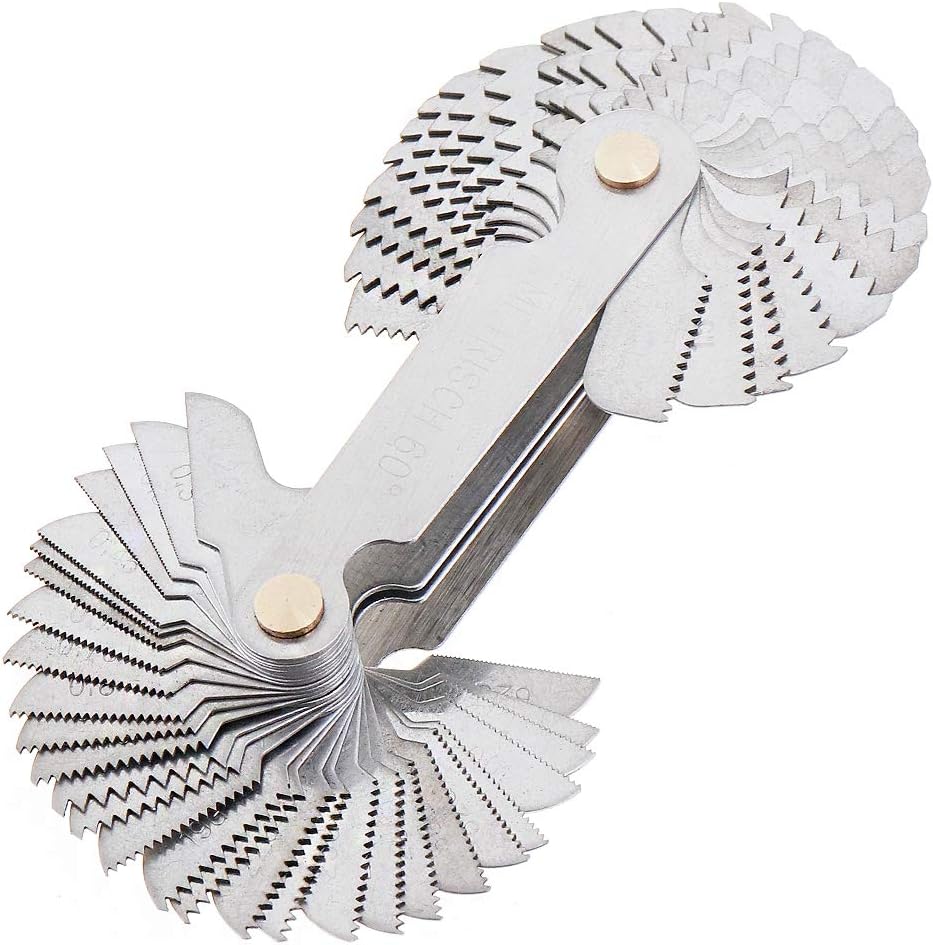
The ChgImposs Screw Gauge is a professional-grade thread pitch gauge featuring comprehensive Metric, Imperial, and US size coverage. It supports both 55ยฐ Whitworth and 60ยฐ SAE/Metric thread angles with a secure lock-up device for precise measurement. Made from rust-resistant stainless steel, this compact tool is ideal for industrial use, especially for verifying thread cutting tool angles on metal lathes, ensuring accuracy and durability in demanding environments.
| Customer Reviews | 4.5 out of 5 stars 3,119 Reviews |
Y**9
Good for Metric & Whitworth - with like five 60* SAE thread pitches.
Good price, works as intended. No complaints - if you know what you're buying.
H**R
Pretty nice to have a full set
I use this to check threads while restoring old bikes or car parts. It's not super easy to use and probably "old school" to some folk but I was taught how to use these and these have been spot on for me. I like that they don't rust, and even though the whole thing is held together by thumb screws, it's not constantly falling apart (but feels like it could which would be a mess to put together). So, once again, this purchase was a win and now I have one in the house and the shop.
R**N
item matches description
sizing could be better listed
H**A
A really important tool for your kit
For anyone trying to reverse engineer or design parts for specific applications, this is a must have tool in you're arsenal. For those who don't know, any thread is designated primarily by two values, the nominal/major diameter, and the thread pitch/designation. The nominal diameter is simply the outer diameter of the thread, the largest diameter you can measure (For example, an .25in screw(imperial) is .25in in diameter or an m5(metric) is 5 mm in diameter). This is easy to measure with a ruler or a pair of calipers (Note that the measured size will be slightly smaller than the actual value due to tolerances, remember to round up). The designation or pitch on the other hand is slightly more difficult. The pitch/designation refers to the distance between each thread. There are ways to do so without the proper tool, but it is incredibly difficult. This tool will save you so much time, especially for how affordable it is. Its small, compact and made with good materials. It now lives in my pencil case since it adds a negligible amount of weight and size. With all of the different pitches/designations available, its incredibly functional and is able to measure a large range of sizes. Using it is quite simple, measure the out diameter to determine metric or imperial threading, then use the associated gauges on the tool and line them on on the threads you are measuring and hold it up to a light source, if a considerable amount of light passes through, its not the right size. Continue trying different sizes until you have reached a size that doesn't have most or any light pass through. Then read the number on the gauge and that's your size! I 100% recommend adding this tool to your kit.
M**N
High quality and very useful tool
I bought this for my husband, and he says itโs excellent quality and very accurate. Itโs well-made, easy to use, and includes everything needed for precise measurements. Heโs very happy with it, so I definitely recommend it
M**R
not the gauge for most users in USA
The product documentation is correct (or not wrong) but the technical terms are confusing because of the history of screw thread standards. Most USA users will want to measure Unified Thread Standard (UTS also known with more precision as UNC/UNF/UNEF course / fine / extra-fine), and this gauge set includes a *VERY SMALL SET* of these, in the middle tier of the device: just six of them, 8, 10, 11, 14, 19, 28 TPI (threads per inch). UTS threads have 60-degree angles and the standard combined and superseded USS ("coarse") and SAE ("fine") threads: the terms USS and SAE are still used informally, and they are valid in the sense that they refer to a subset of threads in the current UTS standard. This gauge includes a much wider set of metric gauges, labeled with decimal points, e.g., 0.25, 1.0, referring to metric thread pitches (these are 60-degree angles). In USA, one encounters metric fasteners pretty often, but not nearly as often as UTS fasteners. This gauge also includes a wider set of BSW (British Standard Whitworth) gauges, labeled with a TPI plus the suffix "G". British fasteners are uncommon in the US. These gauges have 55-degree angles. While they can be used to measure the TPI of the 60-degree UTS screws most common in the USA, they are harder to match, because they don't give you as clear a visual confirmation that the gauge fits the thread you are trying to determine. A well-made thread gauge this size is $40-$50. For the price, this is a fine gauge, if you understand its limited usefulness in the USA. The stamped labels are faint, hard to see, compared to a better gauge.
K**O
Bueno
Bueno
M**W
Must need tool
You need to gauge your threads so you can take proper measures to fix your stripped threads. This is a must need tool if your going to DIY.
B**E
correspond a la commande
A**T
galgas americanas
estan bien hacen su funcion
J**Z
Thread Gauge that pays having in a mechanic's tool-box
The gauge is an excellent tool in one's tool-box and very handy for ascertaining threads in pipes, bolts and nuts. It is also useful when preparing a cutting tool for machining threads on studs as per size and requirements
D**C
must for a toolbox
good compact design ideal for checking threads to match the correct size, ideal for metric and imperial, matches the thread perfectly great value for money.
U**Y
Nive
Good item
Trustpilot
1 month ago
2 weeks ago