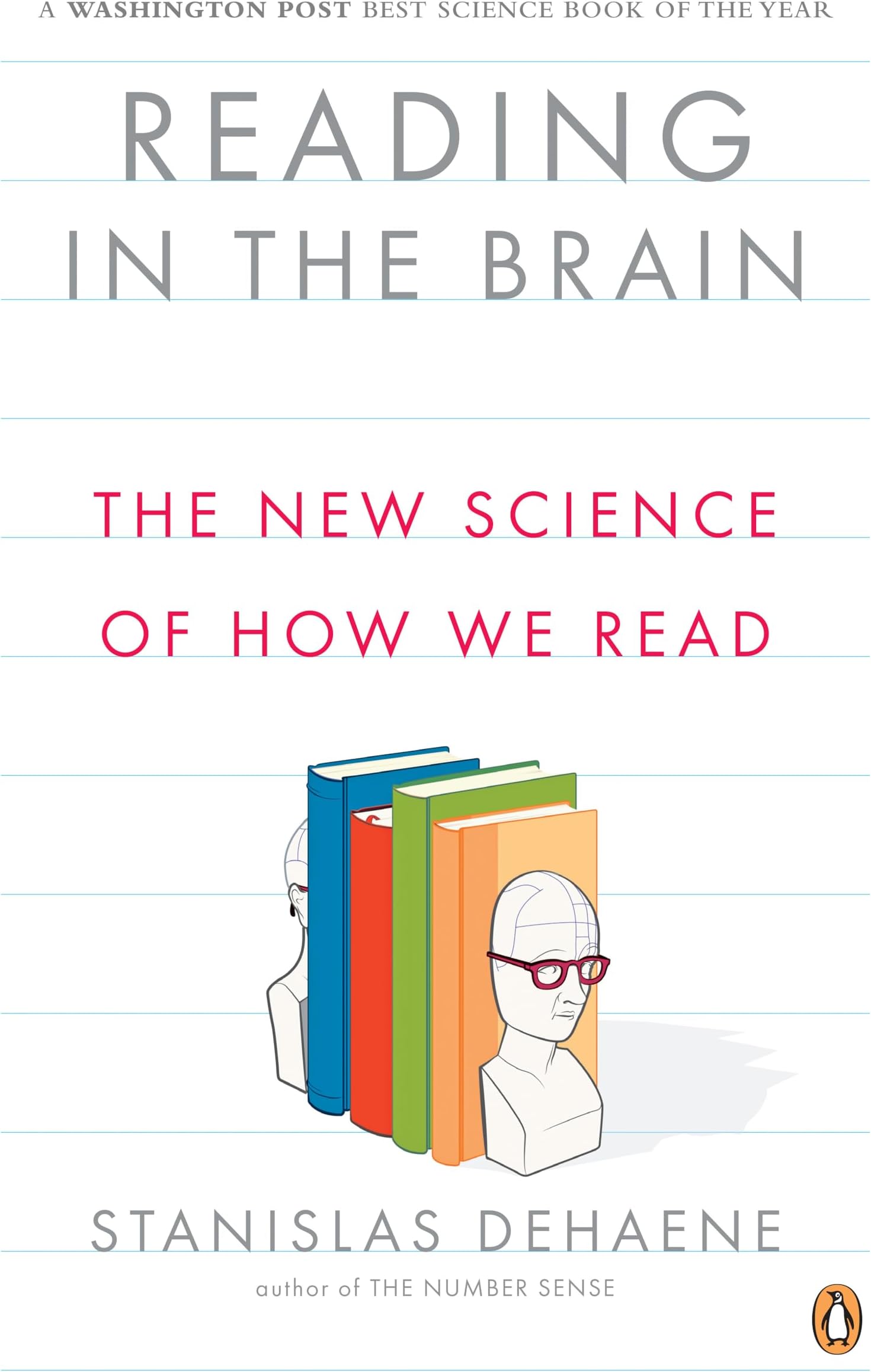
Reading in the Brain: The New Science of How We Read
Product ID: 8717976
Buy anything from 5,000+ international stores. One checkout price. No surprise fees. Join 2M+ shoppers on Desertcart.
Desertcart purchases this item on your behalf and handles shipping, customs, and support to Colombia.
"Brings together the cognitive, the cultural, and the neurological in an elegant, compelling narrative. A revelatory work."--Oliver Sacks, M.D. The act of reading is so easily taken for granted that we forget what an astounding feat it is. How can a few black marks on white paper evoke an entire universe of meanings? It's even more amazing when we consider that we read using a primate brain that evolved to serve an entirely different purpose. In this riveting investigation, Stanislas Dehaene, author of How We Learn , explores every aspect of this human invention, from its origins to its neural underpinnings. A world authority on the subject, Dehaene reveals the hidden logic of spelling, describes pioneering research on hiw we process languages, and takes us into a new appreciation of the brain and its wondrous capacity to adapt. Review: Fantastic read! - I’ve been a teacher for 16 years and throughly enjoyed this book. The science behind how the brain works and learns to read was fascinating to me, and honestly filled in the gaps where my professional education lacked. Very helpful!!!! Review: Must Read for anyone that Teaches Reading - Every educator, including myself, needs to know how the brain actually learns how to read. It is not political it is just plain brain science! Not only is this fascinating but it supports or dispels practices that you may or may not be using. I wish that I read this earlier in my career.

| Best Sellers Rank | #28,889 in Books ( See Top 100 in Books ) #13 in Reading Skills Reference (Books) #37 in Popular Neuropsychology #92 in Cognitive Psychology (Books) |
| Customer Reviews | 4.6 out of 5 stars 661 Reviews |
A**R
Fantastic read!
I’ve been a teacher for 16 years and throughly enjoyed this book. The science behind how the brain works and learns to read was fascinating to me, and honestly filled in the gaps where my professional education lacked. Very helpful!!!!
J**Y
Must Read for anyone that Teaches Reading
Every educator, including myself, needs to know how the brain actually learns how to read. It is not political it is just plain brain science! Not only is this fascinating but it supports or dispels practices that you may or may not be using. I wish that I read this earlier in my career.
J**K
Interesting read, something for everyone!
328 pages 388 pages including references Reading In The Brain: The New Science Of How We Read by Stanislas Dehaene, published in 2009 by Penguin Books, has several potential audiences that could glean truly interesting and potentially useful information from this book. One audience might be Lexile Historians. Dehaene provides copious amounts of details on how cultures have evolved from simply reading the landscape, to drawing images in caves, to the first alphabet written by the Greeks, and so on. How the spoken languages have evolved through various cultures, leading English to be one of the most challenging to speak and spell, seemingly only behind the Chinese, who memorize over 3,000 images to this day. Neurologists (or neurologists-in-training) could also benefit from information provided in this Dehaene’s book. Descriptions of the areas of the brain utilized for reading and writing (spoiler: prefrontal cortex & occipito-temporal region) are provided, explaining how brain formation and development, sometimes at a later age, (check out the chapter on dyslexia!) influence the human ability to recognize letter sounds, followed by the letters themselves, the morphemes, and eventually entire words. We learn about the areas that are linked to facial recognition as well, and how that is linked to reading. In some stages, both hemispheres of the brain play a large role in reading skills, but eventually, one hemisphere takes on a larger responsibility as children are exposed to more and more. The “Letterbox” portion of the brain must be exposed enough to reading to be fully developed at the inception of adolescence in order for the child to be deemed an “expert” in reading. The brain’s function with reading and simple recognition changes over time, and Dehaene provides thorough descriptions of those transformations. Finally, teachers of reading (parents and licensed educators alike) are final benefactors of information in this book. Chapters 4-7 are primary areas of interest for this particular audience, where we learn a bit more about the evolution of writing and reading across cultures, with highlights on several languages and their simplicities or complexities in teaching reading and writing. As an educator, I found the most valuable information in a chapter entitled “Learning to Read.” Dehaene highlights the “Three Steps for Reading,” which are “logographic”-recognizing images, phoneme recognition, and grapheme recognition. It’s important to understand how a child’s brain develops-in that order-in order for them to learn to recognize letters accurately and eventually begin to form words and be able to sound out new ones. Children who are exposed to more speaking and reading at younger ages are more likely to avoid dyslexia, and overall struggles with reading comprehension and verbal processing. We must take our time in teaching children to decipher phonemes & graphemes if we expect them to eventually become fast(er) readers & writers; we cannot rush the process. The most interesting chapter to me was the chapter on Dyslexia-an area which I am very inexperienced with as an educator. Many people with dyslexia also have speech issues, which could be one of the first noticeable red flags for children. The author stresses that no set amount or type of factors play into a diagnosis of dyslexia, but it is predictable based on the parents and genetics, though other factors can play a part. It is also treatable with intensive interventions over the course of several weeks, bringing participants in a study up a few levels of readiness versus where they were prior to the interventions. Cons of the book: This particular reader (me) found some of the content to be bone dry and difficult to get through, primarily due to the heaviness of the material and general lack of interest in the topic. Pros: Plenty of development facts are published in this book, which could truly be a large help in understanding child brain development, and how the brain works when it comes to reading and writing. There is likely something in this book for any of the three audiences previously mentioned, and likely others as well. Fun facts learned: -The eyes move constantly while reading because the fovea, a small part of the cornea, helps to interpret & process. -Our gaze can advance 7-9 letters ahead. -It can take 50 milliseconds to process a word. -Most good readers can read 400-500 words per minute. -Font type influences speed at which we can read. -What we see depends on what we think we’re seeing. -Words take longer to read if they have more graphemes, not necessarily phonemes. -The right hemisphere is linked to facial recognition; the left is linked with reading & writing. -Reading improves verbal memory. -The Literate Mind: spelling mastery, richness of vocabulary, nuances of meaning, pleasures of literature. -Italian is the easiest language to learn (as a child, at least.) Bottom line: This entire book may not be for everyone, but there are portions that anyone could benefit from. It is worth a read, even if you don’t read the whole book.
S**N
The " bible" on how we are able to read
It is a thrilling read for those interested! The book carefully & scientifically describes the miracle of how we are able to read, and many of the variations in our abilities. It is a milestone contribution on how best to LEARN to read. It is a bit dated at this point. Still an excellent basis for learning more in detail and in neurobiological terms. I learned SO much!
D**E
Reading: An Invention of Man
I really enjoyed reading this book.This is a topic in which I am very interested. Dr. Dehaene wrote a thorough, in-depth, and compelling book. He points out that the area of the brain by which we read was a product of evolution but had evolved for an entirely different purpose other than reading. He makes this statement based on when reading emerged in human culture. A period of time that is too short for evolution to have developed writing. Instead, he shows that reading and writing were processes that were invented by man. Of course, the area of the brain, which is the same area for all human beings regardless of their culture, Was "recycled" for the use of this new and novel invention of man. Dr. Dehaene relates how neuroscience identified and traced the circuits involved in reading via an ever progressing imaging machines. Each evolution of imaging machine gave faster, richer, and more detailed results as to which neurons were firing during reading and more accurate locations in the brain. I found this to be a fascinating journey and literally devoured the material.
G**L
The fantastic details of learning to read.
All teachers should read this book. Rigorously researched and scientifically valid. Written by a neurologist who has done his own research. Easy to re ad and understand!!!
S**N
well written and enlightening
i first came across dehaene's name in george lakoff's "where mathematics come from" -- and picked up his earlier number sense book. this book is in my opinion much more substantial -- he has been a researcher in this area for a long time, it seems, and he is very literate in the subject -- he provides a deep consideration of the neural correlates of reading, provides a coherent statement of what he calls neural recycling to explain how the brain adopts for reading across cultures, provides an in-depth exploration of dyslexia, and has a very profound vision of the place of neuroscience in education. he writes extremely well -- which is particularly impressive given that his original language is french. moreover, he has a breath of knowledge of language that goes beyond well english -- even pinker seems to be a professor of english. he makes reference to tomassello which impressed me no end since i wouldn't expect that breath of literacy from a neuroscientist. it provided me with everything i could have wished for, except for the field to be further along. i would not just recommend this book, but the author. i think before his career reaches its twilight, he will have contributed greatly both to neuroscience and its communication to the educated layperson.
J**E
Research, research, research
I bought this book to increase my teaching strategies for reading instruction. The book was heavily laden with scientific research, hypothesis, and anatomical diagrams. I suppose it was the author's intent to justify brain research and relate it to reading. After wading through the research, I did find some good teaching strategies and increased my knowledge of reading development. Also I ordered the kindle edition and found the charts and diagrams difficult to read. I recommend ordering a hard copy.
S**T
An instructive book
Dehaene describes how an area of the temporal cortex processes the written word. This so called 'letterbox' of the brain is situated within the left ventral visual area. All information about written words passes through this, and it is located in the same area whatever the language of the subjects. The brain is seen as dividing its visual work into categories, with each performed by a different patch of the cortex. Many of the preferred shapes of the 'letterbox' neurons are shapes that resemble letters, symbols or Chinese characters; these are collectively referred to as proto-letters. These may have evolved to help identify objects by being invariant to changes in images. With letters, whatever the type of font, size or colour of the letters, our interpretation does not change. The 'letterbox' is located between an area of the cortex that recognises landscapes and buildings and another that recognises faces. Thus the ventral surface of the brain contains areas tuned to recognising particular types of feature. However, the specialisation of such areas overlaps. Specialisation seems to be at the level of neurons, with neurons of different specialisations intermingled. Visual analysis in reading is followed by extraction of sound patterns and meaning. Nerve fibres project from the 'letterbox' towards other parts of the temporal cortex. At their destinations, separate networks appear to be involved in processing sound and meaning. The left-middle and ventral regions of the left temporal lobe are thought to be specialised in processing meaning. The lateral temporal region appears to be subdivided into regions dealing with the meaning of particular words. Regions near the front of the temporal lobe appear to concentrate on the meanings of words when combined into sentences. It is suggested that areas such as this act as convergence zones for information from the rest of the brain. Something that evolves for one purpose can get taken over for another. Literacy is seen as changing the brain with both an increase in left brain engagement and an increase in activity between the two hemispheres. The 'letterbox' was originally evolved for something else, so reading may be paid for by some offsetting cognitive loss. The only serious criticism of the book is that this interesting question is not tackled in greater depth.
C**N
a must read for teachers
I've read this book in Portuguese in 2014 when I was concluding my paper on graduation. It changed completely changed my view about reading (and also of how my paper was being done). Stanislas is a well-respected scientist, especially on the studies of dyslexia.
J**I
A masterpiece....
This is an amazing science book which sheds light about how our brain works to synthesize the anatomy and physiology of reading ....
C**E
Jam packed with reading cognitive science
Read it, read it again and then read it again. With every read, I get a bit more out of it, understand more nuances and attach more bookmarks.
P**E
Thank you
Thank you
Trustpilot
1 month ago
1 week ago