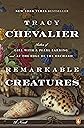
Remarkable Creatures: A Novel
Product ID: 8364741
Desertcart purchases this item on your behalf and handles shipping, customs, and support to Colombia.
From the New York Times bestselling novelist, a stunning historical novel that follows the story of Mary Anning and Elizabeth Philpot, two extraordinary 19th century fossil hunters who changed the scientific world forever. On the windswept, fossil-strewn beaches of the English coast, poor and uneducated Mary learns that she has a unique gift: "the eye" to spot ammonites and other fossils no one else can see. When she uncovers an unusual fossilized skeleton in the cliffs near her home, she sets the religious community on edge, the townspeople to gossip, and the scientific world alight. After enduring bitter cold, thunderstorms, and landslips, her challenges only grow when she falls in love with an impossible man. Mary soon finds an unlikely champion in prickly Elizabeth, a middle-class spinster who shares her passion for scouring the beaches. Their relationship strikes a delicate balance between fierce loyalty, mutual appreciation, and barely suppressed envy, but ultimately turns out to be their greatest asset. From the author of At the Edge of the Orchard and Girl With a Pearl Earring comes this incredible story of two remarkable women and their voyage of discovery. Review: Not drawn to the study of fossils, yet the book was still amazing - "Girl with the Pearl Earring" was the only novel I had read by this author until now. Both of these novels have been book club selections and I am eager to discuss this one with my group next week. After reading this latest from Ms. Chevalier, I am definitely motivated to go back and read the rest of her work. Set in 19th century England, the story mainly takes place on the southern coast in a village called Lyme Regis. A financially comfortable, but not wealthy, family needs to find somewhere the three spinsters sisters may make their home since residing in London is beyond their means. The family members go on a tour of the country looking for an appropriate place to settle the sisters and the decision is made to relocate them to Lyme Regis. Elizabeth Philpot, the middle sister, is fascinated by the fossils to be found on the beach and in the rock formations abutting it. She meets the young daughter of the local cabinet maker who contributes to the family's income by selling the fossils she finds to tourists coming through the town. The lives of these two women and their shared interest in fossils provides the basis of the narrative. There are other supporting characters and secondary storylines, but the focus really is on the discovery of fossils and the impact these finds have on the scientific community. I had no idea this was based upon actual people and true events, but I now have the desire to travel there and see it all for myself. A part historical fiction, part literary fiction, and a small part romance, this novel will appeal to a wide variety of readers. The characters are incredibly drawn and fully fleshed out, even the more minor ones are terrific. The setting is so beautifully described that I could practically feel the sea spray on my face. The dialog is so well written and the voices are so clear that within just a sentence or two the reader knows who is speaking even without that person being identified. I give this book the highest praise since science isn't my thing and I am not particularly interested in fossils but I still thought the novel was fabulous. When a writer can write about a subject I am not particularly interested in and make me love the book - that's pretty amazing. Chevalier is a master of the language as well as a master story-teller. Great, great book! Review: Best read in small doses. - Tracy Chevalier’s story of two real-life fossil-hunters in early 19th-century England reads like a Jane Austen novel, which isn’t surprising since Lyme Regis, a place visited by Austen early in the nineteenth century, is where and when this tale is set. It’s not an edge-of-your-seat page turner, but this historical fiction is worthy of your time. Mary Anning and Elizabeth Philpot were remarkable, as were the relics found by both women. They were extraordinary women for their times and Mary, in particular, found fossils that baffled experts of the day. That bafflement is expressed well in the novel; in addition, Chevalier highlights the difficulty in reconciling the existence of skeletons of unknown and probably extinct creatures with the Creationist philosophy that was prevalent at the time. Chevalier chronicles the possible relationship between Mary and Elizabeth, highlighting their presumed differences and similarities, as she speculates on how known historical events would have played out from the perspective of each of the women. Both women were unmarried, one genteel and one too poor to be strictly genteel, and both were interested in fossils. Mary was around twenty years younger than Elizabeth, but still one would expect they ran into each other a lot, both while fossil-hunting and while conducting business in daily life in their small town. Chevalier presumes that both women lived lives of some despair, having failed to marry, but I prefer to think they lived boldly and without regret. Perhaps they had no time for regret. One note about reading: this is told in first person, alternating between Mary and Elizabeth, and the narrator is not named; one has to read a bit before recognizing from the context and vernacular of the narrator which of the paleontologists is speaking. As with all historical fiction, the facts are the framework but license is taken in building relationships; approach the book with an open and curious mind, and follow up with your own research into the lives and times of Mary and Elizabeth as well as their colleagues. The author gets you started on your research; keep going past the last chapter of the novel and you’ll find a summary of the life and death of each of the women, as well as information on family members and colleagues.
| Best Sellers Rank | #97,582 in Books ( See Top 100 in Books ) #483 in Biographical Historical Fiction #890 in Women's Friendship Fiction #1,116 in Historical British & Irish Literature |
| Customer Reviews | 4.3 out of 5 stars 6,951 Reviews |
H**Y
Not drawn to the study of fossils, yet the book was still amazing
"Girl with the Pearl Earring" was the only novel I had read by this author until now. Both of these novels have been book club selections and I am eager to discuss this one with my group next week. After reading this latest from Ms. Chevalier, I am definitely motivated to go back and read the rest of her work. Set in 19th century England, the story mainly takes place on the southern coast in a village called Lyme Regis. A financially comfortable, but not wealthy, family needs to find somewhere the three spinsters sisters may make their home since residing in London is beyond their means. The family members go on a tour of the country looking for an appropriate place to settle the sisters and the decision is made to relocate them to Lyme Regis. Elizabeth Philpot, the middle sister, is fascinated by the fossils to be found on the beach and in the rock formations abutting it. She meets the young daughter of the local cabinet maker who contributes to the family's income by selling the fossils she finds to tourists coming through the town. The lives of these two women and their shared interest in fossils provides the basis of the narrative. There are other supporting characters and secondary storylines, but the focus really is on the discovery of fossils and the impact these finds have on the scientific community. I had no idea this was based upon actual people and true events, but I now have the desire to travel there and see it all for myself. A part historical fiction, part literary fiction, and a small part romance, this novel will appeal to a wide variety of readers. The characters are incredibly drawn and fully fleshed out, even the more minor ones are terrific. The setting is so beautifully described that I could practically feel the sea spray on my face. The dialog is so well written and the voices are so clear that within just a sentence or two the reader knows who is speaking even without that person being identified. I give this book the highest praise since science isn't my thing and I am not particularly interested in fossils but I still thought the novel was fabulous. When a writer can write about a subject I am not particularly interested in and make me love the book - that's pretty amazing. Chevalier is a master of the language as well as a master story-teller. Great, great book!
C**B
Best read in small doses.
Tracy Chevalier’s story of two real-life fossil-hunters in early 19th-century England reads like a Jane Austen novel, which isn’t surprising since Lyme Regis, a place visited by Austen early in the nineteenth century, is where and when this tale is set. It’s not an edge-of-your-seat page turner, but this historical fiction is worthy of your time. Mary Anning and Elizabeth Philpot were remarkable, as were the relics found by both women. They were extraordinary women for their times and Mary, in particular, found fossils that baffled experts of the day. That bafflement is expressed well in the novel; in addition, Chevalier highlights the difficulty in reconciling the existence of skeletons of unknown and probably extinct creatures with the Creationist philosophy that was prevalent at the time. Chevalier chronicles the possible relationship between Mary and Elizabeth, highlighting their presumed differences and similarities, as she speculates on how known historical events would have played out from the perspective of each of the women. Both women were unmarried, one genteel and one too poor to be strictly genteel, and both were interested in fossils. Mary was around twenty years younger than Elizabeth, but still one would expect they ran into each other a lot, both while fossil-hunting and while conducting business in daily life in their small town. Chevalier presumes that both women lived lives of some despair, having failed to marry, but I prefer to think they lived boldly and without regret. Perhaps they had no time for regret. One note about reading: this is told in first person, alternating between Mary and Elizabeth, and the narrator is not named; one has to read a bit before recognizing from the context and vernacular of the narrator which of the paleontologists is speaking. As with all historical fiction, the facts are the framework but license is taken in building relationships; approach the book with an open and curious mind, and follow up with your own research into the lives and times of Mary and Elizabeth as well as their colleagues. The author gets you started on your research; keep going past the last chapter of the novel and you’ll find a summary of the life and death of each of the women, as well as information on family members and colleagues.
M**E
LADIES FIRST TO DISCOVER TREASURE TROVE OF FOSSILS
Tracy Chevalier always manages to knock my mind into assorted pieces of joy. The author of Girl with a Pearl Earring this time choses an English setting, seaside beaches and cliffs in Southern England in the Devon region. The remarkable creatures are not the academic and pseudo-scientists in Oxford and Paris, but girls who beachcomb and study their treasures; As they age, variations in education, perspective, marital opportunities, among other things, leads to intense jealousy between two particular wormen, one of whom cannot even read. Yet, as fossils become more than trinkets and items to be sold to tourists, each makes remarkable discoveries which wind up in the British Museum. That they have come so far has much to do with the buying and selling to notably wealthy men who understand less about fossils that the women. There are some brutal storms between the women that make .compelling reading, but each carries out her work indefatigably. I deliberately leave out plot details from my reviews because I know they are already posted and need not be recited again. What fascinates me most about this book is that it takes place in the early 19th Century, when women were so restricted in society, and these women manage to slip under the wall of repression. I am amazed also, that their observations, which still stand, are all pre- Darwin. They stumble upon scientific method, observe extinct species, and want to find out why they are extinct, and why a crocodile fossil specimen can wind up in a place like Devon or Lyme. I felt as if, knowing there were others with these interests, Darwin is almost the apex of change in our own species--how we think, learn, question. All the events in the book take place before The Origin of the Species was published. Yet, the questions Darwin raises had been forming its own volcano in the evolution of the human mind. These topics Chevalier brings to life with her typical simple, yet elegant and melodic prose. Chevalier was born in Washington, D.C., although she lives with her husband and children in English. I am sorry the book cannot be short-listed for the Man-Booker Prize. While the work is a novel, the book is based on a true story that is as much part of English history of science as Charles Darwin himself.
R**E
REMARKABLE CREATURES a remarkable read
This is only ADULT novel I've read on Anning, the previous ones having been a children's book and a Young Adult novel (DRAGONS IN THE ROCKS was the title of one of them--i forget which). Mary Ann Anning was a real person, a Napoleonic-era female credited with the discovery, description, and naming of several prehistoric species. I found Chevalier's version--necessarily creative, since facts are, not surprisingly, few about this too-early pioneer-- very absorbing and, btw, very filmable. The novel is actually two interlaced memories; one narrated by Mary Ann Anning, as the story starts a pre-teen of poor family. Her father is a distractible (by fossils, collections of which were trendy) and not highly competent cabinetmaker, whose early death plunges the Annings into marginal living. The other narrator is Elizabeth Philpot, a slightly older and better-off woman, something of an exile from the bright lights of London, through the marriage of her older brother, the sole heir, given the times, to her family's comfortable income. She has the benefits of better education, though, especially relatively to almost all women of early 19th-century England, and is fascinated by science literature of the day. Elizabeth's intellectual interests, and Mary's financial straits, drive them together onto the beaches of Lyme Regis, a small village in Dorsetshire, on the south shore of England, in the days when dinosaurs could be denied, and were, by all but a few, in the infancy of paleontology. To Mary, the "curios" are primarily items to sell to tourists, although she also has her imagination stirred by them. Vacationing Londoners flocked to Lyme Regis for the bathing beaches, which were equipped with "bathing machines" for the ladies--little houses that could be wheeled out into the surf so that ladies (it would be less delicate to refer to them as "women") could bathe in their --slightly-- reduced clothing without being exposed to the eyes of men. The two hit it off, at first in an almost mother/daughter way, and form a working partnership. (Mary's mother, practical and made desperate by pre-safetynet widowhood, has no patience for her daughter's scientific passion or her attraction to the patrician Philpot). The stories from then on trace several developments: Mary's growth into womanhood, her romantic sufferings and an eventual self-acceptance that is shockingly modern (and feminist) for her time; Elizabeth's parallel and…overlapping...romantic sufferings ["Spoiler" spoiler: Despite that last bit, REMARKABLE CREATURES is not a bodice-ripper…well, OK, maybe ONE bodice]; a bitterness that temporarily divides them; the struggle of these two women against the sexism of their times--now long behind us, of course-- in being accepted as women of science; the progress of that science itself against religious prejudices. All told within the convincingly re-imagined context of an absolutely true story of two early science heroes, by a skilled and popular (GIRL WITH THE PEARL EARRING) author.
L**)
OK but rather slow
This historical novel is about Mary Anning (1799-1847), an uneducated woman living in the small coastal town of Lyme, England, who—beginning when she was a child—showed an amazing knack for finding fossils in the local cliffs, including several of water-living dinosaurs (ichthyosaurs and plesiosaurs). The best of her finds eventually graced British museums and fueled the discussions about evolution and geological history that were just beginning in her time, but until fairly late in her life, the men who bought and wrote about her specimens got all the credit for finding them. The novel is narrated alternately by Mary and by Elizabeth Philpot (also a real person), one of three spinster sisters from London who were forced by their lack of money to move to Lyme. As an “impoverished gentlewoman,” Elizabeth had to watch her pennies, but she was upper-class compared to Mary. Nonetheless, they shared an interest in fossils (Elizabeth’s specialty was fossil fish) and, for part of their lives, a close friendship—though the book focuses on a bad breakup between them that lasted some years (I don’t know whether that was fictional or not). Most of the other characters in the book were also real people, though some of the events were fictionalized. Both Mary and Elizabeth were interesting and endearing, and a few of the other characters also stood out—most notably Mary’s mother, Molly, who proved to be a shrewd businesswoman (the Anning family depended financially on the sale of the fossils, or “curies,” that Mary found, so that was important) and much more determined to stand up to Mary’s upper-class patrons than Mary was. On the whole, however, the book was a slow and rather tepid reading experience. The problem, I think, was simply that Mary, in spite of her importance in the history of paleontology, did not lead a very dramatic life, and Chevalier was unable to overcome that disadvantage. I have read historical novels that managed to make outwardly rather quiet lives thrilling (Natasha Boyd’s The Indigo Girl comes to mind), but this wasn’t one of them.
K**E
Kept Me Reading
I thought a story about two women fossil hunters would be interesting and I was not wrong. I did not know it was actually based on real people. The author did a wonderful job of making both the characters and the story engaging. Definitely NOT like reading a history book. I found i was sorry to come to the end but appreciated the prologue at the end that carries out how these two contributed to the world of fossils and creatures who lived long ago. AAA+++
J**E
Remarkable Creatures--a two-pronged title
Remarkable creatures is a very good book. I was aware of Mary Anning before reading this book, but not of Elizabeth Philpot, a new arrival in Lyme Regis, Anning's home town on the Channel coast. It has raw cliffs, which I have seen, which expose many ages of the universe, including dinosaurs. Mary is expert at finding fossils including whole assemblable ichthysouri. Mary is otherwise uneducated (she can't write) and even calls the vertebrates she finds "verteberries." Philpot insists she go to school. The Anning family lives hand to mouth, Mary even sells part of her collection to put food on the table. She finds replacements so easily that she does not much care. She faces two major conflicts in her life. One is from the Anglican Church, which does not understand how a perfect God can create imperfect creatures that He would later have to consign to oblivion. The other is from the curator of the Paris Museum who insists her findings are fraudulent. Philpot comes to Mary's defense, taking a sea voyage around Margate and Ramsgate and up the Thames to London to insist she be admitted to an all-male club, which is on both sides of Mary's conflicts. She arrives on time, but Mary's evidence is shipwrecked and has to be transported over muddy Kentish Roads and does not. I won't spoil the plot here. There is a heavy theme of Hunters (the good guys) and Collectors (bad guys), the ones who like Mary Anning find the fossils versus the ones who collect them only to show them off. There is also a dual meaning to the title: remarkable creatures refers not only to the uncovered dinosaurs but also to Mary and Philpot who devote their lives to prehistoric discoveries. Like another reviewer, I don't find the love stories covincing, but I give it five stars nonetheless because it is a book the reader will long remember. This is the first book of Tracy Chevalier's I've read, but I plan to read more. John K. Crane, Santa Fe, New Mexico
S**Y
two remarkable women
Remarkable Creatures by Tracy Chevalier is a historical fiction novel based on the life of female fossil hunters Mary Anning and Elizabeth Philpot. Mary Anning was a working class young girl when she started finding fossils or "curies" (curiosities) with her father on the beaches at Lyme Regis, England, in the 19th century. Her father died and she continued to collect curies in order to sell them to support her family. Elizabeth Philpot, twenty years Mary's senior, was an unmarried gentlewoman who moved to Lyme Regis with two of her sisters. They were to "retire" there and live out their lives as spinsters. Mary and Elizabeth met and became friends because of their love of fossils. When Mary uncovered the first complete skeleton of an ichthyosaurus she originally thought it was some kind of crocodile - but this error was understandable. At this time most women had few rights and certainly a working class woman would never be educated or given credit for the practical, working knowledge she had - knowledge that surpassed that of many men who claimed to be experts at the time. Elizabeth helped to educate Mary and taught her how to label her fossils using Linnaean classification. Mary went on to discover another ancient marine reptile called a plesiosaur. All of this was before Darwin, so the idea of finding the remains of creatures that no longer existed in the world was a radical idea and not readily accepted by everyone. While fighting to make the male dominated paleontologists of the day recognize Mary's contributions to the field, Elizabeth says, "So be it. A woman's life is always a compromise. (pg. 26)" And while acknowledging that this is a work of fiction, Chevalier writes: "Remarkable Creatures is a work of fiction, but many of the people existed, and events such as Colonel Birch's auction and the Geological Society meeting where Coneybeare talked about the plesiosaur did take place.( pg 309, postscript)" Mary Anning was the inspiration for the tongue-twister "She sells seashells by the seashore." In Remarkable Creatures both characters voice in alternating chapters a first person account of their friendship and how their lives intertwined. Chevalier gives Elizabeth and Mary unique voices so it is immediately apparent who is talking in each chapter. It is a beautifully written account of two remarkable women and made for a compelling novel.
K**N
I felt scammed.
This book arrived later than expected. I received an old copy of the book with a different cover and yellow pages with a water make stain. It was not new or in good condition.
N**X
Lovely Narrative
I couldn't put it down. Though a work of fiction based on a remarkable time in history and remarkable people, I feel I know Mary Anning, Elizabeth Philpot, William Buckland, and many others a bit better now, and they seem more real rather than as names in a textbook. I'm intending to purchase a hardcopy as soon as I am able. I recommend this book to anyone who has an interest in geology, palaeontology, feminism, history, or just love to read.
A**B
Remarkable writer
Tracy Chevalier est une auteur exceptionnelle. Sa maîtrise de la langue anglaise a une puissance d'évocation rarement égalée. Sous sa plume tout un univers prend vie et l'on croirait presque sentir l'air marin de Lyme Regis lorsqu'on parcourt ces pages. Ses portraits de femmes, indépendantes et fortes dans un monde gouverné par les hommes ont fait sa réputation depuis le succès de La jeune fille à la perle. Dans Remarkable creatures ce sont Mary Anning et Elizabeth Philpot que l'on apprend à découvrir, figures historiques des grands débuts de la paléontologie. Chevalier décrit les hommes et les âmes comme personne d'autre, c'est un bonheur de revivre ce grand moment de l'histoire des sciences et de l'évolution des consciences à travers ce roman.
C**A
Besser als gedacht - absoluter Überraschungshit mit spannendem Thema!
Ich muss gestehen, dass meine Erwartungen an das Buch doch relativ gering waren, da das Thema einfach so random ist. Aber was soll ich sagen? Das Buch war ein absoluter Überraschungssieger für mich: Klar, wer Mord,Spannung und Blut erwartet, der ist bei diesem Buch an der falschen Adresse, aber nichtsdestotrotz schafft es das Buch, eine gewisse Grundspannung bei einem doch sehr ungewöhnlichen Thema aufrechtzuerhalten. Tolles Buch!
R**O
muito orgulho e preconceito
Gosto muito de Tracy Chevalier. São livros sobre mulheres, mas não "mulherzinha". Suponho que sejam romances históricos, com protagonistas as voltas com ambientes opressivos e paixões inescapáveis.
Trustpilot
1 month ago
2 months ago