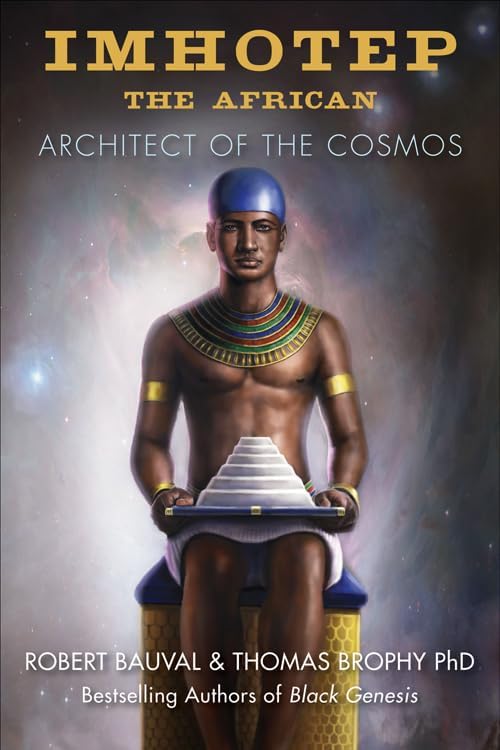
Imhotep the African: Architect of the Cosmos
Product ID: 8243562
🌌Cosmic architectural knowledge
📚Deep historical insights
🕰️Ancient wisdom revisited
Buy anything from 5,000+ international stores. One checkout price. No surprise fees. Join 2M+ shoppers on Desertcart.
Desertcart purchases this item on your behalf and handles shipping, customs, and support to Colombia.
🌟 Unlock the secrets of the cosmos and ancient genius—don’t miss the book reshaping history!
Imhotep the African: Architect of the Cosmos is a compelling used book that challenges conventional history by revealing advanced ancient African knowledge in astronomy and architecture. Authored by respected researchers Bauval and Brophy, it offers a fresh perspective on Imhotep’s legacy and early human civilization, backed by 214 positive reviews and ranked among top African history titles.
| Best Sellers Rank | #1,053,858 in Books ( See Top 100 in Books ) #554 in Ancient Egyptians History #1,047 in Ancient & Controversial Knowledge #1,536 in African History (Books) |
| Customer Reviews | 4.5 out of 5 stars 215 Reviews |
R**S
REWRITING HISTORY ONE CHAPTER AT A TIME
The story of human history that is presently being taught in our classrooms contains many-many inaccuracies and missing chapters. Bauval and Brophy are two of the most prolific modern researchers in the quest to think outside the box and uncover our true shared history more accurately. As a fellow 40+ year researcher/author on human evolution I have personally read all of the books each have written, including their most recent joint project "Black Genesis," and written favorable reviews on most of them. For those of you who are familiar with their earlier work, this book will not disappoint. Those not familiar are in store for a rare exhibition of what cutting-edge, open-minded, modern thinking can achieve. The earliest written records science has available to consider the story of human history are from the two oldest civilizations Egypt & Sumer (hieroglyphs and cuneiform) which date to approximately 3000 BC. Aside from these written accounts the more conventional tools of archaeology and anthropology are the next-best method. Unfortunately, each of these methods are highly subjective and, right or wrong, are largely determined by a consensus of Establishment thinking. Few deny that a remarkably high degree of sophistication in knowledge was clearly displayed in Egypt's most famous sites. In this book you will learn that equally amazing knowledge was also displayed by early humanity in Egypt thousands of years earlier in the now barren desert 100 miles West of the better-known sites. This book is a part of the opening volley which will ultimately form a new worldview and better understanding of history. My only criticism of the conclusions from this book are that the source of knowledge demanded to create the engineering capability clearly put to practice by these early civilizations was far greater, advanced and more expansive than the authors of this book imply. In Brophy's 2005 book "Nabta Playa" the author provided compelling evidence that advanced astronomy, including the knowledge of the true shape of the Milky Way Galaxy, its center and Earth's location, was known in approximately 6500 BC. Also, knowledge of the speed of light, precise distance to the primary stars in Orion and other important information which was only scientifically proved conclusively in the last 50 years. Are we really expected to believe this information was discovered by a primitive people with one foot still in the stone age? This book is a good start toward unraveling the mystery of the existence of highly advanced engineering and technology put to practice in human history ... but additional work must follow to uncover the actual source behind Imhotep's knowledge. Intelligent Intervention
A**E
New light in dark places
I give this book a top star because that's what it deals with, more of the stellar orientation, which is older, rather than just the solar of ancient Kemet. Really like how the author(s) does credit to Heliopolis (Anu/biblical On). The mathematics of the areas (right angles) point to a deep understanding of the cosmos, and that the area was founded upon cosmic jurisprudence. The book is good and like all good things, I'm enjoying it slowly. Makes me want to prepare to order other titles by the same author. I am just elated that this author in particular, has risen above the scientific racist to credit the people who really brought high culture in Africa and thus are the true parents of civilization throughout the world. It is to them that all praise is due.However, I don't think that Imhotep is no more the greatest of the great than Hemianu can be proven to be the builder of the great pyramid. For whoever designed and built the great pyramid, or should I say the entire Giza Project, took it to whole "nother" level. Again, however; I am thankful for Mr. Bauval; he has brought up some deep thought in his research which can only further prepare us for what is to come. Thank you
E**A
IMHOTEP STILL A GREAT MYSTERY!!!
Certainly this is not one of the best books by Robert Bauval. For those interested in Imhotep, I would recommend IMHOTEP BUILDER IN STONE by Maribelle Cormack. In this book we can read the following: "The dark skinned Nubians, who lived beyond the First Cataract ( a barrier such as a waterfall or steep rapids ) of the Nile, were not allowed to enter Egypt. During the period of the Middle Kingdom (about 2000 B.C.), THE Egyptians built a trading post at Samnan, above the Second Cataract, and allowed the Nubians to come there to trade. But no Nubian entered Egypt in the Old Kingdom says except as slaves." This is a real contradiction with the working hypothesis of this book of Robert Bauval! As far as I know this book by Maribelle Cormack is very well documented Anyway Imhotep remains a great mystery for mankind, and perhaps it is in The Urantia Book by reading it with open mind where we can resolve the real mystery not about Imhotep, but about that "ancient history of mankind" that we really do not know anything about. Recently I have read a book by one of the great thinkers of the 20th century Sigmund Freud, MOSES AND MONOTHEISM which I have already reviewed, and there, there is a complete consistent explanation about that topic taken from UB. This time I want just to share with you open minded people, interested in the past of mankind the following taken too from UB: "When the last Andite dispersion broke the biologic backbone of Mesopotamian civilization, a small minority of this superior race remained in their homeland near the mouths of the rivers. These were the Sumerians, and by 6000 B.C. they had become largely Andite in extraction, though their culture was more exclusively Nodite in character, and they clung to the ancient traditions of Dalamatia. Nonetheless, these Sumerians of the coastal regions were the last of the Andites in Mesopotamia. But the races of Mesopotamia were already thoroughly blended by this late date, as is evidenced by the skull types found in the graves of this era. 6. THE ANDITES ALONG THE NILE From the times of the terminal Andite migrations, culture declined in the Euphrates valley, and the immediate center of civilization shifted to the valley of the Nile. Egypt became the successor of Mesopotamia as the headquarters of the most advanced group on earth. The Nile valley began to suffer from floods shortly before the Mesopotamian valleys but fared much better. This early setback was more than compensated by the continuing stream of Andite immigrants, so that the culture of Egypt, though really derived from the Euphrates region, seemed to forge ahead. But in 5000 B.C., during the flood period in Mesopotamia, there were seven distinct groups of human beings in Egypt; all of them, save one, came from Mesopotamia. When the last exodus from the Euphrates valley occurred, Egypt was fortunate in gaining so many of the most skillful artists and artisans. These Andite artisans found themselves quite at home in that they were thoroughly familiar with river life, its floods, irrigations, and dry seasons. They enjoyed the sheltered position of the Nile valley; they were there much less subject to hostile raids and attacks than along the Euphrates. And they added greatly to the metalworking skill of the Egyptians. Here they worked iron ores coming from Mount Sinai instead of from the Black Sea regions. The Egyptians very early assembled their municipal deities into an elaborate national system of gods. They developed an extensive theology and had an equally extensive but burdensome priesthood. Several different leaders sought to revive the remnants of the early religious teachings of the Sethites, but these endeavors were short-lived. The Andites built the first stone structures in Egypt. The first and most exquisite of the stone pyramids was erected by Imhotep, an Andite architectural genius, while serving as prime minister. Previous buildings had been constructed of brick, and while many stone structures had been erected in different parts of the world, this was the first in Egypt. But the art of building steadily declined from the days of this great architect. This brilliant epoch of culture was cut short by internal warfare along the Nile, and the country was soon overrun, as Mesopotamia had been, by the inferior tribes from inhospitable Arabia and by the blacks from the south. As a result, social progress steadily declined for more than five hundred years...
A**E
Imhotep, the Africa
What did we expect him to be: brown, white, copper, red or ?? He appears to be more bronzed than anything else. By African title, does that mean he was totally black? So be it, no demeaning intended here. He was and remains a unique individual who had all the attributes of full physique, intelligence and "presence." The astral sky and its imagery are fully explained here. Therefore Imhotep is depicted as the architect of the Cosmos who used the stars and their layouts as compared to his teachings and thus building structures upon the earth that reflect what's told in the starry sky. The major part of the book is therefore not so much about this person as it is the breakdown and explanation of the cosmos, the calendar circle, Heliopolis, the step pyramids and so forth. In short, a Neolithic Astrological Design above and below with a seeing is believing expo. Book is recommended reading.
P**T
Thought-provoking history about an amazing culture and personality . . .
I have always been intrigued by ancient Egyptians, and this book offers insight into their origin and evolution. The ideas and assessments put forth by the authors are well thought out, and backed by reliable scholarship and data. This is the type of history that provokes more inquiry. They seem to be more concerned with ascertaining the truth, and less concerned with propping up the status quo and I found it refreshing.
T**D
Those who hate the truth profited from it's absence!
The thing about His story is, it has been displayed as the truth for so long, that people honesty think it's the truth! It is scholars such as Ivan Robert Bauval who went to bat just to get people to see the truth, which wasn't of his own opinion, but naturals facts, testimonials, images, reliefs, bust, linguistics, science, radio carbon dating, cultural influences and more. For one to deny the connection, they must extremely ignorant, or they have profited from the absence of truth and will do whatever to keep the lid on real history! Other do not see it this way, and for those people who debate the veracity of truth, get your head out of your culo's and do some research yourselves instead Googling information on Google! Sorry to alert you brainwashed people but Google does not hold all of the answers people! Good old book reading always has it's advantages.
V**Y
Who Was Imhotep?
Actually, this book isn't really about Imhotep at all....... it's more like speculation as to who he was. The main subject of the book concerns the step pyramid at Saqqara, attributed to King Djoser, for whom Imhotep reportedly worked. Nevertheless, I found this book to be a fascinating story of how the large structures of that time in Egypt were built to coincide with certain important stars & constellations. The only part of the book I didn't find interesting was the last section, where the information on Nabta Playa seemed rehashed fwom the previous book, Black Genesis.
B**D
Typical Egyptologist and academia stance on timeline
It was an interesting read and presented another coherent view flawed only by the fact the dates and times of the Egyptian civilization and the civilization that created the pyramids were not one and the same. Some event that caused all the death and upheaval globally in the 3800 BC era seems to have robbed us of the facts pertaining to an earlier civilization that the more modern Egyptian one did a squatters job on. I do like the way Mr Bauval thinks though. However our star charts indicate three cycles through all the star systems and they refer to just a small slice in time. As our MTA evidence shows we as a species are roughly 203,000-212000 years old, it would behove them to draw a timeline to the MTA base and merge that with the clues and writings that survive. It would seem the people of MU and the Lemurians built the Pyramids in cahoots with some character called Saurid. The time when Saurid lived has been the focus of furious and spirited debate for a very long time now. The time of Genesis with regards to humanity was 212,000 years ago, not 6000 years ago. Fitting who came when over that timescale is a puzzle we have only scant fragments of remaining. When Mars and Venus came in near collision with earth in 3700-3800BC was not at the beginning of time....
R**E
[ Cosmos]
" The human Spirit Needs places where Nature has not been rearranged by the Hand of aman." What Value is it to aman,if he gains the world,but loses his/her own primeval[Spirit]???.
J**N
Yet another fascinating book
Once again we have been treated to a thoroughly intriguing insight into ancient Egypt. The contention that Imhotep may have been descended from a black African nation is intriguing. Until his tomb is found and DNA tests are performed on his remains, any hypothesis regarding his ethnicity is possible. Robert Bauval, this time in partnership with Thomas Brophy, has produced another thought provoking book. Thank you Robert and Thomas for a brilliant read.
G**I
Absolutely brilliant
The book is A must read for anyone who loves ancient Egyptian-it’s full of fascinating secrets insights and astonishing facts you will become much wiser after reading this book plus you will outsmart your friends
A**O
Excelente
Muito bom. Satisfeito
D**U
imhotep
good book: does not proove he was black. will be great when they find his tomb, I recommend it to others..
Trustpilot
1 week ago
2 days ago