Buy anything from 5,000+ international stores. One checkout price. No surprise fees. Join 2M+ shoppers on Desertcart.
Desertcart purchases this item on your behalf and handles shipping, customs, and support to Colombia.
⚡ Never be powerless again — your all-in-one emergency lifeline!
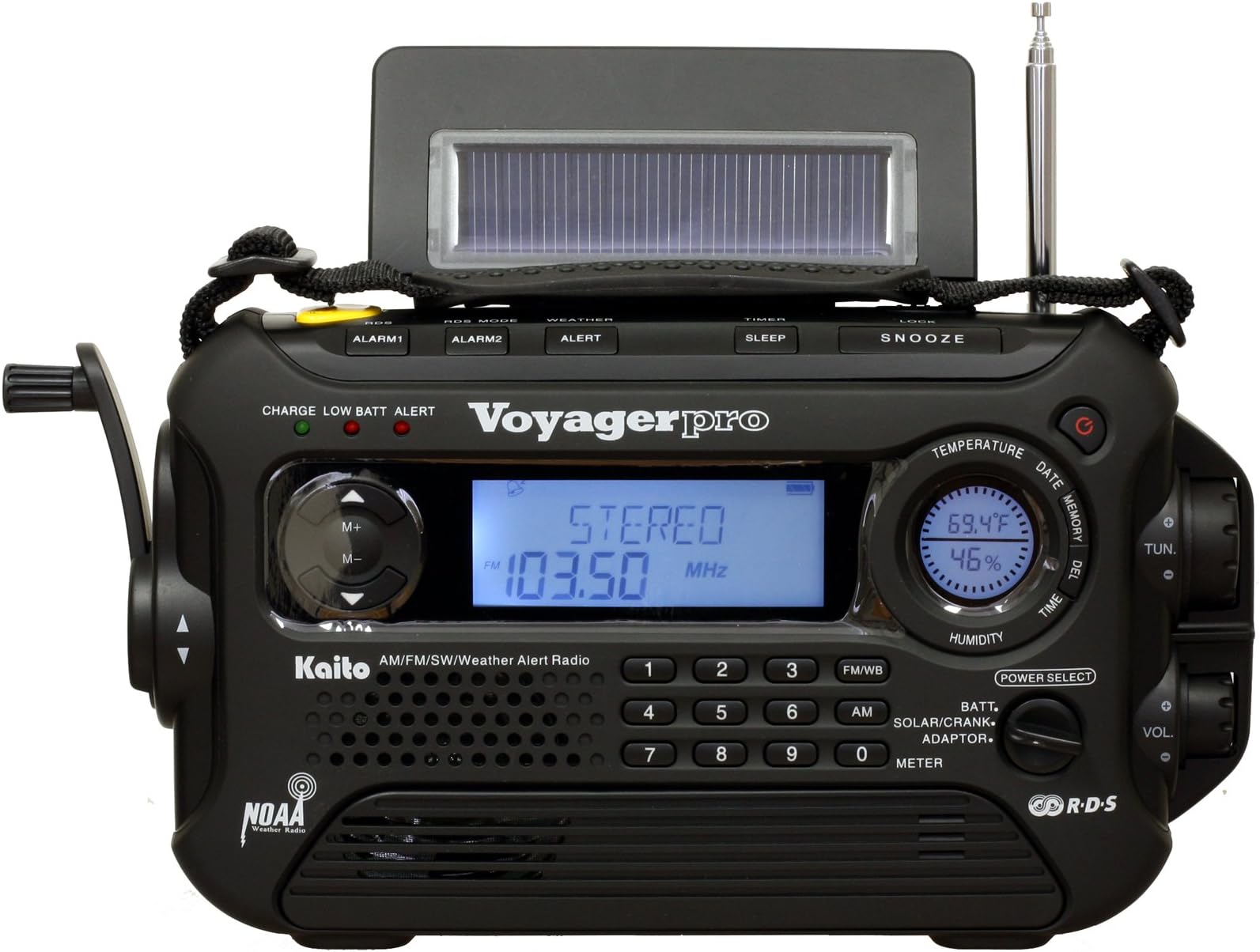
The Kaito Voyager Pro KA600 is a rugged, feature-packed emergency radio combining AM/FM/LW/SW bands with NOAA weather alerts, a 180° adjustable solar panel, and multiple power options including a 600mAh NiMH rechargeable battery, hand crank, USB, and AA batteries. It offers 335 station memories, a backlit digital display, dual alarms, thermometer, humidity meter, and integrated LED reading lamp plus flashlight. Designed for off-grid survival, camping, and emergency preparedness, it also doubles as a USB smartphone charger, ensuring you stay informed and powered no matter the situation.


| ASIN | B0051QJJ1E |
| Additional Features | Adjustable, Alarm, Built-In Flashlight |
| Best Sellers Rank | #131,612 in Electronics ( See Top 100 in Electronics ) #219 in Weather Radios |
| Brand | Kaito |
| Color | Black |
| Compatible Devices | Smartphone |
| Connectivity Technology | USB |
| Customer Reviews | 4.1 out of 5 stars 738 Reviews |
| Display Type | LCD |
| Enclosure Material | Plastic |
| Frequency | 108 MHz |
| Global Trade Identification Number | 06927674206009 |
| Hardware Interface | 3.5mm Audio |
| Item Dimensions L x W x H | 9.75"L x 3"W x 5.5"H |
| Item Weight | 1.25 Pounds |
| Manufacturer | Hisonic International, Inc. |
| Mfr Part Number | KA600 |
| Model Number | KA600 |
| Number of Batteries | 1 Product Specific batteries required. (included) |
| Power Source | Solar Powered |
| Product Dimensions | 9.75"L x 3"W x 5.5"H |
| Radio Bands Supported | AM, FM, Weather |
| Special Feature | Adjustable, Alarm, Built-In Flashlight |
| Style Name | Rugged Outdoor |
| Tuner Technology | AM/FM |
| Tuner Type | AM/FM |
| Unit Count | 1.0 Count |
| Warranty Description | 1-year manufacturer's warranty, labor and parts. |
W**G
Great Features For The Money !!!!!
First of all, I reviewed quite a few similar products before making the final decision. PROS: Seems to be well made, but probably not for rugged use. Some degree of care is required. Station reception is very good, but I do live in the suburbs of a major U.S. city. Harmonic AM hum can be eliminated by tilting out the solar panel part way as a stand, and lying horizontal. FM very clear. SW is adequate, better with a clip on Sangean antenna (ANT 60). I did not expect the capability of my Sangean ATA 818. Multiple power options. Crank works well, not flimsy. Solar charge will power radio by maintaining an existing charge level. Optional AC adapter charges unit fairly quickly. AC adapter can overcharge if left connected for long periods of time, and can shorten battery life. Since I am an electronics geek, at some time I will swap out the 600 Mah internal battery for a larger capacity. An AC charge of 4-5 hours is adequate. My intent was for a lightweight jobsite radio that doesn't chew up batteries, and also will serve for emergency use in off grid situations. I have been using as such for about 10 days, without any hiccups. It runs for about 7 - 8 hours a day. I loaded it with 3 Sanyo Eneloops, which I have hardly used, and are the backup power. The flashlight & "reading lamp" are bonuses in my view, but you never know when they may come in handy. Backlight display is very good. Digital tuner is superior to analog any day. Scan function is a big plus, especially on SW I receive 5 out of the 7 NOAA weather stations in my area, all crystal clear. I have not had the need to use the auto warn feature as of yet. VOLUME is more than adequate. CONS: Tuner knob is very sensitive. The overall compact design puts my big hands in contact with some of the knobs & buttons inadvertently, causing changes. I'm still getting used to using the lockout button AFTER setting to a station. WISH LIST: Add a crossover circuit to charge the 3 main batteries as well (AC & solar only) Add S.A.M.E. capability for weather and other emergency alerts Use a larger capacity rechargeable battery on solar / crank / AC circuit. A 1200 Mah would run this sucker for about 10 - 12 hours, but would require more or extended re-charge. ( A lot more cranking ) BOTTOM LINE: I WAS NOT DISAPPOINTED IN THE LEAST, and will purchase a few more as gifts for family.
R**S
Light and versatile emergency radio
The Kaito KA-600 is a lightweight, sturdy AM/FM, SW, NOAA Weather emergency radio. I bought this one because I wanted a radio that could be charged when there is no electricity available. I live in an area that has frequent winter power outages. As it happens, the power went out this morning at 4:30 am when I was getting up for work. The KA-600 flashlight helped me find my way through my apartment in the dark, while giving me the latest news as well. It was running on the included rechargeable battery pack that I had charged via the mini-USB port the day before. So in its first (minor) grid-down situation, it did the job well. It also takes 3 AA batteries for yet another way to power up. The hand crank will charge the battery pack in about 2 minutes, though I haven't put this to extensive use yet. I've only tried to charge it from fully drained to full using the solar charger once. It was a cloudy day and the battery did not get charged after sitting in front of a window all day. So solar charging in the Pacific Northwest may be wishful thinking. I do like that you can charge it via the built in mini-USB port. It's not necessary to purchase the separate AC/DC adapter to quickly get the battery pack fully juiced. I just used one of my many cell phone AC/DC charge blocks and it worked fine. Just remember to unplug the radio when it's charged up. The speaker is small, but provides clear sound. There is no tone adjustment available, so you can't boost the bass or treble. This is not a great music fidelity radio, but that's not its mission. It's more utilitarian. You can get information easily when you need it and the power grid is down or you are out camping. I easily programmed my fave AM and FM stations into the memory, though I did need to use the manual to figure it out at first. NOAA weather came in loud and clear too. I have not tried to pull in any shortwave or longwave yet as this receiver will need an extended wire antenna to do that. I'm looking forward to checking its capabilities on that score soon. Another thing I love is the temperature and humidity read-out. Along with the time and date display, this radio keeps you fully informed about the world down to the smallest detail. If you want, you can even program a wake-up alarm to get you up in the morning. I'm a licensed Amateur Radio Tech (Ham) and I love radios. I grew up with tiny AM transistor radios and mobile and base station CB radios back in the day too. This KA-600 is a radio nerd's dream. It's small and light enough to throw in your go-bag or just keep on your kitchen counter and it will do well when the power goes out.
F**R
I Dig It!
I have had this radio a few weeks now - but haven't tried charging the battery via solar yet. So I will tell you about the stuff I know about.... I DID notice that there was a warning in the manual NOT to leave the radio in direct sunlight for too long - which is funny given the product being discussed. It's a decent radio - sounds good for a single speaker ditty. I mean - It's no BOSE, but it delivers the weather like you want it; clean and clear. Here's why it gets 4 stars: The case is really well built and feels solid - not like a cheap toy. The radio gets good reception on local stations and the weather stations. I like the scanning feature for the SW a lot. It saves a lot of time. The extra stuff like the thermostat and lights actually work well and the RDS display is nice. The flashlight is bright enough to really annoy my wife while she is seriously playing her MMORPG. The radio has a groovy handle on it you will never use but it looks James Bond cool just the same. They sent some earbuds I wasn't expecting and I appreciate that. The instructions are well written and in plain English. Here's why it don't get 5 stars: I think if you were stupid and didn't know your own strength - you would break the generator crank off pretty easily. It's not built too tough so don't let the kids crank it. The radio tuning knob on my radio has loosey goosey give in it for half a turn and then tightens up. This doesn't affect the digital tuning any but it's weird and I don't like it. PLUS - there's no fine tuning adjustment and that's bad. You get the staticky stations you get and that's it. I bought the 20' antenna extension. I think it helps but I didn't do much comparison testing. That said - I'm not pulling in as many SW signals as I had dreamt of getting when I bought this product. There is a LOT of dead air and I think a better SW radio would find more talkers. But I'm guessing. And also - many people in the world don't have the common courtesy to speak english and this radio doesn't translate. ha ha. Also - this radio doesn't do SAME channels and specific alerts for the weather. So that kinda sucks. But in all fairness - they didn't claim it does and I didn't expect it did. Anyway - I like this thing a lot and would buy another for a backup in case some idiot broke my generator handle off during the apocalypse. I think I will save up my coin and buy the more expensive Grundig with the SW fine tuning knob. Because I want to hear people speak in languages I don't understand - more clearly. I did not drop it to see how durable the case is. For that review you will have to find the same person who broke their dyno handle. CHOW!
D**Z
Excellent Emergency Radio for the Price
Overview: (Short Version) This radio earned a 5-stars rating for the reason that I have used and tested this radio for several months now and find the performance and features of this radio to meet and often exceed my expectations for an emergency / camping radio. (Long Version) For those who want a lot more information about this radio, below is a very long detailed review. If you are interested in this radio, this should be an informative review. Amazon displays only the first half of the review and to see it all you need to click on the blue "read more >" link at the bottom of the text. I tried to include information not previously mentioned in other reviews or available in the Amazon description. Included, is general information for improving the use of this or any radio's performance. This review is not too technical (this review is aimed mostly at the beginning user), but radios are technical instruments and will need a very slight technical understanding to achieve maximum performance. Blue highlighted texts are links that you may click on to see the additional products on Amazon referred to in the review. None of these other Amazon accessory products are necessary to use the radio, but may be useful to get more performance from this radio or any radio for that matter and are included only as helpful guides. Purpose: This radio was purchased primarily to be an emergency grid-down (power failure) or off-grid (camping) radio. Some folks may not fully realize how important a source of reliable communications and lighting are in an emergency, until they do not have them. The radio is loaded with features that will be very useful when faced with a grid-down or off-grid situation. The radio is not the ultimate in shortwave portables on the market, but is does a great job pulling in the lots of shortwave broadcasts with a good antenna. It meets its intended purpose by giving the user plenty of emergency lighting and ability to hear important local, regional and international information when needed. Emergencies have a nasty habit of not announcing their occurrence in advance. This radio fills the niche of a "go to radio/light" when the lights go out or really bad weather is on the way. If things are getting really primitive, whether grid-down or off-grid, then you will be grateful for the intelligently integrated features of this radio. This radio has become my first choice for a dependable portable emergency radio. Construction: The radio is well made, light and durable enough to take in a backpack. Loaded with 3 alkaline AA cells the radio weighs 23.4 oz. (600 grams), reasonable weight for all the features. The case of the radio is made of a good grade plastic that appears very durable. The radio has nice rounded corners and hinges, buttons and pieces fit very tight. The construction is first class, unlike a lot of other poor quality "emergency" radios also on the market. Battery Power Sources: The radio has two sources of power from batteries, a built-in NiMH battery (supplied) and provisions for AA alkaline batteries. The radio comes supplied with an internal 600 maH NiMH (nickel metal hydride) rechargeable battery. The battery compartment uses 3 replaceable AA alkaline batteries, available in just about any store (Duracell, Energizer, etc.). Batteries are one of the first things to disappear from a store in an emergency, it is wise to have plenty in the house now. Internal NIMH Rechargeable Battery: The radio never really shuts off, because it displays the date, time, temperature and humidity all the time, which is a nice feature. The power for these features comes from the internal rechargeable 600 milliamp-hour NiMH battery. The NiMH batteries can power all the features of the radio and lights. The NiMH rechargeable battery is a very common type used in cordless home telephone handsets (about $10 at big box stores), so when it wears out in 5-10 years, a low cost replacement is readily available and easy to access through the battery compartment. Kaitousa sells a replacement NiMH battery for $9.95. The radio has a nice display that shows when the NiMH battery is charging, it scrolls left to right during charging and when charged, all bars show and scrolling stops. The display also gives a rough indication of the charge remaining in the battery. If you deplete the NiMH charge, you still have a backup power source of the alkaline AA batteries (or rechargeable Eneloops Sanyo NEW 1500 eneloop 8 Pack AA Ni-MH Pre-Charged Rechargeable Batteries ) to power the radio. The radio protects the NiMH batteries by shutting down early and a Low Batt light blinks until the NiMH batteries are recharged. This saves the stored memory from being erased and prevents the NiMH from complete discharge, which may reduce the life of the batteries. When new in the box the radio has the NiMH batteries disconnected and you will need to plug them in prior to use. Modern NiMH (Nickel-Metal-Hydride) batteries are great compared to the older Ni-Cad rechargeable batteries. They last much longer (Sanyo Eneloop rates their newest NiMH AA batteries at 1500 charge-discharge cycles). They can replace an alkaline battery in virtually every way, except initial cost, but over the long term are much cheaper than alkaline batteries. My personal experience with Eneloops is that they require between 90 - 100 maH of charge every month topping them off to 1.45 volts with a Powerex charger ( Maha Powerex Wizard One MH-C9000 Advanced Battery Charger and Analyzer - Free Deluxe Accessory Storage Case Included ). This is a first class charger that can also be powered directly from 12 volts in an emergency with a coaxial plug adapter. As a bonus the Powerex charger's padded case fits the KA-600 perfectly. Power Consumption of Various Features: The question is "How long will the NiMH internal batteries or the AA Alkaline batteries last?", since this radio is for emergency and off-grid use. The chart below assumes 600 maH (milliamp-hour) capacity for the NiMH batteries and 2000 maH capacity for the AA Alkaline or rechargeables (numbers in parenthesis are actual measurements made on my radio in milliamps (ma): Estimated Life with 600 maH NiMH batteries: Backlight Only---------(6 ma): 100 hours Radio Low Volume----(28 ma): 21 hours Radio High Volume---(35 ma): 17 hours Weather Alert On-----(26 ma): 23 hours Flashlight-------------(25 ma): 24 hours Reading Light---------(28 ma): 21 hours Estimated Life with 2000 maH Alkaline batteries: Backlight Only---------(6 ma): 333 hours Radio Low Volume----(28 ma): 71 hours Radio High Volume---(35 ma): 57 hours Weather Alert On-----(26 ma): 77 hours Flashlight-------------(25 ma): 80 hours Reading Light---------(28 ma): 71 hours For these measurements on radio power consumption "Low Volume" was the minimum to hear the radio clearly when it is a few feet away. "High Volume" was the volume control turned about 50% of the way up, plenty of volume for a room or outdoors. If you are using more than one feature at a time, such as the radio and the flashlight, then the times will be significantly shorter (about half, 11 hours using NiMH and 38 hours using Alkaline cells). An unusual item discovered during power consumption testing is the Weather Alert feature draws almost as much power as using the Radio Low Volume function. So be aware that the radio consumes the batteries (as if it were turned on, approximately 77 hours, a little over 3 days continuous time on the AA batteries) in the silent Weather Alert mode. This will at least give us a close estimate of how long we can depend on the radio to function under various modes. Always having lots of extra AA batteries is a very good idea. It simplifies keeping the lights and radio playing, without the need to use solar or the crank. You can even use the reading light to light the battery compartment while changing the AA batteries. When a power source is depleted or unavailable the radio will tell you to "Select Power", meaning the power source is not available when the source is selected with the 3 position power switch. Multiple Charging Methods: This is where this radio really shines, the ability to use multiple methods to keep the radio operating. The radio's recharging circuits are for the 600 ma NiMH battery only. A USB adapter cable like ( Philips SWR1249/17 Retractable USB 2.0 Adapter Kit ) or the 6V wall plug charger (not supplied, Kaito Electronics Inc. AD500 AC Adapter for Kaito Voyager KA500 series Radios ) work quickly to charge the radio. There is a 12 volt cigarette lighter adapter (CLA) with 2 USB and 2 CLA ports available on Amazon made by Bestek, which will allow mobile charging from a 12 volt source via USB ( BESTEK car cigarette lighter socket usb socket car charger Cigarette Lighter adapter dc to dc adapter for car charger adapter usb car charger socket car adapter socket car socket splitter car splitter adapter 3 way plug socket usb socket outlet three wa... ). Mobile Charging: The above Bestek USB CLA (or similar) adapter gives the mobile user more options for power. It also allows a user to utilize the car's battery as another way to recharge the 600 maH NiMH battery. Since we would only draw a maximum of 600 maH from the car battery (less than 1% of the car battery's capacity), there is no need to start the car to top off the car battery. It should take around 1 hour to top off the NiMH batteries from a car battery. If you hook direct to the car battery (using alligator clip jumpers, etc.) on a CLA plug the tip is positive (+) and the side is negative (-) which is vehicle ground (chassis). There are low cost direct battery to CLA adapters available (such as, Roadpro 12V Battery Clip-On and Cigarette Lighter Adapter ). In a pinch, you can tap a vehicle's 12 volt battery without having access to the vehicle keys or hood release. Simply locate the starter motor and find the very heavy cable connected (+) to the starter (solenoid) and clip to it and find a piece of clean metal on the chassis (-) for the other lead. Hand Crank Charging: The hand crank is effective for charging the NiMH or charging a USB powered device like a cell phone (not all cell phones will charge from the crank, such as the iPhone, according to other reviews). Charging is fairly fast with hand crank and the radio was topped off from the factory after about 2 minutes (I assume the battery was in a partially charged state from the factory). There is a small switch in the back of the radio for charging "In" or "Out", to charge your phone with the crank make sure the switch is in the "Out" position. The radio uses a single Mini-B USB connector for power in or out. The crank generator is the only method with sufficient power to charge external USB power devices like a phone, GPS, camera, etc. I agree with other reviewer's assessments that the crank handle could be overstressed if really mishandled. The crank in operation should be carefully and smoothly used and no problems should result. The crank does not look poorly designed, but one user did have it break off. It is recommended the cranking speed be around 2 turns per second. The crank seems robust enough to handle normal use. I would try to keep the crank handle inside the crank slot while turning to avoid overstressing the hinge (gently pushing down while turning). This radio conveniently locates the handle on the side out of the way, tucked in almost flush to the case. I feel the hand crank is the last resort power supply if the NiMH and AA batteries are depleted and there is no sun available. Solar Charging: The solar cell charging works very well, although probably the slowest of charging methods (12 individual solar cells). There is some concern about leaving the radio in bright hot sun. On a similar radio (Kaito KA-500 Voyager, a much less capable predecessor to the KA-600). I would wrap the radio in a white plastic grocery bag for all except the solar panel. This shielded the remainder of the radio from the Arizona sun and heat effects on the black plastic. I have seen no degradation of the plastic or the solar panel over the last year (solar is my preferred method of maintaining NiMH charge). Even in light cloudy conditions (bright, but no shadows cast) the Charge light illuminated, and the radio display showed power going to the NiMH battery. I typically leave the similar KA-500 radio in a window (wrapped in plastic bag) which received early morning sun for a few hours a day and that keeps the NiMH fully charged and the radio ready to go. The charging circuits on the KA-600 are virtually identical to the older KA-500. USB / AC Wall Plug Charging: This the fastest way to recharge the internal NiMH batteries. An hour or so is all that is required, depending on the discharge level of the batteries. The radio can be operated normally during this time and will save the charge on the batteries for a later time. A word of caution from the manufacturer about charging. Kaito recommends that you do not leave a USB (approx. 5 volts) or a DC wall charger (as much as 6.6 volts) plugged in more than 3 hours after full charge is reached unless the radio is in use. The charging circuit does not automatically cut off the charge current when the NiMH batteries reach full charge (I use 1.45 volts as max charge voltage per cell). It is therefore possible to overcharge (approx. 4.5 volts max.) the 3 NiMH batteries and cause the service life to be reduced. I would think the lower voltage USB at 5 volts would be less harmful than the wall adapter if accidently left plugged in. If you plan to leave the Weather Alert feature on all the time, I would suggest using a USB charging source. Radio Performance Shortwave and Miscellaneous: The shortwave bands are not what they use to be decades ago. I have been an avid shortwave listener since the 1960s. There are less shortwave stations available to listen to anymore, some moving to the Internet, shortening their broadcast times, etc. This radio receives AM shortwave in 5 KHz increments, which is perfectly fine for 99%+ of the international shortwave stations. It would be nice to have a 1 KHz or finer tuning, but 5 KHz works just fine. With 5 KHz tuning you do not spend a lot of time tuning between "channels" and go direct to the stations, much quicker. There are two methods available to change the frequency, the tuning dial on the side or direct frequency entry through the keypad. The radio has plenty of memories to store favorite radio frequencies on AM/FM and Shortwave. The numbers of stored frequency memories available are: LW (10), AM (25), SW (100) and FM (100). Shortwave reception depends on the time of day, radio propagation and yes, even the sunspots. Just because a shortwave station is broadcasting at a given time, your ability to receive it will vary. Signal fading is common and a lot of the stations broadcast on multiple frequencies, so you can find the one that works best. Broadcasters will often "beam" a radio signal to a particular part of the globe rather than sending out an omnidirectional signal. Shortwave Antennas: The antenna is critical in shortwave listening and the collapsible antenna on the radio is nowhere near enough. Do not expect to hear anything on shortwave with the 14 inch collapsible antenna, except the most powerful stations. Without a decent antenna any radio is not going to perform very well and that applies to this radio as it would to a $2000 radio. A long wire antenna of 25 to 75 feet and as high as possible connected to the collapsible antenna makes all the difference. I have heard many shortwave broadcasts with an indoor long antenna on this radio. A retractable reel antenna (such as, Sangean ANT-60 Short Wave Antenna ) would be great for indoor or portable use, clips right on the retracted collapsible antenna. The Sangean antenna is a small, lightweight and easily portable package that works very well (about the size of small shoe polish can). A lot of other things can also serve as a temporary antenna with some success (make sure you have a clean metal connection), such as metal rain gutters, guard rails, barb wire fences, extension cords, metal air conditioning ducts, metal chimney pipes, metal clothes lines, etc. I would recommend the use of alligator clip jumpers wires to take quick temporary connections ( SE Clip Test Lead Set (10 Piece) or even chain the jumpers together to make a quick antenna. You can hang an "invisible antenna" of 28 gauge magnet wire out a window or off a balcony with a fishing weight attached at the bottom. There is plenty of information available on the Internet for shortwave antennas. Shortwave Broadcast Schedules: Here is a great website (primetimeshortwave) for a list of shortwave broadcasts (like a TV Guide for shortwave broadcasts). I highly recommend the (primetimeshortwave) website to enhance your shortwave listening, it gives you the time and frequency and whether it is beamed to your location, as well as the language of the broadcast. The times displayed on the website are UTC (Universal Time Coordinated, current time in London, England) and to convert Local Time to UTC: EST (add 5 hours), CST (add 6 hours), MST (add 7 hours) and PST (add 8 hours). Here is an example, 1400 MST (2 P.M.) is 2100 UTC (1400 + 7 hours = 2100 UTC). Daylight Savings time takes one hour away from the equation: EDT (add 4 hours), CDT (add 5 hours), MDT (add 6 hours) and PDT (add 7 hours). To go from UTC to Local Time just subtract instead of add, easy after you have done it a few times. There are also websites that will also give you the current UTC time. Other Shortwave Comments: The radio does not receive Single Side Band (SSB) type transmissions from ham radio operators, etc. This would be a nice addition, but at 5 KHz tuning steps and lack of a SSB detector makes it all but impossible. The ability to receive ham radio transmissions could be beneficial in an emergency. You will need a different, more expensive radio to listen to the ham operators (such as, ICF-SW7600GR Digital World Band Radio Tuner , but these radios lack the emergency features of the KA-600). During hurricanes TV stations would relay information gathered from monitoring emergency ham radio operators, rather than their sacrificial cub reporters sent out in 100 mph winds. Radio Performance AM / FM: The performance of the AM and FM features are typical of any radio of this size. With the built in internal AM loop and collapsible whip antennas the radio will work fine with local AM and FM stations. By using enhanced antennas (AM tuned loop, like the less than 1 foot diameter Terk Advantage ( Terk Advantage Indoor AM Radio Loop Antenna ) this radio is capable of pulling in stations from a long way off on AM at night. The tuned loop will improve daytime signals significantly as well, but the range is reduced due to shorter daytime radio propagation (atmospheric conditions) compared to longer night time propagation. The ability to hear radio stations several hundred miles away (at night) is very beneficial. Local radio stations may be "off the air" due to a power failure or weather conditions. If you really want to maximize AM distance performance, look into a 4 foot box loop antenna (mine pulls in strong stations up to 1000 miles away at night, not too expensive to build out of PVC pipe and about 100 feet of wire). These antennas do not need a direct connection to the radio. Placing the radio very close to the loop is all that is needed (inductive coupling). The tuned loop antennas also have the ability to null out an undesired station on the same frequency by rotating the loop. Resolving FM Reception Issues: Some reviewers commented that they felt the radio on FM was weak. I have not observed any issue with the radio's sensitivity and would rate the radio's FM sensitivity as good. The 14 inch collapsible antenna is marginally suitable (not ideal, it is too short and wrong polarization) for weaker FM signals. Those of us who remember the use of "rabbit ears" for TV reception may understand how sensitive a FM receiver is to antenna location and rotation inside the house. Just like old TV signals, FM radio is horizontally polarized and the collapsible antenna on the KA-600 is fixed vertical when sitting on its base (an antenna that swivels horizontally would help). Try these two tests to see if you can receive the FM station you want: 1) Take the radio outside and find a spot several feet away from any metal, car, overhead wires, rain gutters, metal fences, etc. If you now hear well the desired FM station, then something inside or the house itself is absorbing a lot of the FM signal. 2) Rotate the radio and antenna horizontal and turn around slowly and see if there is a direction the antenna is pointed that improves the signal. Signal should be strongest when the horizontal antenna is "broadside" to the station. If you get a great signal under test 1) then try to walk around inside the house and see if there are hotspots (near a window in the direction of a station, etc.) where the radio receives a strong signal. This technique is not unlike trying to optimize a poor cell phone signal. There is no indication of signal strength on the radio, so you need to listen carefully for a quieting of the static background on the FM signal. If you get a great signal under Test 2), but not Test 1) then the collapsible antenna being vertical or too short is likely the problem. Try going inside the house and attaching a 3 or 4 foot horizontal wire to the collapsed antenna. Orient the wire in the direction that worked best outside, this may improve the FM signal captured by the radio. If you cannot hear the FM station under Tests 1) and 2) outside, then it is very unlikely you will be successful inside the house. Things in the house that adversely affect the FM signal are: metal window screens, aluminum siding, metal roof, foil backed wall insulation, chicken wire stucco, steel frame construction, large metal objects inside in line with radio station (like a mirror, refrigerator), etc. Nearby computers, televisions, and fluorescent lights can also interfere with the radio's ability to hear a weak signal by generating radio noise. Hope this helps, trial and error seems to be the best method to resolve any FM reception issue. It typically is not the radio, but the location and orientation / length of the antenna that is the culprit. Radio Performance Weather Band: The Weather band is a real plus for this radio, you can receive 24 hour a day regional weather forecasts. Most Weather radio stations also have emergency power available to keep them on the air in a power outage, so you can count on them in a dangerous weather situation. The radio has an Alert feature that silences the radio unless severe weather is forecast, like a tornado, flood, hurricane, etc. The radio will turn the speakers on and relay the severe weather message through the speaker (it still is drawing power from the batteries in the Alert mode). The radio speaker will remain on if a Weather Alert was issued (must be manually shut off). The Weather Alert tone is transmitted once a week as a test and will trip the Alert feature and leave the radio broadcasting weather information with no severe weather in the forecast. The Weather Alert signal is not tested if there is severe weather in the forecast. The Weather Alert feature alone is well worth having in an emergency radio. During a recent test of the nationwide emergency broadcast, I discovered the Weather Alert feature is also activated. So if there is something serious going on that the President or DHS (Dept. of Homeland Security) feels a national alert needs to be issued, you are ensured of hearing it through this radio's Alert feature. The weather radio alert system also works with other Federal, State, Local Emergency Managers and other public officials to broadcast information on non-weather related emergencies and warnings (such as, chemical spills, earthquake, flood, tsunami, evacuation, etc.). It is basically a one-stop emergency or warning alert system when needed, but is primarily used to issue routine weather reports and forecasts 24 hours a day. Emergency Lighting: The reading light is 5 LEDs located under the solar panel and pivots 180 degrees to direct light to where it is needed. The reading light relies on friction to maintain the angle of the light (or solar panel). The reading light is limited in range, but does offer an area type light for a room. An issue pointed out by another reviewer stated that the reading light was easy to turn on and not notice. This is absolutely true; the slide switch is under the handle and needs just a slight bump to turn it on. It is impossible to see the retracted reading light (flush with the back case) in any room light and even in the dark you need to get the angle just right to notice the faint glow from the very bottom. This is another way to accidently drain the batteries. The flashlight located on the side is quite good. I went for a walk with this radio on a moonless night and the flashlight worked well, more than adequate for emergency lighting, camping, etc. It is not going to replace a dedicated flashlight, but in a pinch will work great. Power consumption on these light sources is relatively low and could be utilized instead of a dedicated flashlight to conserve the flashlight's batteries for more demanding uses. A piece of red cellophane or similar could be placed over the flashlight or reading light lens to protect night vision, if needed. Yellow cellophane might also work to stop bugs from being attracted to the light if you are outdoors. A feature that is greatly appreciated is the built in dial light. The dial light is activated any time a button is pushed on the radio. The light automatically turns off after about 15 seconds (there is no other way to turn it on other than hitting a button). The backlight draws so little power (6 ma.) for a short period of time that it is not a significant battery power consumer. Without the automatic dial light there is no way to read the LCD dial in the dark with the built in flashlight or reading light. The numerical keypad for frequency entry does not light up and can be a challenge in darkness if their location has not been memorized. The dial light feature is disabled when using the Key Lock feature (see below). Speaker: The built-in speaker (around 2.6 inches, 66 mm) is more than adequate and better suited for voice than music, it tends to drop the lower bass frequencies. The speaker provides very clear audio when listening to people speaking. Using a good set of headphones the audio is great, full fidelity. The radio also has great audio when played through a nice set of external computer speakers, just plug them into the earphone jack. I was surprised how great the radio sounded through a pair of amplified computer speakers. Weatherproofing: The radio is definitely not waterproof and may not even be weather resistant. However, the radio looks like it may have limited resistance to vertical rain for a short period of time if it is accidently caught in a rain storm. There are major openings for the speaker starting about one half inch from the bottom of the radio. There is a very fine mesh screen on openings which look like it could repel rain water splashes (or at least bugs) from getting into the radio. The buttons on the top of the radio fit very tightly and look like they will resist the seepage of water to the inside of the radio from a rain storm. I would suggest the radio be put into a clear freezer bag, grocery store produce bag or similar if there is a chance of the radio being out in the rain. The controls should be able to be manipulated through the plastic bag. The sealed plastic bag will also help in areas prone to salty air; switches and electronics do not perform well in salty environments over time. Key Lock Feature: The outside of the front and top of the radio are covered with buttons. It is very easy to turn on Weather Alert or the Alarm features and not realize you accidently hit the button. The radio has a Key Lock feature which disables all the radio keys and displays a key symbol on the top of the LCD screen (operated through the Snooze button). The only keys that work are the flashlight and reading light. It is easy to accidently turn something on or off just by just picking the radio up or placing or handling it in a snug padded case. I completely drained a set of alkaline batteries by accidently activating the Weather Alert feature while putting it in a case. The Key Lock is a nicely engineered feature; you will appreciate the Key Lock after you have had the radio for a while. The Key Lock feature may also be accidently activated by hitting the Snooze button for a few seconds. Once you have done this the radio will not operate and nothing you do will turn the radio on, until you hit the Snooze button again to turn the Key Lock off. The word "Lock" is written above the Snooze button, but it may not be obvious to a new user what this feature does. This may unnecessarily frustrate a few new users, but it is a great feature once you are familiar with it. Thermometer: The built in thermometer is accurate, but has one small drawback. It is very slow to report the correct temperature. Apparently, it measures the temperature inside the radio case and can take up to 1 hour to read the real ambient temperature accurately when the radio is taken from a warm area to a cold area or the other way around. An example, if you leave the radio to solar charge in a window it will show 10 - 15 degrees higher than the room temperature and when removed it takes close to an hour to show the actual room temperature. The thermometer can be changed between Fahrenheit and Celsius scales (the switch is located in the battery compartment next to the NiMH battery pack and is changed with a small pointed object). User Manual: It is important to read the entire user manual, the radio is loaded with features that need a little explanation to properly understand and use. The operator controls are rather simple to use and you will not need to keep referring to the manual to figure out how to do something once you become familiar with all the features. The user manual is well done and is useful to explain all the features of the radio. There are lots of pictures and good explanations to go with the pictures. It is best to sit down with the manual and the radio and become familiar with all the features. The user's manual is available free on the Internet (reading it will help in understanding all the radio's features before you purchase). There are a few websites that offer a .pdf user manual version online (using internet search engine terms like: "kaito 600 user manual" will get you right to one at kaitousa, it is large, 31 MB). Alarm Clocks, Snooze and Sleep Timer: Other features that are very useful are 2 alarm clocks with a snooze feature. In addition, there is a sleep timer (up to 90 minutes) so you can listen to the radio at night and then it will automatically shut off after an adjustable period of minutes. Conclusion: In conclusion, I am quite impressed with the quality and performance of this radio for the price. There is a whole lot of radio here for the money. Many other radios in this price class are much less suitable. I researched this radio and similar radios very carefully before purchasing and I am delighted with the features, construction and performance of this radio having been able to use it for many months. Should something catastrophic happen to the radio (lost, damaged, etc.), I would replace it immediately. The engineering Kaito used to design this radio is first class; this radio meets all my expectations for an emergency and off-grid radio. I rate this radio an easy 5 stars for the purpose intended, there are way too many great things about this radio to give it anything less. Hopefully, you found this review helpful. Have a Great Day!
J**N
Kaito KA600
Amazon estimated delivery on Wednesday, it arrived Tuesday. (Can't give them credit for it, it was the USPS's good performance in this case.) It's a very attractive little unit, nice handy size and features but doesn't appear particularly robust, so don't knock it around and it will probably last you a long time. The "whip" antenna extends but doesn't tilt or swivel, a throwback to old old portable radios and a disappointment; this would make it a lot easier to break off. also, it's very short, which results in poorer performance on FM, WB, and Short Wave. (However, on FM, if you have a number of FM stations in your area, it may be better to NOT extend the antenna, as that can result in "splatter" type interference overloading the radio's "front end", and making reception of desired FM stations more difficult; try it with the antenna telescoped in first. On Short Wave, the performance is mediocre - I'd say one step better than poor, but one step below good. Since the bult-in "whip"antenna is short anyway, I would suggest that you go down to your local radio shack store, or anyplace else that sells such items, and get an alligator clip (you may have to buy a pack of several of them, but they're cheap) and a roll of 22 gauge (or similar) hookup wire, and make your own external Short Wave antenna; extend the wire to be as long as is possible in the area in which you'll be using the radio, and clip it to the top of the whip antenna (not extended, so as to make it harder to break it off) and experiment with the best position and length of it for best reception. (Clip or otherwise secure the other end to something that will keep it in place; curtain rods, etc. If you're in a building with a lot of metal in its structure, try to rig it up with as much antenna as possible outside the building, but being careful not to let it contact outside power lines!) I tried it out by comparing it to a few other Shortwave receivers I have, and was not very favorably impressed. My experience with several other "winder-upper" type radios is that it takes an awful lot of cranking to get much operating time out of them, and a person would be better off to stock up on AA cells at a good low-price outlet store and rotate them before the expiration date so as to have enough fresh ones on hand; they're not all that expensive or heavy or big! As for the radio's performance - I'd call it good, but not outstanding. All in all, probably worth the price, but just barely. After a couple of months, I'm amending this review. This little radio is just about completely useless on all the shortwave bands. Considering the price, I wouldn't repeat the mistake of buying another Kaito radio. It works OK on the AM, weather, and FM bands but it's NOT worth the price charged - at half that price it would be questionable. Kaito is not a brand I will buy again. ADDENDUM 11/30/2013: I downgraded this item to 2 Stars, but now I'm going to downgrade it to one star. I was using it to listen to a local FM station, which any cheap radio ought to do well enough. Now it's developed a "cracking noise that is almost as loud as the station you're listening to. MY ADVICE: Do yourself a favor and NEVER buy anything with the name "Kaito" on it!
E**N
Not bad, could be better...
Overall, I'd rate it a 3.5/5.0 with 5 being the highest. Nice features, but I question some of the design... It has an odd combination of switches, knobs, and buttons. With the keypad on front for direct tuning, you don't really need a tuning knob. The buttons can be disabled with the key-lock button, but that doesn't kill the flashlight button, WHICH IS MY BIGGEST GRIPE WITH THIS UNIT!!! All of the other buttons are a momentary-press type and are disabled with the key-lock. HOWEVER.... the flashlight button (the bright yellow one on the left) is NOT disabled by the key-lock. Even worse, it is a push-type that is easily depressed and stays depressed until you push it again to switch it off. So, if you shove it in a bag or a go-box, chances are high that you can easily activate the flashlight without knowing it and drain the batteries D-E-A-D. I guess it is a good thing that it comes with a solar panel and crank to charge the batteries!!! Other than that, no other real problems. I can't really pick up any SW, but I live/work in a concrete tube, so whatever. AM is OK, FM/Weather no problems. The reading light is fine. The AUX-in jack works great, it was kinda funny hooking up a Zune through the line-in and blasting AC/DC's "Back in Black". It recharges the built-in battery using a mini-USB just fine. The crank works OK too, don't know how long it take to build up a charge, I haven't read the manual yet. I picked it up for my Mom, who is about seven hours away and recently went through a five-day spell with no power due to windstorms. Roads were blocked, she hadn't charged her cell phone, and her cordless phones were TU due to no power at the base station. The land-line I gave her was still sitting in the box when I finally got there. She won't be able to run a generator or a solar hookup, so I figured this will keep her informed, with a little light to read, and able to charge her cell phone. It is a nice unit overall so I'll keep it for myself, but I'll probably get her either the Ambient Weather WR-111 or the Etón FR160R (Red) . She probably isn't going to be listening to SW that much anyways...
F**Z
Kaito Voyager Pro KA600 used it overseas
In short words this radio is really cool, just as promise a great radio in case of an emergency, many reviewers have provided many detail about this radio, so I'm only going to list at the end of my review the factory specification of this great radio, I'm going to focus in this radio use outside the U.S. I live in Guatemala City. Guatemala City is surround by mountains so SW reception is not very good, you can try to use an external antenna like the " Kaito Radio antenna, T1 " but as my review said (look for it) it helps but not as much as you might hope. How ever, you still going to listen some radios and as I learn and still learning SW frequencies transmit programs at specific hours one hour might be a Italian program and later a Spanish radio. I have found out that at least in Guatemala there are a lot Cuban SW programs that you can listen (not that I'm interest any way), I have listen also some programs in Italian, Japanese, Dutch, English and what appears to be Hindi, and Arab, and Spanish from Cuba, Spain, Argentine, and others countries, the sound however is not quite great but that's is as you could expect from SW and also in a highly mountain region. The next trip to the beach I will test it I, hopefully with better reception. FM, AM is great you would find great reception and sound, it really amazing given the little speaker. As you read in the product description, it has a flash and a reading light, it is brighter but not as much any other led lamp, that probably just to save energy, but in an emergency that what you want. It can be charge by the sun (quite slowly), by a crank (the best method without electricity), you can use batteries (alkaline, or rechargeable), and it have a internal Ni-MH battery pack just like the used in wireless phones (include with the radio and can be replaced), actually you must know that you need that battery in order to charge the radio with the sun or the crank, or by an electric adapter " Kaito AD500 AC Adapter for Kaito Voyager Series Radios " (look for my review for more details) or using a usb pc port. This radio can charge some phones (sadly not my blackberry 9800 torch) with the use of the crank, I found that you can charge your Kindle Keyboard 3G, Free 3G + Wi-Fi, 6" E Ink Display - includes Special Offers & Sponsored Screensavers , and my Apple iPod nano 16 GB Silver (5th Generation) OLD MODEL , I'm still testing other devices. By the way if you want to charge other devices with the crank you have to move a little switch in the back and remember to change it later, no big deal. Some reviewers have said that "The manual is a little confusing", I don't think so, if you can change your stereo, VCR, TV, DVD player time you will understand this radio without problem. If you live in a country like Guatemala without a Fahrenheit degrees system you will be happy to know you can change it. For the FM RDS at least in Guatemala you would not find much FM radios that have info, and the NOAA information is useless at least in Guatemala, but there are many more reasons to bought this radio for an emergency, a lot of options for listen, FM (88-108MHz), AM (MW:520-1710KHz), LW (longwave: 150-521KHz), SW (shortwave: 2300-23000 KHz), great sound, a lot of memories for each band, 2 alarms for wake up in the morning, sleep functions, 2 sources of light and 6 ways of power it. It show the temperature and the humidity. Specifications: 6 Ways of Power: 1. Dynamo Cranking Power: 120 turns per minute of cranking will power the built in Ni-MH battery pack with strong current and voltage. 2. Solar Panel Power: Under the direct sunlight, the solar panel will power the radio without a problem. 3. AA Batteries: You can use 3 normal AA batteries to run the radio for maximum reception. 4. A built-in Rechargeable battery pack. 5. AC adaptor charge from the 3.5 mm jack. (Optional) 6. Charge from a computer via USB port. Lighting: 1. 5 LED reading lamp for camping and emergency use. 2. White LED flashlight Radio Reception 1. AM: 520-1710 KHz 2. FM: 87.00- 108.00 MHz 3. SW: 2.30MHz-23.00MHz 4. NOAA Weather Band: 7 standard bands for all stations, PLL crystal control circuit for stable reception 5. Weather Alert: To be activated by weather alert signals. 6. Temperature 7. Thermometer 8. 2 Alarm Clocks 9. Sleep Mode up to 90 minutes and infinity. 10. 100 Memories on all bands Optional: 1. Earphone 2. USB Cord (not include)
A**R
The Best Emergency/Everyday Radio For The Price
Everything works as it should. I tested all functions of this amazing radio and found all worked as advertised. The unit is well made and feels solid and durable. The polymer case has a nice tactile feel to it (almost a fuzzy finish) that adds positive retention and won't slip easily from the hand. The sound quality is OK for the size speaker but the headphone-out jack can be used as a line-out function to feed a higher fidelity unit if desired (it also sounds great through the supplied ear buds and fantastic through a quality set of headphones). It also has a line-in port located with the other ports and you can feed any signal into the radio with a small jack if you want. The multiple charge sources are amazing (battery, rechargeable battery, USB source, crank, DC adapter Kaito AD500 AC Adapter for Kaito Voyager Series Radios (not included) and solar) so you will never be without a flashlight, reading light, phone charge source, FM, AM, SW, MW, LW, NOAA radio signal ever again. I tested all the bands and they all provide an acceptable level of reception. Of course, the better the antenna, the better the reception, especially for short wave. Too many features to go over in detail. I used them all and they do the job. Just read the manual and keep it handy for awhile. Operation can be a bit complex until you get the hang of things. Over all I give it five stars for a complex product that does everything it's supposed to without complaint.
K**R
Kaito Voyager Pro KA600 sehr gutes Notfall Radio
Wir haben das Kaito Voyager Pro KA600 Radio als Notfallradio und für Camping gekauft. Dieses Radio ist durch den Empfang von UKW, MW, SW und LW wirklich ein sehr guter Weltempfänger. Durch eine kleine zusatzdraht Antenne die an der eingebauten Antenne angeklemmt wird haben wir schon Sender aus aller Welt damit empfangen z.B. China, Türkey, und andere Länder. Dadurch das ein zusätzliches Batteriefach für herkömmliche AA Batterien oder AA Akku's eingebaut ist hat es den vorteil das man sehr unabhängig von der Stromversorgung ist. Das aufladen des eingebauten Akkus kann über den USB anschluss, ein seperat erhältliches Netztteil, das SolarPanel oder die Kubel erfolgen.
J**N
Good Radio
I have been using this radio for 1 year. All functions are still working. Good quality.
S**S
Good acquisition
Very fast delivery. Excelent device.
P**T
Very good. Careful when charging with the crank
Very good. Careful when charging with the crank. Keep the radio steady with one hand while using the crank. Needs about fifteen minutes of cranking to get a useful length of listening time. Charging the batteries by plugging it in is very fast. I have not tried charging with the solar panel yet. Stations are quite easy to tune in to. Covers a very good range in the SW/MW/FM bands. Overall, quite satisfied with the performance.
I**N
最悪
説明が過大評価 本体表面が、溶けてきた手につく 感度が悪い 商品の名前負け。ボイジャーで購入してもた。
Trustpilot
1 week ago
3 weeks ago