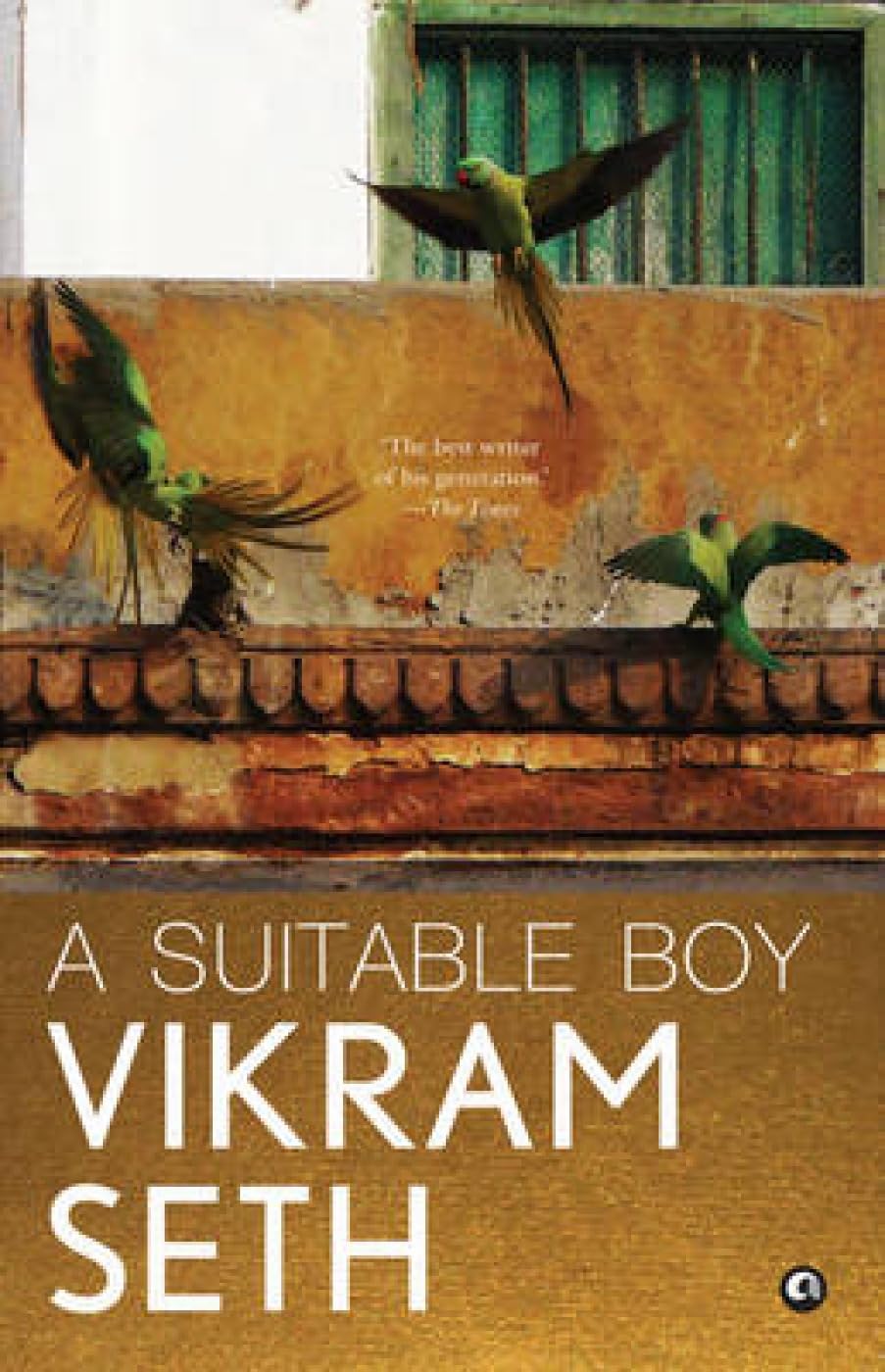
A Suitable Boy
Product ID: 64759837
Buy anything from 5,000+ international stores. One checkout price. No surprise fees. Join 2M+ shoppers on Desertcart.
Desertcart purchases this item on your behalf and handles shipping, customs, and support to Colombia.
From the Publisher ‘You too will marry a boy I choose,’ said Mrs Rupa Mehra firmly to her younger daughter. Lata avoided the maternal imperative by looking around the great lamp-lit garden of Prem Nivas. The wedding guests were gathered on the lawn. ‘Hmm,’ she said. This annoyed her mother further. ‘I know what your hmms mean, young lady, and I can tell you I will not stand for hmms in this matter. I do know what is best. I am doing it all for you. Do you think it is easy for me, trying to arrange things for all four of my children without His help?’ Her nose began to redden at the thought of her husband, who would, she felt certain, be partaking of their present joy from somewhere benevolently above. Mrs Rupa Mehra believed, of course, in reincarnation, but at moments of exceptional sentiment, she imagined that the late Raghubir Mehra still inhabited the form in which she had known him when he was alive: the robust, cheerful form of his early forties before overwork had brought about his heart attack at the height of the Second World War. Eight years ago, eight years, thought Mrs Rupa Mehra miserably. ‘Now, now, Ma, you can’t cry on Savita’s wedding day,’ said Lata, putting her arm gently but not very concernedly around her mother’s shoulder. ‘If He had been here, I could have worn the tissue-patola sari I wore for my own wedding,’ sighed Mrs Rupa Mehra. ‘But it is too rich for a widow to wear.’ ‘Ma!’ said Lata, a little exasperated at the emotional capital her mother insisted on making out of every possible circumstance. ‘People are looking at you. They want to congratulate you, and they’ll think it very odd if they see you crying in this way.’ Several guests were indeed doing namaste to Mrs Rupa Mehra and smiling at her; the cream of Brahmpur society, she was pleased to note. ‘Let them see me!’ said Mrs Rupa Mehra defiantly, dabbing at her eyes hastily with a handkerchief perfumed with 4711 Eau de Cologne. ‘They will only think it is because of my happiness at Savita’s wedding. Everything I do is for you, and no one appreciates me. I have chosen such a good boy for Savita, and all everyone does is complain.’ Lata reflected that of the four brothers and sisters, the only one who hadn’t complained of the match had been the sweet-tempered, faircomplexioned, beautiful Savita herself. ‘He is a little thin, Ma,’ said Lata a bit thoughtlessly. This was putting it mildly. Pran Kapoor, soon to be her brother-in-law, was lank, dark, gangly, and asthmatic. ‘Thin? What is thin? Everyone is trying to become thin these days. Even I have had to fast the whole day and it is not good for my diabetes. And if Savita is not complaining, everyone should be happy with him. Arun and Varun are always complaining: why didn’t they choose a boy for their sister then? Pran is a good, decent, cultured khatri boy.’ There was no denying that Pran, at thirty, was a good boy, a decent boy, and belonged to the right caste. And, indeed, Lata did like Pran. Oddly enough, she knew him better than her sister did—or, at least, had seen him for longer than her sister had. Lata was studying English at Brahmpur University, and Pran Kapoor was a popular lecturer there. Lata had attended his class on the Elizabethans, while Savita, the bride, had met him for only an hour, and that too in her mother’s company. ‘And Savita will fatten him up,’ added Mrs Rupa Mehra. ‘Why are you trying to annoy me when I am so happy? And Pran and Savita will be happy, you will see. They will be happy,’ she continued emphatically. ‘Thank you, thank you,’ she now beamed at those who were coming up to greet her. ‘It is so wonderful—the boy of my dreams, and such a good family. The Minister Sahib has been very kind to us. And Savita is so happy. Please eat something, please eat: they have made such delicious gulab-jamuns, but owing to my diabetes I cannot eat them even after the ceremonies. I am not even allowed gajak, which is so difficult to resist in winter. But please eat, please eat. I must go in to check what is happening: the time that the pandits have given is coming up, and there is no sign of either bride or groom!’ She looked at Lata, frowning. Her younger daughter was going to prove more difficult than her elder, she decided. Review: Re-read after two decades and loved it! - “Re-read your favourite books at different stages of your life. The plot never changes but your perspective does.” I’m not sure who said this but the maxim resonated with me as I re-read Vikram Seth’s “A Suitable Boy” after more than two decades. The book is set in a newly independent India that is still recovering from the trauma of partition while also dealing with tough issues like land reforms and communal strife. The story follows four families for about eighteen months in the early 1950s – the Mehras, the Kapoors, the Chatterjis who are all linked through marriage and the Khans who are close friends of the Kapoors. The fictional north Indian town of Brahmpur along the river Ganga is the capital of the fictional state of Purva Pradesh, and this is where the Mehras, Kapoors and Khans live, while the Chatterjis are in Calcutta. A narrative thread that brings these families and the events in the book together is the search for ‘a suitable boy’ by Mrs. Rupa Mehra for her nineteen-year-old daughter Lata Mehra. Lata has three young men who are wooing her and she must “choose”. The story without doubt is appealing. But what really kept me engrossed is Vikram Seth’s writing. His easy yet eloquent prose, with just that right tinge of humour, is interspersed with lyrical verse. In fact, the contents page has rhyming couplets to mark the nineteen parts of the book. There’s an abundance of evocative detail for every scene, nuance, emotion - be it a romantic boat ride to Barsaat Mahal, a first kiss, crowds at the Pul Mela, breakfast banter at the eccentric Chatterji household, dusty villages of rural Rudhia, an intimate garden music concert, or the rough and tumble of India’s first general election campaign. The ambiance envelopes you each time, like you are actually there. The writing itself is never in a hurry yet the book is completely engaging, a page-turner. There are no heroes or villains just people who have hopes, expectations, vulnerabilities, and cannot be slotted into stereotypes. Seth’s engagement with his characters is empathetic, sensitive, and at times even fondly indulgent - as it often is with Rupa Mehra who easily swings from bouts of tearful self-pity to being determined and practical! Mahesh Kapoor is a balanced, well liked politician but pretty dismissive of his wife’s views. There’s the lively charming Lata trying to make sense of her own complex emotions and Maan Kapoor who is exasperating and endearing. Saeeda Bai is as independent and strong, as she is vulnerable. Lata’s three suitors, markedly different in their sensibilities, are all likeable young men. The Chatterji siblings are insensitive at times but the delightfully inane couplets they come up with every once in a while, simply to irritate or annoy each other, more than makes up for it! “Buy me before good sense insists, you’ll strain your purse and sprain your wrists”, says Seth to the reader in a rhymed ‘word of thanks’. The book did not strain my purse but holding up 1535 pages – my wrists certainly hurt and so did my neck. But I’m not complaining. I wish I was still reading ‘A Suitable Boy’! Review: Don't buy the Aleph edition - Beautiful book but publisher Aleph is so damn irresponsible. Pages are missing by the dozens!


| Best Sellers Rank | #104,439 in Books ( See Top 100 in Books ) #2,179 in Indian Writing (Books) #3,273 in Contemporary Fiction (Books) |
| Customer Reviews | 4.4 out of 5 stars 4,538 Reviews |
S**A
Re-read after two decades and loved it!
“Re-read your favourite books at different stages of your life. The plot never changes but your perspective does.” I’m not sure who said this but the maxim resonated with me as I re-read Vikram Seth’s “A Suitable Boy” after more than two decades. The book is set in a newly independent India that is still recovering from the trauma of partition while also dealing with tough issues like land reforms and communal strife. The story follows four families for about eighteen months in the early 1950s – the Mehras, the Kapoors, the Chatterjis who are all linked through marriage and the Khans who are close friends of the Kapoors. The fictional north Indian town of Brahmpur along the river Ganga is the capital of the fictional state of Purva Pradesh, and this is where the Mehras, Kapoors and Khans live, while the Chatterjis are in Calcutta. A narrative thread that brings these families and the events in the book together is the search for ‘a suitable boy’ by Mrs. Rupa Mehra for her nineteen-year-old daughter Lata Mehra. Lata has three young men who are wooing her and she must “choose”. The story without doubt is appealing. But what really kept me engrossed is Vikram Seth’s writing. His easy yet eloquent prose, with just that right tinge of humour, is interspersed with lyrical verse. In fact, the contents page has rhyming couplets to mark the nineteen parts of the book. There’s an abundance of evocative detail for every scene, nuance, emotion - be it a romantic boat ride to Barsaat Mahal, a first kiss, crowds at the Pul Mela, breakfast banter at the eccentric Chatterji household, dusty villages of rural Rudhia, an intimate garden music concert, or the rough and tumble of India’s first general election campaign. The ambiance envelopes you each time, like you are actually there. The writing itself is never in a hurry yet the book is completely engaging, a page-turner. There are no heroes or villains just people who have hopes, expectations, vulnerabilities, and cannot be slotted into stereotypes. Seth’s engagement with his characters is empathetic, sensitive, and at times even fondly indulgent - as it often is with Rupa Mehra who easily swings from bouts of tearful self-pity to being determined and practical! Mahesh Kapoor is a balanced, well liked politician but pretty dismissive of his wife’s views. There’s the lively charming Lata trying to make sense of her own complex emotions and Maan Kapoor who is exasperating and endearing. Saeeda Bai is as independent and strong, as she is vulnerable. Lata’s three suitors, markedly different in their sensibilities, are all likeable young men. The Chatterji siblings are insensitive at times but the delightfully inane couplets they come up with every once in a while, simply to irritate or annoy each other, more than makes up for it! “Buy me before good sense insists, you’ll strain your purse and sprain your wrists”, says Seth to the reader in a rhymed ‘word of thanks’. The book did not strain my purse but holding up 1535 pages – my wrists certainly hurt and so did my neck. But I’m not complaining. I wish I was still reading ‘A Suitable Boy’!
S**L
Don't buy the Aleph edition
Beautiful book but publisher Aleph is so damn irresponsible. Pages are missing by the dozens!
K**R
A Story of Good Old Days
This is a unique book.It touches upon the society and political set up of those times and the personal lives of three individuals namely Lata Kabir and Haresh who represent different personalities.The end is extremely subtle It is a novel some what like Gone With The Wind.The author deserves full appreciation.
N**L
A must read for those with an insatiable interest in every possible detail about every possible person
As Vikram Seth's Magnum Opus A Suitable Boy approached its 20th year, since first being published by Faber & Faber, the public's affection for this epical work still remains as strong as it ever did. Finally, after many years, I sat down to read this book, for which I had read so much praise. Neither with scepticism nor anticipation did I enter into this world conceived by Seth, before even turning to the first page, I fastidiously cleansed my mind of all prior knowledge, dismissing the reviews and the twittering of book lovers the world over, becoming a figurative virgin. Vikram Seth is quite an anomaly, particularly in this day and age, not just is he a novelist, but a poet, librettist, children's writer, memoirist and biographer. It is as if he's drifted from the pages of some 19th century novel, lost in the mists of time, and ended up here, in this age of ravenous vulgarity and mediocrity, to act as a sought of literary saviour. A Suitable Boy is set in Post-Independence and Post-Partition India; just as the country was entering into its first decade, free from foreign rule. It had been centuries since India had actually been fully independent, not truly since the days of the Gupta Dynasty, having just immediately gained independence from Britain, prior to that there were the Mughals, the Turks, the Mongols, but now India was finally ready to progress on its own. The book begins at a gently simmering pace, giving the reader ample time to absorb the characters in true depth, starting off with the wedding of Savita Mehra to Praan Kapoor, a university lecturer. No sooner has the wedding ended, that Mrs Rupra Mehra, the matriarch of the family, begins her search for a suitable boy for her youngest daughter Lata, who at 19 is determined not to have an arranged marriage, but to fall in love first. Lata is a girl who does not possess the preconceived prejudices of her mother, with regards to inter-religious marriage and class hierarchies; her aim is to fall in love and to experience the emotional euphoria and complexities that it brings. She has only ever read about true love in books, through the works of Jane Austin and Shakespeare et al, and also through her mother and late father's relationship. Lata ventures into an alien territory, where all previous poetical notions fly out of the window. She develops a fondness for Kabir, a cricket and literature enthusiast, who attends college with her in Brahmpur, then the inevitable happens, what first began as an awkward affection, quickly develops into a love, so deep and so penetrating. When Lata, and eventually her meddling mother find out Kabir is a Muslim, what begins as a pleasant courtship becomes clouded by upset and emotional conflictions. The inter-marriage of Hindus and Muhammedan's and vice-versa, was, and in parts of contemporary Indian society still remains, a cause of much confliction. Vikram Seth's writing is reminiscent of Jane Austin and in parts Dickens's, yet the overall style is entirely his own, and though the central thread of the novel is marriage, Seth also concentrates on the political and societal upheavals experienced by all Indians at that time in microscopic detail, regardless of class. No one could not possibly accuse Seth of producing a novel of perfumed frivolity, because there is so much depth and sensitivity, A Suitable Boy is not just about the pursuit of marriage and happiness, but heartache and disappointment, which is universal. Throughout its sprawling 1474 pages, there was no emotion left unexplored, no character left misunderstood and with not even a hint of saccharine. No other novelist could possibly give so much scope to such a complex world. Reading this at 25, my empathy and attachment magnetically drew towards the younger characters Lata, Kabir, Varun, Maan and so on. It was for Kabir in particularly that I felt an immense affection for, a true brotherly love developed as this character, so in love, so intelligent and so sweet unfolded as I read each page. I felt his deep-rooted love for Lata burning in his soul, like a raging forest fire, growing and becoming ever more intense. There was such beauty in his use of poetic lines, lifted from the pages of Keats and Byron. Here was a lyrical and sensitive individual, who through societal and personal circumstances was forced to experience a heart ache, never felt before. The novel matures with each chapter, the quest for love continues, and the many characters have to face their own demons and desires head on. A Suitable Boy is a novel which will stay with me for a long time; holding a special place in my heart, I will continue to remember these characters for many years to come.
A**E
Every emotion captured
Spellbinding
N**A
A long journey to India in the 1950's
WOW! Just W.O.W! It’s a long book—1,500 pages. And every single page was worth the time I spent on it and more. After many years, I sat down to read this book for which I had read so much praise. I enter into this world created by Seth with great anticipation even before even turning to the first page The book is a snapshot of life in India in the 1950's. Set in the post-independence, post-partition era in India, the novel follows the story of four intertwined families over a period of 18 months as a mother searches for a suitable groom for her daughter. It takes us into a splendidly imagined world of highly extended multi-cultured families and creates for us an accurate and compulsively readable tale of their lives and loves. The ghazals and the lovely long letters add a sparkling touch to the novel. The couplets that the Chatterjis fling back and forth are frequently funny The research put in by the author is simply incredible. The story is so engrossing, each character so completely developed and believable, that is it hard to move on once you turn the last page. I secretly wished that the novel never ends. The characters were so real, that you miss them as if they were a part of your life. An absolute masterpiece of prose.
A**S
... length of this book it can prove to be tiresome. But this factor does not undermine the magnificent ...
The font size is small and given the length of this book it can prove to be tiresome. But this factor does not undermine the magnificent work by Vikram Seth.
P**R
Good
Good
Trustpilot
2 months ago
1 month ago