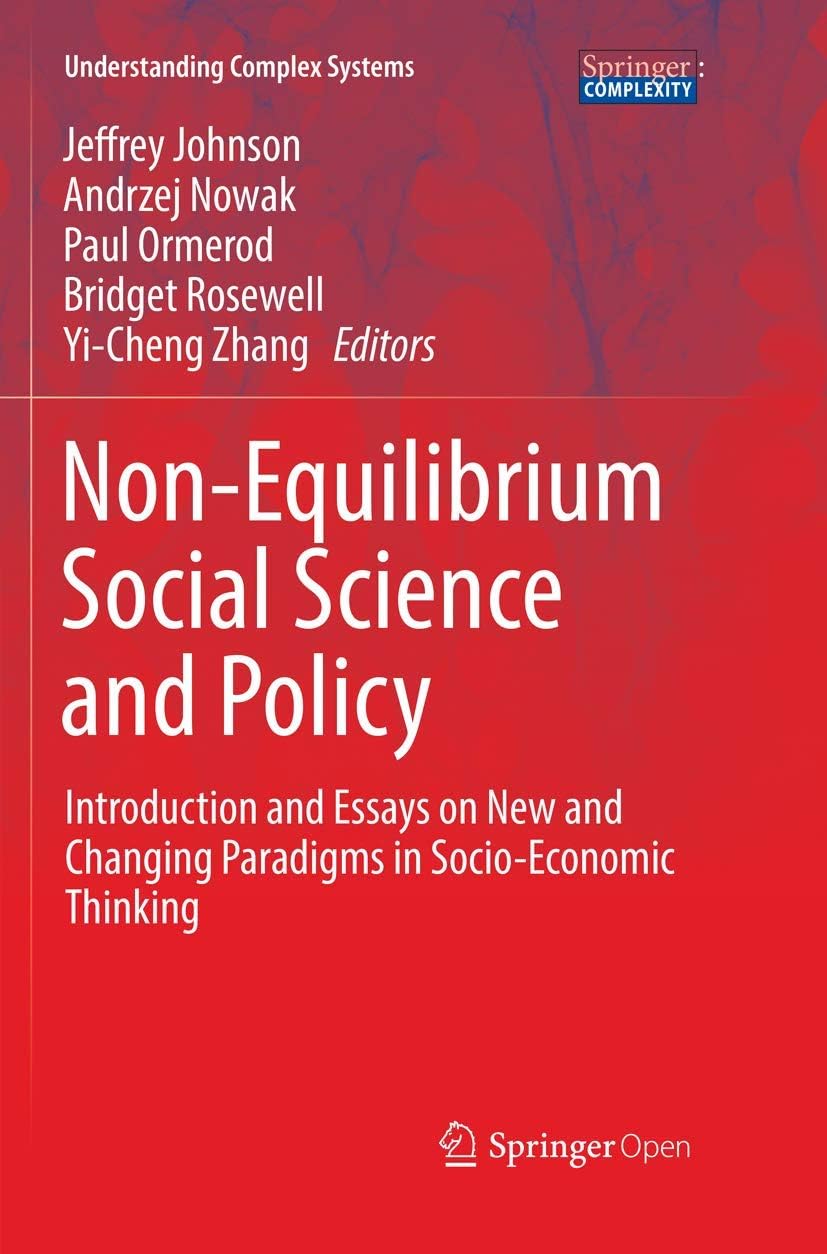
Non-Equilibrium Social Science and Policy: Introduction and Essays on New and Changing Paradigms in Socio-Economic Thinking (Understanding Complex Systems)
Product ID: 570574140
Buy anything from 5,000+ international stores. One checkout price. No surprise fees. Join 2M+ shoppers on Desertcart.
Desertcart purchases this item on your behalf and handles shipping, customs, and support to Colombia.
The overall aim of this book, an outcome of the European FP7 FET Open NESS project, is to contribute to the ongoing effort to put the quantitative social sciences on a proper footing for the 21st century. A key focus is economics, and its implications on policy making, where the still dominant traditional approach increasingly struggles to capture the economic realities we observe in the world today - with vested interests getting too often in the way of real advances. Insights into behavioral economics and modern computing techniques have made possible both the integration of larger information sets and the exploration of disequilibrium behavior. The domain-based chapters of this work illustrate how economic theory is the only branch of social sciences which still holds to its old paradigm of an equilibrium science - an assumption that has already been relaxed in all related fields of research in the light of recent advances in complex and dynamical systems theory and relateddata mining. The other chapters give various takes on policy and decision making in this context. Written in nontechnical style throughout, with a mix of tutorial and essay-like contributions, this book will benefit all researchers, scientists, professionals and practitioners interested in learning about the 'thinking in complexity' to understand how socio-economic systems really work. Review: Readable, Informative and Timely - An enjoyable read in a fast moving area. This entertaining collection of essays does three things. 1) It provides an accurate snapshot of the toolkit loosely grouped under the headings, "complexity", "big data" and "computational." 2) It describes the strengths and problems of classical analytical methods in economics, the social sciences and public policy. 3) It maps out the road ahead for researchers and those who rely on computational tools. One area of interest is the gradual shift from systems lingua franca to a more use-friendly vernacular approach to explaining methods and ideas in this area. The title alone shows that, while progress is being made, the preference for system language may still limit the range of ideas and audience scope. When top-down policy wonks were the audience, the use of systems language made sense. The trend toward blending top-down and bottom-up processes in our emerging understanding of complex reality is producing a language shift toward the vernacular from systems language. Something like it was seen in the Middle Ages in the gradual move from Latin to local tongues for writers, starting with Dante and Chaucer. Suzanne Simard's TED talks show everyday words can effectively describe the workings of complex adaptive systems. This book, Non-equilibrium Social Science and Policy, points the way to the future and is a must read for anyone interested in this area.
| Best Sellers Rank | #6,340,049 in Books ( See Top 100 in Books ) #1,487 in Econometrics & Statistics #1,522 in Business Operations Research (Books) #1,752 in System Theory |
| Customer Reviews | 4.3 out of 5 stars 18 Reviews |
R**Y
Readable, Informative and Timely
An enjoyable read in a fast moving area. This entertaining collection of essays does three things. 1) It provides an accurate snapshot of the toolkit loosely grouped under the headings, "complexity", "big data" and "computational." 2) It describes the strengths and problems of classical analytical methods in economics, the social sciences and public policy. 3) It maps out the road ahead for researchers and those who rely on computational tools. One area of interest is the gradual shift from systems lingua franca to a more use-friendly vernacular approach to explaining methods and ideas in this area. The title alone shows that, while progress is being made, the preference for system language may still limit the range of ideas and audience scope. When top-down policy wonks were the audience, the use of systems language made sense. The trend toward blending top-down and bottom-up processes in our emerging understanding of complex reality is producing a language shift toward the vernacular from systems language. Something like it was seen in the Middle Ages in the gradual move from Latin to local tongues for writers, starting with Dante and Chaucer. Suzanne Simard's TED talks show everyday words can effectively describe the workings of complex adaptive systems. This book, Non-equilibrium Social Science and Policy, points the way to the future and is a must read for anyone interested in this area.
Trustpilot
5 days ago
1 month ago