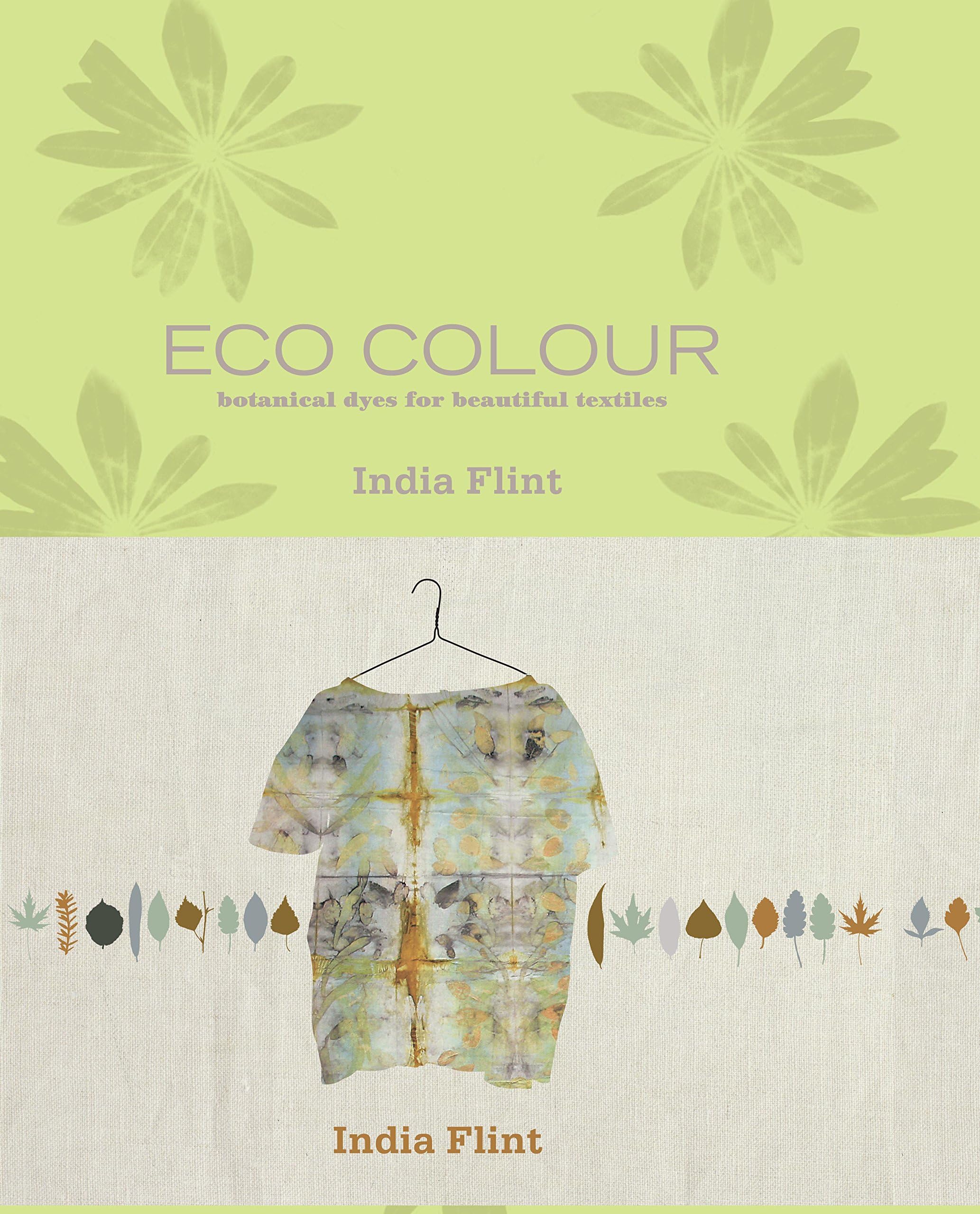
Eco Colour: Botanical Dyes for Beautiful Textiles
Product ID: 51683064
Eco Colour fills a gap in the literature and uses an exciting range of projects to demonstrate a variety of techniques, some of them entirely new processes developed by the author. Projects range from solar dyeing to dyeing with 'ice-flowers'. The result is a range of pure natural colours produced with the least possible harm. Review: Loved it! - I almost didn't buy this book, after reading some of the reviews. I am so glad I trusted my judgement and went ahead,I am absolutely thrilled with this book, I did feel initially (before receiving it) it was a bit pricey, but it is actually a very big book with a great deal of content. For those wanting ABC instructions, this is perhaps not for you - India does give a great amount of detail about how to use natural dyes for eco printing etc, but it is a very loose format, you have to read each chapter in it's entireity, and the little nuggets of instructional info are tucked between lovely stories from the authors past and present, relating to her experiences of dyeing. Her techniques are quite new and it is worth delving in, just to get an insight into this woman's incredible and effective methods of using natural dyes. I cannot understand the reviews from others that complain she describes using leaves and flowers not available in their home territory... The whole point of this book, is that you are supposed to use what nature offers you in YOUR area, this is not a dictionary of suitable plants for dyeing. Instead it encourages you to experiment and really this is the most thrilling part about natural dyeing. If you want something more concise that details all known plant dyes and the colours you are likely to achieve from them, try "A Dyers Handbook" by Jenny Dean. I have this book to, and whilst it is very informative, it is not nearly as inspiring as the India Flint book, the two go nicely together. India Flint's book focusses on techniques for eco printing and ideas which you can expand on, whilst Jenny Colgans has all the scientific and technical terms. I really enjoyed the loose format and could not put the book down, it was also really interesting to learn (from this book) about synthetic dyes, how they are created and their impact on the environment. All in all, I would recommend it highly, it ticks all the boxes, useful info, inspiring images (worth it for the eye candy alone!) and beautifully written. Review: Lovely to look at and useful - I bought this book after leafing through a copy a friend had. I shouldn't really have bought ANOTHER book, but it looked so interesting - and it is. ALthough I am a bit allergic to 'coffee table' sized books this proved the exception. Its full of useful info on natural dyeing, plants to use, their preparation and end uses. She also gives lots of information on preparing fabric and fibres for dyeing and printing in eco ways, and what effects the mordants can have. Masses of illustrations. The main drawback is that she is Australian, and so many of the plants she uses are indigenous to the Antipodes which means they are not really relevant to European dyers. THere are also plently of other plants discussed so don't let that put you off, its just important to realise that if you want to buy the book. I am not to keen on the 'eco' dyed and printed T shirts etc India Flint produces with the dyeing, but thats personal taste and the point of buying the book is to experiment myself, not copy her products. I also bought Jenny Dean's Dyers Handbook, (in Flint's bibliography) which solves the problem of the Australian plants, and with these two I feel ready to get dyeing.
| Best Sellers Rank | 796,369 in Books ( See Top 100 in Books ) 5,707 in Needlework & Fabrics 86,597 in Arts & Photography (Books) |
| Customer Reviews | 4.6 out of 5 stars 371 Reviews |
H**T
Loved it!
I almost didn't buy this book, after reading some of the reviews. I am so glad I trusted my judgement and went ahead,I am absolutely thrilled with this book, I did feel initially (before receiving it) it was a bit pricey, but it is actually a very big book with a great deal of content. For those wanting ABC instructions, this is perhaps not for you - India does give a great amount of detail about how to use natural dyes for eco printing etc, but it is a very loose format, you have to read each chapter in it's entireity, and the little nuggets of instructional info are tucked between lovely stories from the authors past and present, relating to her experiences of dyeing. Her techniques are quite new and it is worth delving in, just to get an insight into this woman's incredible and effective methods of using natural dyes. I cannot understand the reviews from others that complain she describes using leaves and flowers not available in their home territory... The whole point of this book, is that you are supposed to use what nature offers you in YOUR area, this is not a dictionary of suitable plants for dyeing. Instead it encourages you to experiment and really this is the most thrilling part about natural dyeing. If you want something more concise that details all known plant dyes and the colours you are likely to achieve from them, try "A Dyers Handbook" by Jenny Dean. I have this book to, and whilst it is very informative, it is not nearly as inspiring as the India Flint book, the two go nicely together. India Flint's book focusses on techniques for eco printing and ideas which you can expand on, whilst Jenny Colgans has all the scientific and technical terms. I really enjoyed the loose format and could not put the book down, it was also really interesting to learn (from this book) about synthetic dyes, how they are created and their impact on the environment. All in all, I would recommend it highly, it ticks all the boxes, useful info, inspiring images (worth it for the eye candy alone!) and beautifully written.
V**N
Lovely to look at and useful
I bought this book after leafing through a copy a friend had. I shouldn't really have bought ANOTHER book, but it looked so interesting - and it is. ALthough I am a bit allergic to 'coffee table' sized books this proved the exception. Its full of useful info on natural dyeing, plants to use, their preparation and end uses. She also gives lots of information on preparing fabric and fibres for dyeing and printing in eco ways, and what effects the mordants can have. Masses of illustrations. The main drawback is that she is Australian, and so many of the plants she uses are indigenous to the Antipodes which means they are not really relevant to European dyers. THere are also plently of other plants discussed so don't let that put you off, its just important to realise that if you want to buy the book. I am not to keen on the 'eco' dyed and printed T shirts etc India Flint produces with the dyeing, but thats personal taste and the point of buying the book is to experiment myself, not copy her products. I also bought Jenny Dean's Dyers Handbook, (in Flint's bibliography) which solves the problem of the Australian plants, and with these two I feel ready to get dyeing.
C**E
Deeply inspiring and informative
Really inspirational book, just as I'd hoped it would be. Its packed with images and very useful practical information, as well as lots of lovely anecdotes and background information. Highly recommended for anyone interested in using plants for natural dyes and especially if you are looking for a deeper insight. This could never be a book with "quick fix how to do" activities that you just copy without doing some of your own creative experiments, natural dyes just don't work like that; this really is a highly captivating process which will require some time and experimentation on the part of anyone exploring it - but that time will be deeply rewarded. This book has all sorts of really great lists of dye plants, dye mordants, dye modifiers etc and there's some brilliant information about health and safety, toxic plants etc - things you need to know before embarking on using natural dyes. I've just started creating eco prints with plants and this book has given me a massive extra insight into all sorts of wonderful things connected to that. Plus its a really beautiful book, the illustrations are gorgeous.
A**K
Ice Flowers, mordants, shibori, fermented urine and cow pats: eco printing or alchemy? I'll let you know!
This is a beautiful book just to look at. I love the little beige paper 'shawl' which enwraps the hard cover - an apt metaphor and which doubles as a bookmark. The interior is as gorgeous as the cover as every page is illustrated and usually in more than one way. This is the first book I've bought on the subject of 'eco printing' (the dyeing of papers and textiles using natural found or cultivated organic matter.) The contents do not disappoint. The book begins with a prologue which outlines what the book is for; then follow eight parts, beginning with 'Before you Begin' and ending with 'References'. In between is an encyclopaedic range of information and technique, imparted in the author's engaging style. A complete beginner, I was yet able to produce some of my own eco prints within a week of my purchase of the book. (Some are posted on my website/blog). Tomorrow I am going to attempt another batch of prints using the author's (India Flint) 'Ice Flower' technique and I will be experimenting with two of the listed 'mordants': alum and vinegar. (I could have gone for fermented urine, or 'cow pats' but will save these for another time! This book is a must have for the would-be and the experienced 'eco printer'. I shall be forever delving into this lovely tome.
A**A
Botanical dyes
very useful book, easy to follow
K**R
A valuable book , which is well worth buying
This book, which is out of print, is chock full of information on natural dyeing and ecoprinting. I would recommend it as an alternative to expensive on-line courses. The paper is quite thin, however I can ignore this in the light of its factual value. India Flint's recipes are light on mordants, in comparison to some that use very large amounts of alum. Currently, I have scoured, mordanted & dyed wool for a play set in 1930s rural Ireland & will be working my way through the book. Shipping, from the USA took half the time expected. Thank you, Fenella
A**I
my latest obsession
All about Dyeing with natural and safe flora or fauna material; I love this book, I have read it cover to cover about 3 times. It is a great mix of chemistry knowledge, an artistic eye and a fascination with colour. It does talk alot about eucalyptus leaves which I have no access to, but the techniques can be used with any plants, and it does encourage you to experiment which is really what I wanted to do. It has good links at the back and references to follow up for more info. The photos are beautiful. Very inspirational.
M**H
An inspiring book
What a lovely book. It is full of ideas and artistic inspiration. I work with textiles but have never quite had the nerve to risk dying with plants before but I am already busily pressing flowers between different fabrics in the garden and the book only arrived a few days ago. I cant wait for the plants in my garden to grow this summer so I can do more! it does have some instructions and information about methods of preparing fabric for dyeing in tables which are quite wel laid out. there is a little to-ing and fro-ing ( if they are real words!) in the book to extract it all but not too difficult to find. one previous reviewer suggested getting the Jenny Dean book too so I did, but as that only arrived today I haven't had a good look at that yet. After flowers I'm going to try rust.....
A**H
Perfect starting
Perfect starting.
M**A
Très bon livre
Ce livre a de jolies illustrations, les techniques sont très bien expliquées, avec de nombreuses recettes de solutions et des conseils très utiles.Je suis très contente d'avoir étudié ce livre sur les techniques de teintures végétales, qui se distingue très agréablement des autres livres portant sur ces techniques. Contrairement à ce que certains sites français prétendent, India Flint n'est pas une technique, mais une artiste très proche de la nature. J'ai déjà testé des techniques avec certaines plantes trouvées près de chez moi, dans le Beaujolais et dans mon jardin floral et potager : les couleurs correspondent aux couleurs que j'aime, d'un ton pastel qui contrastent agréablement avec certaines couleurs agressives de la teinture au Procion pas assez diluées.
M**E
Textile art
Sono una textile artist e colleziono libri di approfondimento sulle varie tecniche artistiche diffuse nel mondo ed in particolare sull'arte tessile e delle ricette per creare colori tessili naturali . Questo libro è una pietra miliare ed è entrato a far parte dei miei tesori. Lo consiglio vivamente ad esperti e neofiti del settrore
M**E
Natural dyes
India Flint is recognized as one of the leading authorities on natural dyes. This is a charming book teeming with information about natural dyes and various techniques. Although based in Australia, I found many of the plants mentioned can be found in Canada.
K**T
Eco Colour
I've been working with dyeing silk scarves with plant materials, vinegar and metal wire. But this book takes things to a different level that I was hoping to find. I read an article about India Flint in Fiber Arts magazine and then went hunting for this book online. I have yet to try experimenting with her methods, since we're still in the throes of winter, but I love the results pictured in this book. It's a beautiful book that has a very scientific feel, with charts of plants, their scientific and common names, what parts to use for dyeing, and what color will result. But it also has anecdotal information that's fascinating. The author has shared a lot here. The one thing that concerns me is her statement at the beginning of the book, which is that some colors will fade over time. Since I sell my products, I hate to tell a customer that the beautiful colors they're buying may fade. But I'm looking forward to see what botanical alchemy I can come up with while using this book as a guide.
Trustpilot
2 months ago
2 months ago