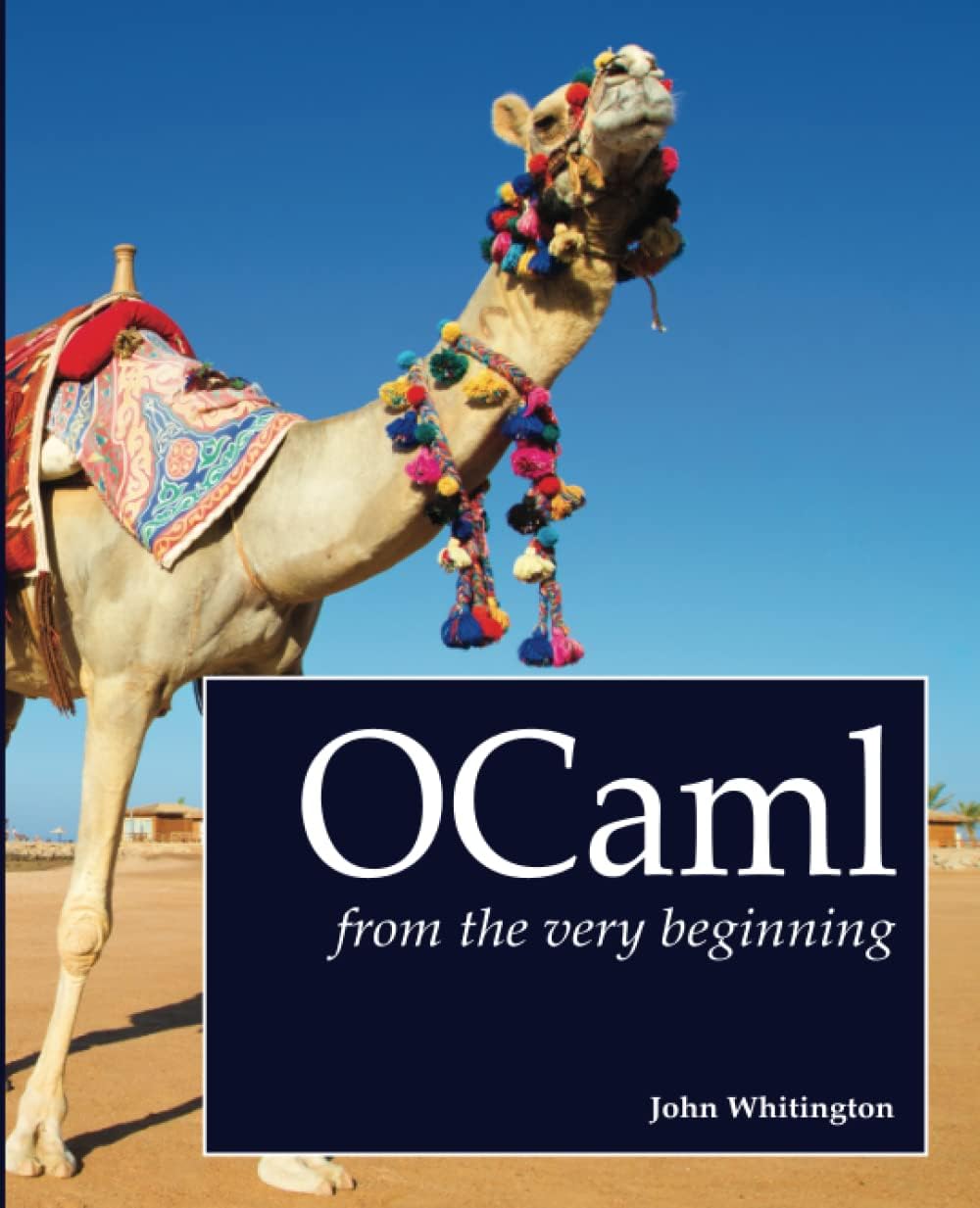
OCaml from the Very Beginning
Product ID: 51083711
Buy anything from 5,000+ international stores. One checkout price. No surprise fees. Join 2M+ shoppers on Desertcart.
Desertcart purchases this item on your behalf and handles shipping, customs, and support to Colombia.
In OCaml from the Very Beginning John Whitington takes a no-prerequisites approach to teaching a modern general-purpose programming language. Each small, self-contained chapter introduces a new topic, building until the reader can write quite substantial programs. There are plenty of questions and, crucially, worked answers and hints. OCaml from the Very Beginning will appeal both to new programmers, and experienced programmers eager to explore functional languages such as OCaml. It is suitable both for formal use within an undergraduate or graduate curriculum, and for the interested amateur. Chapters: Getting Ready Starting Off Names and Functions Case by Case Making Lists Sorting Things Functions upon Functions upon Functions When Things Go Wrong Looking Things Up More with Functions New Kinds of Data Growing Trees In and Out Putting Things in Boxes The Other Numbers The OCaml Standard Library Building Bigger Programs Answers to Questions Hints for Questions Coping with Errors Review: Accessible tutorial style that is actually deeper than one initially thinks - Coming from a Python background and wanting to learn OCaml, I have found this book to be very accessible as a tutorial - far more so than the Real World OCaml which, though excellent, is dive-into-the-deepend stuff quite fast, and also mixed in with too many Jane Street specifics too soon. Here is a great book to get you started on the learning curve of OCaml. As the other reviewers said, it's deceptively easy going, but actually these light chapters are quite dense if you go through some of the latter questions at the end of each. What I like most about it is that it has that concise, incremental, orthogonally organised feeling that mirrors what I expect to get out of functional programming itself. One could argue that it is a mite expensive for a 190 page book that uses a lot of whitespace (that's a positive for organization and readability, as an aside), but then OCaml is not really mainstream and one has to accept that this book will have a relatively low print run, and therefore I won't begrudge it a star on this point as I would much rather pay a few pounds more and have this book exist. Review: Easy to understand - With a background in imperative language, I found it is quite hard to learn functional language. I've tried many OCaml tutorial, and found this is the best one for me. It was written for first year graduates without any programming experience, so it gives me a clear picture of the basis of functional programming.
| Best Sellers Rank | 786,667 in Books ( See Top 100 in Books ) 593 in Programming Languages & Tools 1,040 in Introduction to Programming 1,884 in Software Design & Development |
| Customer Reviews | 4.2 out of 5 stars 52 Reviews |
M**E
Accessible tutorial style that is actually deeper than one initially thinks
Coming from a Python background and wanting to learn OCaml, I have found this book to be very accessible as a tutorial - far more so than the Real World OCaml which, though excellent, is dive-into-the-deepend stuff quite fast, and also mixed in with too many Jane Street specifics too soon. Here is a great book to get you started on the learning curve of OCaml. As the other reviewers said, it's deceptively easy going, but actually these light chapters are quite dense if you go through some of the latter questions at the end of each. What I like most about it is that it has that concise, incremental, orthogonally organised feeling that mirrors what I expect to get out of functional programming itself. One could argue that it is a mite expensive for a 190 page book that uses a lot of whitespace (that's a positive for organization and readability, as an aside), but then OCaml is not really mainstream and one has to accept that this book will have a relatively low print run, and therefore I won't begrudge it a star on this point as I would much rather pay a few pounds more and have this book exist.
Y**J
Easy to understand
With a background in imperative language, I found it is quite hard to learn functional language. I've tried many OCaml tutorial, and found this is the best one for me. It was written for first year graduates without any programming experience, so it gives me a clear picture of the basis of functional programming.
P**.
Five Stars
Great start!
J**Y
Happy
Happy with this, no problems at all :)
N**T
Five Stars
easy understanding
R**B
Excellent for Beginners; A Little too Short; No Good for the Experienced
The blurb on the reverse claims that the book "will appeal both to new programmers and experienced programmers". This is a little misleading, as there is very little here for the experienced programmer. OCaml is one of the family of functional languages; this book does serve well as an introduction to these. One of the features of OCaml that distinguishes it from many others in the ML family, and indeed the functional family, is its support for objects (the 'O' of OCaml, formerly known as Objective Caml); these are not touched upon at all in this book. Finally, this book is shorter that it seems. Each short chapter is followed by a questions page, and then by a pointless "so far" page. The last third of the book is worked answers. Having said that, the book is a very clear, easy read, and the progression of topics is well-chosen. I would highly recommend it as a first, very light, introduction to programming generally, and to simple functional programming. I've given 3 stars. Whilst the book is really excellent for an (early) beginner¸ it loses two stars mainly for not covering what distinguishes OCaml from other functional languages. So, if you're a beginner, this is a good place to start. If you're experienced, or if you already know a functional language, this is not the book for you.
M**Y
DO NOT BUY THE KINDLE EDITION! The code is ...
DO NOT BUY THE KINDLE EDITION! The code is in a completely unreadable 5 point font. Even bumping up the reading font doesn't increase their size.
A**3
Solid introduction to OCaml
This book is very well structured. For those new to programming this book is a great introductory text - may be a bit fast - but for those familiar with non-functional languages this book is a quick, easy and motivating way to get up and going with OCaml. If you are an experienced programmer that is new to OCaml I highly recommend you pick this up and quickly go through it (should take < 15 hrs w/ examples) before moving onto other texts. A lot of the other texts for example Real World OCaml get really quick really fast spending only a brief moment on helping you think and practice in the "OCaml way". The books topics are well structure with all of the basics covered. The examples are also very doable with both solutions and hints - there aren't for example any really obnoxious examples all are fair and sufficiently interesting. By the end of the book you build a simply command line app. This book however isn't the be all end all of OCaml - for example this only briefly covers modules (modules are very very different than for example's Java private/protected/public and to me one of the more challenging aspects of the language to understand...). It also doesn't touch upon functional concepts such as monads, functors, memoization, etc. But as far as getting your feet wet and developing an appreciation for the language this does a great job and I highly recommend it. Edit - looks like most of content that I mentioned above that is left out is addressed in John Whitington's second book - More OCaml
L**R
Three Stars
Good for starting out. I am a little disappointed 'cause I got farther by reading the online documentation.
S**U
Excellente introduction à OCaml
Un livre idéal pour débuter en douceur avec OCaml. Agréable à lire et aborde l'apprentissage du langage par des exemples simples et pragmatiques. L'ouvrage est toutefois uniquement destiné aux débutants. Il donne en effet un simple aperçu du langage en faisant notamment l'impasse sur la partie programmation objet et les foncteurs.
W**S
Easy Introduction
A very good and simple introduction to the basics of this amazing language. Short, easily digested chapters introduce each new concept. More advanced concepts are only briefly covered such as modules. Functors and OO are not covered. Having said that, this must be the easiest way of getting into the language or getting an introduction to the language. This book will prepare you to tackle the more comprehensive treatises such as " Real World OCaml: Functional programming for the masses " (also highly recommended) with ease.
M**Y
A useful short introduction
This is a kind of minimalistic introduction. Nothing wrong with that. But it is by no means the complete language. Just the first steps for a complete OCaml beginner with some programming experience. Overall recommended. Pros: - contains all the essential things to introduce the language - has an extensive set of exercises with solutions at the end of the book - each chapter is shortly reviewed at the end - mostly clear explanations Cons: - some of the chapter titles should be better descriptive, it is not easy to find things - you may have to do the exercises to really get the best out of this book. I hardly ever do that. I exercise by trying to use the language as soon as possible. - it introduces only OCaml, it does not say much about functional programming and its virtues. My copy of the book is filled with my own handwritten notes and comments, the chapter titles have been extended. Then it is more useful. I never read programming books cover to cover, I always pick things. OCaml is one of the best functional languages I know. Of course, this is my personal opinion.
C**S
Very interesting
Complete but simple to read. Very usefull book for early beginners of this language. It is perhaps the missing book on OCaml. OCaml OOP not enough covered.
Trustpilot
1 month ago
2 weeks ago