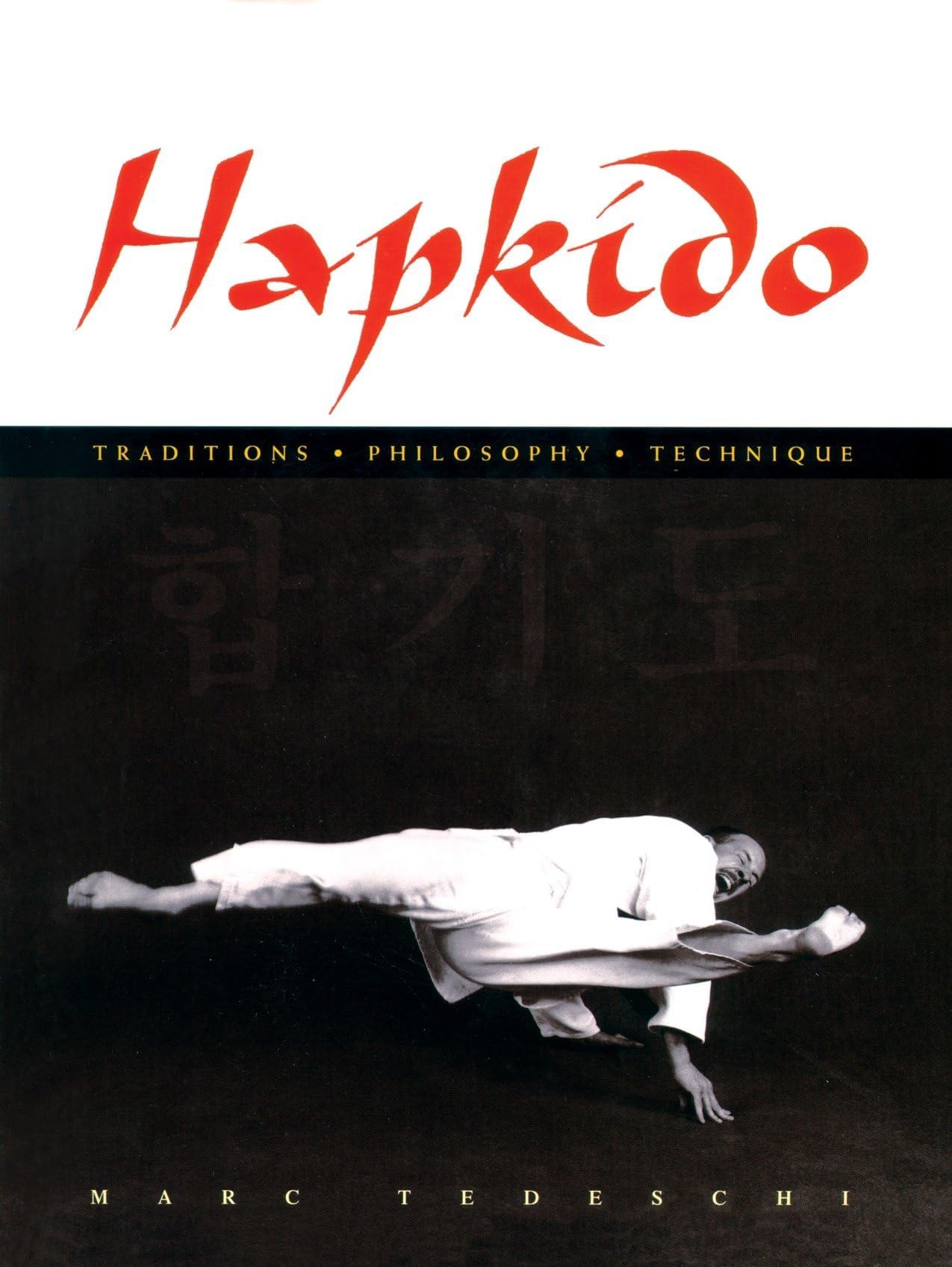
Hapkido: Traditions, Philosophy, Technique
Product ID: 5081579
📚1136 pages of deep knowledge
📸9000+ detailed photos
🥋2000+ precise techniques
Desertcart purchases this item on your behalf and handles shipping, customs, and support to Colombia.
🥋 Unlock the secrets of Hapkido mastery—your ultimate martial arts blueprint!
This definitive Hapkido tome spans 1,136 pages with over 9,000 photos illustrating 2,000+ techniques, blending tradition, philosophy, and practical martial arts science. Ideal for self-directed learners and martial artists across disciplines, it offers an unparalleled, visually rich guide to mastering Hapkido’s dynamic and versatile fighting system.
| Best Sellers Rank | #498,470 in Books ( See Top 100 in Books ) #225 in Sports Encyclopedias #327 in Sports Reference (Books) #963 in Martial Arts (Books) |
| Customer Reviews | 4.8 out of 5 stars 230 Reviews |
K**S
Now THIS is how you structure a book to learn a martial art from!
This mighty tome and the dynamic of presentation through which it presents its sillibus is how you write a martial arts book for those who want to self-learn when there is no hope of finding a teacher or dojang anywhere in the region, let alone one that's not an after school sport-McDojo. If you have no other source of instruction in the whole region for the actual style as intended for its true and genuine puropse, THIS is THEE kind of book you want to try and book-learn from. Yes, THIS ONE. Marc Tedeschi presents his material in a properly segmented, modular, almost megolythically detailed body of instruction that encompasses nearly his entire art itself. THE WHOLE THING. He even publilshed a supporting series of 9 stand-alone booklets that cover the exact testing requirements for each belt level up to 4th-degree black, and the 9th of these books covers promotion beyond that point. And those booklets are equally as detailed in their presentation format as this one. If you have this large beefy tome of knowledge and those 9 ranking booklets together, you have Marc Tedeschi's entire Hapkido school in book form to self-train from for those who have no choice but to do it that way. Note however that certain assertions about trying to do so are HALF-correct; You can't easily learn martial arts just from READING a book, no matter how detailed or well-structured in its material. It's putting the book's instructions into physical practice in trial-and-error sessions that can reveal the rest of the little nuances for you. You can even alieviate many of the issue of sparring-enabled discovery of a lot of those nuances by learning to incorporate the Mook Jong wooden Kung Fo dummy into your practice of whatever fighting techniques are instructed in the book in front of you... most of, anyway. But the point is that the better qualilty the book, the more details you have to work from when trying to glean martial skill from that book when you have no choice but to try and do it entirely alone like I do. Secondly, there is also no such thing as learning martial arts from just ONE book on the subject. Even this huge book, while its level of instructional detail comes very close, stops just short of being enough to know EVERY little thing you need to know to attempt to gain real martial skill in the art or style. BUT: When you start to include other books that cover the missing categories of knowledge into the total combined martial arts instructional library you're self-training from, you start getting closer to forming the more complete picture after all. In my case, not only do I own this book and all 9 of the supporting belt-ranking booklets - I also own Marc Tedeschi's suppliment volume "Essential Anatomy." But I didn't stop there; See, while this book and 'Essential Anatomy' perfectly map out WHERE every pressure point is on all the meridian lines, they do not go into extensive hard-medical-science details about the exact effects of striking each of those points. Michale Patrick's book "Masters Series: Martial Science & Pressure Points" is however a 600+ page book that is exclusively a dictionarized volume solely on that subject. It lists each pressure point on the human body, shows exactly where it is and how to strike it in the form a photo showing the author doing so with a training partner, and gives a scienticfic description of the exact medical effects of that striking point. Get that book to suppliment the big Hapkido book my Marc Tedeschi, and now you approach the cusp of having the completely fleshed out Hapkido training corriculum. But for me it STILL does not stop there; There are even books on exact step-by-step processes for learning proper form and technical correctness on ones own, when it comes too such minutia as postute or the exact positioning of the fist and shoulder during a punch, ect. For example, I also own and train from a book titled "Dynamic Movement," which is part of the Karate Science series. In it, there are exact descriptions of not only how to position/angle your fists/shoulders/ankles/feet/knees and so on, but how to know on your own if you're getting it right by sensing how your wrists/ankles/knees/sense of balance/etc are supposed to feel to you when you are doing it right versus doing it wrong. Then there's the companion book to that one, titled "Fight like a Physicist." This one goes into detail on the hard Newtonian sciences of leverage, rotational forces, weight and balance, momention forces and how to use them in your movements toward what exact fighting purposes, etc. - It even goes into detail on exactly how breaking techniques for boards and bricks actually works and how it doesn't. I also have another book called "Iron Power Palm: 90 days to skull smashing power." This book is exclusively dedicated to exact step-by-step instructions for hard-science hand and body toughening methods used in breaking skills, and the raw science of why those methods work. There is even a section containing formulas for making your own Dit-Daw-Jow linaments using American-sourced equivalent ingredients to the original Chinese ones if you can't easily get supplies of those. Next I have my stack-o physical fitness manuals and books, one of which is titled "Ultimate Flexibility for Martial Arts," and another stretching-related one titled "Secrets of the Pelvis for martial arts." Having those two books together has helped me master proper martial arts stretching to effectively MAKE those high kicks become combat-practical. I've heard many accomplished masters of this art or that one all agree that the tool is only as useful as he who knows how/when to weild it, and I agree with that. As long as your fight strategy A-game is on point as far as fighting your fight (not your opponent's) to set him up just right, you can lead him into your perfect opportunity to flying roundhouse kick him over backwards at full power in a real fight. It's the preceding setup techniques and strategies that get you there, not just being physically faster or more frantic in your sheer will to try and haphazardly force such a kick into completion through his defense. And so I submit to you that having the right COMBINATION of different martial arts books, each one covering a whole category of martial knowledge and minutia that the other books in your training library don't cover... this is what makes all your training books work together to more effectively offer you the complete picture. After that it's your own hard work and eanest trial-and-error efforts in which you must get serious about those efforts, that will do the rest in gaining you the levels of skill you hope to achieve or at least begin to approach... if your location and situation leave you with absolutely no choice but to do it all on your own without an available dojang or instructor in or near your area. But as far as starting at the core knowledge of the particular martial art you're interested in learning, if it's Hapkido at its finest, then I can speak first hand that Marc Tedeschi's "Hapkido: History, Philosopy, Technique" is the finest example of the best kind of starting point in book form. If you want to learn real Hapkido but don't have access to a living instructor, then buy this book. But do more than that, like I did: Do your research to learn what other additional categories of information and skills are needed to master a martial art, find out what books by what authors will contain sufficiently detailed instructional material in those categories and buy them, REAR READ READ and internalize, and then put it all into physical experimentive practice as you go, and correct what needs correcting based on what the whole collective knowledge base in all those books says, and good luck to you.
L**Y
Possibly the most comprehensive source I have ever possessed.
This is more then simply a book, this is a lifelong wealth of historical information, traditions, knowledge, philosophy, and technique.
D**Y
Great Reference
Outstanding reference for Hapkido/Combat Hapkido practitioner. The photos illustrate each technique.
P**S
Fantastic book on Hapkido for all martial artists
This is an enormous book. A bible of Hapkido, and a wonderful book for anyone interested in martial arts. Marc Tedeschi has shown a masterful knowledge of all aspects of Hapkido and includes training information and applications for everything. I was interested in Hapkido because I do Taekwondo and wanted Taekwondo with another Korean martial art. This book provides a lot of useful information on the history of Hapkido and the Masters of Hapkido, as well as giving valuable information about other masters from other martial arts. This book will prove valuable for any martial artist who likes to read, and is probably the most comprehensive reference book for the Hapkido practitioner. I will be making constant reference to it as I pursue my Hapkido journey. This review is not aimed toward influencing martial artists to take up Hapkido, all martial arts have their good points. However, I did not realise, before getting this amazing book, how many things are included in Hapkido; like joint locks and throws, vital points, pressure points (similar to what I learned in my Kyusho Jitsu black belt training), and a vast array of weaponry including long staff, short staff, cane, sword, rope etc. I give this book the highest recommendation.
K**Y
Excellent Quality and Quantity +++
This very fine, but REALLY BIG, "Classic" has a great over-all style with clarity down to small detail. "Hapkido" is of excellent quality and quantity; as a textbook, and in its content. It is very well-bound and sturdy, with good paper and print, in a clear style and font. It offers a generous quantity of technique with a quality of skill, style and meaning. This is made possible by a very well done modular pattern of presentation of precise explanations, diagrams, pictures and photos -- easily matching the best of academic works. "Hapkido" has a nice full balance of Arts -- striking, avoiding and blocking, holding, throwing, weapons, internal and healing ones -- tradition and creation -- subtle and direct -- soft and hard. This reflects well the Art of Hapkido. Of a quiet, modest, eclectic Kenpo style, I especially enjoyed the honest respect in this "Classic" -- as shown by the page fifteen "Comparison of Eclectic Arts". Such a modest attitude and book-price for such a wonderful work +++
G**W
Be prepared for a loooong read. A good read, but a long one.
I bought this about 16 years ago as a reference tool. I am not a Hapkido practitioner, but I wanted to be familiar with some of the moves. A decade and a half later, I am still not an official Hapkido practitioner, but this fantastic resource has made me as close as I could be without having a personal instructor. This work is nothing short of amazing - the only work I have that is close in quality and information is the same author's work on Taekwondo. If you have any interest in this art, or in Martial Arts in general, then you will not regret this purchase. You can buy a dozen of the smaller books, and still not get the quality of information and instruction that can be found here.
C**E
A little water damage
I love the book and am glad to have it at the price that I got it. However, I do not remember the seller mentioning that the book had water damage. Other than that, It is in great condition.
B**D
Most comprehensive description of hapkido
This book is absolutely the most comprehensive book on hapkido. With its 1200 pages, it truly is a treasure cove of hapkido techniques waiting to be read by an enthusiastic practitioner of the art. The only minute downside that I can think of is that the pictures are a tad small, but this is a reference book after all. Tedeschi does an excellent job of explaining why every technique works, and the reason behind some central concepts (e.g., bowing, philosophy, pressure points). I think that this is probably the biggest lesson this book will learn you: not individual techniques, but the physics behind them. For everyone who will be seriously practicing hapkido, buy it, you will not regret it!
C**N
Livro espetacular!
Com certeza o melhor e mais completo livro de Hapkido,os detalhes são incríveis! totalmente ilustrado com centenas de fotos técnicas explicadas passo a passo!sou instrutor e praticante de artes marciais coreanas Taekwondo e Hapkido há mais de 32 anos e colecionador de livros e esse é o melhor!
S**E
Très bon livre sur le Hapkido
Pour tous les pratiquants de Hapkido, ce livre est une référence. Un énorme pavé sur tout ce que l'on devrait connaître lorsque l'on pousse sa vision sur les arts martiaux : Tradition, philosophie, Points de pressions, Techniques détaillés et j'en passe. Certes, le livre est peut-être chère et uniquement en anglais, mais, il vaut le coup. On y passe du temps et on y apprend pleins de choses utiles pour l'apprentissage du Hapkido en tant qu'élève et en tant qu'enseignant. Seul petit bémol, le nom des techniques sont uniquement en anglais. Il n'y a pas les termes coréens. Je vous le recommande.
A**S
excelent book....
excelent book.... must have for all hapkido practitioners or instructors - masters
M**L
Excelente. En perfecto estado y entrega rápida.
Magnífico producto con un gran contenido.
G**A
Wondrous edition
Just wonderful. It is the most complete book about martial arts I have ever read. Plus, it includes very clear photographs, and the binding is great.
Trustpilot
2 weeks ago
2 weeks ago