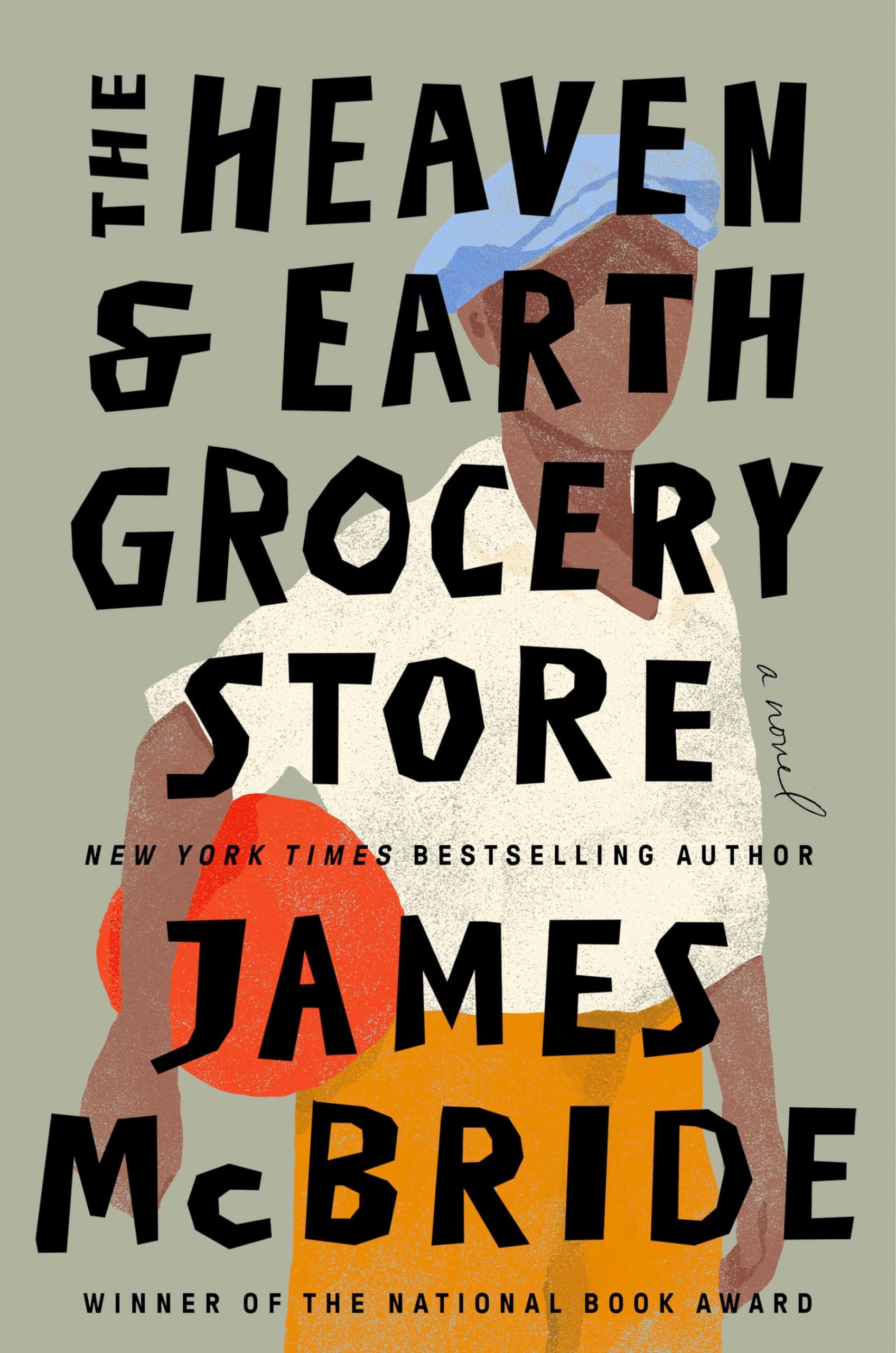
The Heaven & Earth Grocery Store: A Novel
Product ID: 505194631
Buy anything from 5,000+ international stores. One checkout price. No surprise fees. Join 2M+ shoppers on Desertcart.
Desertcart purchases this item on your behalf and handles shipping, customs, and support to Colombia.
The Heaven & Earth Grocery Store: A Novel [McBride, James] on desertcart.com. *FREE* shipping on qualifying offers. The Heaven & Earth Grocery Store: A Novel Review: It does move heaven and earth for the reader - James McBride is an accomplished saxophonist/jazz musician. I knew that going into the book. (Oh, digression--did you know that he also played with the band, The Remainders? That’s a band with other writers like Amy Tan, Dave Barry, Barbara Kingsolver, Stephen King, Maya Angelou and several others who played for charity and fundraising). Anyway, I mention his musicianship because I see it all over the pages of The Heaven and Earth Grocery Store. This is the first book I’ve read by McBride (definitely more to come), so pardon my schoolgirlish, giggly first crush for the way that his writing lifts me up, how his words and characters opened my heart, only to break it, and then put it back together in a most absolute and tender way. James McBride is a kind, gentle soul, and his writing reflects this—his ability to bring the world together in a novel. He honors humanity. We are all connected, and this author compels that naturally from his characters. Now, how great is that, yeah? I want to put this in your hands and promise you a magnificent reading experience. It starts off in a shaggy dog kind of way, with an ensemble of characters, several who possess whimsical names like Fatty, Big Soap, Monkey Pants, Dodo. And their names fit flawlessly to their nature. The story starts with a 1972 prologue—a human skeleton is found in an old abandoned well, and then the body of the story begins in 1936 in Pottstown, Pennsylvania, a place called Chicken Hill, where Jews, immigrants, and Black folks lived side by side, sometimes in harmony, other times in discord, but here’s the thing—the goodness of people, the kindness of their hearts—that is what ultimately rises to the top. For the story to unfold, there has to be some sinister aspects, too—aren’t we still fighting the fight of ignorance, bigotry, corruption, meanness? But, in the McBride world, well, we also follow the long stretch of yarn as it wends around this way and that, through streets and backyards, dirt roads, onto hills and a shul and a church, through tunnels and a dance hall. And The Heaven and Earth Grocery Store. I don’t need to rehash the plot, but there are a few fun facts about this book worth mentioning in a review. Such as, there are an abundance of characters introduced early on, and then again later on, before the plot actually launches. That’s the shaggy part. We don’t get to the plot too quickly—instead, Mcbride takes his time, builds the characters. They are already leaping off the pages by the time the plot rolls in. There are subplots, too, but in the end, they all weave their chords and come together. McBride may slow your roll at first, but it’s a winning bonanza of breadth and depth, from the smallest detail to the broadest design. Scenes that seem initially inconsequential become key notes later on. Early on, we meet the arresting Jewess, Chona. Chona is an unforgettable female protagonist—I’m keeping her in my journal of best. female. characters. ever. She is handicapped with a limp—but her limp doesn’t stop her strength of purpose, her fierce dignity, her bounteous benevolence, her gentle grace, and her consummate integrity. You will fall in love with her, just like Moshe, the theater and dance hall owner, did. Moshe and Chona dared to welcome change and inclusivity to their part of the world. At this time, in the 1930s, Black people were almost exclusively cast in menial jobs. But Moshe books Black jazz bands to play at his theater, and successfully includes all tribes together at the dance hall, who “frolicked and laughed, dancing as if they were birds enjoying flight for the first time.” Chona runs the grocery store, and extends credit to anyone who can’t afford to pay; she rarely keeps a record of their debt. The Heaven and Earth Grocery Store may lose money, but it is rich in goodwill and kindness. Back to this being like a musical book—a jazzy book. Jazz music conjures that raspy, soulful, edgy flavor, blended from a mix of cultures and harmonies. McBride embraces those diverse, insistent, zingy, soul-stirring rhythms and blues into the narrative threads of his novel. I can hear the swing and the chase, the boogie and the blues, the sounds that go everywhere at once and jelly roll the story within a complex set of fusion and feelings. It’s also just a damned good story! The narrative pulls you here and there, up and down, and when you meet Dodo, the sweet and barely teenaged deaf kid, your protective instincts will wrap yourself around him and never want to let him go. And, when Dodo meets Monkey Pants—well, this right there—the heart of the novel that will break you in pieces. At times, I had a wellspring of tears—not just for joy or anguish. Sure, comedy and tragedy fill these pages. But McBride’s natural humanity and gentle nature is the colossal, phenomenal heart of the book. The author steps aside, he doesn’t ever intrude. The core of the narrative are the characters. Their cacophony becomes a coda for living large. This tale made me want to be better, to do better, to open my eyes to all the missed connections, to fix the broken chords and forge new ones, and seek eternally to strengthen them. We are humanity, we are the essential substance to add love to the world, one modest good deed at a time. That is The Heaven and Earth Grocery Store. Review: tough but excellent read - This book is about faith in all forms, and how sometimes we let our trust in God, either as an excuse or as a balm, keep us from taking agency in our own lives. There's an interesting divide between characters who put their faith in prayer and an overarching plan and God's timing, and those who have different beliefs, maybe sharing space with more traditional religion in their souls, who are spurred to act when needs must. The titular grocery store in the book is run by Chona, who lives her convictions, calling out injustice and extending credit and charity to the community around her in the once-mixed but mostly Black area where she lives. The good she puts out in the world touches every other character in the book, and when she dies, every other character is spurred in some way to action. She and her husband are hiding an orphan boy who the state wants to institutionalize in their store, he is discovered under terrible circumstances, and stories converge around it. This is one of those books where the author skillfully plants tiny seeds throughout and they grow and tangle together until all the disparate plots and threads comes together in the end. The writing is lovely, with talk of the town's founder's "portrait looming in every town building, the old man's face peering over every citizen's shoulder like a ghost taking attendance" and "slices of his memory fluttered back like pages in a book." The book takes place for the most part in the 1930s, except for a couple instances of flash forward references to the (our present) future, with "they didn't realize it but one day there would be cell phones or school shootings" asides. I just didn't see how we needed it. This book is about the cancer of white supremacist thought and the mistreatment of immigrants, the injustice of the carceral state especially how it affects Black people, and the shocking small mindedness and protective husbanding of who gets to live the American Dream in the 1930s. I think I can follow the breadcrumbs to present day fairly easily without anyone pointing the way. The author is undeniably good, and the story was important and interesting. The mixing of Black and Jewish immigrant neighborhoods, and how that stands in contrast with the "older" white parts of town is an area of American history I hadn't spent a lot of time in. But it's a rough read, particularly when we see the playbook that motivates the worst characters here being used in society today. I do, however, wish I had the gravitas to pull off "Come set down here and feel some of the Lord's quiet." when people are talking too much. CW for two attempted/initiated SA on page, and description of CSA off page in past.


| Best Sellers Rank | #15,667 in Books ( See Top 100 in Books ) #71 in Black & African American Literature (Books) #138 in Historical Fiction (Books) #180 in Literary Fiction (Books) |
| Customer Reviews | 4.4 4.4 out of 5 stars (74,035) |
| Dimensions | 6.2 x 1.2 x 9.26 inches |
| ISBN-10 | 0593422945 |
| ISBN-13 | 978-0593422946 |
| Item Weight | 2.31 pounds |
| Language | English |
| Print length | 400 pages |
| Publication date | August 8, 2023 |
| Publisher | Riverhead Books |
S**N
It does move heaven and earth for the reader
James McBride is an accomplished saxophonist/jazz musician. I knew that going into the book. (Oh, digression--did you know that he also played with the band, The Remainders? That’s a band with other writers like Amy Tan, Dave Barry, Barbara Kingsolver, Stephen King, Maya Angelou and several others who played for charity and fundraising). Anyway, I mention his musicianship because I see it all over the pages of The Heaven and Earth Grocery Store. This is the first book I’ve read by McBride (definitely more to come), so pardon my schoolgirlish, giggly first crush for the way that his writing lifts me up, how his words and characters opened my heart, only to break it, and then put it back together in a most absolute and tender way. James McBride is a kind, gentle soul, and his writing reflects this—his ability to bring the world together in a novel. He honors humanity. We are all connected, and this author compels that naturally from his characters. Now, how great is that, yeah? I want to put this in your hands and promise you a magnificent reading experience. It starts off in a shaggy dog kind of way, with an ensemble of characters, several who possess whimsical names like Fatty, Big Soap, Monkey Pants, Dodo. And their names fit flawlessly to their nature. The story starts with a 1972 prologue—a human skeleton is found in an old abandoned well, and then the body of the story begins in 1936 in Pottstown, Pennsylvania, a place called Chicken Hill, where Jews, immigrants, and Black folks lived side by side, sometimes in harmony, other times in discord, but here’s the thing—the goodness of people, the kindness of their hearts—that is what ultimately rises to the top. For the story to unfold, there has to be some sinister aspects, too—aren’t we still fighting the fight of ignorance, bigotry, corruption, meanness? But, in the McBride world, well, we also follow the long stretch of yarn as it wends around this way and that, through streets and backyards, dirt roads, onto hills and a shul and a church, through tunnels and a dance hall. And The Heaven and Earth Grocery Store. I don’t need to rehash the plot, but there are a few fun facts about this book worth mentioning in a review. Such as, there are an abundance of characters introduced early on, and then again later on, before the plot actually launches. That’s the shaggy part. We don’t get to the plot too quickly—instead, Mcbride takes his time, builds the characters. They are already leaping off the pages by the time the plot rolls in. There are subplots, too, but in the end, they all weave their chords and come together. McBride may slow your roll at first, but it’s a winning bonanza of breadth and depth, from the smallest detail to the broadest design. Scenes that seem initially inconsequential become key notes later on. Early on, we meet the arresting Jewess, Chona. Chona is an unforgettable female protagonist—I’m keeping her in my journal of best. female. characters. ever. She is handicapped with a limp—but her limp doesn’t stop her strength of purpose, her fierce dignity, her bounteous benevolence, her gentle grace, and her consummate integrity. You will fall in love with her, just like Moshe, the theater and dance hall owner, did. Moshe and Chona dared to welcome change and inclusivity to their part of the world. At this time, in the 1930s, Black people were almost exclusively cast in menial jobs. But Moshe books Black jazz bands to play at his theater, and successfully includes all tribes together at the dance hall, who “frolicked and laughed, dancing as if they were birds enjoying flight for the first time.” Chona runs the grocery store, and extends credit to anyone who can’t afford to pay; she rarely keeps a record of their debt. The Heaven and Earth Grocery Store may lose money, but it is rich in goodwill and kindness. Back to this being like a musical book—a jazzy book. Jazz music conjures that raspy, soulful, edgy flavor, blended from a mix of cultures and harmonies. McBride embraces those diverse, insistent, zingy, soul-stirring rhythms and blues into the narrative threads of his novel. I can hear the swing and the chase, the boogie and the blues, the sounds that go everywhere at once and jelly roll the story within a complex set of fusion and feelings. It’s also just a damned good story! The narrative pulls you here and there, up and down, and when you meet Dodo, the sweet and barely teenaged deaf kid, your protective instincts will wrap yourself around him and never want to let him go. And, when Dodo meets Monkey Pants—well, this right there—the heart of the novel that will break you in pieces. At times, I had a wellspring of tears—not just for joy or anguish. Sure, comedy and tragedy fill these pages. But McBride’s natural humanity and gentle nature is the colossal, phenomenal heart of the book. The author steps aside, he doesn’t ever intrude. The core of the narrative are the characters. Their cacophony becomes a coda for living large. This tale made me want to be better, to do better, to open my eyes to all the missed connections, to fix the broken chords and forge new ones, and seek eternally to strengthen them. We are humanity, we are the essential substance to add love to the world, one modest good deed at a time. That is The Heaven and Earth Grocery Store.
J**E
tough but excellent read
This book is about faith in all forms, and how sometimes we let our trust in God, either as an excuse or as a balm, keep us from taking agency in our own lives. There's an interesting divide between characters who put their faith in prayer and an overarching plan and God's timing, and those who have different beliefs, maybe sharing space with more traditional religion in their souls, who are spurred to act when needs must. The titular grocery store in the book is run by Chona, who lives her convictions, calling out injustice and extending credit and charity to the community around her in the once-mixed but mostly Black area where she lives. The good she puts out in the world touches every other character in the book, and when she dies, every other character is spurred in some way to action. She and her husband are hiding an orphan boy who the state wants to institutionalize in their store, he is discovered under terrible circumstances, and stories converge around it. This is one of those books where the author skillfully plants tiny seeds throughout and they grow and tangle together until all the disparate plots and threads comes together in the end. The writing is lovely, with talk of the town's founder's "portrait looming in every town building, the old man's face peering over every citizen's shoulder like a ghost taking attendance" and "slices of his memory fluttered back like pages in a book." The book takes place for the most part in the 1930s, except for a couple instances of flash forward references to the (our present) future, with "they didn't realize it but one day there would be cell phones or school shootings" asides. I just didn't see how we needed it. This book is about the cancer of white supremacist thought and the mistreatment of immigrants, the injustice of the carceral state especially how it affects Black people, and the shocking small mindedness and protective husbanding of who gets to live the American Dream in the 1930s. I think I can follow the breadcrumbs to present day fairly easily without anyone pointing the way. The author is undeniably good, and the story was important and interesting. The mixing of Black and Jewish immigrant neighborhoods, and how that stands in contrast with the "older" white parts of town is an area of American history I hadn't spent a lot of time in. But it's a rough read, particularly when we see the playbook that motivates the worst characters here being used in society today. I do, however, wish I had the gravitas to pull off "Come set down here and feel some of the Lord's quiet." when people are talking too much. CW for two attempted/initiated SA on page, and description of CSA off page in past.
J**.
McBride has another stunning novel
This novel is set in Pottstown, PA, a grimy eastern Pennsylvania factory town, not far from where I grew up. The characters (in the 70's) are the town's black residents and Jewish immigrants living on "Chicken Hill" which is the "wrong side of the tracks." The town's chief doctor marches feebly disguised as the Grand Wizard of the Klan (and as you know they aren't any fonder of Jews than black folks) and people are going through that struggle to create a business and make a go of life in the United States, away from the horrors of Europe or the Jim Crow South--and creating their own heaven-or hell on Earth. The book has an almost fairytale or fantasy quality to the story telling, the characters are roughly drawn with larger-than-life attributes; an ability to tell the future, a hunchback or lame leg, a boy deafened by a domestic accident. The quality of the storytelling is also rather timeless--it could have been set in the 19th century, as well as the mid 20th. I started reading and couldn't put it down for a minute--grabs you page one. So if you love any other of McBride's books or the stories of Alice Walker or Toni Morrison or E. Annie Proulx, you'll love this too.
B**S
Good book
Very good book with a very good story thank you.
R**A
Didn’t enjoy the book at all . The story was a good one , but the unravelling of the plot was uninteresting, and language difficult to follow Disappointing book
H**F
James McBride has a gift of embracing the reader with both arms and guiding them through each page with honesty and humor. His characters are painted with layers of complexity and compassion. This book left me with hope and endearment for humanity.
J**P
Heel goed geschreven. Heelnmooi maar ook droevig verhaal. Mooie karakterschetsen.
R**N
A beautiful moving story, couldn’t put it down ! I loved each character & didn’t want it ever to finish!!
J**U
Ein hervorragendes Buch!
Trustpilot
3 days ago
1 month ago