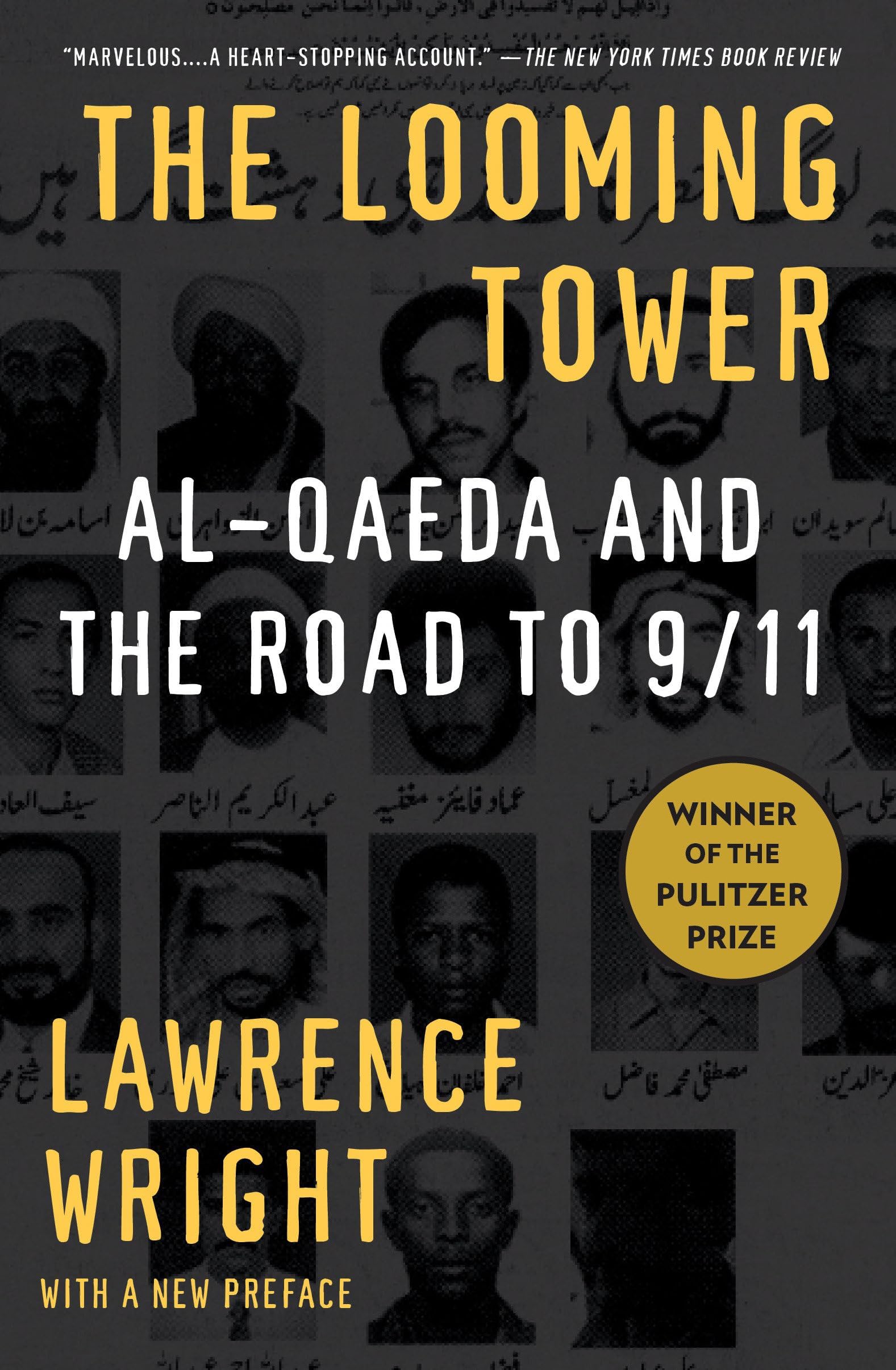
The Looming Tower: Al-Qaeda and the Road to 9/11
Product ID: 4630008
Buy anything from 5,000+ international stores. One checkout price. No surprise fees. Join 2M+ shoppers on Desertcart.
Desertcart purchases this item on your behalf and handles shipping, customs, and support to Colombia.
NATIONAL BESTSELLER • PULITZER PRIZE WINNER • A “heart-stopping account of the events leading up to 9/11” ( The New York Times Book Review ), this definitive history explains in gripping detail the growth of Islamic fundamentalism, the rise of al-Qaeda, and the intelligence failures that culminated in the attacks on the World Trade Center. One of the New York Times ’s 100 Best Books of the 21st Century • A Kirkus Reviews Best Nonfiction Book of the Century • A Los Angeles Times Best Nonfiction Book of the Last 30 Years In gripping narrative that spans five decades, Lawrence Wright re-creates firsthand the transformation of Osama bin Laden and Ayman al-Zawahiri from incompetent and idealistic soldiers in Afghanistan to leaders of the most successful terrorist group in history. He follows FBI counterterrorism chief John O’Neill as he uncovers the emerging danger from al-Qaeda in the 1990s and struggles to track this new threat. Packed with new information and a deep historical perspective, The Looming Tower is a sweeping, unprecedented history of the long road to September 11. Review: Captivating! - Well-researched and based on a carefully constructed timeline, The Looming Tower reveals facts about the rise of al-Qaeda and the 9/11 attacks that most readers will find surprising. For instance, a common misconception is that Osama Bin Laden was wealthy and therefore able to self-fund the training and equipping of al-Qaeda fighters. In Lawrence Wright's account, we learn instead that while certainly wealthy, Bin Laden's strength is as a prolific fundraiser. He is able to tap both wealthy Arab governments and private donors, particularly as he demonstrates al-Qaeda's increasing lethality. Much more significant perhaps, Wright portrays Bin Laden as a master of public relations. Indeed, he demonstrates early on that his charisma and soft-spoken charm could both inspire followers and unleash horrific violence. In the lead up to 9/11 Bin Laden captures the imagination of disaffected but well-educated young Muslim males searching for validation and a deeper meaning in their lives. Already steeped in traditional Muslim thought (many studied in madrasses in Western Pakistan), these individuals merely need a catalyst and some direction for their aims and readily find it in Bin Laden's radical proselytizing. Proving Josef Goebbels' famous quote, "make the lie big, make it simple, keep saying it, and eventually they will believe it", Bin Laden convinces his followers that America (and its staunch ally, Israel) is the source of all persecution in the Islamic world. He eventually gains a critical mass of converts and hence a blunt instrument to wage global jihad. The scheme to strike at the soft underbelly of American 'infidel' society and the means to do it are born. Wright also exposes the many seams in the U.S. national security infrastructure and schisms within the law enforcement and intelligence organizations that existed prior to 9/11. Ironically, those same intelligence organizations were created with the single purpose of detecting and preventing terrorist attacks. Simply tragic... The mosaics the author pieces together in developing his characters (based on scores of interviews) bring to life such leading U.S. counterterrorism officials as Richard A. Clarke and John P. O'Neill. These individuals' relentless efforts to protect America's domestic and international interests undoubtedly prevent countless attacks. Yet, as Wright alludes, their persistent demands to go on the offense against an emergent al-Qaeda are stymied by poor communication and internecine rivalries between government agencies combined with bureaucratic inertia and simple inaction on the part of our country's political leaders. The Looming Tower traces the roots of al-Qaeda to radical Islamic organizations such as Egyptian Islamic Jihad and the Muslim Brotherhood and fiery Islamic scholars like Sayyid Qutb and Dr. Abdullah Yusuf Azzam. We learn that while their extreme views prove a source of discomfort for mainstream Islamic governments - they espouse violent uprising to achieve their ends - their aggressive activism is largely contained. Interestingly, despite Azzam's pleas for moderation, Bin Laden exhorts his charges to commit suicide bombings as a means of achieving al-Qaeda's aims (and those of greater Islam) while punishing America for 'occupying' the Arabian Peninsula. Additionally, we discover that Ayman al-Zawahiri and Bin Laden find refuge and a sympathetic ear in failed states such as Somalia, Sudan, and Afghanistan and co-opt their governments to help nurture and train radicals for jihad. Their demands ever more insistent and their attacks growing in ferocity, Islamic extremists in the Bin Laden era gain a new sense of urgency. Yet, incredibly, despite many alarm bells Western intelligence agencies remain unable to convince their governments of the seriousness of the threat posed by al-Qaeda. Wright pieces together through hundreds of interviews each militant Islamist plot from the 1993 World Trade Center bombing through the 2000 USS Cole suicide attack. He painstakingly traces the steps of the jihadists as they gradually ratchet up the stakes while leaving unmistakable clues as to their grand design. Only a handful of astute, hyper-vigilant FBI and CIA agents grasp the significance of those clues, but their voices are seemingly drowned out by the bureaucracy with, of course, calamitous results. The Looming Tower ranks with Rohan Gunaratna's Inside Al Qaeda and Steve Coll's Ghost Wars in its narrative sweep. Not nearly as dense as the Pulitzer Prize-Winning Ghost Wars, The Looming Tower combines the right amount of detail with the author's lighter prose style. Wright manages to entertain as much as he informs. Perhaps most enjoyable about Wright's book, it details unusual aspects of his characters' personalities that make them seem more human. Bin Laden, the devoted family man; John O'Neill, the sentimental romantic; and, Richard Clarke, the ambitious product of blue collar roots... These are the figures who grace Wright's pages. And a truly fascinating cast of characters it is! Lawrence Wright's book, though a work of investigative journalism, reads like a Greek tragedy. A sobering insider's look at the first (and arguably most) serious threat facing the West in the 21st Century and an immensely satisfying read... Captivating! Review: Know the Enemy - "So it is said that if you know others and know yourself, you will not be imperiled in a hundred battles; if you do not know others but know yourself, you win one and lose one; if you do not know others and do not know yourself, you will be imperiled in every single battle". --- Sun Tzu's The Art of War Our troops are in Iraq...still. They are there as a consequence of 9/11. Obviously, this is not news. Why did 9/11 happen? Who were those guys who hijacked those jets and committed suicide by flying them into the Twin Towers? We know they were all Muslims and this attack on America had something to do with these guys being Muslims. I ask you all, who of you knows much more than that? Do you know the enemy? We don't hardly even spend much, if any, time thinking about those Mid-Eastern guys and why they did what they did. We should. We better. Whether we like it or not, this is World War III folks. Many of us think the big issue of the day is what to do about our troops in Iraq. Do we leave things as they are and continue ad infinitum? Do we send more troops? Do we bring the troops home? Saddam Hussein is dead...Mission Accomplished - as our President declared over three years ago. But, as you're all aware, the violence in Iraq is escalating. The issues are bigger folks. What is the answer? I don't know. I don't think anybody knows. Do any of you know a Muslim? Have you ever read the Kuran/Koran? Do you know the difference between a Sunni and a Shiite? What do you really know about Osama bin Laden? It is long past time for all of us to educate ourselves, to find the answers to all these questions. World War III is upon us. We must know the enemy. There is a book. There are many books we can and should read to begin to find the answers, but I highly and unequivocally recommend that every American begin to find the answers by reading the following book: THE LOOMING TOWER Al-Qaeda and the Road to 9/11 by Lawrence Wright. Published by Alfred A. Knopf, New York, 2006 "A sweeping narrative history of the events leading to 9/11, a groundbreaking look at the people and ideas, the terrorist plans and the Western intelligence failures that culminated in the assault on America. Lawrence Wright's remarkable book is based on five years of research and hundreds of interviews that he conducted in Egypt, Saudi Arabia, Pakistan, Afghanistan, Sudan, England, France, Germany, Spain, and the United States...Brilliantly conceived and written, The Looming Tower draws all elements of the story into a galvanizing narrative that adds immeasurably to our understanding of how we arrived at September 11, 2001. The richness of its new information, and the depth of its perceptions can help us deal more wisely and effectively with the continuing terrorist threat."------ part of the book's introduction. I bought my copy through [...]. A few days ago I shared with you my thoughts about Al Gore's movie An Inconvenient Truth. Today its World War III. Sounds like its all doom and gloom but it isn't...not if we take our heads out of the sand and face reality. Education is the beginning. There are answers. Please distribute this email as far and as wide as you are able. Happy New Year to one and all! George Collins


| Best Sellers Rank | #22,877 in Books ( See Top 100 in Books ) #215 in World History (Books) |
| Customer Reviews | 4.6 out of 5 stars 4,479 Reviews |
T**T
Captivating!
Well-researched and based on a carefully constructed timeline, The Looming Tower reveals facts about the rise of al-Qaeda and the 9/11 attacks that most readers will find surprising. For instance, a common misconception is that Osama Bin Laden was wealthy and therefore able to self-fund the training and equipping of al-Qaeda fighters. In Lawrence Wright's account, we learn instead that while certainly wealthy, Bin Laden's strength is as a prolific fundraiser. He is able to tap both wealthy Arab governments and private donors, particularly as he demonstrates al-Qaeda's increasing lethality. Much more significant perhaps, Wright portrays Bin Laden as a master of public relations. Indeed, he demonstrates early on that his charisma and soft-spoken charm could both inspire followers and unleash horrific violence. In the lead up to 9/11 Bin Laden captures the imagination of disaffected but well-educated young Muslim males searching for validation and a deeper meaning in their lives. Already steeped in traditional Muslim thought (many studied in madrasses in Western Pakistan), these individuals merely need a catalyst and some direction for their aims and readily find it in Bin Laden's radical proselytizing. Proving Josef Goebbels' famous quote, "make the lie big, make it simple, keep saying it, and eventually they will believe it", Bin Laden convinces his followers that America (and its staunch ally, Israel) is the source of all persecution in the Islamic world. He eventually gains a critical mass of converts and hence a blunt instrument to wage global jihad. The scheme to strike at the soft underbelly of American 'infidel' society and the means to do it are born. Wright also exposes the many seams in the U.S. national security infrastructure and schisms within the law enforcement and intelligence organizations that existed prior to 9/11. Ironically, those same intelligence organizations were created with the single purpose of detecting and preventing terrorist attacks. Simply tragic... The mosaics the author pieces together in developing his characters (based on scores of interviews) bring to life such leading U.S. counterterrorism officials as Richard A. Clarke and John P. O'Neill. These individuals' relentless efforts to protect America's domestic and international interests undoubtedly prevent countless attacks. Yet, as Wright alludes, their persistent demands to go on the offense against an emergent al-Qaeda are stymied by poor communication and internecine rivalries between government agencies combined with bureaucratic inertia and simple inaction on the part of our country's political leaders. The Looming Tower traces the roots of al-Qaeda to radical Islamic organizations such as Egyptian Islamic Jihad and the Muslim Brotherhood and fiery Islamic scholars like Sayyid Qutb and Dr. Abdullah Yusuf Azzam. We learn that while their extreme views prove a source of discomfort for mainstream Islamic governments - they espouse violent uprising to achieve their ends - their aggressive activism is largely contained. Interestingly, despite Azzam's pleas for moderation, Bin Laden exhorts his charges to commit suicide bombings as a means of achieving al-Qaeda's aims (and those of greater Islam) while punishing America for 'occupying' the Arabian Peninsula. Additionally, we discover that Ayman al-Zawahiri and Bin Laden find refuge and a sympathetic ear in failed states such as Somalia, Sudan, and Afghanistan and co-opt their governments to help nurture and train radicals for jihad. Their demands ever more insistent and their attacks growing in ferocity, Islamic extremists in the Bin Laden era gain a new sense of urgency. Yet, incredibly, despite many alarm bells Western intelligence agencies remain unable to convince their governments of the seriousness of the threat posed by al-Qaeda. Wright pieces together through hundreds of interviews each militant Islamist plot from the 1993 World Trade Center bombing through the 2000 USS Cole suicide attack. He painstakingly traces the steps of the jihadists as they gradually ratchet up the stakes while leaving unmistakable clues as to their grand design. Only a handful of astute, hyper-vigilant FBI and CIA agents grasp the significance of those clues, but their voices are seemingly drowned out by the bureaucracy with, of course, calamitous results. The Looming Tower ranks with Rohan Gunaratna's Inside Al Qaeda and Steve Coll's Ghost Wars in its narrative sweep. Not nearly as dense as the Pulitzer Prize-Winning Ghost Wars, The Looming Tower combines the right amount of detail with the author's lighter prose style. Wright manages to entertain as much as he informs. Perhaps most enjoyable about Wright's book, it details unusual aspects of his characters' personalities that make them seem more human. Bin Laden, the devoted family man; John O'Neill, the sentimental romantic; and, Richard Clarke, the ambitious product of blue collar roots... These are the figures who grace Wright's pages. And a truly fascinating cast of characters it is! Lawrence Wright's book, though a work of investigative journalism, reads like a Greek tragedy. A sobering insider's look at the first (and arguably most) serious threat facing the West in the 21st Century and an immensely satisfying read... Captivating!
G**S
Know the Enemy
"So it is said that if you know others and know yourself, you will not be imperiled in a hundred battles; if you do not know others but know yourself, you win one and lose one; if you do not know others and do not know yourself, you will be imperiled in every single battle". --- Sun Tzu's The Art of War Our troops are in Iraq...still. They are there as a consequence of 9/11. Obviously, this is not news. Why did 9/11 happen? Who were those guys who hijacked those jets and committed suicide by flying them into the Twin Towers? We know they were all Muslims and this attack on America had something to do with these guys being Muslims. I ask you all, who of you knows much more than that? Do you know the enemy? We don't hardly even spend much, if any, time thinking about those Mid-Eastern guys and why they did what they did. We should. We better. Whether we like it or not, this is World War III folks. Many of us think the big issue of the day is what to do about our troops in Iraq. Do we leave things as they are and continue ad infinitum? Do we send more troops? Do we bring the troops home? Saddam Hussein is dead...Mission Accomplished - as our President declared over three years ago. But, as you're all aware, the violence in Iraq is escalating. The issues are bigger folks. What is the answer? I don't know. I don't think anybody knows. Do any of you know a Muslim? Have you ever read the Kuran/Koran? Do you know the difference between a Sunni and a Shiite? What do you really know about Osama bin Laden? It is long past time for all of us to educate ourselves, to find the answers to all these questions. World War III is upon us. We must know the enemy. There is a book. There are many books we can and should read to begin to find the answers, but I highly and unequivocally recommend that every American begin to find the answers by reading the following book: THE LOOMING TOWER Al-Qaeda and the Road to 9/11 by Lawrence Wright. Published by Alfred A. Knopf, New York, 2006 "A sweeping narrative history of the events leading to 9/11, a groundbreaking look at the people and ideas, the terrorist plans and the Western intelligence failures that culminated in the assault on America. Lawrence Wright's remarkable book is based on five years of research and hundreds of interviews that he conducted in Egypt, Saudi Arabia, Pakistan, Afghanistan, Sudan, England, France, Germany, Spain, and the United States...Brilliantly conceived and written, The Looming Tower draws all elements of the story into a galvanizing narrative that adds immeasurably to our understanding of how we arrived at September 11, 2001. The richness of its new information, and the depth of its perceptions can help us deal more wisely and effectively with the continuing terrorist threat."------ part of the book's introduction. I bought my copy through [...]. A few days ago I shared with you my thoughts about Al Gore's movie An Inconvenient Truth. Today its World War III. Sounds like its all doom and gloom but it isn't...not if we take our heads out of the sand and face reality. Education is the beginning. There are answers. Please distribute this email as far and as wide as you are able. Happy New Year to one and all! George Collins
M**.
“Wherever you are, death will find you, even in the looming tower.” — Quran 4:78
This is a thoroughly researched book that describes the family background, recent history, and influences on Osama bin Laden, the beginning of al-Qaeda, and the events that led to the attacks of September 11, 2001. This book took me so long to read because it is so chock-full of information and threads of events I either didn’t know about, or didn’t realize were connected, I ended up buying a used copy once I started reading my library check-out, just so I could highlight passages that were critical to understanding (I also needed to buy another highlighter when my first one ran out of ink), so this kind of slowed me down a bit. Since there are so many names of people involved, many with similar names, or people who disappear only to pop up again sometime later, I was very grateful for the detailed playlist of principle characters provided, in addition to a map of the region, an index, and a bibliography. The author describes bin Laden’s father, Mohammed bin Laden, a wealthy and well-connected man responsible for building a ramp to the Royal palace and a previously unattainable road over the al-Sarawat Range, which united the Kingdom of Saudi Arabia, thus garnering favor with the Royal family, who subsequently appointed him honorary minister of public works. His growing reputation and Royal connections allowed for him to expand his businesses throughout the country, and at a time of financial difficulty, he loaned a substantial amount of money to the Royal family when the banks would not, further solidifying his relationship with the Royals. Growing up in this privileged life, his 17th son, Osama bin Laden, also enjoyed a close relationship with the Royal family. Since he was further down the ladder in the order of sons, there were no positions of power within his father’s companies for him to assume, so he was left to “make his own way”. Of course, he was also provided a monthly stipend, so he never actually had a job, and this would be his primary source of income and how he financed his terrorist organization for much of his life. Surprisingly, he comes across as rather aimless and ineffective, lacking ambition or his father’s keen business sense. Without his father’s money to support him and his endeavors, it seems to me he would have become an unknown farmer, pontificating to his wives, children, and neighbors about the presence of Americans in the Middle East. It is only due to his father’s money and his willingness to spend it on the disillusioned masses that he found an audience for his disgruntled rantings and financially supported their destructive, rage-fueled fantasies of Islamic dominance. While the book initially includes various events that occurred overseas, the author points out that bin Laden hadn’t really done anything at that point, and the events he publicly took credit for were events he had little to nothing to do with, so for some time, his reputation was being built on exaggerations or flat-out lies. His organization did continue to grow, but ignoring the aid of hindsight, there truly does not appear to the average reader to be a connection to the US that was overlooked by the authorities. There were, however, a handful of fastidious US intelligence agents who monitored bin Laden and those he financed throughout the 1990s, and they did see connections, but when they alerted others to the potential dangers posed by the largesse of this largely unknown man, without a direct or specific threat to the US, they were ignored. This error was further compounded by the folly of American bureaucracy and the unwillingness of the FBI, CIA, and NSA to work together and share information, which resulted in several missed opportunities. This is what I believe to be the crux of the “road to 9/11”: our intelligence agencies provided the unobstructed path with their lack of communication and teamwork. If each agency had not been so busy trying to keep any information they had away from the other agencies, they would have realized that they each possessed pieces of information that, when fit together, would have provided them with a better idea of what was going on, and could have led to the capture of key al-Qaeda members that would have thwarted their plans. Instead, their continued secrecy and stubbornness allowed known al-Qaeda members to enter the US and without hindrance, they were free to develop their plans. On another disconcerting note, the author also points out that bin Laden knew he could not win a fight with Americans on US soil, and sought to devise a plan that would bring the fight to him, on “a large-scale front which it cannot control”, where American soldiers “cannot stand against warriors of faith who do not fear death”. Since Islamic extremists believe that jihad never ends, they would have generations of radical, resentful, and repressed Muslims, mesmerized by the myth of martyrdom, to fight the “eternal war” to defend Islam. We played right into his hands, waging war on their soil, where we have been for well over a decade now, without an exit strategy or an end in sight. The author has done a fantastic job of writing a comprehensive history that creates a broader picture for the average reader to get a better understanding of how events that occurred a continent away would have rippling effects here in the US years later. This should be required reading for all.
-**-
The Looming Tower
The Looming Tower, by Lawrence Wright, traces the history of Al-Qaeda from its roots in Egypt and Saudi Arabia to Afghanistan and Pakistan and finally to the 9/11 attacks on the World Trade Center and the Pentagon. Wright's narrative begins in Egypt, where the humiliation of the Arab states in the 1948 war and popular disgust with King Faisal helped build support for Islamic fundamentalists. There, the Muslim Brotherhood, using a structure of secret cells with no more than five members each, built a powerful political, economic, and social force. However, Egypt's geography did not favor guerilla warfare, and Egypt's secular governments brought force to bear to suppress the Brotherhood and other radical Islamic movements. In Saudi Arabia, the intolerant Wahhabi sect was "a dam against the overwhelming, raging river of modernity" that accompanied exploitation of the country's oil resources. According to Wright, radical fundamentalism was also a reaction against royal ostentation and displays of wealth. The collapse of oil prices in the 1980s accentuated stresses within Saudi Arabia. According to Wright: "Radicalism usually prospers in the gap between rising expectations and declining opportunities. This is especially true where the population is young, idle, and bored; where the art is impoverished; where entertainment - movies, theater, music - is policed or absent altogether; and where young men are set apart from the consoling and socializing presence of women." In 1979, a Palestinian cleric named Abdullah Azzam issued a fatwa against the Soviets and helped convince 3,000 Arabs to move to Peshawar, Pakistan where they expected to support the Afghan mujahideen. His emphasis on martyrdom "created the death cult that would one day form the core of al-Qaeda." While this force had no practical impact in the conflict with the Soviets - Wright says most members never left Peshawar - Osama bin Laden was able to exploit a "David and Goliath" myth to enhance his prestige. Bin Laden split from Azzam in 1990 to form al-Qaeda, and he returned to Saudi Arabia a hero. Expelled for his criticism of Saudi cooperation with the United States after Iraq's invasion of Kuwait, he moved to Sudan. There, he enjoyed a bucolic life until 1996, when the United States pressured Sudan's government to expel him. By now, the Saudi government had confiscated bin Laden's share of his family's construction business, and Sudan's government confiscated nearly all of his remaining wealth when he was forced to leave Sudan. Hereafter, bin Laden would be dependent on external financing to keep al-Qaeda in operation. In Afghanistan again, bin Laden set up camps that, according to Wright, trained 10 to 20 thousand Sunni fighters. These were not the dreamers and posers that came to Peshawar in the 1980s. These were educated men who had lived in Europe or the United States and spoke several languages. Many of them were not very religious before joining al-Qaeda. The United States focused on bin Laden and al-Qaeda as an unambiguous threat after the embassy bombings in Kenya and Tanzania in 1998. But, according to Wright, U.S. intelligence and military forces were not well prepared to respond to this type of unconventional threat. In retaliation for the bombings, the United States fired $750 million worth of cruise missiles at a pharmaceutical plant in Sudan and at bin Laden's camps in Afghanistan, but only a handful of al-Qaeda members were killed. At this point, bin Laden and his organization were a liability to the Taliban. It was not in the Taliban's interests to allow bin Laden to turn the United States into an enemy by planning and launching attacks from Afghanistan. In fact, Wright says, Mullah Omar had already reached an agreement in principle to turn bin Laden over to the Saudi government. But these considerations were discarded when bin Laden pledged his "personal fealty" to Mullah Omar and recognized his authority as his "noble emir." From this point onward, a friendship developed between the men and Mullah Omar defended bin Laden against complaints by other members of the Taliban. Wright's book ends with an account of the 9/11 attacks themselves, focusing on John O'Neill, a former FBI agent who became the World Trade Center's security chief just a few days before the attacks. Wright's account of the attacks is deeply disturbing and includes details that other writers have omitted, possibly from a sense of delicacy. It is best written account I have seen. Wright is critical of poor communication within the U.S. intelligence and law enforcement communities on al-Qaeda's intentions. He attributes this poor communication not to legal obstacles, but to a fear that arrests and prosecutions would allow al-Qaeda to learn too much about U.S. intelligence gathering activities. The Looming Tower has three principal strengths that distinguish it from similar histories. First, Wright includes enough information about his principal characters to make them three-dimensional: bin Laden is not just an evil plotter, he is also "the most daring terrorist in history" and his "commitment and relentlessness" are "unequaled." O'Neill is not just an indefatigable FBI agent locked in a contest with bin Laden, he is also a deceitful womanizer who runs up large debts. Second, Wright is careful with his evidence and discloses its limitations. Third and finally, Wright can write. The narrative rushes along, pulling the reader through the book to its final, violent denouement.
A**R
The definitive and chilling history of Al-Qaeda
Lawrence Wright's Pulitzer Prize-winning The Looming Tower is the best history of Al Qaeda and Osama Bin Laden that I have come across. Wright traces not just the history of the terrorist, but the fascinating if disturbing history of Saudi Arabia and other parts of the Middle East, where religion was more intimately linked with people's way of life than in any other nation in the world, and where a perception of the world engendered by old tribal customs and anti-Western attitudes fanned hate and extremism that was nonetheless seen by its practitioners to be essential to maintain their culture and religion- a point that has been sadly lost on Westerners. As CIA agent and bin Laden expert Michael Scheuer says, they don't attack the US because of "its freedoms". They attack the US because they see the US as interfering in their quintessential Islamic way of life, what they hold dearest, irrespective of whether it's justified or not. They are as much in love with Islam as any one ever was with any entity. That is what is frightening. Wright traces the roots of extremism in the Middle East through Saudi Arabia's history, where extreme and primitive religious traditions juxtaposed strangely with immense wealth driven by exploration for oil. It was in this milieu, after World War 2 that Osama Bin Laden and Ayman Al-Zawahiri grew up and acquired a taste of jihad. Often lucidly Wright talks about the environment where they spent their childhoods, and brings the rustic Saudi Arabian landscape to life. Wright also talks about the enduring influence of Syed Qutb, the devout Egyptian religious scholar who was disturbed by what he perceived as the hedonistic coed culture of the United States, when he visited the country as an exchange scholar in the 1950s. It was his writings and his image as a martyr- Qutb was jailed and executed as an extremist in Egypt- that greatly inspired Bin Laden's and Al Zawahiri's calls for worldwide Jihad. Wright also documents in considerable detail both Bin Laden's and Al-Zawahiri's transformation from educated, well-to-do moderates to extremist radicals in love with the Quran and martyrdom. Bin Laden's extremism was only set aflame during the Soviet invasion of Afghanistan, and Wright vividly describes the deadly brotherhood and romantic visions of martyrdom that bound the Jihadis together in that war-torn country. It only helped that Bin Laden had the money to draw followers and finance missions. After that, it was only natural and a small step before Bin Laden turned his already brainwashed and transformed psyche towards the US. On this side of the Atlantic, Wright also narrates the urgent and often heartbreaking efforts of the few CIA and FBI agents who recognized Bin Laden's threat in the 90s, the marginalized Michael Scheuer among them. The central tragic figure in the book is John O'Neill, the brilliant, swaggering but restless and tormented FBI agent who was desperate to snare Bin Laden, often fighting tenaciously against the foot-dragging and bureaucracy in the government agencies. A man who never achieved satisfaction in life, O'Neill was a heavy drinker who lived with three women at the same time. After many failed attempts to capture Bin Laden and convince the administration to be more serious about the threat- a journey that along with some other dedicated FBI agents led him around the world from Africa to the Middle East- O'Neill finally had enough and took up a new position as head of security...at none other than the World Trade Center. O'Neill could have escaped in the initial attacks. But keeping with tradition, he decided to go inside the flaming towers to save others. The man who more than almost anyone else had been trying to catch or kill Bin Laden tragically perished inside the World Trade Center on 9/11. Wright's book is a gripping treatment of an urgent subject. It demonstrates what fearsome power religion can summon, how it can completely transform the minds of men in the service of romanticized deadly causes, how blind ideology can have devastating and heartbreaking consequences. It shows us how the Middle East is largely and tragically still a land stuck in time, where irrational beliefs and tribal brotherhood can manifest in the most violent ways. The story of these gentle-looking, pious Jihadis is chlling by any standards. It is yet another illustration of the insidious nature of religious faith. It deserves to be read, and we all deserve to read it and think about what we can do to stop such fanaticism. The leader of the United States is not even close when he says that the men of Al Qaeda are cowards and fanatics. They are anything but that; they are cold, calculating, determined men who have dedicated their lives to what they see as the most just cause in their lives. They need to be stopped at any cost, and understanding where they come from will be the first step in trying to do that.
B**N
Captivating account of events leading to 9-11
Lawrence Wright has written an utterly absorbing book that will both captivate and appall you, and not just because of his recounting of the breathtaking horrors that took place on September 11, 2001. Equally appalling is Wright's depiction of the entrenched bureaucrats at the CIA, FBI and the National Security Agency, who failed to share crucial information with one another because of petty personal differences and agency cultures that value conformity above true investigative ability. Had the CIA, in particular, released information regarding the whereabouts of several individuals who ultimately participated in the 9-11 attacks, those tragedies might well have been prevented. Reading these things was deeply painful for me, who watched the Trade Towers collapse as I sped across Queens trying to get home to my family in Brooklyn Heights. I can only imagine how distressing this experience might be to those who lost friends and loved ones in the attacks that day. Yet Wright has handled this difficult material in a way that makes it bearable to read, and his pacing of the story is masterful. The Looming Tower reads like a suspense novel at times and the writing is lyrical. The book is also chock full of pertinent facts and background material that help make sense, insofar as that is even possible, of the motivations of the terrorists. I have never seen logic in the tactics of al Qaeda and similar groups, but this book has helped me understand that logic is not the driving force. Rather it seems to be history, the pursuit of a tribal conception of "honor" and a desire to recreate past glory that is far more important than logic. Wright connects those dots to paint a picture of the "terrorist" that is far more three-dimensional than the one that Bush Administration officials and the media have given us. There are also a number of oddball facts and anecdotes that enliven The Looming Tower and add to its interest. For example, Wright relates a tidbit that highlights the so-called "clash of cultures" better than anything I've read to date: "[Jamal al-Fadl] would become al-Qaeda's first traitor. He offered to sell his story to various intelligence agencies in the Middle East, including the Israelis. He eventually found a buyer when he walked into the American Embassy in Eritrea in June 1996. In return for nearly $1 million, he became a government witness. While in protective custody, he won the New Jersey Lottery." There are lots of other gems in this book, including some nearly unbelievable tales about John O'Neill, who would be the hero (or perhaps anti-hero) of Wright's book, if it had a hero, which it doesn't. You should really buy The Looming Tower right away and read it for yourself.
T**H
THE book to read if you ever want to know why 9/11 happened
I like to read a lot. I owned the hard copy version of The Looming Tower and because I have well over 500 other books on my shelves, hadn't gotten around to reading it. Then I downloaded the iPod audiobook version which ended up grasping me totally. Finally I bought a Kindle and The Looming Tower now resides there as well. The book is an incredible story of 9/11 and those who made, and let it happen as well as those who tried as hard as they could to prevent it. One of the latter was an FBI agent who is as complex a character as full of flaws as a human can be but if there is a hero in this book, it's him -warts and all. He was killed on 9/11 trying to save people in the WTC. Why is this book so good? Because it really delves into the mind set of those who made it happen from bin Laden and his henchmen, to a certifiable "nut case", a Sayyid Qutb whose repressed sexuality and heavens knows what else drove him to father the current version of Islamic fundamentalism. It's easy to realize what sort of sociopaths are drawn to this belief system, but America has its own nut case fundamental religious zealots be they Jewish or Protestant. They range from harmless "speaking in tongues" types and rattle snake handlers to "W", who is as motivated by religious fundamentalism as is bin Laden. "W" has at least permitted and encouraged wiretapping and torture to deal with the violent brand of Arab crazies who wish a lot worse than 9/11 on us. It may seem out of line to those shuddering in horror at our loss of liberty, but so far there are no more 9/11s in the USA. I was born in 1938 and remember WW2 [barely] but know enough history to know that when you are at war, you should spare no effort in totally destroying the enemy as we did in WW2 with the Japanese and Germans. After spending 20 years in the military, I only became more convinced that war should occur only if you mean business. Bringing "democracy" to Iraq is a sick joke. "W" should have watched Lawrence of Arabia and maybe he might have gotten a clue of the inevitable morass that awaited those stuck in the tar of Iraq. In WW2 we weren't worried about locking up presumably innocent Japanese, or censorship of all letters from our soldiers. All this under a president who many Americans considered the political equivalent of Stalin, or the equivalent of a socialist's greatest hope. Today the liberals are still worrying about the loss of freedoms, but freedoms can return AFTER the war. Whether they will is another story. The fault with our current miasma of political manure lies with us citizens. What we see in Congress, not to mention the executive and judicial branches merely reflect America's citizens own lack of care, education and hedonism. But I digress. The Looming Tower is an incredible "morality tale" and Greek tragedy wrapped up in one. Hubris abounds, those idiots responsible for the debacle are named, although it is apparent that none suffered career reversals for their poor performance with the exception of the two people who saw it coming and couldn't stop it - FBI agent O'Neill and Richard Clarke. Clarke was smeared by Bush gunsels from Limbaugh to other White House staff thugs who fear the truth as a vampire fears sunlight. Condoleza Rice is shown as witless and also very much responsible for 9/11 because when presented with reality she couldn't think clearly or was driven by political expediency to the wrong decision - i.e. ignoring the threat. The book is NOT a hatchet job on anybody. You get to see all the characters responsible on both sides and there is little to no judgmental criticism. As Det. Friday used to say on Dragnet, for those of you ancient enough to remember him, "Just the facts, M'am. Just the facts." Much as I hate to swallow my atavistic tendencies to dismiss the likes of bin Laden and his cronies as crazy "rag heads", you will understand the character attributes that made his hellish plans come to fruition, and they certainly did not start with 9/11. I can only wish we had the likes of him to conduct our own war on the terrorists, although fortunately Cheney comes close. Read this book. You can only grow wiser and sadder from the experience.
T**C
The Inside Story of al-Qaeda -- a Must-Read
Lawrence Wright's "The Looming Tower: Al-Qaeda and the Road to 9/11" tells the story of the rise of al-Qaeda and some of the early U.S. government attempts to thwart al-Qaeda. This is an interesting, well-researched, and well-written book, although it does not tell the whole story. Wright begins his story with some of the early Egyptian Islamists who formed the Muslim Brotherhood. Their writings and actions formed the foundation for al-Qaeda. Then he tells the story of Osama bin Laden - first his father's rise to wealth and influence in Saudi Arabia, then the personal story of Osama bin Laden, his work in Pakistan, his time in Sudan, his adoption of extreme Islami and founding of a terrorist network, and finally his fleeing to Afghanistan under the Taliban. Wright tells not only the public story of these men but also their private lives - who they married, their children, their relationships with their wives, and other interesting details that are little-known to most. Finally, Wright tells the story of the FBI's counterterrorism efforts, especially those run by John O'Neill, who was driven by his belief that al-Qaeda would strike the U.S., but whose personal life read like a soap opera. Wright's story is very well-researched. He traveled extensively throughout the Middle East and interviewed over 500 people for this book. However, despite all of this research, Wright does not quite tell the whole story of al-Qaeda and the path to the 9/11 attacks. Some of these holes are in his own story; for example, Wright makes it a point to stress that Osama bin Laden was broke when he fled Sudan and that the time in Afghanistan with the Taliban was a frugal one, but he never explains how al-Qaeda was able to find the funding for 9/11 or for al-Qaeda's continued existence. He also tells of the early rise of the Taliban but never finishes the story of how they secured power in Afghanistan. But this is an important and informative book that sheds light on America's enemy. Wright also illuminates some of the inter-agency problems and barriers that hampered the U.S. government's ability to foil terrorism before 9/11. Because Wright does not quite tell the whole story, readers of "The Looming Tower" should also read Steve Coll's "Ghost Wars: The Secret History of the CIA, Afghanistan, and Bin Laden, from the Soviet Invasion to September 10, 2001" for more background on Afghanistan and Terry McDermott's "Perfect Soldiers : The 9/11 Hijackers: Who They Were, Why They Did It" for the personal stories of the 9/11 hijackers.
M**T
Excellent. Unique.
Livre en anglais. On comprend le prix Pulitzer pendant la lecture et aussi en voyant à la fin de l'ouvrage la liste des personnes rencontrées, plus de cinq cent, la bibliographie sur onze pages, les commentaires sur cinquante pages. Partant des débuts avant le sujet principal, il raconte toute l'histoire des luttes, conflits, mouvements, personnes ayant fini par conduire au 9/11. Tout est détaillé, précis, méticuleusement suivi dans le temps et l'espace. Le lecteur fait plus qu'apprendre, il découvre, il comprend, enfin ! L'auteur fait partager l'évolution des idées, mais aussi les doutes, les hésitations, les craintes de tous les acteurs de cette tragédie. Il les situe constamment dans le contexte de l'histoire du 9/11 que nous avons suivi, ce qui donne de très bons repères chronologiques et permet de situer le récit dans le contexte des informations des média du moment. Et on comprend bien qu'on ne savait pas tout, pas plus la CIA que le reste du monde. Vraiment excellent.
A**O
Recommended to anyone looking in gaining a well researched and narrated insight on the topic
Very interesting and well written book, it gives you an insight into the events that led to 9/11 in a novel-like way, therefore making it an easy read. Recommended to anyone interested in this very current topic.
M**N
Excellent Account Of The Events Leading To 9/11 - And The MP3 Audio Book Version Is Well Done
This is the best book I've read about the events leading to 9/11. It won a Pulitzer Prize in 2007, and deservedly so. The author's research is thorough, his writing style is very good and he presents the information in a very interesting way, tracing al-Qaeda's ideological and philosophical roots through Islamic theorists like Sayeed Qutb and Ayman al-Zawahiri up to Osama bin Laden. He also examines the US positions and actions in exhaustive detail by concentrating on several key FBI and CIA figures. His account of Saudi Arabian political and security arrangements comes primarily from a Saudi Prince who was ousted as the Kingdom's Chief of Intelligence after 9/11. In short, a fascinating book. If you want to understand 9/11, this book should be at the top of your reading list. The mp3 audio book is well done. The reader does a good job with the material and the writer's style adapts easily to narration. My only complaint with the audio book is that the individual audio tracks are often divided in the middle of sentences and/or paragraphs, so there are frequent short delays and pauses in the narration in the middle of sentences and paragraphs as the player changes tracks. But that's a technical production issue which does not reflect in any way on the quality of the author's work. But overall, this is an excellent book and audiobook. If you only have time or money for one book about 9/11, this one would be a good choice.
S**A
Gripping and Riveting!
This narrative is sweeping and magisterial in scope. What is intriguing is that even though the various pieces of the jigsaw puzzle was available with different agencies, petty and personal issues came in the way to prevent this tragedy.
A**.
The Towers - how and why.
Watching Tv when the towers fell, will always remain. A lot of questions often discussed with friends were answered. How could this happen? A lesson for organisations and in-fighting. Deeming always said problems like these are systems issues, appearing to be individual. A monumental price paid by 3,000 people.
Trustpilot
2 weeks ago
1 month ago