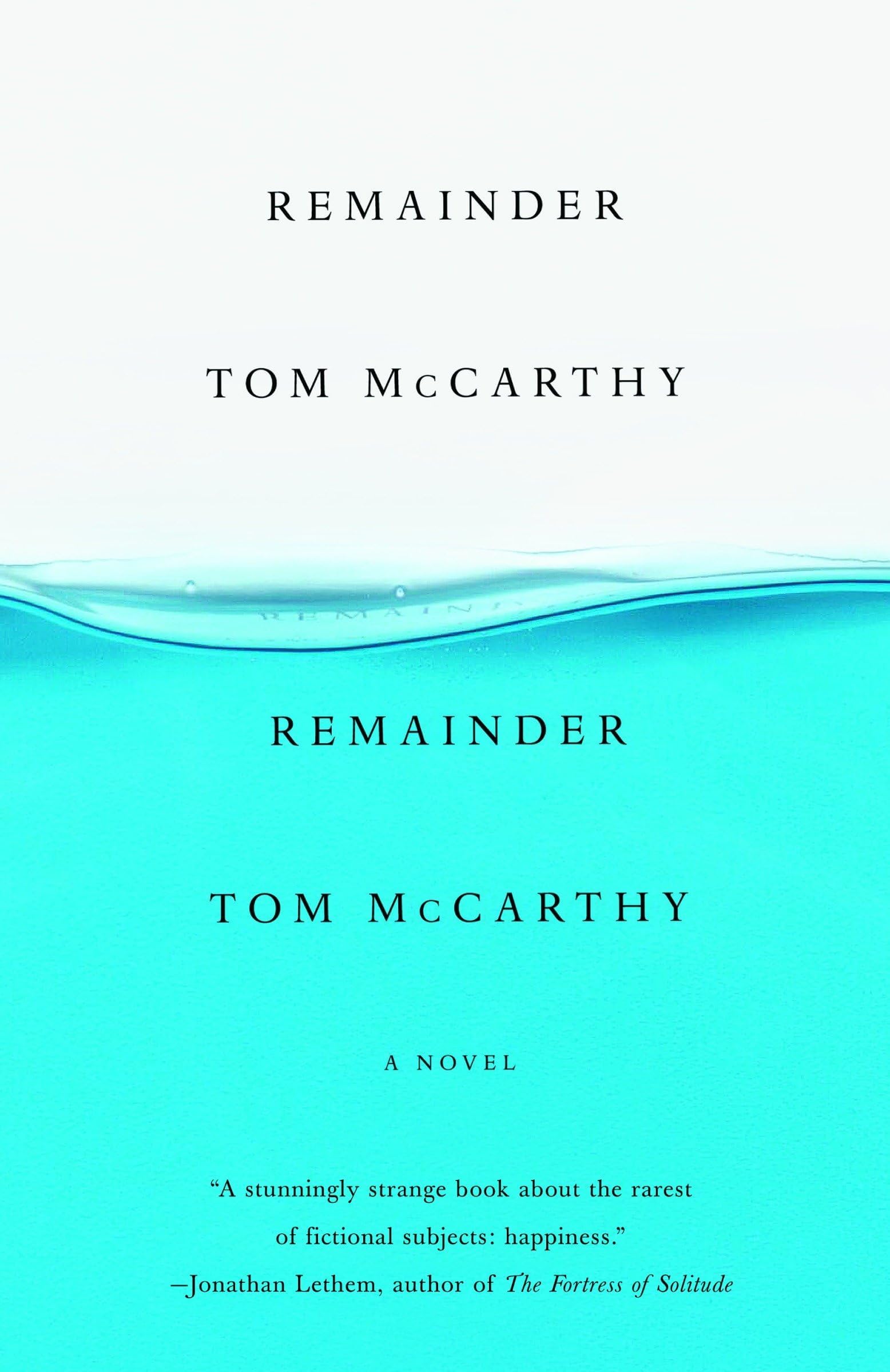
Remainder
Product ID: 4568275
Buy anything from 5,000+ international stores. One checkout price. No surprise fees. Join 2M+ shoppers on Desertcart.
Desertcart purchases this item on your behalf and handles shipping, customs, and support to Colombia.
A man is severely injured in a mysterious accident, receives an outrageous sum in legal compensation, and has no idea what to do with it. Then, one night, an ordinary sight sets off a series of bizarre visions he can’t quite place. How he goes about bringing his visions to life–and what happens afterward–makes for one of the most riveting, complex, and unusual novels in recent memory. Remainder is about the secret world each of us harbors within, and what might happen if we were granted the power to make it real. Review: Wow, what an excellent book! - I like it when a book can take the world and make you see it In a new way, to illustrate a new pattern and cadence in something you’ve seen before. Remainder is about a man who has sustained a brain injury, one which has forced him to relearn the use of his limbs, and thrown him into a mechanical sort of being, where he struggles to understand his own relation with and movement through the world. His memories too have become disjointed and separated from his reality, leading him to view the world as a kind of series of symbols and reflected patterns. He wishes to create an authentic state of being, whatever that means, and does so by becoming obsessed with recreating and examining certain moments ad nauseam. The accident which caused the narrator’s condition has also provided a settlement which made him wealthy, and with this money he produces recreations of mundane events. For example, he buys an apartment building and remodels it to match a memory he can’t place, with every detail in place from the stains on the carpets to the cracks in the walls. He hires actors to recreate certain scenes over and over again, such as an old lady taking out the trash who he passes by, rewinds, and passes by again, sometimes hundreds of times a day. The surreal atmosphere of the book reminds me of the film Synecdoche, New York, which covered some of the same themes. I think it captures some of the confusion of life, of trying to map a stream as it flows around you, and of playing a game whose rules are only revealed after you make your move. It captures some sense of the uncertainty of being, and the impossibility of truly understanding or controlling even the smallest aspect of being. Review: What Is Left When You Die? What Is Lost While You Live? - REMAINDER is about a man who has recently recovered from a near-fatal accident. He has been awarded an obscene amount of money as recompense for the tragedy, on condition that he never discuss its particulars. All you will learn is that it involved something falling from the sky. The narrator, having undergone extensive rehabilitation to learn again how to move and simply be, now finds himself at a remove from reality. While casting about for something to do with his newly acquired millions, he experiences a powerful jolt of deja vu and has the brilliant idea to recreate every aspect of that moment, from the cracks in the walls to the smells and sights of the world outside. What follows is an escalating examination on the nature of being as the man begins embarking on ever more complicated recreations of reality, some mundane and others decidedly not so. As the man immerses himself ever more in simply being in these moments -- or analyzing them in excruciating detail -- he ironically begins to lose his grip on reality until, in the final portions of the novel, he finally learns a profound truth not only about what it means to exist perfectly, but also about how such a thing is almost certainly not possible. This is a truly brilliant and disorienting novel, and McCarthy's prose never misses a chance to linger over every detail. Since it is aggressively ontological, it may very well bore some people. Analyzing the nature of being is highly problematic from the get-go because such analysis requires observation, which is impossible apart from being. Our protagonist, recognizing this, tries to understand his recreations in every permutation, from within and without and above, and although he comes very close to achieving transcendence, it is at the expense of actually living. He argues at one point that he is not trying to understand anything, but there's a very real chance that the man has no idea what he's talking about. I found it a fascinating topic for a book, and the execution is nearly flawless. However, by its very nature, the subject matter gets a little tiresome in the second half of the novel. The exhaustive minutiae of the book's observations nearly obscures what it is trying to reveal. That may very well be part of the point, but that also makes certain segments of the story a chore to read, since they are repetitive, vague and overly specific at the same time. If you are a relentless analyst of life, if you often ponder what it all means, and if you have ever found yourself wishing you could contain, capture, collapse and expand a single moment to keep for the rest of your life, you should still give the book a try. Some parts may drag, but by the conclusion, McCarthy has found a way for the story (and your imagination) to soar.
| Best Sellers Rank | #226,310 in Books ( See Top 100 in Books ) #1,827 in Contemporary Literature & Fiction #2,512 in Psychological Fiction (Books) #9,499 in Literary Fiction (Books) |
| Customer Reviews | 3.8 out of 5 stars 477 Reviews |
J**Y
Wow, what an excellent book!
I like it when a book can take the world and make you see it In a new way, to illustrate a new pattern and cadence in something you’ve seen before. Remainder is about a man who has sustained a brain injury, one which has forced him to relearn the use of his limbs, and thrown him into a mechanical sort of being, where he struggles to understand his own relation with and movement through the world. His memories too have become disjointed and separated from his reality, leading him to view the world as a kind of series of symbols and reflected patterns. He wishes to create an authentic state of being, whatever that means, and does so by becoming obsessed with recreating and examining certain moments ad nauseam. The accident which caused the narrator’s condition has also provided a settlement which made him wealthy, and with this money he produces recreations of mundane events. For example, he buys an apartment building and remodels it to match a memory he can’t place, with every detail in place from the stains on the carpets to the cracks in the walls. He hires actors to recreate certain scenes over and over again, such as an old lady taking out the trash who he passes by, rewinds, and passes by again, sometimes hundreds of times a day. The surreal atmosphere of the book reminds me of the film Synecdoche, New York, which covered some of the same themes. I think it captures some of the confusion of life, of trying to map a stream as it flows around you, and of playing a game whose rules are only revealed after you make your move. It captures some sense of the uncertainty of being, and the impossibility of truly understanding or controlling even the smallest aspect of being.
M**E
What Is Left When You Die? What Is Lost While You Live?
REMAINDER is about a man who has recently recovered from a near-fatal accident. He has been awarded an obscene amount of money as recompense for the tragedy, on condition that he never discuss its particulars. All you will learn is that it involved something falling from the sky. The narrator, having undergone extensive rehabilitation to learn again how to move and simply be, now finds himself at a remove from reality. While casting about for something to do with his newly acquired millions, he experiences a powerful jolt of deja vu and has the brilliant idea to recreate every aspect of that moment, from the cracks in the walls to the smells and sights of the world outside. What follows is an escalating examination on the nature of being as the man begins embarking on ever more complicated recreations of reality, some mundane and others decidedly not so. As the man immerses himself ever more in simply being in these moments -- or analyzing them in excruciating detail -- he ironically begins to lose his grip on reality until, in the final portions of the novel, he finally learns a profound truth not only about what it means to exist perfectly, but also about how such a thing is almost certainly not possible. This is a truly brilliant and disorienting novel, and McCarthy's prose never misses a chance to linger over every detail. Since it is aggressively ontological, it may very well bore some people. Analyzing the nature of being is highly problematic from the get-go because such analysis requires observation, which is impossible apart from being. Our protagonist, recognizing this, tries to understand his recreations in every permutation, from within and without and above, and although he comes very close to achieving transcendence, it is at the expense of actually living. He argues at one point that he is not trying to understand anything, but there's a very real chance that the man has no idea what he's talking about. I found it a fascinating topic for a book, and the execution is nearly flawless. However, by its very nature, the subject matter gets a little tiresome in the second half of the novel. The exhaustive minutiae of the book's observations nearly obscures what it is trying to reveal. That may very well be part of the point, but that also makes certain segments of the story a chore to read, since they are repetitive, vague and overly specific at the same time. If you are a relentless analyst of life, if you often ponder what it all means, and if you have ever found yourself wishing you could contain, capture, collapse and expand a single moment to keep for the rest of your life, you should still give the book a try. Some parts may drag, but by the conclusion, McCarthy has found a way for the story (and your imagination) to soar.
B**T
Great start, tedious middle, crappy ending
This actually started out as one of the best books I have read in some time. Superb writing and interesting characters. Someplace in the middle, though, it starts to get tedious, and then just as it appears the story is going someplace again it falls completely off track.
J**G
Faust Redux
As the book begins, the narrator (never named) has just received an enormous financial settlement for a traumatic accident which is never quite revealed. With this money he tries to find a moment in time which will deliver him an epiphany, his Faustian "stay a while" moment. (For those needing a quick refresher: Goethe's Faust tells the devil he may have his soul if he can deliver a single moment so profound, so recondite, that Faust tells the moment, "Stay a while, you are so beautiful." The devil takes him all over the place, gives him all kinds of experiences, but in the end, Faust has a moment of bliss in spite of the devil's efforts, not because of them). But not just any epiphany, he has a specific scene in mind. And a bizarre scene it is. He buys an entire apartment building. He hires actors to live in the building, each in their own apartment, just practicing to be the person he requires them to be. He does this through a factotum he has hired expressly to make it all happen. He spends Croesean amounts of money to have people live his extravagant fantasy, and re-enact his dream, over and over again, until he decides he's done. Then he witnesses an incident on the street, involving a car and a bicycle, and spends even more money, using his same logistics manager, to re-enact that scene. And then he decides to re-enact yet another scenario, even more complicated than before. What is the narrator searching for? Does he finally achieve it, and if so, what form does it take? Or does he keep going, believing the moment will yet arrive? Did he achieve it, but miss it? Does he give up, understanding the moment will never come? Or does he realize he's already had that moment, and settle down? And if this is Faust, is there a devil? Is the devil the factotum, that logistics expert who gives him everything he requests? Or is it the narrator himself? After all, he is the one with all the power and money to make it all happen. Or maybe there is no devil at all; maybe the narrator is being driven by his own "inner demons", as it were. Personally I think the ending is brilliant. Yes, as other reviews have mentioned, it is a bit existential, a bit philosophical, a bit un-plotted; but I like the way McCarthy brings us to the conclusion, and shows us the choices the narrator ultimately makes, and lets us steep in the conclusion to live with our own thoughts and reactions. And the writing along the way is simply fantastic. I love the way McCarthy applies philosophical filters to everything, how he sees tangible objects and real happenstance in terms of events and interactions, some real and some inscrutable. A very thoughtful and deep book, a smart retake on the Faustian myth, and a satisfying read.
M**N
Disappointing, tedious and empty
I was looking forward to this novel, as the mysterious adjective 'experimental' had been applied in some of the blurbs I'd read. Having read it, I find the critical response utterly baffling--there really is no accounting for taste. The novel is really a long demonstration of a damaged psychological state. Neither the telling nor the condition were remotely interesting, provocative or insightful. The sum of what is said could have fit into a story less than 10 pages. Reams of the book are redundant to the point of self-parody. Imagine an autistic adult pounding middle C on the piano over and over again for 16 hours. Now imagine a writer describing that behavior in real time. That's what this book reads like. But then I find most ontological inquiries, as this book is, the best cure for insomnia ever written. So Mr. McCarthy has good company in that regard (Paul Auster, Virginia Woolf, Sartre...). If you are the type of person who sets an apple on a table, and wonders if the table or apple are real simply because they have mass and obey the laws of gravity, or maybe they aren't there at all but exist only because of societal pressure, or collective conscious, or whatever--if this question absorbs you for hours, well this is the book for you. The best I can say was stated in another post: "it's not poorly written."
R**S
How to waste a life being wasted
As I write this, I have not yet read the end of the story. I expect that I shall, but I am not expecting its ending will be much more than running out of energy and space to continue. I found the middle part of the story plodding but the beginning and the denouement well worth the read. If you read novels for pleasure alone, this one may well not satisfy. A reviewer on this site says the book tells the reader more about himself than about any other reality. I agree. It has me thinking about the purposes of ritual in my life, which always come mixed with the rewards of doing the familiar and the frustrations of having been there before many times. I have never ever been the same at two separate time periods. Yet I am the same person at all times, even when I am "not being myself." It could well be I see the story in those terms because philosopher Heidegger employs "the same" to be a mixture of identity and difference--both inescapable, reciprocally implicit, and bedeviling. Hence REMAINDER for me is a philosophical novel--hardly in the Iris Murdoch style, yet equally worthy in its contribution to the tradition of British think-pieces. PS. Now, a week after writing the above, I read the final chapter. It reminds me of what Hollywood did with "Howard, the Duck." It's not that the ending cannot match the build-up. One might also accuse Shakespeare of that. Is it Fowles who gives us two endings to choose from? Which is still pretty lame. Or you can choose which version of the flick "Brazil" suits you? But when in doubt, fall back on horror? Had to have a film script in mind at that point. Pity.
B**D
Creative Malice
I found this novel to be a completely effective, and thoroughly entertaining modern existential gem. It sparkles with wit and talent; It was dark, gruesome, hilarious, bizarre, and utterly original. The story of a misanthropic, almost Dostoyevskian victim of falling debris, mental imbalance, amnesia, and an evil imagination; a man turns injury into creative malice, trying to artificially rebuild a broken memory by staging the world around him until reality itself turns wretched, broken and false. See it as metephor, expressionism, or a claim on man's soul, vision, or insight...but see it as a comedy first, because it truly is one of the more risky and out-there comic takes on modern humanity I've yet come across. Virtuosic but somehow simplistic, a great summer read you won't soon forget.
M**O
"Oh, no no no. I say when it's over."
McCarthy's book is difficult to talk about without spoiling. That is often the case, but I will step especially lightly here. In short, Remainder is a stupendously imaginative piece of writing. I suppose it would have to be classified as existential, and the first-person narrator assumes the role of the seeker. Books of this ilk are often characterized by an oppressive tone, but here it's not as clear. Indeed, there are moments of wry hilarity as the narrator arranges his first reenactment. I laughed out loud, shaking my head. That same segment also contains an essential tedium, and some readers will probably be turned off by it. But it provides the crucial ground-zero for a pace that begins to accelerate. And, thematically, it's absolutely necessary. In addition to the intricately imagined, not-quite-straight world, it is this unity between writing and theme that makes Remainder so extraordinary. People looking for a light read are unlikely to enjoy this book, and may complain about the plot or the narrator. Those complaints are beside the point. However, potential readers of this fantastic novel should be prepared for an amusing, gripping, but occasionally laborious look at obsession and the quest for fulfillment.
E**E
A slow slap in the face or a fast kick in the head, can't decide which it is
While this book remains one of the most original concepts of the last years to come out of literature, it does have issues with its resolution. Maybe it's meant to, as our nameless protagonist is mental, after all. But unreliable narration aside, the whole reason he starts his project is never addressed in any way. I cannot decide if this is intentional, given McCarthy messes with the reader the whole book, and I do love the ending, but having no payoff at all is a difficult pill to swallow after so much dense text and problematic development. Maybe the payoff there is no payoff. If variation truly lies in repetition, I should read it again. I certainly haven't been able to stop thinking about it since I finished. And here I am, making no sense with this review. If you liked Hamsen's Hambre (3ª edición) (Biblioteca Nórdica) , or the movie Synecdoche, New York [DVD ], this book is exactly your kind of read. The protagonist is unable to control himself, he cannot control the reader, and however many times he repeats himself and sees different results, he can never get the result he is looking for. This book is highly recommended, despite its incredible demand for the reader. But don't read it if you are not willing to go with anything that happens, because it's easy to see from reviews here that if you try and take just a crumb of expectation in with you, you won't come out of it in one piece.
W**Y
Watch for falling space junk...
The moment that I finished Tom McCarthy’s Remainder, I began reading it again, slower this time; often pausing and re-reading a particular passage 10 or 20 times over again. I would spend hours going over a single sentence to the point where the words entirely lost their meaning and the very act of reading became the mechanical exercise of my eyes discerning the white space between the black of the type. At one point in the process of turning page 97 over to page 98, I became so enthralled by the way that the texture of the paper fell away from my fingertips and settled so serenely under my opposite thumb that I spent the rest of the afternoon reliving this moment, practicing that exact transition from 97 to 98 until I could do it effortlessly and exactly every time. Other days I would lie in the bath and simply think about reading the book as it sat on my bedside table and that would be enough. Any and all of the above methods for fully appreciating Remainder should be taken under strict advisement by the reader; however, if you begin to experience black outs or mild seizures, then I must advise that you consult a physician immediately.
S**T
Great book worth reading
Great book
S**M
Don't take too close a look at life!
Does it occasionally happen to you that particular detail in your field of vision attracts, then absorbs your attention and becomes, for a brief moment, larger than life? Children have this capacity to read the world in its smallest details, which are very real to them, but then their horizons don't yet much extend beyond the small world around them. Grown ups tend to disregard the insignificant detail as mere trifle, larger perspectives are what makes their world view. Now imagine viewing and construing your world again from such trifling observations. A crack in the wall, viewed as a path to a long forgotten past. Repetitive piano tunes defining your acoustic world. The smell and sizzling noise of liver being fried in oil. Then start to reconstitute a world from these details - and ask yourself, where this might take you. The hero of Tom McCarthy's breathtaking novel does just that. Having survived an accident which involved some unknown object falling from the sky, he receives compensation and suddenly finds himself a rich man. A chance observation sets in motion the kind of train of thought sketched above: He begins to reconstruct a more authentic world than the one he lives in from trifling details which he arranges according to some felt, but never quite explicit plan. To this end he recruits the help of man people, building up and simulating his imaginings in every precise detail. It is his aim to get reality perfectly right, and to this end scenes are acted, or more precisely, re-enacted numerous times until every detail is just perfect. But the hero fails to grasp reality to the extent he had expected. This drives him on into the re-enactment of of scenes taking from the real life around him. But what starts in a harmless way, when a particular event at a filling station is re-enacted, takes on an ever more frightening aspect when the hero turns to scenes of murder. And, eventually, to a scene, that has not had its counterpart in the real world yet. Tom McCarthy has written a gripping and yet witty, sometimes even funny story which follows a crystal clear and inescapable logic: If you start to rethink reality in a quest for authenticity you will, inevitably, unless you stop in time, run into the risk of shaping reality. You might then end up in the air, as the hero does, going in circles between what is real and what is unreal.
リ**ち
イライラが極限に
ずいぶんと絶賛された作品のようで、間違いなく面白かろうと読み始めた初日は好印象。二日目はちょっと細かいなぁ、くどいなぁと違和感。ここで半分。三日目に残りを読み上げたのは、面白くてやめられないからではなくて、イライラがどんどんつのって、早く結末にたどり着きたいという一心から。微熱で体調の悪い中読むには最悪の本でストレスが3倍増。せめてラストはカタルシスがあるかと思ったが・・ストーリーはある日、空からの落下物で危うく命を落としかけた若い男が巨額の賠償金(通常の事故とは桁が違う)を得るところから始まる。事故前後の記憶がすっぽり抜け落ち、退院後の生活に現実感を持てなくなった男は大金を投じて奇妙なヴィジョンの再現にのめりこむが、次第に正気を失っていく。
Trustpilot
2 months ago
5 days ago