

Buy anything from 5,000+ international stores. One checkout price. No surprise fees. Join 2M+ shoppers on Desertcart.
Desertcart purchases this item on your behalf and handles shipping, customs, and support to Colombia.
โก Keep your ride readyโsolar-powered peace of mind, wherever you park!
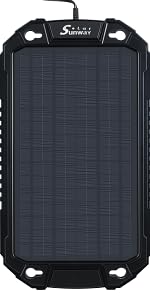
The Sunway 1.5W Amorphous Solar Battery Charger is a compact, durable, and easy-to-use solar maintainer designed to keep any 12V vehicle battery topped up. Featuring an amorphous solar panel that charges efficiently even in low light, built-in reverse charge protection, and a convenient cigarette lighter plug, itโs the perfect eco-friendly solution for maintaining battery health during long idle periods. Ideal for cars, motorcycles, boats, and RVs, this charger prevents battery drain without risk of overcharging, ensuring your vehicle is always ready to go.


| AC Adapter Current | 0.13 Amps |
| ASIN | B06WP95W51 |
| Amperage Capacity | 0.13 Amps |
| Best Sellers Rank | #12,989 in Patio, Lawn & Garden ( See Top 100 in Patio, Lawn & Garden ) #8 in Solar Battery Chargers & Charging Kits |
| Brand | Sunway Solar |
| Brand Name | Sunway Solar |
| Connector Type | cigarette lighter plug |
| Customer Reviews | 4.2 out of 5 stars 3,161 Reviews |
| Included Components | cigarette lighter adapter, battery alligator terminal clamps |
| Item Dimensions L x W x H | 13.9"L x 5.04"W x 0.55"H |
| Item Weight | 640 Grams |
| Manufacturer | Sunway Solar |
| Manufacturer Part Number | SWS-C2W001 |
| Material | Glass |
| Material Type | Glass |
| Maximum Power | 1.5 Watts |
| Maximum Voltage | 12 Volts |
| Model Number | dca72e5d-f776-4f55-acb6-418d5da553fe |
| Product Dimensions | 13.9"L x 5.04"W x 0.55"H |
| Special Features | Amorphous solar panel, reverse charging protection, LED indicator |
| Unit Count | 1 Count |
N**E
Works great
Short answer: Contrary to some of the negative reviews speaking about "warping", "discharging your battery" and other such things, it works exactly as advertised. I drive the test vehicle only a handful of times per year, so it sits outside for months on end sometimes which is bad for batteries, they like to be topped off all the time due to their internal chemistry. Long answer: I'm an Electrical Engineer so I did a few basic tests, with the following findings and some recommendations: NOTES: DO NOT leave the panel plugged in when starting or driving, spikes in the line might cause damage to the circuitry. It could fail and then put a load on the battery in that case. NO test for weather/water resistance was conducted, I have yet to test it in the winter time, which is a more challenging time for it and batteries too. I'm optimistic it will work ok given what I've seen so far. I tested this resting on the dashboard (no suction cups, I wouldn't trust that ever), with clear view of the sky facing generally slightly east of North during mid-late August, near the Washington DC area using a cigarette lighter connection with the supplied adapter. (it's FUSED, and works with a NEGATIVE ground socket/system, i.e. most everything not vintage) Some people have said the cig cable polarity is backwards, but in order to work as a CHARGER, the + connects to + as it should! Btw, the BLUE LED does NOT adversely effect the performance, and need not be "disabled" as some have claimed. The numbers I'm reporting are all with the unit as delivered, no modifications were made. 1) NO Battery discharge when dark (i.e., it doesn't drain your battery in the dark, or ever due to internal diode) Tested on the bench as well with a power supply and ammeter. 2) NO WARPING of case in direct sun 8hrs/day mid latitude US East Coast in August. (measured CABIN peak temps up to 117 deg, low of 69F, dash probably hotter in direct sun). ABS plastic has a glass transition temp (i.e. warping) around 105C (221F) so IF it is actually ABS, no melting/warping seems possible at temps found in cars NOT on fire lol! 3) For a HEALTHY battery, it MAINTAINS charge easily overcoming a parasitic drain in my vehicle of 9mA or (0.009Amps), and still puts a NET 44mA (0.044Amps) charging current INTO the battery in direct noon sun, and a NET positive charge current (in clouds/overcast), albeit only 7.3mA. In only 1 sunny day (and overnight) my new battery @ 12.34v went to 12.55v from this device. This is because it is a HEALTHY battery. The max open circuit voltage of the charger I measured around 22v but it can only deliver 1.5W max so you aren't going to hurt the battery with such low currents, and at best charging currents are only present up to about a 1/3 the time during a 24 hr period I'd estimate. NOTE: A dead/failing battery cannot be rescued by this or any charging device, and my prior failed battery at 12.24v (after 2 day commercial charge from "dead") with this same device under same summer conditions in 2 days went down to 12.01v and failed to turn over the engine! After the attempt it was down to 11.5v, clearly no good. I think this is suited as a MAINTAINER, don't bother thinking this will "charge" a vehicle battery. I drive that vehicle very very rarely, so this will keep the battery ready to go without having to periodically start it every few weeks to charge it up. Temperature and time will reduce the efficiency of the panel, but there is a 4x margin in my case (with a 9mA parasitic drain, which is quite small). If your car has a lot of electronic features, security systems etc, your parasitic drain could be more than this can even put out. In that case you would need a bigger higher power panel (this is only 1.5W). To measure the parasitic drain: with all vehicle doors shut, pull the main battery fuse and put an ammeter there, since it will measure absolutely everything, using any other fuse will only get a subset of what your battery drain is. Start with the maximum scale (typically 10A) to be safe, switch to smaller scales once you know the range. Let the initial connection settle since there will be a surge for a bit as all the electronics initialize and settle into a steady state. My vehicle settled in about 5 seconds (an after market CD player self test used 250mA during that 5 seconds) In principle, some sensors and other fancy stuff could spike some current periodically, but this couldn't be known without a logging ammeter. In all likelihood it won't boost the average drain in any significant way from your measured steady state.
M**.
Good product
Works great as long as you have a good battery to begin with. If your battery is already dead it is not going to necessarily charge it but will maintain a good battery. Bought several of these to use on multiple cars over the winter and for cars that sit for long periods of time.
J**I
Charger can't fix stupid
For the uniformed a 12 v battery is fully charged when it is 12.9 volts. 12.2 is 50% discharged. 12.0 will not even start your average vehical. Before trying to tend a unused battery first fully charge then 1 leave battery hooked up overnight to be sure I have no parasitic loads and if the voltage drops overnight u may have to unhook positive lead to vehical when stored or charger won't keep up. If no parasitic loads then also from full charge let battery sit overnight unhooked from everything and rest baytery check voltage after 6 or 8 hr and watch going forward from there for a day or so. If batt voltage continues to drop after resting voltage is achieved battery has a dead cell it's junk no charger will help. If storing in FULL SOUTHERN sun try to set it in a slightly less glaring spot than at the dash. Be conch
N**!
Very reliable
Easy to use. Mount to my boat to keep the batteries charged during the winter. Have used them for three years without any issues.
F**1
Good value, fast shipping
Need a battery trickie charger? This is the one. Will not charge a battery below 12v but does an excellent job of maintaining a charged battery. Highly recommennded
A**R
Mine doesn't seem to produce current power
I'm measuring 0 watts. 0 amps. Using a solar power meter and also using a fluke power meter.
S**.
It's OK
First the suction cups fell off into the defrost vent. A spare set was in the packaging, so I put them on and used a bit of electrical tape to hold them in place. Over about two weeks, the ball at the end of the suction cups (yes both) broke off. Now there are no suction cups. The solar panel seems to collect light even on overcast days, however my battery in my 2020 Tacoma still dies over about two weeks or less. Of course Toyota says the battery is fine and nothing wrong with the vehicle. But the solar trickle chargers fault. It seems like the panel should be enough, but I guess itโs not. Time for an AGM battery. The Pandemic has caused my truck to sit for longer periods of time....I donโt think I would purchase this again, but I would try one that is bigger perhaps. Update- Now the case has cracked. Before I even noticed the crack the case was separating. It still works but it's not a year old and already has minor issues. I don't think I would but this again hard on durability alone.
S**R
Excellent (but be careful where you place it)
EDIT: I ended up returning these, because the batteries slowly lost their charge over a couple of weeks. Maybe I should have bought the ones with a higher wattage! However, I'm leaving them at 5 stars, because they do put out the advertised amperage. PS, I installed quick-disconnects instead; they do a fantastic job of preventing battery discharge. *************** I have a couple of cars that haven't been driven much because of COVID lockdowns. We could go out & drive them around each week, to keep the batteries charged, but my wife & I have a second home so, when we are there, we couldn't do that. As a result, whenever we came back home, both batteries were discharged. So, I bought two of these 1.5W solar trickle chargers. I installed them both on the inside of the cars' windshields. I didn't want them outside, because (i) they could be stolen and (ii) they might get rain damage. Neither of the windshields is tinted, so I didn't think it would make much difference. They were in almost full sun much of the day (and where I live, we get a LOT of sunny days). I decided to use a voltmeter to measure the output, and (for both units) I got about 18V, and 8 milliamps. Watts = V x A, so that indicated an output of (18 x 0.008) = 0.144W - which is only about 10% of advertised. I wasn't too happy, so I emailed tech support. They replied very promptly and politely asked me to send photos of how I was testing the voltage & current. So the next day (also sunny) I went outside, and repeated the test (and got the same results). BUT, then I decided, to be fair, to repeat the tests, but this time with the unit on top of the windshield (that is, outside the car) rather than inside. And doing that made a HUGE difference. Voltage = 20V; current = 71 mA. So, wattage was now 1.42 = MUCH closer to spec. Time will tell (i) if this will keep the batteries charged and (ii) if the units can withstand rain, but as of now, they are operating as described - so 5 stars for that (and for the quick reply from tech support).
Trustpilot
3 weeks ago
1 day ago