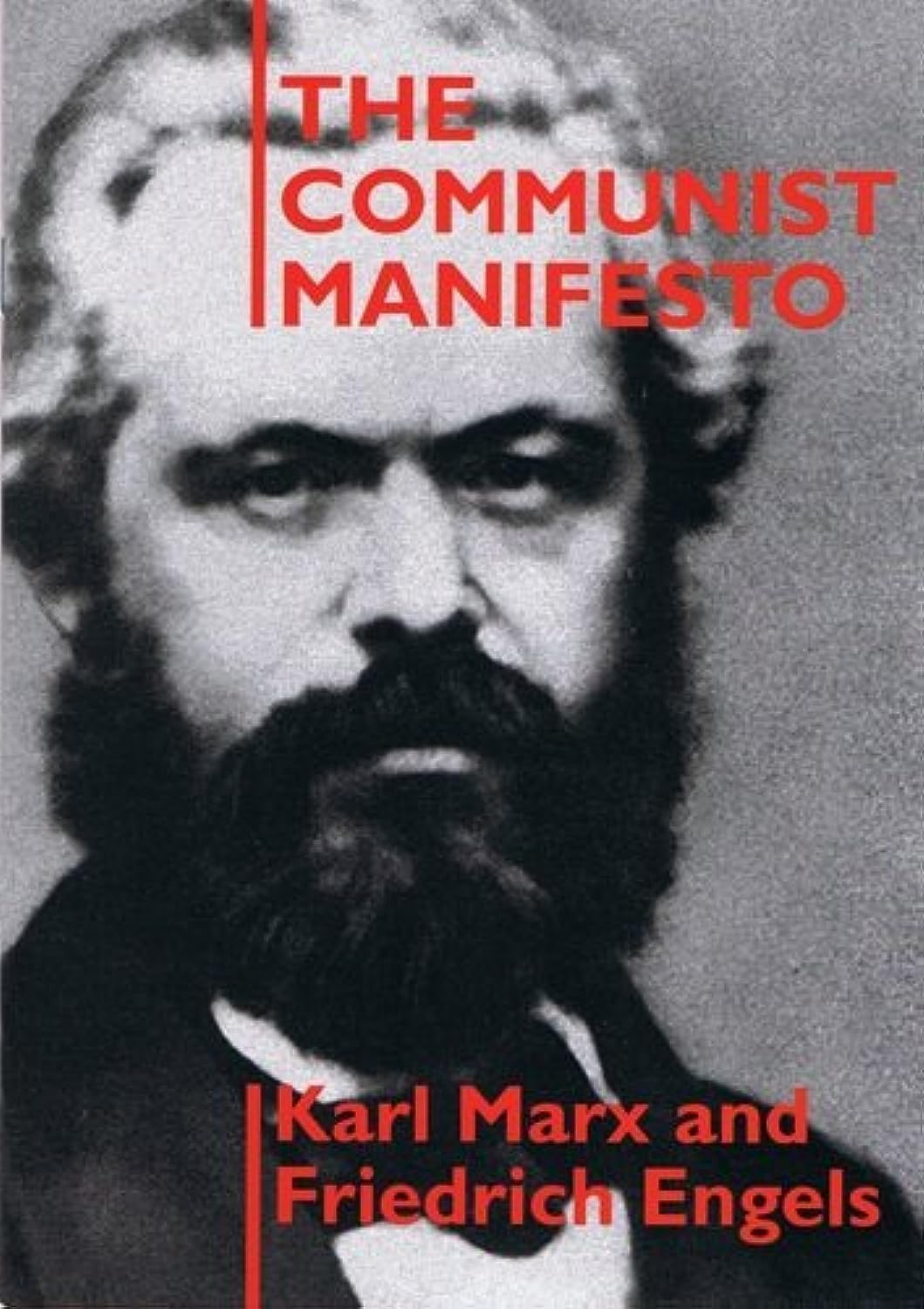
The Communist Manifesto
Product ID: 3846630
Desertcart purchases this item on your behalf and handles shipping, customs, and support to Colombia.
The Communist Manifesto [Marx, Karl, Engels, Friedrich, Moore, Samuel] on desertcart.com. *FREE* shipping on qualifying offers. The Communist Manifesto Review: ‘One of the world's most influential political manuscripts’ - “The Communist Manifesto originally titled Manifesto of the Communist Party is a short 1848 publication written by the political theorists Karl Marx and Friedrich Engels. It has since been recognized as one of the world's most influential political manuscripts.’’ Of course, I’ve heard about this document since youth. Never read it. But, seems so influential, especially recently, decided to examine it. “Commissioned by the Communist League, it laid out the League's purposes and program. It presents an analytical approach to the class struggle (historical and present) and the problems of capitalism, rather than a prediction of communism's potential future forms. The book contains Marx and Engels' theories about the nature of society and politics, that in their own words, "The history of all hitherto existing society is the history of class struggles".It also briefly features their ideas for how the capitalist society of the time would eventually be replaced by socialism, and then eventually communism.’’ This from preface. Marx penned this in 1848. This English translation by Engels in 1888. Some highlights . . . These measures will of course be different in different countries. Nevertheless in the most advanced countries, the following will be pretty generally applicable. 1. Abolition of property in land and application of all rents of land to public purposes. 2. A heavy progressive or graduated income tax. 3. Abolition of all right of inheritance. 4. Confiscation of the property of all emigrants and rebels. 5. Centralisation of credit in the hands of the State, by means of a national bank with State capital and an exclusive monopoly. 6. Centralisation of the means of communication and transport in the hands of the State. 7. Extension of factories and instruments of production owned by the State; the bringing into cultivation of waste-lands, and the improvement of the soil generally in accordance with a common plan. 8. Equal liability of all to labour. Establishment of industrial armies, especially for agriculture. 9. Combination of agriculture with manufacturing industries; gradual abolition of the distinction between town and country, by a more equable distribution of the population over the country. 10. Free education for all children in public schools. Abolition of children's factory labour in its present form. Combination of education with industrial production.’’ Fascinating that most of these programs have been implemented in many western societies. Another is this rejection of history. “There are, besides, eternal truths, such as Freedom, Justice, etc. that are common to all states of society. But Communism abolishes eternal truths, it abolishes all religion, and all morality, instead of constituting them on a new basis; it therefore acts in contradiction to all past historical experience." Recalls Daniel’s prophecy about the king of the north . . . “He will show no regard for the God of his fathers; nor will he show regard for the desire of women or for any other god.’’ Marx . . . “Abolition of the family! Even the most radical flare up at this infamous proposal of the Communists. On what foundation is the present family, the bourgeois family, based? On capital, on private gain. In its completely developed form this family exists only among the bourgeoisie.’’ How abolish family? Forbid private property. “The proletarians cannot become masters of the productive forces of society, except by abolishing their own previous mode of appropriation, and thereby also every other previous mode of appropriation. They have nothing of their own to secure and to fortify; their mission is to destroy all previous securities for, and insurances of, individual property.’’ ‘Destruction of all property’ seems to be now coming to pass. “ All previous historical movements were movements of minorities, or in the interests of minorities. The proletarian movement is the self-conscious, independent movement of the immense majority, in the interests of the immense majority. The proletariat, the lowest stratum of our present society, cannot stir, cannot raise itself up, without the whole superincumbent strata of official society being sprung into the air.’’ ‘Official society cut loose’ from its world. “Though not in substance, yet in form, the struggle of the proletariat with the bourgeoisie is at first a national struggle. The proletariat of each country must, of course, first of all settle matters with its own bourgeoisie. In depicting the most general phases of the development of the proletariat, we traced the more or less veiled civil war, raging within existing society, up to the point where that war breaks out into open revolution, and where the violent overthrow of the bourgeoisie lays the foundation for the sway of the proletariat.’’ ‘Violent overthrow’ and ‘veiled civil war’. Well . . . Another heartfelt cry of anguish . . . ““ The bourgeoisie cannot exist without constantly revolutionising the instruments of production, and thereby the relations of production, and with them the whole relations of society. Conservation of the old modes of production in unaltered form, was, on the contrary, the first condition of existence for all earlier industrial classes. Constant revolutionising of production, uninterrupted disturbance of all social conditions, everlasting uncertainty and agitation distinguish the bourgeois epoch from all earlier ones.’’ Note Marx complaining about ‘everlasting uncertainty’. Marx’ personal life was just that - uncertain, troubled, turbulent. His family eventually refused to support him. He was furious. He is really demanding that someone else guarantees him a comfortable life. In fact, Engels (rich factory owner) did eventually support Marx. “All fixed, fast-frozen relations, with their train of ancient and venerable prejudices and opinions, are swept away, all new-formed ones become antiquated before they can ossify. All that is solid melts into air, all that is holy is profaned, and man is at last compelled to face with sober senses, his real conditions of life, and his relations with his kind.’’ And this unique facet of capitalism, its turbulent, uncertain, constant change to unknown directions obviously disturbs many. Marx nailed it! Last paragraph — “The Communists disdain to conceal their views and aims. They openly declare that their ends can be attained only by the forcible overthrow of all existing social conditions. Let the ruling classes tremble at a Communistic revolution. The proletarians have nothing to lose but their chains. They have a world to win.’’ Lots of familiar ideas that seem current. I wonder how many recognize the influence of this German philosopher on modernity. I didn’t realize how much of his thought still remains. One thing which has not endured is his analysis of economics. The labor theory of value which he borrowed from Adam Smith is now known to be completely wrong. Capitalism has not self-destructed. In fact, world dozens of times richer than when Marx lived. Nevertheless, this goal, desire to destroy is stronger than ever in the mind of many. Review: Descriptively Accurate But Unduly Sanguine - Marx and Engels wrote The Communist Manifesto in 1848 at the request of the Communist League, a secret association of workers driven underground by political oppression aimed at preventing concerted revolutionary activity against bourgeois regimes throughout Europe. The Manifesto was written to provide a theoretical foundation and a practical program for the advancement of international communism and eventual elimination of bourgeois domination of property-less wage laborers. The title of the document, simple and purely descriptive though it is, is commonly regarded as inflammatory, arousing derision, disdain, and virulent hostility among many, including those whom it was written to benefit. Nevertheless, there is much in the Manifesto, especially in the first chapter, that with the aid of hindsight could have been written by a contemporary neo-conservative intellectual, someone like Harvard sociologist Daniel Bell. Specifically, Marx and Engels begin with a tribute to the unparalleled productive capacity of the capitalist organization of production. They freely laud the technological innovations fostered by capitalists' pursuit of surplus value, a process that has dramatically transformed the forces of production and the social relations of production. The result has been rapidly expanding output of industrial and agricultural goods of all kinds. In accomplishing this, capital has extended its markets beyond national borders, creating a world market and a world economy. Raw materials from Latin America, Africa, and Asia are routinely used to manufacture finished goods in England, Germany, and other European countries. The same manufactured goods may then be sold in the very places that supplied the raw materials. All this, Marx and Engels observe, requires concentration of vast numbers of people in swollen industrial cities. Small manufacturers and family farms are swallowed up by larger enterprises with which they have neither the capital nor productive capacity to compete. Marx and Engels find it particularly noteworthy that men like Thomas Jefferson had envisioned America as a land of independent yeoman farmers with small land holdings, but the concentration of agriculture was rendering this vision obsolete. As we get farther into this brief document, Daniel Bell, the other neo-conservatives, and people generally may take angry exception to its tone and substance. Concentration of resources in capital-intensive enterprises, Marx and Engels argue, reduces the vast majority of people to the degraded status of wage labor, workers who own nothing but their labor power. It is in the interests of the bourgeoisie -- of capital -- to pay workers as little as possible, increasing surplus value by buying labor power for no more than its natural price, the amount needed to survive and reproduce. The culture of workers is nothing more than a brutalizing culture of production, lacking in scope and richness due to the pitifully small part that each worker plays in the overall production process. Families of working people are men, women, and children who labor for the natural price and have little time, energy or emotional sustenance to offer each other, having been wrung dry by capital's conditions of employment. The more productive the worker, the more he or she strengthens the hand of capital. However, capital's immense productive power and its success in keeping wage rates abysmally low are not an unmixed blessing for the bourgeoisie. Periodic over-production crises wreck havoc with national and international markets, undercutting profits and threatening the commanding position of capital. As a timely example, the U.S. economy is currently approximating an over-production crisis: unemployment is high, wages are low and falling, capital has roughly two and a half trillion dollars to invest, but in the absence of demand the bourgeoisie has become risk averse, and money is not being invested in productive endeavors. The long-term solution to all this, for Marx and Engels, is elimination of bourgeois property and the property relations that capitalism has created. This is not to say that private property must altogether disappear, but private property as capital, as that which creates a two-class system of exploitation of labor by the bourgeoisie, certainly must cease to exist. Marx and Engels were entirely too sanguine about the eventual joining together of members of the working class to present a united front in their conflict with capital. They realized that there were ethnic, racial, religious, national, linguistic, occupational, and other barriers that would be difficult to overcome, but I doubt they expected the workers of the world to be as fractionated as is currently the case. If Marx and Engels were alive today, they might take the view that things would have to get much worse for labor before a revolution becames possible. If you're not inclined to read the Manifesto, just read the introductory remarks by Vladimir Posner, once a member of the Communist Party of the USSR. Posner spent much of his childhood and adolescence in the West, and his insights into the appeal of communist ideals and the failure of the USSR to develop communism as Marx and Engels sketchily envisioned it are extremely interesting. Posner is no apologist for anything, just an honest and intelligent journalist whose idealism is genuine but far from boundless or excessive.










| Best Sellers Rank | #86,689 in Books ( See Top 100 in Books ) #8 in Political Philosophy (Books) #9 in Communism & Socialism (Books) #70 in History & Theory of Politics |
| Customer Reviews | 4.1 4.1 out of 5 stars (20,022) |
| Dimensions | 5.75 x 0.2 x 8.75 inches |
| Edition | New edition |
| ISBN-10 | 0850364787 |
| ISBN-13 | 978-0850364781 |
| Item Weight | 1.9 ounces |
| Language | English |
| Print length | 29 pages |
| Publication date | January 1, 1998 |
| Publisher | Merlin Press |
| Reading age | 18 years and up |
C**R
‘One of the world's most influential political manuscripts’
“The Communist Manifesto originally titled Manifesto of the Communist Party is a short 1848 publication written by the political theorists Karl Marx and Friedrich Engels. It has since been recognized as one of the world's most influential political manuscripts.’’ Of course, I’ve heard about this document since youth. Never read it. But, seems so influential, especially recently, decided to examine it. “Commissioned by the Communist League, it laid out the League's purposes and program. It presents an analytical approach to the class struggle (historical and present) and the problems of capitalism, rather than a prediction of communism's potential future forms. The book contains Marx and Engels' theories about the nature of society and politics, that in their own words, "The history of all hitherto existing society is the history of class struggles".It also briefly features their ideas for how the capitalist society of the time would eventually be replaced by socialism, and then eventually communism.’’ This from preface. Marx penned this in 1848. This English translation by Engels in 1888. Some highlights . . . These measures will of course be different in different countries. Nevertheless in the most advanced countries, the following will be pretty generally applicable. 1. Abolition of property in land and application of all rents of land to public purposes. 2. A heavy progressive or graduated income tax. 3. Abolition of all right of inheritance. 4. Confiscation of the property of all emigrants and rebels. 5. Centralisation of credit in the hands of the State, by means of a national bank with State capital and an exclusive monopoly. 6. Centralisation of the means of communication and transport in the hands of the State. 7. Extension of factories and instruments of production owned by the State; the bringing into cultivation of waste-lands, and the improvement of the soil generally in accordance with a common plan. 8. Equal liability of all to labour. Establishment of industrial armies, especially for agriculture. 9. Combination of agriculture with manufacturing industries; gradual abolition of the distinction between town and country, by a more equable distribution of the population over the country. 10. Free education for all children in public schools. Abolition of children's factory labour in its present form. Combination of education with industrial production.’’ Fascinating that most of these programs have been implemented in many western societies. Another is this rejection of history. “There are, besides, eternal truths, such as Freedom, Justice, etc. that are common to all states of society. But Communism abolishes eternal truths, it abolishes all religion, and all morality, instead of constituting them on a new basis; it therefore acts in contradiction to all past historical experience." Recalls Daniel’s prophecy about the king of the north . . . “He will show no regard for the God of his fathers; nor will he show regard for the desire of women or for any other god.’’ Marx . . . “Abolition of the family! Even the most radical flare up at this infamous proposal of the Communists. On what foundation is the present family, the bourgeois family, based? On capital, on private gain. In its completely developed form this family exists only among the bourgeoisie.’’ How abolish family? Forbid private property. “The proletarians cannot become masters of the productive forces of society, except by abolishing their own previous mode of appropriation, and thereby also every other previous mode of appropriation. They have nothing of their own to secure and to fortify; their mission is to destroy all previous securities for, and insurances of, individual property.’’ ‘Destruction of all property’ seems to be now coming to pass. “ All previous historical movements were movements of minorities, or in the interests of minorities. The proletarian movement is the self-conscious, independent movement of the immense majority, in the interests of the immense majority. The proletariat, the lowest stratum of our present society, cannot stir, cannot raise itself up, without the whole superincumbent strata of official society being sprung into the air.’’ ‘Official society cut loose’ from its world. “Though not in substance, yet in form, the struggle of the proletariat with the bourgeoisie is at first a national struggle. The proletariat of each country must, of course, first of all settle matters with its own bourgeoisie. In depicting the most general phases of the development of the proletariat, we traced the more or less veiled civil war, raging within existing society, up to the point where that war breaks out into open revolution, and where the violent overthrow of the bourgeoisie lays the foundation for the sway of the proletariat.’’ ‘Violent overthrow’ and ‘veiled civil war’. Well . . . Another heartfelt cry of anguish . . . ““ The bourgeoisie cannot exist without constantly revolutionising the instruments of production, and thereby the relations of production, and with them the whole relations of society. Conservation of the old modes of production in unaltered form, was, on the contrary, the first condition of existence for all earlier industrial classes. Constant revolutionising of production, uninterrupted disturbance of all social conditions, everlasting uncertainty and agitation distinguish the bourgeois epoch from all earlier ones.’’ Note Marx complaining about ‘everlasting uncertainty’. Marx’ personal life was just that - uncertain, troubled, turbulent. His family eventually refused to support him. He was furious. He is really demanding that someone else guarantees him a comfortable life. In fact, Engels (rich factory owner) did eventually support Marx. “All fixed, fast-frozen relations, with their train of ancient and venerable prejudices and opinions, are swept away, all new-formed ones become antiquated before they can ossify. All that is solid melts into air, all that is holy is profaned, and man is at last compelled to face with sober senses, his real conditions of life, and his relations with his kind.’’ And this unique facet of capitalism, its turbulent, uncertain, constant change to unknown directions obviously disturbs many. Marx nailed it! Last paragraph — “The Communists disdain to conceal their views and aims. They openly declare that their ends can be attained only by the forcible overthrow of all existing social conditions. Let the ruling classes tremble at a Communistic revolution. The proletarians have nothing to lose but their chains. They have a world to win.’’ Lots of familiar ideas that seem current. I wonder how many recognize the influence of this German philosopher on modernity. I didn’t realize how much of his thought still remains. One thing which has not endured is his analysis of economics. The labor theory of value which he borrowed from Adam Smith is now known to be completely wrong. Capitalism has not self-destructed. In fact, world dozens of times richer than when Marx lived. Nevertheless, this goal, desire to destroy is stronger than ever in the mind of many.
N**L
Descriptively Accurate But Unduly Sanguine
Marx and Engels wrote The Communist Manifesto in 1848 at the request of the Communist League, a secret association of workers driven underground by political oppression aimed at preventing concerted revolutionary activity against bourgeois regimes throughout Europe. The Manifesto was written to provide a theoretical foundation and a practical program for the advancement of international communism and eventual elimination of bourgeois domination of property-less wage laborers. The title of the document, simple and purely descriptive though it is, is commonly regarded as inflammatory, arousing derision, disdain, and virulent hostility among many, including those whom it was written to benefit. Nevertheless, there is much in the Manifesto, especially in the first chapter, that with the aid of hindsight could have been written by a contemporary neo-conservative intellectual, someone like Harvard sociologist Daniel Bell. Specifically, Marx and Engels begin with a tribute to the unparalleled productive capacity of the capitalist organization of production. They freely laud the technological innovations fostered by capitalists' pursuit of surplus value, a process that has dramatically transformed the forces of production and the social relations of production. The result has been rapidly expanding output of industrial and agricultural goods of all kinds. In accomplishing this, capital has extended its markets beyond national borders, creating a world market and a world economy. Raw materials from Latin America, Africa, and Asia are routinely used to manufacture finished goods in England, Germany, and other European countries. The same manufactured goods may then be sold in the very places that supplied the raw materials. All this, Marx and Engels observe, requires concentration of vast numbers of people in swollen industrial cities. Small manufacturers and family farms are swallowed up by larger enterprises with which they have neither the capital nor productive capacity to compete. Marx and Engels find it particularly noteworthy that men like Thomas Jefferson had envisioned America as a land of independent yeoman farmers with small land holdings, but the concentration of agriculture was rendering this vision obsolete. As we get farther into this brief document, Daniel Bell, the other neo-conservatives, and people generally may take angry exception to its tone and substance. Concentration of resources in capital-intensive enterprises, Marx and Engels argue, reduces the vast majority of people to the degraded status of wage labor, workers who own nothing but their labor power. It is in the interests of the bourgeoisie -- of capital -- to pay workers as little as possible, increasing surplus value by buying labor power for no more than its natural price, the amount needed to survive and reproduce. The culture of workers is nothing more than a brutalizing culture of production, lacking in scope and richness due to the pitifully small part that each worker plays in the overall production process. Families of working people are men, women, and children who labor for the natural price and have little time, energy or emotional sustenance to offer each other, having been wrung dry by capital's conditions of employment. The more productive the worker, the more he or she strengthens the hand of capital. However, capital's immense productive power and its success in keeping wage rates abysmally low are not an unmixed blessing for the bourgeoisie. Periodic over-production crises wreck havoc with national and international markets, undercutting profits and threatening the commanding position of capital. As a timely example, the U.S. economy is currently approximating an over-production crisis: unemployment is high, wages are low and falling, capital has roughly two and a half trillion dollars to invest, but in the absence of demand the bourgeoisie has become risk averse, and money is not being invested in productive endeavors. The long-term solution to all this, for Marx and Engels, is elimination of bourgeois property and the property relations that capitalism has created. This is not to say that private property must altogether disappear, but private property as capital, as that which creates a two-class system of exploitation of labor by the bourgeoisie, certainly must cease to exist. Marx and Engels were entirely too sanguine about the eventual joining together of members of the working class to present a united front in their conflict with capital. They realized that there were ethnic, racial, religious, national, linguistic, occupational, and other barriers that would be difficult to overcome, but I doubt they expected the workers of the world to be as fractionated as is currently the case. If Marx and Engels were alive today, they might take the view that things would have to get much worse for labor before a revolution becames possible. If you're not inclined to read the Manifesto, just read the introductory remarks by Vladimir Posner, once a member of the Communist Party of the USSR. Posner spent much of his childhood and adolescence in the West, and his insights into the appeal of communist ideals and the failure of the USSR to develop communism as Marx and Engels sketchily envisioned it are extremely interesting. Posner is no apologist for anything, just an honest and intelligent journalist whose idealism is genuine but far from boundless or excessive.
J**Y
Very Popular at my School!
I bought 30 of these to hand out at school, and there was so much demand! I managed to hand out all of them within a day, people were so excited to get a copy of it. We all took ours to the Mexican Bakery. The content is also really good, it's very enlightening and brings some interesting thoughts to mind. Me and my friends have had some really good discussions about communism. This version is also quite nice, it's just the manifesto, no unnecessary filler that some other versions have, it makes it much lighter to carry around and smaller, and makes it so that it's all communism, all the time. My main critique and the reason for the only 4 stars is that although this version is cheap, having to spend money for it goes against the communist vision, which is why I give them away for free, but it's cheaper here than most other places. Would very highly recommend!!!!!!!
C**S
A great read to be introduced in the theory of communism, always relevant and a must read to understand the basics of a system that is the opposite of capitalism
J**A
Very good, no frills edition of the text. What more could you want?
A**A
It is worth reading the book to get an understanding of what the de-facto founders of communism thought. Luckily, the book is short and a quick read. It feels to be composed of two parts: their understanding of the evolution from feudalism to capitalism and the overall environment at the time, plus their understanding of what communism should be. Based on the book, it seems that the countries that claimed to be communist were mostly communist, as the main principle seemed to be to abolish private property. It is also clear that Marx and Engels did not understand human psychology. They also did not have the foresight to realize that in communism, the ruling class ownership (the single party) would replace private property or that there would even be a ruling class and that a much worse type of oppression would replace the injustices of the time. Based on their definition of communism, it is also clear that China is no longer a communist country but a one-party rule country - an oligarchy.
A**M
Very quality print and it's a nice looking pocket book as well.
P**P
I'm a beginner to communist discourse and am not well versed. This was my first foray into communism and I have to say, this has been an incredible read. Without talking too much about the book, there's people here that are much more knowledgeable, here's my review. I researched a lot for what the best translation would be and I was very pleased to be lead to the Penguin Classics translation. I love a good hardback book, and this is one. I can't comment on the introduction as I skipped it. Great value for money .
Trustpilot
3 weeks ago
3 weeks ago