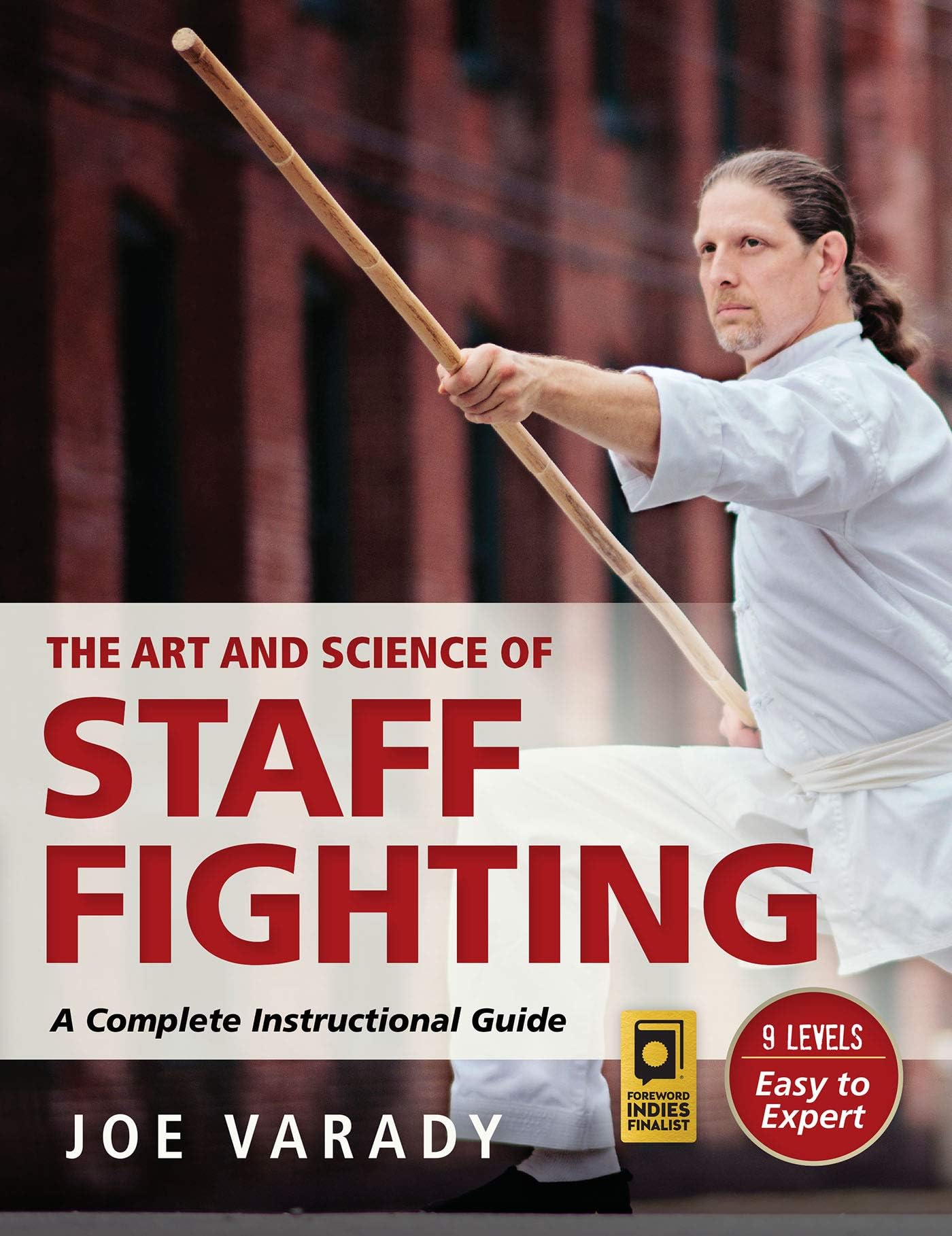

The Art and Science of Staff Fighting: A Complete Instructional Guide (Martial Science)
Product ID: 35994827
📚Comprehensive Guide
🥋Expert Techniques
🧠Mental Strategies
Buy anything from 5,000+ international stores. One checkout price. No surprise fees. Join 2M+ shoppers on Desertcart.
Desertcart purchases this item on your behalf and handles shipping, customs, and support to Colombia.
🥋 Elevate Your Skills: Become a Fighting Pro!
The Art and Science of Staff Fighting is a comprehensive instructional guide that combines expert techniques with psychological insights, designed for martial artists looking to enhance their skills and understanding of combat. This book offers step-by-step instructions and connects readers to a community of passionate practitioners.


| Best Sellers Rank | #70,151 in Books ( See Top 100 in Books ) #2 in Fencing (Books) #105 in Hiking & Camping Instructional Guides #126 in Martial Arts (Books) |
| Customer Reviews | 4.6 out of 5 stars 809 Reviews |
M**G
If you train with the staff or want to learn, this book should be considered required reading and added to your library!
The Art and Science of Staff Fighting is one of the most complete and well laid out training guides I have read! If you train with the staff or want to learn, this book should be considered required reading and added to your library! Joe Varady is one of the most passionate martial artists I have ever met. Spend a minute training with him and his passion for the martial arts is immediately apparent. He has a gift for teaching; he presents material in a very clear and easy to understand way and his enthusiasm is contagious. Joe's passion and enthusiasm on the training floor made the transition to printed form in this fantastic training manual. Joe extensively researched the topic of staff fighting which is evident throughout his book. He includes history of staff use through time and across different cultures. Furthermore, he goes beyond simply trying to explain how to perform a technique; he describes the physics behind the technique to help the reader understand the broader principles needed for mastery of the staff. The addition of history and science provides the reader with a solid foundation for a deeper understanding of staff fighting. Overall the book's layout is exceptional. The chapters (levels) represent increasing levels of difficulty. The numerous photos and illustrations clearly illustrate the topic being discussed. Each of the first 6 chapters end with an excellent workout specifically focused on the subject of that chapter. Throughout the book he identifies training equipment designed to work a specific technique. He provides detailed descriptions on how to make the majority of them yourself. The Art and Science of Staff Fighting is divided into 9 levels, from beginner to expert. Level 1 introduces fundamentals of the staff, and basic blocking, striking, and footwork. Levels 2 and 3 discuss middle grip, double strikes, disarms, and training equipment. Levels 4 and 5 discuss extended grips, snap strikes, thrusting, fencing-style techniques (cutover, beat, change of engagement), and additional training equipment. Level 6 gets serious and fun--combat where you will learn to make padded weapons and get fighting! In Level 7 and 8 Joe provides expert and master level ideas, including advanced guards, close combat, ground work, multiple attackers, and empty hand defense against armed opponents. Level 9 discusses a relative of the staff, the spear, it's similarities and differences, and techniques to incorporate into your training regimen. This book really is a complete instructional guide to the staff. I always look forward to training with Joe each year at the Cuong Nhu International Annual Training Camp and when other opportunities arise. - Mark Brandenburg, Cuong Nhu Oriental Martial Arts 3rd degree black belt, Co-Head Instructor of Kim Hiep Si Dojo, University of Central Florida, Orlando.
T**4
Excellent New Book on Staff Fighting – A Complete Approach
Sixth-degree black belt Joe Varady has over 30 years of martial art experience. With a background that includes karate, judo, eskrima, boxing, fencing and the long sword, Joe has numerous awards competing in weapons tournaments world-wide. His new book, The Art and Science of Staff Fighting, emphasizes the combat aspects of the staff. Regarding the book’s title, Joe points out that the “art” aspect is highly rewarding, offering elements such as self-expression, development of self-confidence, self-control and greater physical coordination. As Joe sets forth, any reliable self-defense system must absolutely be rooted in the “science” of the pursuit. He points out that this includes understanding the physical nature of the weapon, the importance of your stances and the psychological aspects – what the opponent is thinking and how you can capitalize on that. Arranging his instruction into nine levels (beginner to advanced), he teaches stances, striking, blocking and footwork. Advanced readers can benefit from lessons on disarming techniques, groundwork and fighting several opponents. No need to worry about whether this is tai chi staff, shaolin staff or some other discipline – Joe takes a “nondenominational” approach that can benefit your practice regardless of the specific art your staff work belongs to. One excellent feature of the book: over 600 photos with arrows indicating the direction of the staff’s motion. Among Joe’s nine levels are the foundation, basic middle grip of the staff, advanced middle grip, basic extended grip, advanced extended grip, combat with the staff, and expert and master staff-training levels. Each level contains roughly 9 to 12 topics such as figure eights, thrusting, snap strikes, blocking disarms, timing and blitz attacking. Expert training topics include switching grips, alternate ready positions and techniques such as upward heel strike, overhand heel thrust, jabbing thrusts, trapping and pinning, flicking and throwing. A unique section deals with unarmed defense against the staff. One thing I really like about the book: For each level in Joe’s program, he provides a detailed workout, spelling out the objectives as well as the steps you can complete to learn the concepts in that level. Joe also shows the reader how to make simple training tools such as spinners (pinwheel-like objects), horizontal makiwara boards and striking balls. Of course, he then shows how to use the tools as part of your practice. Joe points out that even for non-martial artists, his techniques can be used with improvised/found objects such as a coatrack, curtain rod, floor lamp, hockey stick, fallen tree limb, a broom, mop, shovel or a rake. I highly recommend this book. It is chock full of insights, techniques, strategies and workouts to apply them.
J**S
I am impressed by the layout and practical-oriented attitude of this book
I found the style of writing and book layout concise, interesting, and informative. I read the text in it's entirety before completing level 1. Although I was initially confused by the title-inclusive word "complete", it refers to this book being an entire curriculum instead of meaning complete sets of knowledges (there are a few techniques I know of that are not found in this book). Varady consolidates a variety martial arts and sport techniques (Eastern, HEMA, Ethiopian, etc) in the writing of this book. He also keeps practicality, physics (especially on leavers), and training techniques in mind. Found it noteworthy Musashi and Fiore are referenced. You also will be taught how to create training equipment and items from everyday objects (duct tape might be a favorite binding item of his). If you have the space and resources, you can make a nice training ground/area for yourself from his recommendations and inspiration alone. The pictures of solo-and-with-partner techniques are clear, and ends of Varady and his partner's staffs are taped white and black, so you can easily tell when they are alternating strikes with either end of his staff (it especially helps eliminate confusion). Varady even includes warnings of moderation and developing accuracy over power first, especially in regards to training with partners. I was impressed also by his sense of realism, as he states in one vs. multi-opponent battles the best option is to flee when possible. If you are looking for a list of forms for performing at length (he does have some in there, but you would need to work at assembling them), such as in with Taiji/Tai-Chi, then this probably won't be the book for you. I think someone who is interested in education on the topic, has or is taking martial arts, or someone looking to better understand staff fighting from an applied approach will benefit most from this book.
S**N
a gem of a book!!
My experience with staff fighting comes through the jo (5' staff) used in Aikido. Desiring to do a more in depth study of staff fighting, I picked this book up. The author has presented a method of staff fighting that borrows for eastern and western traditions and presents this universal method in a logical progression of study along with suggested exercise to hone one's skills. I'd have to rate this book in the top 10 Martial Arts books I've owned in my life for it's clarity and detail. In terms of the subject matter, I believe it to be without equal (outside perhaps his other book on fighting with a short stick which I have now ordered.) However, as good as the material is, it will take practice, practice, and more practice - you can't soak this material up by osmosis! So grab your staff, this book, and a partner and get busy!
M**.
Good practical approach, just as I was trained
What this book does really well is bring older concepts taken from tradition and Kata, and gives us the modern interpretation of them. Many of the concepts and drills, blocks, drills and games played out on this book were just like the ones I was shown coming up through the ranks. Knowing the author is a champion fighter with the staff makes me feel that this training really is high quality and validates not only my own training but that shown in this book. I recommend this book to any students and teachers who teach a staff curriculum. I'm so happy to have found a book that not only demonstrates fighting strategies but also has many new ways to train and hone these skills. We will be taking some of these ideas to add training equipment in our dojo. My gratitude to the author, and I feel this book should be required reading for those who fight with the bo staff.
A**.
Finally, a staff fighting book
I have not seen many books on kindle directly addressing staff fighting or Bojutsu, and this was a pleasant surprise. The instructions were clear and the techniques were good. I am so glad I found this book, as a 2nd Dan in Tae Kwon Do who learned staff fighting, I cannot be any more satisfied than this. Thank you, Joe Varady,
J**S
Not a how r
Warning: this is NOT a book on how to fight with a stick! It is a book on competitive stick fighting for which it is a fine book. But don’t think you will learn how to disarm an adversary with a knife or anything like that.
A**S
Awesome book
I never did very much weapon work but if you're looking for a guide to start off with for staff this is a good option. It's really well organized and it gives you step by step lessons.
O**I
Joe ist großartig
Du suchst eine systematische Einführung in den Langstock? Du hast sie gefunden.
D**L
Essential for all martial artists
A straight manual about the usage of staff which all martial artists should read and share with students. The book arrived on time and in good conditions.
J**S
C'est un livre qui montre comment jouer avec un baton
livre correcte avec photo. Attention, meme si il est bien fait, il est en anglais et c'est toujours difficile de travailler avec un livre. Il faut du temps, beaucoup de temps
T**M
Excellent Training Manual
Joe has written an excellent training manual for the staff. It is by far the best book I have read on staff fighting. Straight forward, concise and excellent photographs make this an easy guide to staff fighting.
R**C
Bo
This is an excellent step by step manual. The Instructor takes you over many many things slowly so you can perfect your style. Be careful of your ceilings. The Foam Bo are perfect for practicing inside
Trustpilot
1 month ago
1 day ago