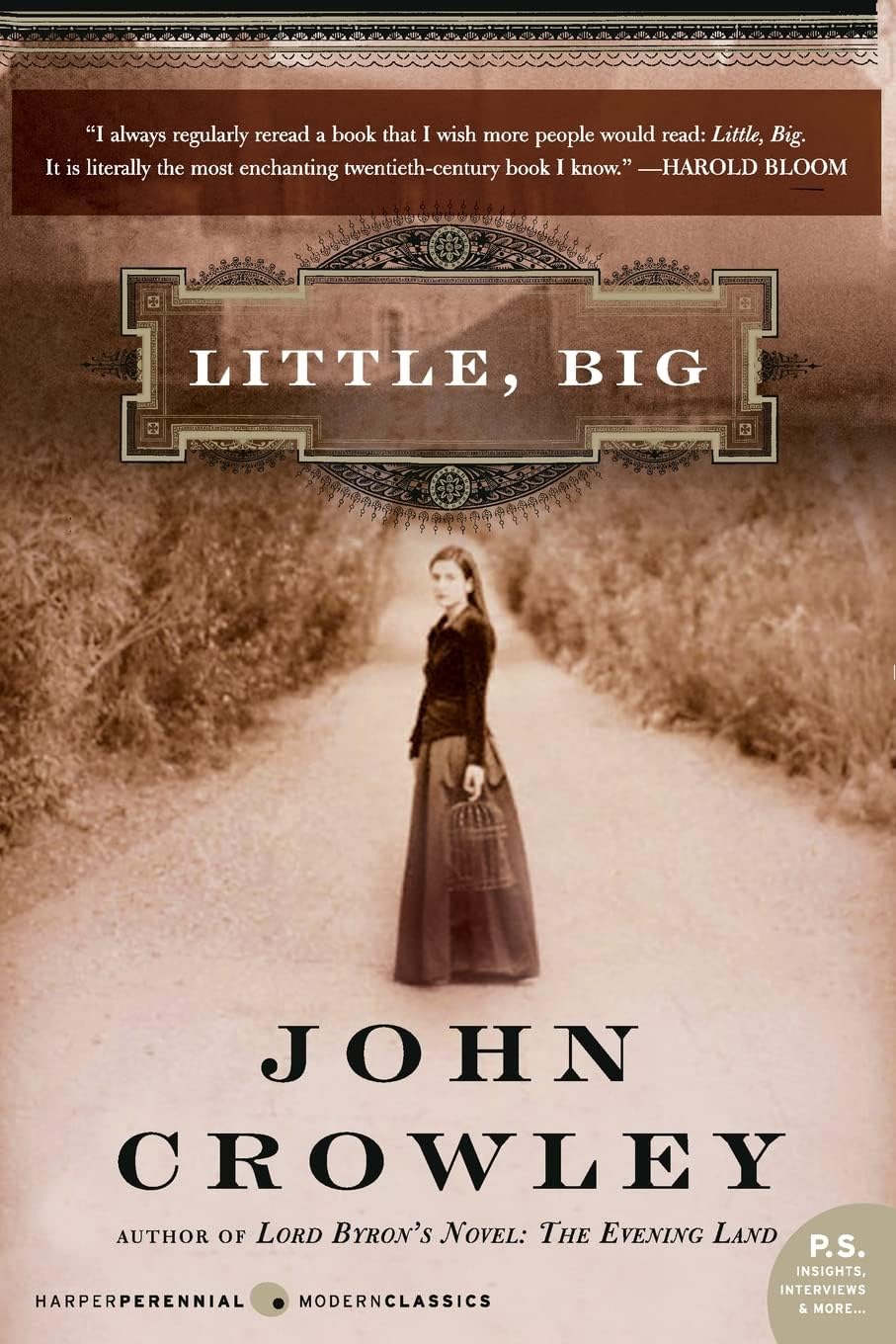
Little, Big
Product ID: 3326967
Buy anything from 5,000+ international stores. One checkout price. No surprise fees. Join 2M+ shoppers on Desertcart.
Desertcart purchases this item on your behalf and handles shipping, customs, and support to Colombia.
John Crowley's masterful Little, Big is the epic story of Smoky Barnable, an anonymous young man who travels by foot from the City to a place called Edgewood—not found on any map—to marry Daily Alice Drinkawater, as was prophesied. It is the story of four generations of a singular family, living in a house that is many houses on the magical border of an otherworld. It is a story of fantastic love and heartrending loss; of impossible things and unshakable destinies; and of the great Tale that envelops us all. It is a wonder. Review: The ultimate adult fantasy - Where do I begin in attempting to review this remarkable book? I'll apologize in advance for being long-winded but I have much to say about John Crowley's tour de force. It's place might be in the fantasy genre, but it's unlike any fantasy novel I've ever read. First off, it's for intelligent adults, not children, or anyone looking for pure escapism. It's also not a Tolkien type fantasy. The bulk of the plot doesn't take place in an imaginary kingdom, with stereotypical heroes and villains, and exalted but all too obvious themes. It's not allegorical as are the works of MacDonald and Lewis. The fantastic elements, fairies, elves, and such, aren't ubiquitous, but operate for the most part in clandestine fashion, behind the scenes. LITTLE, BIG can rightly be termed realistic fiction with unrealistic elements, and the fantastic elements are often presented with a Carrollian wit. Characters are introduced much the way Dickens would have. Even their names have a certain Dickensian flavor. Most of the major characters are painted with subtle, rather than broad brush strokes, in a way reminiscent of George Eliot. Despite a basic goodness and decency, major characters like Smokey and George Mouse do things that violate certain moral codes, but these transgressions aren't unduly focused on. We discover things about these people that surprise us, but shouldn't shock us. Human weakness in the form of a surrendering to carnal urges serves to counterpoint inherent nobility. The action starts in the middle part of the 20th century, with the very mundane Smokey Barnable, on his way to a place called Edgewood, to marry a girl named Daily Alice Drinkwater, and play his part in the Tale. The Tale is one of the major motifs in LITTLE, BIG, and it ends at the conclusion of the novel. This "Tale" encompassed by the greater fiction of the novel is one of the charming aspects of this book, sort of a myth grafted onto a slice of 20th century American history. What is the Tale? On the surface, it is something a mysterious old woman named Mrs. Underhill may have mentioned to Alice's great grandmother Violet Bramble. It was understood that the Tale involved the family of Violet and her architect husband John Drinkwater, and it wouldn't end for quite some time. LITTLE, BIG tells the story of 4 generations of this family in lavish, beautifully descriptive prose. Part of the plot also involves a distant cousin of the family named Ariel Hawksquill and a sinister individual named Russell Eigenblick. Both will have their own important parts to play in the Tale. A good portion of the story takes place in Edgewood, which is represented by a very unusual house, designed and built by Violet's husband John, and located somewhere in the Northeast countryside (upstate NY?). Edgewood was built not merely to serve as a residence (a quite disorienting one at that), but as a way station between this dimension and the dimension of Faerie. It exists on the "edge" of the 2 realities. Edgewood is actually one of the main characters in the novel, and it's purpose is made clearer at the end of the book. Parts of the story also take place in the Great City (NYC), where Smokey and Alice's son Auberon (named after a great uncle) goes to play his role in the Tale. Auberon's journey is one of self discovery, in which he finds love, then loses it and almost loses his sanity in the aftermath. Crowley is wonderful at drawing parallels between things. In one instance he mentions a time when the Woods were wild and fearsome. Now the Woods are peaceful, and the city is in actuality, the Wild Wood. Smokey journeys from the wild city to the peaceful woods to marry and unwittingly becomes part of something greater and more profound than his humdrum reality, while years later, his only son does the reverse to escape the meaninglessness of his own existence and unwittingly fulfill his own destiny. Beautiful symmetry abounds in this novel. A recurring theme involves the seasons. Each season has a symbolic significance in the novel, and key sections of the narrative have plot elements that reflect the season in which they occur. There are many subtle and clever devices Crowley employs to foreshadow events in the novel. A charming scene in a subway tunnel between Auberon and his lover Sylvie, anticipates future events. Near the end, even something as simple as Smokey reaching for a copy of Ovid's Metamorphosis has a portentous significance which in an offhanded way underscores the Tale's mythic nature. LITTLE, BIG consists of 6 books, divided by 26 chapters headed by epigrams from famous philosophers and literary figures like Cicero, Samuel Johnson, and Virginia Woolf; further subdivided into sections with titles crystallizing thoughts presented in each section. This process of subdivision, rather than confusing the reader, allows one to draw a breath and absorb what is presented without getting mentally exhausted. It's necessary, because Crowley's writing often flaunts his erudition. He'll embellish passages with words that send you scrambling for the dictionary. This may not be a style of writing that pleases everyone, but for this novel I think it's effective. The story held my interest from the beginning, further piqued my curiosity as it progressed, and built anticipation to a crescendo which culminated in a tearful, yet truly sublime ending. Crowley does more than just tell a wonderful story. A fascinating sidelight is the presentation of certain philosophical elements.. historically controversial visions of reality which have seldom been presented in such a beautiful and imaginative way. There are elements of Gnosticism in the Tale; an attempt to link the spiritual with the rational. It brings to mind Hamlet's words to his rational buddy, "There are more things on heaven and earth, Horatio, than are dreamt of in your philosophy". Whether or not Mr. Crowley is a proponent of, or even believes in such notions is not for me to surmise, although I 'm more inclined to think that the Gnostic and Hermetic ideas are used more as plot devices to flesh out the crucial emotional underpinnings of the story, rather than serve as major thematic components. Smokey represents to me, the rational, pragmatic, reasonable world. Alice and her family, the link to the world of spirit and wonder and imagination. The 2 must join together for the Tale to proceed, just as man must recognize his spiritual as well as rational nature. Smokey's life has little value at the start, but ends with a supreme personal fulfillment. The novel describes concentric levels of reality, the deeper in you travel, the more spacious it becomes. Man lives on one level. The faeries on a deeper level. Who knows what exists on levels further in? Carl Jung, in accord with Gnostic and Hermetic sources, describes man as a unique link between the microcosm (Little) and the macrocosm (Big), a portal so to speak, between 2 eternities, one inner and the other outer. The notion presented in the novel of alternative universes is not strictly proprietary to metaphysics. It has been a valid topic of debate in advanced physics. The notion of death in this book is not a fearful notion. Everything we are made of, including our consciousness, has always existed, and will always exist in one form or other for eternity. The deep thoughts are there, but they do not take away from the things in the novel that have primary importance for us as humans who live in the real world and don't pay much thought to alternative realities. In trying to compare LITTLE, BIG to other works of similar style, I am reminded a bit of One Hundred Years of Solitude, by Garcia Marquez. Both novels make reference to occultism and hermeticism. Both novels contain family trees, and relate unusual family histories through several generations.. but where the Colombian master's Buendia family were almost impossible for me to relate to, Crowley creates characters that are very easy to empathize with. They live and breathe, love and ache, undergo physical, emotional, and spiritual changes, and act all too human even when they become more or less than human. They resonate in your consciousness long after you finish the book. At least they did in mine. I highly recommend this book, and hope more people get to discover it's wonders. Like all great books, this one demands multiple readings. Great books are life experiences..journeys of self discovery, always there to be travelled, each successive venture leading us down more scenic routes to our destination. With LITTLE, BIG Crowley has fashioned his own Edgewood for the reader. We enter through the gates and proceed to a familiar world, one we all know, but nonetheless, a world ripe with mystery, enchantment, and some danger. There are puzzles to solve, and once solved, new ones arise to challenge us. Questions are asked, and once answered, new ones posed for pondering. The world we thought we knew changes into a new world. We leave with new insights, and perhaps a new world view, part of ourselves changed forever as we perceive life from an altered perspective. It may only have been a tale, but it had become our tale. We lived it along with the characters. The experience was just as meaningful for us as for them. Review: A Little Bit of a Big Deal - This is a great American novel that is not meant for everybody, which is why it's a great American novel that's mostly unknown. It's a fairy tale book not meant for little children. Who this book is meant for are those who want to experience the truth of a world like ours that just happens to be poked, prodded, and moved about by the Fey peoples of an alternate plane of existence. This is a novel about an extraordinary family across multiple generations--a family with foibles and flaws and beauty and strength, who struggle to understand the Why of their existence as they also alternately struggle against and work with the Little People (who may not be so little). And so this novel asks a lot of big philosophical and metaphysical questions. The author, John Crowley, is not interested in pat answers. The questions are sometimes more important than the conclusions that follow. And sometimes, there are no conclusions explicitly stated. It's up to the reader to use some mental effort to figure out what's happening in the story. This is why I say that this novel is not for everyone. In today's reading culture, where even college-educated adults are only willing to read young adult novels, this book may be a challenge to some. For one thing, Crowley's prose is DENSE. What I mean by that is that he'll write sentences that are their own paragraphs. Sentences with numerous clauses that are separately by a multitude of commas, semi-colons, hyphens, long dashes, and parentheticals. And within these long sentence constructions, Crowley will pack in multiple disparate ideas that he is able to artfully connect with an overarching theme, philosophical thesis, or series of actions. And also, the sentences are beautiful, almost musical, in their prose. Here's an example (the hairy thing mentioned is a squirrel's tail; a love totem from the Fey): "But they had kept their promise, oh they had, he was on the way to becoming an entire anthology of love, with footnotes (there were a pair of step-ins under his seat, he could not remember who had stepped out of them); only, as he drove from drugstore to church, from farmhouse to farmhouse, with the hairy thing flying from his windscreen, he came to know that it did not and had not ever contained his power over women: his power over women lay in their power over him." Some people have compared this novel to Gabriel Garcia Marquez's book "One Hundred Years of Solitude". It's an apt comparison in that both novels are shining examples of the magic realism genre and great prose, and both are concerned with the rising and falling fortunes of remarkable multi-generational families. But Crowley's novel dives more deeply into the metaphysical. In his story, the universe is actually a multiverse with fantastical realms of existence nested within each other, yet paradoxically, the deeper ones are larger than the ones that contain them. And from this mind-expanding idea, Crowley is able to craft an epic narrative that takes the reader to some truly bizarre and beautiful settings. Some of the characters start to wake up to this and take advantage of this strange architecture of the universe. The main characters here will speak and live and breathe and stumble and fall their way through this story. For all the magic-realism trappings of this story, the characters always feel like real people. And that is perhaps Crowley's great strength as an author. He never lets the metaphysical or phantasmagoric elements of the story cloud the essential humanity of the people who live inside that reality. I challenge anyone to read this novel from beginning to end and not fall in love with at least 3 of the main characters.


| Best Sellers Rank | #40,366 in Books ( See Top 100 in Books ) #349 in Contemporary Literature & Fiction #2,162 in Epic Fantasy (Books) #3,191 in Literary Fiction (Books) |
| Customer Reviews | 4.3 out of 5 stars 1,113 Reviews |
J**Y
The ultimate adult fantasy
Where do I begin in attempting to review this remarkable book? I'll apologize in advance for being long-winded but I have much to say about John Crowley's tour de force. It's place might be in the fantasy genre, but it's unlike any fantasy novel I've ever read. First off, it's for intelligent adults, not children, or anyone looking for pure escapism. It's also not a Tolkien type fantasy. The bulk of the plot doesn't take place in an imaginary kingdom, with stereotypical heroes and villains, and exalted but all too obvious themes. It's not allegorical as are the works of MacDonald and Lewis. The fantastic elements, fairies, elves, and such, aren't ubiquitous, but operate for the most part in clandestine fashion, behind the scenes. LITTLE, BIG can rightly be termed realistic fiction with unrealistic elements, and the fantastic elements are often presented with a Carrollian wit. Characters are introduced much the way Dickens would have. Even their names have a certain Dickensian flavor. Most of the major characters are painted with subtle, rather than broad brush strokes, in a way reminiscent of George Eliot. Despite a basic goodness and decency, major characters like Smokey and George Mouse do things that violate certain moral codes, but these transgressions aren't unduly focused on. We discover things about these people that surprise us, but shouldn't shock us. Human weakness in the form of a surrendering to carnal urges serves to counterpoint inherent nobility. The action starts in the middle part of the 20th century, with the very mundane Smokey Barnable, on his way to a place called Edgewood, to marry a girl named Daily Alice Drinkwater, and play his part in the Tale. The Tale is one of the major motifs in LITTLE, BIG, and it ends at the conclusion of the novel. This "Tale" encompassed by the greater fiction of the novel is one of the charming aspects of this book, sort of a myth grafted onto a slice of 20th century American history. What is the Tale? On the surface, it is something a mysterious old woman named Mrs. Underhill may have mentioned to Alice's great grandmother Violet Bramble. It was understood that the Tale involved the family of Violet and her architect husband John Drinkwater, and it wouldn't end for quite some time. LITTLE, BIG tells the story of 4 generations of this family in lavish, beautifully descriptive prose. Part of the plot also involves a distant cousin of the family named Ariel Hawksquill and a sinister individual named Russell Eigenblick. Both will have their own important parts to play in the Tale. A good portion of the story takes place in Edgewood, which is represented by a very unusual house, designed and built by Violet's husband John, and located somewhere in the Northeast countryside (upstate NY?). Edgewood was built not merely to serve as a residence (a quite disorienting one at that), but as a way station between this dimension and the dimension of Faerie. It exists on the "edge" of the 2 realities. Edgewood is actually one of the main characters in the novel, and it's purpose is made clearer at the end of the book. Parts of the story also take place in the Great City (NYC), where Smokey and Alice's son Auberon (named after a great uncle) goes to play his role in the Tale. Auberon's journey is one of self discovery, in which he finds love, then loses it and almost loses his sanity in the aftermath. Crowley is wonderful at drawing parallels between things. In one instance he mentions a time when the Woods were wild and fearsome. Now the Woods are peaceful, and the city is in actuality, the Wild Wood. Smokey journeys from the wild city to the peaceful woods to marry and unwittingly becomes part of something greater and more profound than his humdrum reality, while years later, his only son does the reverse to escape the meaninglessness of his own existence and unwittingly fulfill his own destiny. Beautiful symmetry abounds in this novel. A recurring theme involves the seasons. Each season has a symbolic significance in the novel, and key sections of the narrative have plot elements that reflect the season in which they occur. There are many subtle and clever devices Crowley employs to foreshadow events in the novel. A charming scene in a subway tunnel between Auberon and his lover Sylvie, anticipates future events. Near the end, even something as simple as Smokey reaching for a copy of Ovid's Metamorphosis has a portentous significance which in an offhanded way underscores the Tale's mythic nature. LITTLE, BIG consists of 6 books, divided by 26 chapters headed by epigrams from famous philosophers and literary figures like Cicero, Samuel Johnson, and Virginia Woolf; further subdivided into sections with titles crystallizing thoughts presented in each section. This process of subdivision, rather than confusing the reader, allows one to draw a breath and absorb what is presented without getting mentally exhausted. It's necessary, because Crowley's writing often flaunts his erudition. He'll embellish passages with words that send you scrambling for the dictionary. This may not be a style of writing that pleases everyone, but for this novel I think it's effective. The story held my interest from the beginning, further piqued my curiosity as it progressed, and built anticipation to a crescendo which culminated in a tearful, yet truly sublime ending. Crowley does more than just tell a wonderful story. A fascinating sidelight is the presentation of certain philosophical elements.. historically controversial visions of reality which have seldom been presented in such a beautiful and imaginative way. There are elements of Gnosticism in the Tale; an attempt to link the spiritual with the rational. It brings to mind Hamlet's words to his rational buddy, "There are more things on heaven and earth, Horatio, than are dreamt of in your philosophy". Whether or not Mr. Crowley is a proponent of, or even believes in such notions is not for me to surmise, although I 'm more inclined to think that the Gnostic and Hermetic ideas are used more as plot devices to flesh out the crucial emotional underpinnings of the story, rather than serve as major thematic components. Smokey represents to me, the rational, pragmatic, reasonable world. Alice and her family, the link to the world of spirit and wonder and imagination. The 2 must join together for the Tale to proceed, just as man must recognize his spiritual as well as rational nature. Smokey's life has little value at the start, but ends with a supreme personal fulfillment. The novel describes concentric levels of reality, the deeper in you travel, the more spacious it becomes. Man lives on one level. The faeries on a deeper level. Who knows what exists on levels further in? Carl Jung, in accord with Gnostic and Hermetic sources, describes man as a unique link between the microcosm (Little) and the macrocosm (Big), a portal so to speak, between 2 eternities, one inner and the other outer. The notion presented in the novel of alternative universes is not strictly proprietary to metaphysics. It has been a valid topic of debate in advanced physics. The notion of death in this book is not a fearful notion. Everything we are made of, including our consciousness, has always existed, and will always exist in one form or other for eternity. The deep thoughts are there, but they do not take away from the things in the novel that have primary importance for us as humans who live in the real world and don't pay much thought to alternative realities. In trying to compare LITTLE, BIG to other works of similar style, I am reminded a bit of One Hundred Years of Solitude, by Garcia Marquez. Both novels make reference to occultism and hermeticism. Both novels contain family trees, and relate unusual family histories through several generations.. but where the Colombian master's Buendia family were almost impossible for me to relate to, Crowley creates characters that are very easy to empathize with. They live and breathe, love and ache, undergo physical, emotional, and spiritual changes, and act all too human even when they become more or less than human. They resonate in your consciousness long after you finish the book. At least they did in mine. I highly recommend this book, and hope more people get to discover it's wonders. Like all great books, this one demands multiple readings. Great books are life experiences..journeys of self discovery, always there to be travelled, each successive venture leading us down more scenic routes to our destination. With LITTLE, BIG Crowley has fashioned his own Edgewood for the reader. We enter through the gates and proceed to a familiar world, one we all know, but nonetheless, a world ripe with mystery, enchantment, and some danger. There are puzzles to solve, and once solved, new ones arise to challenge us. Questions are asked, and once answered, new ones posed for pondering. The world we thought we knew changes into a new world. We leave with new insights, and perhaps a new world view, part of ourselves changed forever as we perceive life from an altered perspective. It may only have been a tale, but it had become our tale. We lived it along with the characters. The experience was just as meaningful for us as for them.
F**M
A Little Bit of a Big Deal
This is a great American novel that is not meant for everybody, which is why it's a great American novel that's mostly unknown. It's a fairy tale book not meant for little children. Who this book is meant for are those who want to experience the truth of a world like ours that just happens to be poked, prodded, and moved about by the Fey peoples of an alternate plane of existence. This is a novel about an extraordinary family across multiple generations--a family with foibles and flaws and beauty and strength, who struggle to understand the Why of their existence as they also alternately struggle against and work with the Little People (who may not be so little). And so this novel asks a lot of big philosophical and metaphysical questions. The author, John Crowley, is not interested in pat answers. The questions are sometimes more important than the conclusions that follow. And sometimes, there are no conclusions explicitly stated. It's up to the reader to use some mental effort to figure out what's happening in the story. This is why I say that this novel is not for everyone. In today's reading culture, where even college-educated adults are only willing to read young adult novels, this book may be a challenge to some. For one thing, Crowley's prose is DENSE. What I mean by that is that he'll write sentences that are their own paragraphs. Sentences with numerous clauses that are separately by a multitude of commas, semi-colons, hyphens, long dashes, and parentheticals. And within these long sentence constructions, Crowley will pack in multiple disparate ideas that he is able to artfully connect with an overarching theme, philosophical thesis, or series of actions. And also, the sentences are beautiful, almost musical, in their prose. Here's an example (the hairy thing mentioned is a squirrel's tail; a love totem from the Fey): "But they had kept their promise, oh they had, he was on the way to becoming an entire anthology of love, with footnotes (there were a pair of step-ins under his seat, he could not remember who had stepped out of them); only, as he drove from drugstore to church, from farmhouse to farmhouse, with the hairy thing flying from his windscreen, he came to know that it did not and had not ever contained his power over women: his power over women lay in their power over him." Some people have compared this novel to Gabriel Garcia Marquez's book "One Hundred Years of Solitude". It's an apt comparison in that both novels are shining examples of the magic realism genre and great prose, and both are concerned with the rising and falling fortunes of remarkable multi-generational families. But Crowley's novel dives more deeply into the metaphysical. In his story, the universe is actually a multiverse with fantastical realms of existence nested within each other, yet paradoxically, the deeper ones are larger than the ones that contain them. And from this mind-expanding idea, Crowley is able to craft an epic narrative that takes the reader to some truly bizarre and beautiful settings. Some of the characters start to wake up to this and take advantage of this strange architecture of the universe. The main characters here will speak and live and breathe and stumble and fall their way through this story. For all the magic-realism trappings of this story, the characters always feel like real people. And that is perhaps Crowley's great strength as an author. He never lets the metaphysical or phantasmagoric elements of the story cloud the essential humanity of the people who live inside that reality. I challenge anyone to read this novel from beginning to end and not fall in love with at least 3 of the main characters.
D**S
Magic and Memory
Much like many of the other reviewers, I find it difficult to put down why this book is so good in many respects, but not so good at times. I would say, first off, that I truly don't think that this book is primarily concerned with fairies, save as a sort of thematic trope. In any event, Crowley himself has asseverated (after being asked by so many readers) that he does NOT believe in fairies. I would say that, like Proust, Crowley's main concern is with memory and its elusive, magical quality.-Witness the number of times that memory (or the loss of it, or the regaining of it, partial or wholly) is mentioned throughout the book -Just an example of this theme is the quote from St. Augustine (p.343 of my edition): "The fields, the caves, the dens of Memory cannot be counted nor the kinds of things counted that fill them...I force my way in amongst them, even as far as my power reaches, and nowhere find an end." For whatever reason, the book comes to sparkling life for me when Sylvie "leaves" Auberon and he is left to ebriously roam the city for a year in desolation, spiritual and otherwise, meditating (again, much like Proust) on love and memory. It's the richest, most rapturous part of the book, where "magic" is seen to be in the world we daily inhabit, in our loves and memories----in our lives, that is. As for the rest-Edgewood and the family and all its doings and undoings, all I can recommend is that the reader carefully bookmark the family tree at the book's beginning and try to keep up with things as much as is possible, and it will NOT be possible to keep up with them all. In this sense, the book is, as another reviewer has remarked, a sort of quagmire, especially towards the ending of "The Tale" or, shall we say, the Little, Big. Summing up: A genuine, neglected piece of true literature that, while not a masterpiece exactly, surely deserves much more attention and serious consideration than the literary world (save the wonderful Harold Bloom) has afforded it.
C**K
One of the most beautiful stories ever written
John Crowley is a rare writer--he has a massive vocabulary, his sentences are so well-constructed you will fall into them like falling onto a feather bed--engrossed in their beauty and comfort and pleasure. The Tale he tells in this book is a timeless one--love, fantasy, expectations both realized and dashed--and it will stay with you long after reading the final page. The story begins with Smoky Barnable, an "anonymous" young man who is walking from the big city (unnamed but most obviously New York) to a house upstate called Edgewood where his fiancée, Daily Alice Drinkwater, lives, so they can be married. Smoky's and Alice's pasts are very different, but have been destined to come together to make a new life together. What Smoky does not fully realize (though Alice does more) is that he and this marriage are part of The Tale, a long, long story concerning members of this family he is about to marry into, that has been told for generations; Smokey and Alice's marriage and what follows are only the latest chapters. The Tale involves fantastical beings, strange houses, odd situations, and the details are best left for the reader to discover rather than discuss in this review. Let me say only that the Tale gets told in ways that can lift your heart high or break it, and Smoky is only the beginning of this accounting of it. The rest will not fail to engage you in its beauty and its poetry. Crowley has crafted a truly incredible story, one that cannot be easily forgotten once finished. It's an adult fairy tale, a multi-generational story about a family, marriage, love, heartbreak and consequences, and even a historically accurate accounting of the history of magic. It's enduring. Extraordinary. A Tale I have read so many times over again I've lost count. And absolutely my most favorite book ever written, bar none. If you like it, it's a great precursor to his four-volume set known as the Aegypt tetralogy--which continues some of the same ideas and incidents mentioned in this book into a different in-depth study about history and magic, with characters that are also exceptional and poignant. That is a completely different story, but also in many ways the same for it continues one of the threads in Little, Big into a multi-branching ensemble of concepts, history and philosophies. But the Aegypt cycle is not this story, not yet. Crowley is a storyteller that deserves to be exalted for his knowledge, his understanding and his ability to weave the past into the present in ways that take the reader down roads and into places he or she might never have known existed but for these tales. Mostly, however, Crowley is a writer who is an absolutely master of the craft. His ability is so expert that it can leave the reader breathless with admiration. It is my opinion as a reader and a writer that there is no better writer alive today. Everything I've ever read by Crowley is a masterpiece.
J**T
writing is sometimes elegant, and imagery interesting, but overall story just rambles on, and on....
I heard of this book highly recommended in a podcast, including some fairly glowing remarks written by reputable folks in/on the book itself. Podcaster said it takes reading the first 60-pages or so, to get into it, but totally worth it. So I got the book, eager to enjoy some of the touted experience. And I read 30 pages, then 70 - still nothing grabbing my attention... then 100, and finally stopped around page 160. I just had no desire to pick up the book after that. I felt like I was reading effectively the same story or narrative over and over again with only minor details changing. It felt like a "forced read" for a class, not a pleasant leisure activity. so... in deference to the sometimes elegant wordings, and the high praise from others, I'll grudgingly give 3-stars - I mean maybe some folks will actually enjoy it??? But that's all I can spare for this book, which I found tedious, repetitive, boring, as written, at least for the first ~160 pages. There might be a good story here, but as written I won't be spending any more time trying to pull it from the pages.
A**N
Poetic diversion
To be fair, this book is not for everyone. In rapt affection, i read passages to my friend, and he balked at the superfluous language. He is a man who enjoys concise, dense language full of references that would make Pound proud. He doesn't read poetry, or like language for the sake of language. I am a reader who enjoys the slipstream of language that one typically finds in poetry: taking many words, allegories, symbols to describe an emotion more so than a place or event. If your reading style is like that of my friend, you will not like this book. That is what happens in this book. It uses Faerie as a vehicle for the reverence of nature and the mysteries of changing seasons and individual relationships to those seasons: the way Drinkwater was fearful as each Winter encroached upon his safe Spring/Summer and Smokey Barnable appreciated the facets of each season to its fullest. (incidentally, i believe that might be one reason why Smoky, who despite also being an outsider, was so much closer to Faerie, while John Drinkwater had to struggle with his discoveries (much like Auberon later does). Smokey understood that there was a certain amount of flexibility in thought necessary, and appreciation of the mysteries which John couldn't let go and dealt with by creating the house that later became an access point to those mysteries.). The relationships between people are equally poetic and it is a joy to discover who will end up "holding court" so to speak, over our new understanding of Faerie. We learn about Oberon and Titania and their start in the world. The trip between what we remember as fantasy and this seemingly "real" world that is just slightly beyond our view (and even their own reality) keeps the movement for those who enjoy the discoveries and the mysteries that never reveal themselves. How does Daily Alice know what's happening, and how does Sophie deal with her daughter being stolen. How does the family cope with the changling left in her place, and does she exist to anyone but Auberon (really?)? The story is rife with questions, answers to questions you didn't ask, more questions that will never be answered and throughout it all is the author poet, leading the reader down a road where Faerie might be a very plausible place, just outside our peripheral vision, behind that fence, at a bus stop for which you must ask, and know, but isn't really there, hidden in a house with untold rooms behind a turn you knew was there, but kept forgetting to find.... The world is little, big. Just as a house may increase in size as you explore the smallest rooms, just as you may feel immense while watching the stars knowing and feeling what you do, just as you may enter the smallest garden park in the middle of a city and feel it engulfs you.....so is the world of Faerie--tiny, vast and surrounds....
M**A
Simply Magnificant, Stellar, Wonderful, and Everything Between
The biggest problem with "Little, Big" is that it makes almost anything you read afterward, stale and disappointing. It makes you want to return to Edgewood, it makes you want to meet Auberon and Smokey and Daily Alice all over again, and it makes you wish that this new author could write as well as John Crowley. "Little, Big" may be the finest piece of English literature produced by a living American author. Crowley, in fact, is so good, that he ranks there with some of the most acclaimed, canonical authors ever. It's a family saga, of the last years of the Drinkwater family, who live on the edge of a wood peppered with fairies. It's a love story, as Daily Alice and Smokey and their children meet, fall in love, deal with love and each other, and live their lives. It's a story of finding things get bigger the further you go in. The sentences are winding elliptical passages that wrap you into their beauty, wisk you away, and leave you in the most pleasent elation. It takes its time, moves slowly, sets the mood, and throws you in for the curve. The good guys don't always appear good and the villains may not be exactly that. Crowley plays with fantasy conventions, from the hero's journey to the epic wizard fantasy, and even instances of Shakespeare (notably "A Midsummer Night's Dream") though he merely toys with them and doesn't seriously investigate their causes. This isn't "Lord of the Rings," where more focus is placed on the setting than on the characters, this is almost the American answer to "One Hundred Years of Solitude," and it's just as magnificant, if not moreso. As a fantasy, it's atypical and in fact pages fly by without anything overtly fantastic occurring; there are more important matters afoot. Who says there isn't conflict? Who says there's no villain? No real action? Anytime anyone mentions this, you have to wonder if they read the book. Yes, these matters are placed more in the background to the characters and their interactions and their own lives, but they're there, from a family's decision to face their Destiny to a politician trying to reclaim a royalty, to scenes involving changelings, kidnappings, and fireworks. To anyone who suggests the novel misses any of those things, I challenge them to actually read closer. To not just gloss over the book, for it's not a book that you gloss over; no, you let it take you in on its terms. Recommending the book isn't enough, and instead of wondering if you should or shouldn't read this, you need to just walk, not drive, to Edgewood and prepare for one spectacular visit.
J**5
Magical in Every Sense
Little, Big is no easy read, but is well worth the time. To summarize the plot briefly just to give an idea of the backdrop, Little, Big tells the Tale of Smokey Barnable, an ordinary man who leaves the City to visit with the family of one of his coworkers at their country house, Edgewood. There he meets (and marries) Daily Alice Drinkwater and her family, who all are Somehow part of a larger tapestry bridging the world as Smokey knows it and the world of the faerie. Be forewarned, though -- for a book about Faerie, don't expect little people with pointy ears on each page a la Lord of the Rings (which I love, btw, that is not meant disparagingly). On first read, there won't seem to be a lot of Faerie in it at all. But, the Faerie are mostly hidden on each page of Little, Big just as they are in Edgewood, and thoughout the read the sense of magic is everywhere. Little, Big is at once epic in scope and deeply personal, magical and commonplace. That is part of the wonder of the book, the sense of magic that Crowley works into the quotidian, the feeling that something so unplausible really could be. Crowley's prose is incredibly rich, atmospheric and moving -- I often found myself wondering how he could write so many rich and beautiful lines in one book without ever feeling artificial. There is not a lot of action, although so many things happen. There is not a lot of dialogue, although there are at least 8 major characters and scores of supporting players. And, as mentioned, there's not a lot of faeries, although they are everywhere (read it and you'll understand!). But, Little, Big is easily one of the best books I've read in the past ten years, the kind of work that is as magical as its subject matter and makes you long for more works this grand. It is a crime that Crowley has not found a wider audience, he is truly one of the most talented writers I've read.
C**R
Haunting
I was originally listening to this on Audible, which was very well read but too relaxing. I kept falling asleep - so its a very good sleep aid. But I decided I had better read the book as I was getting confused. It's a very unusual story and when I finished the book I felt quite haunted by it. I dont call it an easy read but its worth the effort. In terms of influences I would say George MacDonald.
A**D
Read it as you would slowly savor a very good meal
I was immediately and gently seized by the writing style. A way to make one consider the expression of the world from an unexpected viewpoint. Following the story told as if in a dreamlike state, I found myself meandering through different consciousnesses, speculations on reality and faery with the author. Delightful. Warning : the author sows here and there a word that is so seldom used it’s probably the first time you’ll encounter it. If this exasperates ; ) you, you will have to wince once upon a sheaf of pages ! As I read this book on a Kindle, it was very easy to get immediate explanation of the words. John Crowley's literature will not please everyone. A neat style, with delicious sentences, words researched for the pleasure of words, a slow, dreamlike rhythm, and a construction of the text that can be confusing. He suggests, shows discreetly, does not explain. He evokes atmospheres. The story reminded me of some American family sagas, in which the clan is irrigated by the shared blood, theses impossible to leave behind genes, making it undoable to take in for real the « outsiders » (spouses). There are chosen ones… Towards the end of the book I became impatient : in spite of the flavor saveur of the text, I wanted the action to happen. And then it did. And the story ended. And the last words… kept me suspended, as when a concert - the type you listen to sitting down and being silent - ends, and there is that extraordinary moment outside of time, before we shatter it with this deplorable habit of applause…
A**T
Loved it!
My second time reading it! Really such a well written book, pulls you into an altered time and place.
L**A
Beautiful
Amazing, poetic and disquieting story set up in a Victorian country setting of magical beauty touching, often merging with the otherworldly.
B**E
Fiktion in bester Form
Little, Big (P.S.) Erzählt wird die Geschichte einer Familie, deren reale Welt sich mit einer zweiten, magischen Welt berührt, die auf das Leben der vier Generationen wirkt. Die Handlung ist nicht immer offensichtlich, nicht immer passiert etwas Großes oder Wichtiges. Es kann durchaus sein, dass es für manchen Geschmäcker etwas zu langweilig ist. Es ist ein sehr schönes, poetisches Buch, mit einer ganz eigenen übernatürlichen, verträumten Atmosphäre. Einige Tage nachdem ich das Buch zu Ende gelesen hatte, habe ich gemerkt, dass ich immer wieder an die Figuren und die Geschichte denken musste, und bekam Lust es wieder zu lesen. Little, Big ist etwas Einzigartiges im Fantasy-Genres.
Trustpilot
2 months ago
2 months ago