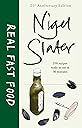
Real Fast Food
Product ID: 312222869
📚350+ recipes
🥗Vegetarian & vegan focus
⏱️30 min or less prep
Desertcart purchases this item on your behalf and handles shipping, customs, and support to Colombia.
⏳ Eat fast, live fully – master quick gourmet meals with ease!
Real Fast Food by Michael Joseph Ltd offers over 350 quick, nourishing recipes designed for busy professionals who value fresh ingredients and minimal prep time. With a focus on meals for one or two people, this cookbook embraces modern eating habits, featuring vegetarian and vegan options alongside versatile chicken dishes. Written in an engaging, personal style by a renowned TV chef, it transforms everyday cooking into a simple, enjoyable experience without the fluff of glossy photos.
| Best Sellers Rank | #166,858 in Books ( See Top 100 in Books ) #331 in Vegetarian & Vegan Food #398 in Celebrity & TV Show Cookbooks #461 in Quick & Easy Cooking |
| Customer Reviews | 4.4 out of 5 stars 674 Reviews |
M**Y
It is an amazing book. The recipes focus on fresh ingredients and ...
It is an amazing book. The recipes focus on fresh ingredients and meals that can be made (mostly) in half an hour or less. I borrowed Real Fast Food from a friend and found myself entranced by the straightforward writing of a man who enjoys food and knows that simple, speedy cooking is a boon to many households. I particularly like the fact that his recipes are often for 1 or 2 people (ingredients can of course be multiplied for more eaters). I have often cooked just for myself and recipes usually provide quantities more suitable for a family than one person. The book is divided in to easily digestible sections including Eggs, Fish, Pasta, Meat and Vegetables & Salads. This content is light on meat - the author says this is because he believes eating habits are changing and people eat less meat than they used to. He does, however, devote a section to Chicken which he believes is "the most versatile meat for the quick cook". Real Fast Food was originally published in 1992 - the edition I have used was republished in 2006. It is great to see a book without the glossy pictures which are so common in cookery books nowadays. The writing is dense yet light, imbued by personal observations which make the book real, human and accessible. Each chapter starts with narrative about the food in question, written in the first person, as is other commentary in the book - often remarks about a dish before the ingredients list. This gives the writing an immediacy that helps bring the author in to your kitchen - relaxed, easy, non-fussy, taking huge pleasure in his craft. The writing reflects Slater's presentation style - he has been a regular on TV over the years. Slater describes himself on his website as "a cook who writes". The advice he gives in Real Fast Food is eminently practical. He is not afraid of addressing food a lot of cooking purists might avoid, from fish fingers to mash - he claims to "love mashed potatoes more than anything else edible". Slater sometimes follows a recipe with several potential variations, under such headings as "Good things to stir into Rice" - for instance rice, mint and cucumber which I have found a heavenly combination on a hot summer's day. Some of his suggestions are very simple, but I have found all I have tried highly enjoyable - from scrambled eggs in pitta bread to baked potatoes with goats cheese and spinach (baked potatoes being included as fast food due to the fact that although they take a long time to cook they take little preparation time). To my mind this book is extremely good value. Recipes are simple, quick and clearly explained. Slater's love of food shines through his writing
S**6
Tips and ideas for the kitchen, written like a novel
I love watching him on TV. This is just like reading through his everyday cooking show. It reads more like a novel than a cookbook, but just reading through it I've been inspired to pick up a few extra staples and mix things up in the kitchen.
B**D
Even Better than Rachael. Buy it Twice!!
`real fast food' is one of the English culinary writer, Nigel Slater's early books, which in many ways is much more friendly to American audiences than many of his later cookbooks, right down to the silly conceit of putting his title in all lower case instead of the way we were taught in fourth grade to capitalize titles of things! Two of the more obvious Americanizations are the presence of Jamie Oliver's blurb on the cover that `Nigel is a genius' and the subtitle saying that the book contains `350 recipes ready to eat in 30 minutes'. This puts the book in almost direct competition to Rachael Ray's latest offering, `365:No Repeats' which was published after Slater's volume, so one may say that Rachael is cribbing from the Brits this time. One less obvious but very gratifying change is the fact that all of Slater's recipes in this book are done using Imperial measurements rather than metric measurements. That is, everything is in spoons, cups, ounces, and pounds rather than in grams, kilograms, and milliliters. The very best thing about this book is that the qualities which made his other books so good, it was worth puzzling through all the metric units are still here in this `mass market' issue. Slater starts out on the right foot with me early in his introduction on ingredients when he gives me a corollary to Marold's Law of Fast Cooking in that he strongly recommends using fresh herbs for all `fast food' cooking because it takes too long for the virtues of dried herbs such as thyme to develop in quick cooking dishes. Fresh herbs are invariably more expensive than dried herbs. I should warn you that this book does have more than a few dishes that should more properly be considered `simple' or `easy' rather than fast. This should not be surprising, as `simple' cooking has been Slater's ideal in all his books. I confess to be pretty fond of Rachael Ray's approach to fast cooking in that she always genuinely aims for being done within 30 minutes, she uses few prepared ingredients and she uses lots of fresh fruits and vegetables. I believe Slater does Rachael one better by bringing his deep love and knowledge of his ingredients to us to understand and use, instead of following Miss Rachael's scripts without learning much beyond the particular recipe. Rather than organize his recipes around courses or types of dishes, Slater promotes our understanding by organizing his book by ingredient and within ingredient, by method. For instance, like all great food writers, he has lots to say about what you can do with eggs. One of the most delightful things I found in this book is his take on making scrambled eggs, on which he devotes much more love and attention than he does to that most finicky dish, the omelet. This may be do to his French influence, as I almost fell out of my chair when I read Slater saying that the French always seem to manage to find a simple approach to food. Since most of us see the Italians, or at least their British disciples such as Jamie Oliver, Rose Gray, and Ruth Rogers, as the great recipe simplifiers, it's unusual for those of us brought up on `Mastering the Art of French Cooking' to see French techniques as simple, but dust off your Elizabeth David and Richard Olney and you will find French simplicity aplenty. Slater is one of those rare food writers who actually admits to not liking a particular kind of raw ingredient. In his case, it is the Brussels Sprout! I find this odd, because I was always especially fond of Brussels Sprouts, even as a child, and even in preference to some of its cabbage family relatives. It is simply beyond me how someone can rhapsodize about artichokes, and not like Brussels Sprouts. Well, Slater actually doesn't rhapsodize about artichokes, and in this book he gives us the best times and methods for dealing with the little sprouts, so I forgive him. I don't believe Slater is a genius. I just believe that where Jamie Oliver is ebullient and something of a force of nature, Slater is articulate and insightful about what works in cooking and what goes together with what. You should be warned that Slater trades good tasting food done simply with a fair number of concerns about the heavy use of both saturated fats and carbohydrates. The man simply loves bacon, butter, heavy cream, potatoes, and beans! And why not. A little bacon or anchovies, cream and parsley would make shoe leather taste good. The bottom line is that you will learn a lot more about cooking technique and ingredients from Slater, even in this `quick cooking' book than you will from just about any other cookbook writer, including both Rachael Ray and Jamie Oliver. If you are already a Slater fan, this book offers a great reference to quick meals which follow his principles, when you don't have time to mine his deeper books, especially his most interesting and important book, `Appetite'. If you are unfamiliar with Slater, but you like good cooking, you can get no better introduction to his eloquence than in this volume. Very highly recommended.
K**N
ein genialer Koch
Sehnsüchtig und erfolglos wartete ich auf die deutsche Ausgabe und nun kämpfe ich mich mit miesem Englisch durch die Rezepte meines Küchenhelden. Bitte, liebe Verlage, druckt diese Serie auch auf Deutsch. Zwischen Nigel und Tim liegen Welten. Lieber Slater als Mälzer!
J**Y
Nigels recipes
Nice book. No colored pics.
Trustpilot
1 week ago
3 weeks ago