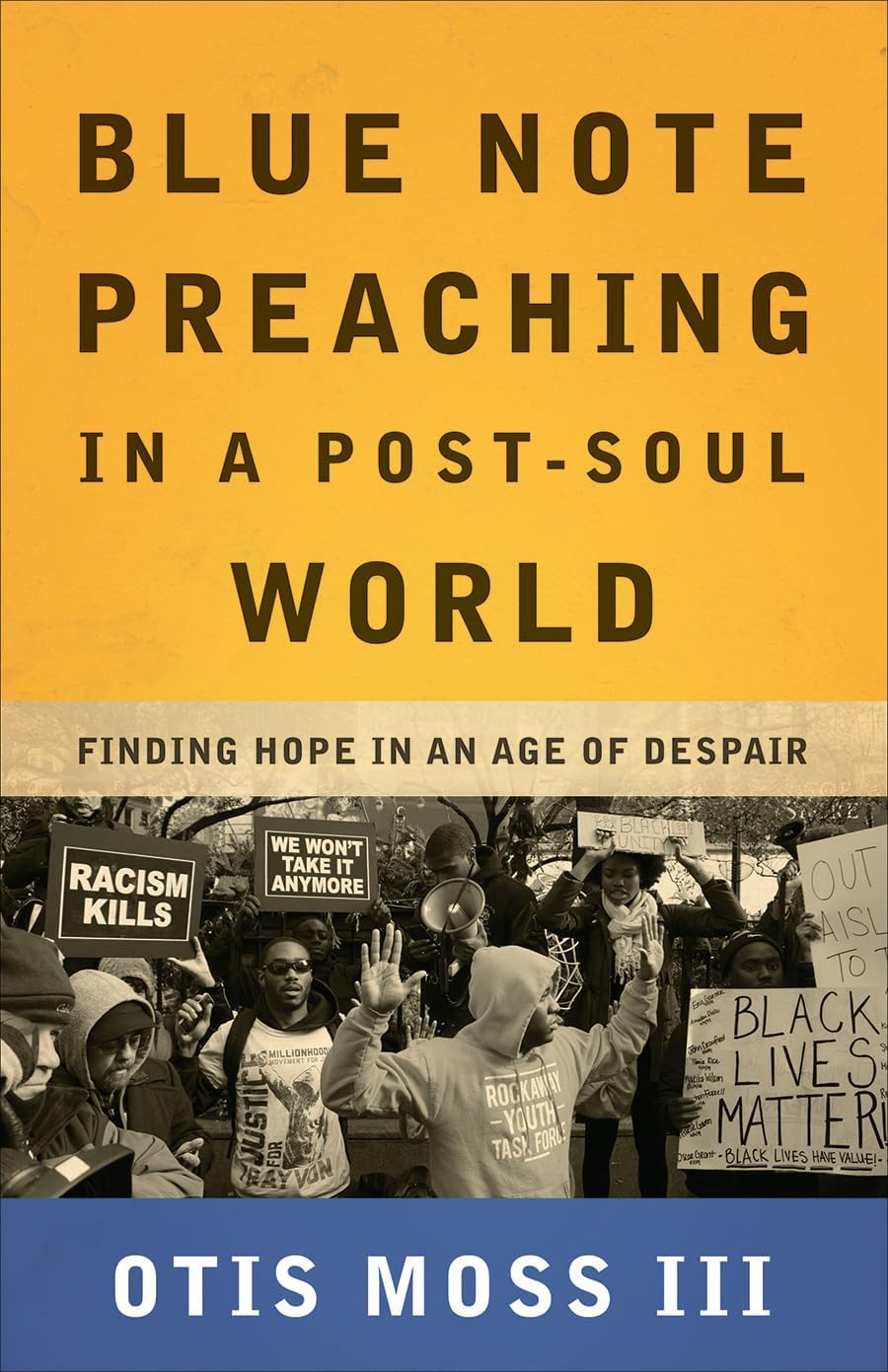
Blue Note Preaching in a Post-Soul World: Finding Hope in an Age of Despair
Product ID: 20353861
Desertcart purchases this item on your behalf and handles shipping, customs, and support to Colombia.
"Can preaching recover a Blues sensibility and dare speak with authority in the midst of tragedy? America is living stormy Monday, but the pulpit is preaching happy Sunday. The world is experiencing the Blues, and pulpiteers are dispensing excessive doses of non-prescribed prosaic sermons with severe ecclesiastical and theological side effects." â€"from chapter 1 Uniquely gifted preacher Otis Moss III helps preachers effectively communicate hope in a desperate and difficult world in this new work based on his 2014 Yale Lyman Beecher Lectures. Moss challenges preachers to preach with a "Blue Note sensibility," which speaks directly to the tragedies faced by their congregants without falling into despair. He then offers four powerful sermons that illustrate his Blue Note preaching style. In them, Moss beautifully and passionately brings to life biblical characters that speak to today's pressing issues, including race discrimination and police brutality, while maintaining a strong message of hope. Moss shows how preachers can teach their congregations to resist letting the darkness find its way into them and, instead, learn to dance in the dark. Review: The Blues ain't no pity party! - The words in this book ...they are Spirit and they are life. Brother Otis Moss III is one great preacher/ communicator and author,. Through this book, he is a voice for those who walk right along beside him; a voice for the suffering on the periphery. His encouragement to those of us who preach Jesus, and his perspective is not a lazy one. He has studied his craft. The love he shares for everybody, not just those who are in his tribe shows throughout his whole expression... He keeps it real. He keeps it simple. He keeps it JESUS! ... and to those of us who are in the suffering, the Blues ain't no pity party... It becomes a prophetic word and a shout for Joy. A Praise for those who have worked before us, a Praise for the here and now... As well as a yet-to-be Praise... Review: Learning to dance in the dark - Rev. Moss has written a wonderful book. It's part philosophical exposition of the Blues, part theological reflection on the Blues' relationship with the Gospel, and part sermons of conviction and uplift. I know I'll return to this one many times.
| Best Sellers Rank | #263,857 in Books ( See Top 100 in Books ) #275 in Christian Preaching (Books) #486 in Christian Church Leadership (Books) #675 in Discrimination & Racism |
| Customer Reviews | 4.7 out of 5 stars 150 Reviews |
M**Y
The Blues ain't no pity party!
The words in this book ...they are Spirit and they are life. Brother Otis Moss III is one great preacher/ communicator and author,. Through this book, he is a voice for those who walk right along beside him; a voice for the suffering on the periphery. His encouragement to those of us who preach Jesus, and his perspective is not a lazy one. He has studied his craft. The love he shares for everybody, not just those who are in his tribe shows throughout his whole expression... He keeps it real. He keeps it simple. He keeps it JESUS! ... and to those of us who are in the suffering, the Blues ain't no pity party... It becomes a prophetic word and a shout for Joy. A Praise for those who have worked before us, a Praise for the here and now... As well as a yet-to-be Praise...
R**T
Learning to dance in the dark
Rev. Moss has written a wonderful book. It's part philosophical exposition of the Blues, part theological reflection on the Blues' relationship with the Gospel, and part sermons of conviction and uplift. I know I'll return to this one many times.
F**Y
A book we desperately need in renewing HOPE..
Now don’t let the title prompt you to think that this book is only for those that either like music, particularly blues or soul, or even those that are preachers or in ministry. There is a broad-reaching audience that this book has the potential to impact. In these ominous times of community and police shootings, the school to prison pipeline, the inequality and failing performance of our education system, the financial struggles of cities, communities and families, and much more, Blue Note Preaching In A Post-Soul World: Finding Hope In An Age Of Despair by Otis Moss, III, addresses not only what is needed in our communities and the current state of our world, but also in Moss’ own words “rescues us from acceptance and dares us to move from the couch of apathy to the position of work”.(1) Whether or not you understand, like, or even really listen to it, many people have a sense of the soul-stirring sound of blues music, created out of the African-American tradition in the 19th century, which incorporates a call-and-response pattern, specific chord progression, notes typically flatter in pitch, as well as spirituals, shouts, and chants. Moss initially discusses the connection of other music forms like jazz, soul, and Hip-Hop, as well as, preaching, our history, and even our current state of the world, to the blues or blue note. As we know, there are many who can and do speak to the problems and challenges of the world today. We can talk about it, complain about it, cry about it, shake our heads, and the like, however, what Moss does is dare us not to continue to hem and haw in a “blues moan”, but to envision and focus on the “gospel shout”. For those that are pastors, ministers, people who seek to touch and inspire others in the world, Moss challenges us not to simply talk and preach. As he states, “We are called to place a word in people.”(2) And yet, this book challenges a variety of different people; from those who have been wearing pain and abuse while allowing that to define them; to being able to listen, discern and learn how others receive things and consider how to communicate, in order to relate to them and still be authentic; to those who have been given a gift and have yet to give it over to God and allow it to be used for greater things. In Blue Note Preaching In A Post-Soul World, Moss beautifully connects styles, generations, messaging and mediums, allowing us to see how all can relate and come together in a profound way. The inclusion of sermons depicts and give us a further understanding of “blue note preaching” while giving what I feel is desperately needed to uplift our communities and this world. You might expect references to scandals in the Bible, however, references to Grey’s Anatomy and Scandal, as well as a breakdown of dating versus courting from the sermon entitled, “Loving You Is Killing Me” in the book, is exactly what’s needed to address the shift in our culture and its relation to relationships, our family unit, and our values that further diminish our communities and feed our current struggles. And yet in that same sermon, an epiphany that despite our mistakes, often God can do more with us and we can greatly impact the communities and world around us after those pitfalls. (A gospel shout for those of us: such as individuals who have been incarcerated, homeless, or otherwise failed in some way.) Moss even speaks to those who feel that the church has not been there for our communities, particularly with recent events. To those who question and doubt that the church has not been fighting or leading the fight in the issues our communities have been dealing with, he eloquently explains 2 key points that really hit home. The first is that rather than waiting for anyone to lead, we all have in us the capacity to start, contribute, and lead in the work that we see needs to be done. And the other key point is that, it is not that the church has not been doing many things, but that their work is not often what you see in the paper, hear on the radio, see on the news. This is such a redeeming point for many that continue to criticize and attack the biggest and most enduring historically foundation the Black community has ever had. I hope that Moss’ clarification of this can serve to once and for all silence the attackers of the church and help them focus on working together. You have to love how Moss connects and uses the depictions of current media and social references, especially in the book’s section and sermon entitled “How To Get Away With Murder”. The link between scripture and the story of Herod and Mary & Joseph to the slavery and peonage systems and our current justice system demonstrates the gift that Moss has not only connecting history, but our relationship to it. The details that he breaks down serve to depict various things we see in our communities, how people like Dr. King and W.E.B. Dubois served to liberate our communities, and how we can use those examples to charge ahead. When he states, “there’s got to be some point in our moment and in our lives where some brothers stand up and adopt some children who are not your own, if we are to change this situation in our community”(3), Moss sets before us a challenge on things we must all start to do and things we have to look at differently if we want to see that beautiful world of which we dream. As we are living in what can be considered desperate and disheartening times, Blue Note Preaching In A Post-Soul World: Finding Hope In An Age Of Despair serves to relate our history and spiritual roots, to our current state, while meeting us where we are in an effort to plant seeds of possibility, renew dreams and hope, and insight into what we can do individually and collectively to create and work towards that world we envision. (1). Page 7. Blue Note Preaching In A Post-Soul World: Finding Hope In An Age Of Despair (2). Page 25. Blue Note Preaching In A Post-Soul World: Finding Hope In An Age Of Despair (3). Page 120. Blue Note Preaching In A Post-Soul World: Finding Hope In An Age Of Despair
S**R
Black Preaching Style Revival
This book is a quick read with sample sermons included. It is a call to return to the art of preaching that acknowledges the lament and the tough experiences both in the life of the Biblical characters and the congregation. It is a call to reclaim the hallmarks of the Black preaching tradition while embracing 21st-century problems and styles. One of the added aspects is that the book closes with examples of the hallmarks the first few chapters mentions.
H**G
OM3: The Message in Metaphor & Music
Readers will quickly appreciate the fact that Blue Note Preaching in a Post-Soul World is written in the key of see sharp rather than be flat. In this unique and concise little book, only 127 pages, the Rev. Dr. Otis Moss III invites the reader to sit with the audience at his Lyman-Beecher lectures at Yale Divinity School AND to listen as a member of the congregation at Trinity United Church of Christ in Chicago while the gifted preacher delivers four sermons, each one demonstrating what “Blue Note Preaching” is all about. The creative inclusion of Quick Response Bar Code icons enables readers to view the lectures as well as read them. Using metaphors from music, art, drama, and literature, Moss illustrates how preachers can discern God’s presence in the midst of tragic experiences where some might see only darkness and despair. Preachers need to be willing to stand in the midst of the violent storm and not just get the Blues but sing the Blues. When preachers risk that depth of vulnerability, faith, and courage, God can use their prophetic witness (just as God used Amos, Hosea, and Jeremiah) to transform the old world into a new one. If potential readers or purchasers are reluctant to take a closer look at a book like Blue Note Preaching in a Post-Soul World because they don’t happen to be jazz enthusiasts or don’t find themselves in a predominantly African-American congregation, they should set those misgivings aside. All preachers can grow from the insights that “Blue Note Preaching” bring to the discipline of homiletics. Moss acknowledges that there are multiple ways in which a preacher can communicate and embody the Word of God, that preachers need to find and use their own voice, and that there is nothing worse than being inauthentic in the pulpit. Moss cautions against yielding to certain temptations that preachers often face, such as the inclination to soften the demands of discipleship, particularly when one is dependent upon one’s listeners for one’s income - or the lure to bypass or race through life’s Good Friday moments with our people so we can quickly move on to the more appealing Easter shouts. All four of Moss’s sermons invite us to identify with people who experience pain, who know tragedy, and who sing the blues, but neither Moss nor God leaves us there. Like Jacob, we may emerge from our long, dark night of the soul with a limp, but we also find ourselves invited, equipped, and empowered to join God in conceiving and giving birth to a better world. Harry L. Strong
A**R
A Must Read
There is a lot going on in the world today. There are bombs going off and people are being killed. There is racial tension in America at an all time high. There are individuals walking onto college campuses and killing students while they are trying to learn. There are people that are unemployed and underemployed. The world right now is in despair, but Dr. Moss tells us that there is hope in the midst of despair. It is difficult to preach in times like these. However, Dr. Moss tells us that there has to be Blues before there can be Soul/R & B. Dr. Moss not only looks back to the Blues and R & B. He also looks back to the beginning of Hip Hop. We have to know the past in order to understand the future. Dr. Moss' book is timely because he teaches us how to live with hope, even when things appear hopeless. Preachers need to know how to "bring" a sound buoyant message in troubled times. Otis Moss includes several sermons in his book that demonstrate how to preach when things are topsy turvy. Every preacher should have this book in his/her preaching library.
C**L
Otis Moss III has an amazing command of language and content
Incredibly insightful and inspiring! Otis Moss III has an amazing command of language and content. Have recommended this book to musicians and writers who have felt disconnected from organized religion but who hunger for spiritual connection. A wonderful read!
D**S
Authentically Proclaiming the Reality of Good Friday and the Truth of Resurrection Sunday
I appreciated Dr. Moss' analysis of the homiletical needs of post modernity. He gives vocabulary that helps us not jump over Good Friday to get to Easter. He reminds us that GOD is present in our Good Fridays. Dr. Brueggemann contends that America does not know how to grieve; Dr. Moss reminds us that authentic faith means that we embrace our grief while claiming God's ultimate victory. But Dr. Moss does not stop there; he gives a flexible road map for preachers to follow to express this truth. Flexible in the sense that it does not require the preacher to abandon her/his GOD given gifts but calls the preacher to be a prophetic utterance so often missing in today's easy theology. I highly recommend this book.
D**Y
Three Stars
I was hoping for more in terms of how he goes about constructing a sermon.
Trustpilot
5 days ago
1 month ago