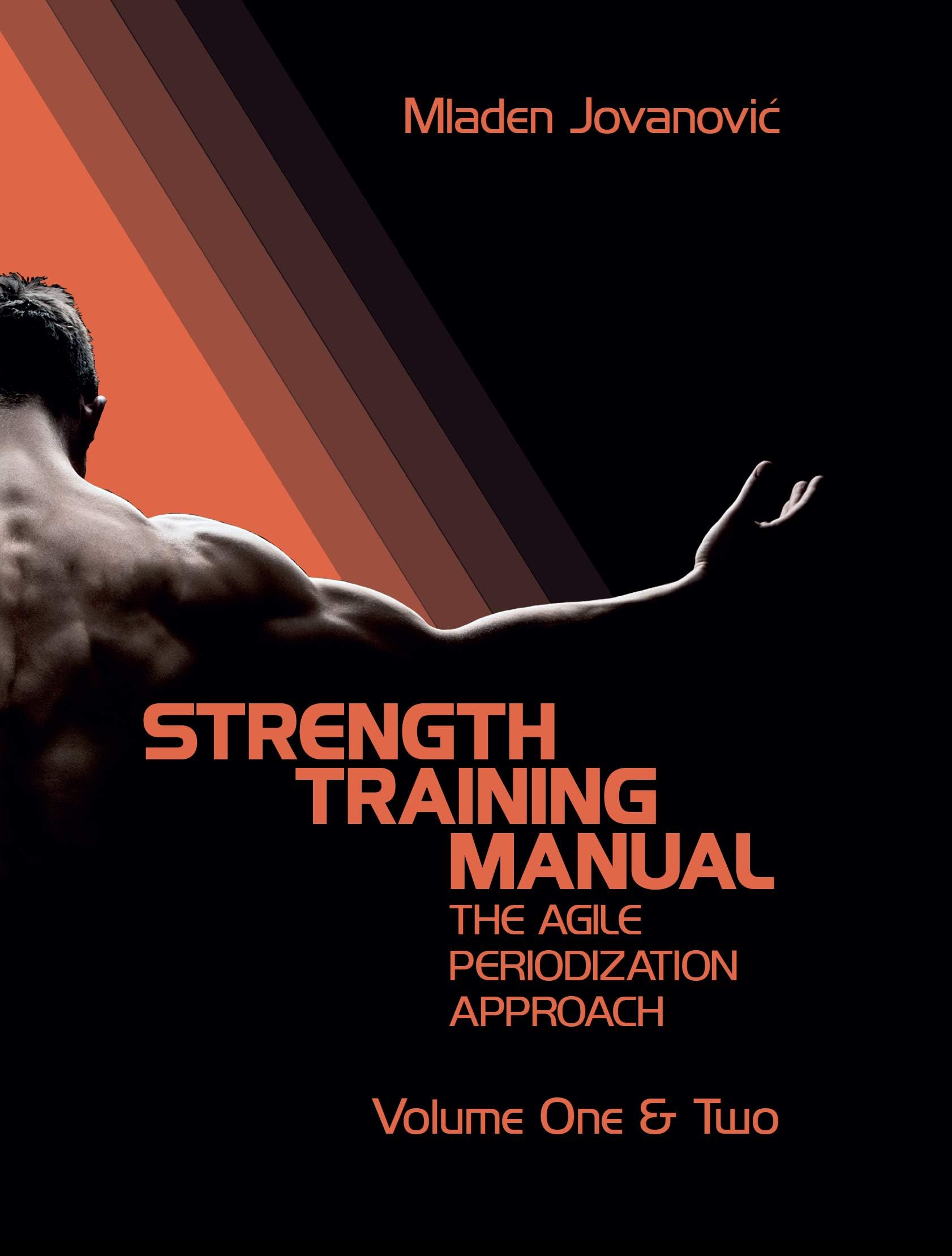
Strength Training Manual: The Agile Periodization Approach
Product ID: 191657789
Strength Training Manual represents my ongoing pursuit in understanding both strength training and training theory in general, by providing an overview of the conflicting opinions, but also giving practical, heuristic solutions to common problems and their reconciliation. The framework for such an approach is the Agile Periodization , which approaches planning from uncertainty perspective, iterations, and experimentation while providing satisficing and robust solutions. Besides being very rich in theory, Strength Training Manual is also rich in forum-for-action solutions, including reference tables, useful heuristics, and more than 1,900 set and rep schemes provided and analyzed. It also provides the best practices from other experts tinkering in this field. Paperback edition of the Strength Training Manual comes in two volumes: Volume One & Two, and Volume Three. Volume One and Two of this manual is an in-depth look into strength training planning and general training theory, as well as an introduction to the Agile Periodization framework. I believe that I haven’t left any stone unturned in Volume One and Two. But to do that I had to go full circle: I had to go deep into nitty-gritty details, show issues, assumption, flawed reasoning, and finally present simple solutions or even different paradigms. Volume Three is straighter to the point and represents a collection of all the useful tables and heuristics from Volume One and Two that you can use as a starting point when designing your strength training programs. Volume Three is my original writing intention, but when I started writing I realized that some things needed a more thorough description and explanation (and besides, I went off-the-track to explore some concepts that emerged during the writing process), rather than do-this-and-not-this perspective. Volume One and Two covers the following topics: The philosophical underpinning of the Agile Periodization Exercise classifications and their relationships Testing approaches for establishing 1RM used for percent-based prescription as well as the novel Estimation through iteration approach Prescribing training loads using various methods and their modifications A thorough discussion of the training dose concept, as well as dose -> response models Anatomy of set and rep schemes and their archetypal variants Mladen’s Methodological System of classifying Set and Rep schemes Horizontal and Vertical planning perspectives (This will cut through all the periodization crap you have been fed over the years) Novel planning strategies and concepts such as robustness , microdosing , Don’t break the chain and Markov Chain A thorough discussion on what individualization really is (and what it should be) Review and Retrospective practices including updating planning 1RMs between phases and phase potentiation ideas and critiques (and novel iterative approach) Discussion on predictive and causal modeling in strength training Strength Training Manual will give you not only a practical solution to tackle everyday problems of planning, prescribing, and monitoring strength training, but also critical thinking skills. You can use these essential skills of thinking and tools in other types of physical preparation and training in general. Review: If you're a coach or athlete looking to improve your game....this is where it's at! - Although I have been studying and working in the field of strength and conditioning for the last decade, I have a weird confession. I rarely buy books or articles on training anymore. When I first started, I would devour a book a week and drown myself in mountains of research studies attempting to learn as much as humanly possible. After a while, I began to realize that training was more so an arte-scienzia, and that most books and articles on training failed to add anything productive beyond the musings from the original greats like Zatsiorsky, Siff, Verkhoshansky, Pfaff, Al Vermeil and Charlie Francis to name a few. I continued to pour over the classics from Bosch, Poliquin, and countless other masterpieces, but during undergrad, I began to notice the field was moving away from the art and philosophy of training, to an intellectually impoverished, reductionist, myopic variant deemed the “evidenced-based” movement. Having been mislead by the allures of this movement early on in my career, (with the countless injuries and lack of improvement to show for it!), I began to focus more on the art and philosophy aspects of the profession as this appeared to yield the most benefits for most of the populations I trained. After undergrad, I pivoted slightly into the field of nutrition and increased focus on the psychological elements involved in the interplay of nutrition, training, and behavior change. Although I still read training research, devoted 25-40 hours weekly to in-person observing and/or training for many years after graduate school, and read numerous fantastic, informative articles from the likes of Carl Valle and other great coaches; overall my purchases and consumption of training centric books sharply decreased over the years. It wasn’t last year when I made my first training book purchase, as my friend and fellow strength coach Mladen Jovanovic released his magnum opus, Strength Training Manual: The Agile Periodization Approach. As a big fan of Mladen’s work in the past, I was excited to dive in. After finally finishing this beast of a manual, I can happily conclude that I am grateful that this was my first training related purchase in years. Unlike the unrelenting production of noise and unnecessary garbage that typically circulates academia and the internet nowadays, Mladen’s introduction alone provides content that is worth the price of admission. Paralleling my own journey, Mladen has similarly realized the power of philosophy, and the utility of outside fields like psychology research pertaining to intuition, personality, and statistically informed risk management paradigms to effectively counter the numerous pitfalls that commonly plague the industry today. This process in turn provides a stable base for formulating an effective, agile, periodization framework. Building off this base, Mladen provides a comprehensive approach to designing training programs and navigating the innumerable possible conflicts or challenges that can arise during training cycles. Written in a casual, conversational tone, Mladen’s work is easy to read but does not lack depth. The ability to convey complex ideas in a simple, accessible manner is yet another testament to Mladen’s abilities and I often found myself pausing to reflect on the countless astute observations loaded in each chapter. His humor and personality are interspersed throughout, and the tone conveys both confidence, edge, and a strong personality. Some readers might be offended by the lack of political correctness or a filter, but you can tell that Mladen is sick and tired of the ideological nonsense that frequently plagues the field. That being said, the confidence is well earned as Mladen’s ideas are both legit and effective. They are backed by both sound philosophical and scientific arguments as well as decades of elite-level experience. If you are interested in a training book that is informative, insightful and unlike any other training book you’ve ever read, I strongly recommend reading Mladen’s manual. Check it out! Review: Top Strength Training Book - One of the best reads on strength training in totality. It’s not just about a book based on the physiology occurring in the human body, it’s more on the ’agile’ planning during an athletes year and how to apply these different methods throughout it.
| Best Sellers Rank | #1,817,420 in Kindle Store ( See Top 100 in Kindle Store ) #1,209 in Weight Training (Books) #1,297 in Weight Training (Kindle Store) #2,429 in Sports Training (Kindle Store) |
M**G
If you're a coach or athlete looking to improve your game....this is where it's at!
Although I have been studying and working in the field of strength and conditioning for the last decade, I have a weird confession. I rarely buy books or articles on training anymore. When I first started, I would devour a book a week and drown myself in mountains of research studies attempting to learn as much as humanly possible. After a while, I began to realize that training was more so an arte-scienzia, and that most books and articles on training failed to add anything productive beyond the musings from the original greats like Zatsiorsky, Siff, Verkhoshansky, Pfaff, Al Vermeil and Charlie Francis to name a few. I continued to pour over the classics from Bosch, Poliquin, and countless other masterpieces, but during undergrad, I began to notice the field was moving away from the art and philosophy of training, to an intellectually impoverished, reductionist, myopic variant deemed the “evidenced-based” movement. Having been mislead by the allures of this movement early on in my career, (with the countless injuries and lack of improvement to show for it!), I began to focus more on the art and philosophy aspects of the profession as this appeared to yield the most benefits for most of the populations I trained. After undergrad, I pivoted slightly into the field of nutrition and increased focus on the psychological elements involved in the interplay of nutrition, training, and behavior change. Although I still read training research, devoted 25-40 hours weekly to in-person observing and/or training for many years after graduate school, and read numerous fantastic, informative articles from the likes of Carl Valle and other great coaches; overall my purchases and consumption of training centric books sharply decreased over the years. It wasn’t last year when I made my first training book purchase, as my friend and fellow strength coach Mladen Jovanovic released his magnum opus, Strength Training Manual: The Agile Periodization Approach. As a big fan of Mladen’s work in the past, I was excited to dive in. After finally finishing this beast of a manual, I can happily conclude that I am grateful that this was my first training related purchase in years. Unlike the unrelenting production of noise and unnecessary garbage that typically circulates academia and the internet nowadays, Mladen’s introduction alone provides content that is worth the price of admission. Paralleling my own journey, Mladen has similarly realized the power of philosophy, and the utility of outside fields like psychology research pertaining to intuition, personality, and statistically informed risk management paradigms to effectively counter the numerous pitfalls that commonly plague the industry today. This process in turn provides a stable base for formulating an effective, agile, periodization framework. Building off this base, Mladen provides a comprehensive approach to designing training programs and navigating the innumerable possible conflicts or challenges that can arise during training cycles. Written in a casual, conversational tone, Mladen’s work is easy to read but does not lack depth. The ability to convey complex ideas in a simple, accessible manner is yet another testament to Mladen’s abilities and I often found myself pausing to reflect on the countless astute observations loaded in each chapter. His humor and personality are interspersed throughout, and the tone conveys both confidence, edge, and a strong personality. Some readers might be offended by the lack of political correctness or a filter, but you can tell that Mladen is sick and tired of the ideological nonsense that frequently plagues the field. That being said, the confidence is well earned as Mladen’s ideas are both legit and effective. They are backed by both sound philosophical and scientific arguments as well as decades of elite-level experience. If you are interested in a training book that is informative, insightful and unlike any other training book you’ve ever read, I strongly recommend reading Mladen’s manual. Check it out!
C**R
Top Strength Training Book
One of the best reads on strength training in totality. It’s not just about a book based on the physiology occurring in the human body, it’s more on the ’agile’ planning during an athletes year and how to apply these different methods throughout it.
K**N
The Modern Day Strength Coaches' Bible A++
If you're a lifelong learner in the world of strength and conditioning, no doubt you've read the perennial works of Verkoshansky, Issurain, Bompa and the other big-hitting Eastern European coaches of the USSR's Golden era of sports. These have long been considered great works, with many elevating them to the status of 'biblical texts'. For decades, strength coaches have fallen in love with the plan-in-advance approaches the texts espouse and these days, long-term planning is rarely challenged or critiqued. Indeed, the underlying premise that the effects of training are predictable, is assumed to be true. Since the Golden Age of the USSR on the world sporting stage where these texts and ideas emerged (some of which, are still invaluable), the dynamics of sports preparation has changed. The status quo is no longer planning for world-class athletes in 4-year training cycles who do nothing else but train and compete in their sport; nor, are they assisted by the 'supplements' that became popular during the 70's and 80's. In reality, 'plan in advance' strategies espoused by the 'Old Gods' rarely work out in practice; if it did, we would expect to see linear and consistent progress from our athletes across time... which we know is simply not the case. In reality, sports planning is marred with uncertainty; and the Strength Training Manual is an antidote to this. Rich in storytelling, archetypal frameworks, and heuristics or 'rules of thumb', it assists in decision making in an environment where it's more important to recognise what you don't know, then what you do. The Strength Training manual is in many ways, the New Testament; it adds much-needed context to our 'biblical texts' and explains why our much-loved periodisation models rarely turn out the way we expected them to. It refines our thinking, replacing rigid periodization structures with adaptable, 'agile' frameworks, 'rules of thumb' and shortcuts to make the life of a strength coach easier and more effective. This piece of work will no doubt in time, find itself on the bookshelves of every open-minded strength coach who is keen to elevate themselves out of dogmatic thinking and into a world of more pragmatic, practical and effective coaching.
R**S
Very developed S&C book, but complicated
I first want to point out that there are a ton of variables I am now adding to my spreadsheets to track athletes. I found that to be the best part of the book in my opinion. If you're new into the S&C field, I'd recommend this as a good but complicated source. The reason it is complicated is due to Jovanovic's intellectual philosophy and him terming things completely different from what I've read and learned about in S&C. In fact that first couple of chapters are basically going over his terminology and philosophy (it can be annoying as you don't really need to know his terminology for the CSCS or maybe conversing with other practitioners in the field (except for Jovanovic)). Once you get past the terminology, Jovanovic does bring up some great points in terms of training athletes and really having an 'agile periodization' program as there is never a team in which all the athletes show up for their lifts.
C**R
Mladen takes a look at strength training from a lens few others do
I enjoyed this book quite a bit. The initial chapters were worth the read by themselves. Mladen does an excellent job of looking at strength training from the standpoint of decision making under uncertainty. A constant risk faced is programming for the individual you think is in front of you instead of the person that is. Traditional methods of programming often suffer from an inability to adjust to changes that were not initially predicted. This book explores the other option - that of creating a program that keeps the goals in mind while adjusting to ensure that the stimulus is appropriate for the situation at hand. Definitely recommended for anyone who programs for humans.
A**R
Not worth a dollar
I was very disappointed by this. It's basically a collection of anecdotal, incoherent ramblings that read like they were written by a third grader. Not a lot of info that would actually help you get better at lifting. It seems more like a personal project that the author took on to feel better about himself. Definitely not worth $35. If you want to get better at lifting, there is plenty of info on the internet that is free and vastly more helpful than this book. If you really want to read a book, there are other books about strength training that are both cheaper and actually well written.
N**A
Buon libro per intermedi
Libro abbastanza interessante, l'autore critica alcuni dei classici modelli di programmazione/periodizzazione sulla base della sua esperienza e citando anche alcune fonti scientifiche. Muove critiche sui concetti cardini di alcune scuole di programmazione, ed in parte condivido la sua idea di pensiero, unico neo è che si perde in formule verso il finale veramente astruse, cioè prima parla di come bisogna essere più rapidi e semplici possibili parlando di un approccio bottom-up però poi invoglia a riprendere mano ad un blocco di programmazione e fare un "mea culpa" che chiama revisione per trovare i problemi, i punti di forza ecc in base all'atleta. Ho trovato utile invece i consigli nei casi di allenamenti di squadra. Però come dico nel titolo va bene se si è un "intermedio" nel mondo della programmazione, sicuramente meno adatto a novizi. Ps: Peccato per l'assenza del volume 3
C**C
A bible and must have for all strength coaches
I highly recommend the Strength Training Manual by Mladen Jovanović to all coaches! All of the best strength training resources are compiled into this one manual simply and easily. Some of the best works of Dan John, Dr.Matt Jordan and Dan Baker have been integrated into the manual with the practical application and examples. As a new strength coach, I believe this book has given me an unfair competitive advantage of knowledge with all the great content inside. I know I will reference this book for many years to come! I love this book so much that I have bought copies for my friends and mentors because it is so resourceful and saves them so much time and money. What better way to show you care than to buy a resourceful book to help others with their careers! I can't wait for the third volume to come out!
C**R
Comprehensive strength training planning and programming manual.
Comprehensive manual on strength training planning and programming. Many models and concepts supported with real world examples.
M**.
Greatest book in the strength training (Theory + Application)
A mixture of science and criticism of sports science. Mladen recognised that there are not definite answer until we understand everything of the whole picture, thus, we can only create models that try to explain processes and strategies that are likely the best. Other than Renaissance Periodization, I think his goal is to actually teach people, other than creating fancy concepts that tell us "this is the best way to train". This book does a great job in order to: - understand the bigger picture, and how to think about sports science - understand more of the complexity of adaptation - how to organize training - how to progress - how to autoregulate Etc. I think there is an theoretical optimal way to train if we take EVERYTHING into account, but do we understand it fully, so that we can give definite answers? Thanks to this book, I can calm down a little bit, chasing the "optimality".
D**O
Magnifico libro
Muy buen libro, muy recomendable su lectura para personas relacionadas con el deporte de alto nivel
Trustpilot
1 month ago
5 days ago