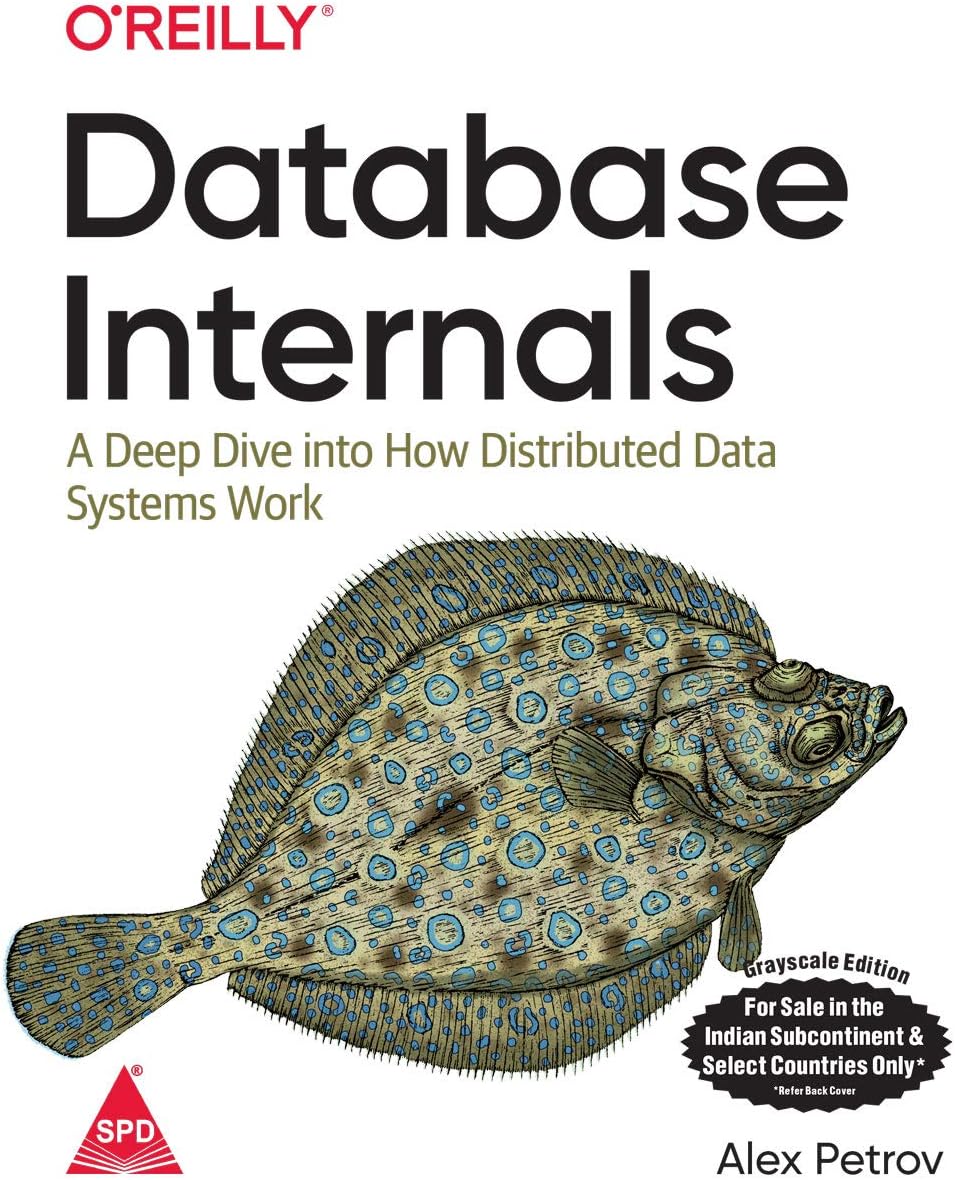
Database Internals: A Deep Dive into How Distributed Data Systems Work (Greyscale Indian Edition)
Product ID: 170241107
Buy anything from 5,000+ international stores. One checkout price. No surprise fees. Join 2M+ shoppers on Desertcart.
Desertcart purchases this item on your behalf and handles shipping, customs, and support to Colombia.
Disclaimer Shroff Publishers do not endorse the preview pages of kindle linked to our ISBNs. All Indian Reprints of O'Reilly are Printed in Grayscale When it comes to choosing, using, and maintaining a database, understanding its internals is essential. But with so many distributed databases and tools available today, it’s often difficult to understand what each one offers and how they differ. With this practical guide, Alex Petrov guides developers through the concepts behind modern database and storage engine internals. Throughout the book, you’ll explore relevant material gleaned from numerous books, papers, blog posts, and the source code of several open source databases. These resources are listed at the end of parts one and two. You’ll discover that the most significant distinctions among many modern databases reside in subsystems that determine how storage is organized and how data is distributed. This book examines: Storage engines : Explore storage classification and taxonomy, and dive into B-Tree-based and immutable Log Structured storage engines, with differences and use-cases for each Storage building blocks : Learn how database files are organized to build efficient storage, using auxiliary data structures such as Page Cache, Buffer Pool and Write-Ahead Log Distributed systems : Learn step-by-step how nodes and processes connect and build complex communication patterns Database clusters : Which consistency models are commonly used by modern databases and how distributed storage systems achieve consistency Review: Good read, and came in well wrapped - I read other reviews, which said "this book is very technical". That made me think, that this book is going to have source code of database internals.. But, these are just theories. Because, of that i am a little disappointed. If you are an experienced programmer, then you can read and absorb this books content in single day. It is a good book, otherwise. Review: Excellent overview of distributed databases - If you're looking for a not-too-deep introduction to distributed databases and plan to use it as a jumping off point for digging deep into the topics mentioned here, this is an excellent book.
| Best Sellers Rank | #4,543 in Books ( See Top 100 in Books ) #2 in Database Storage & Design |
| Customer Reviews | 4.3 out of 5 stars 539 Reviews |
A**R
Good read, and came in well wrapped
I read other reviews, which said "this book is very technical". That made me think, that this book is going to have source code of database internals.. But, these are just theories. Because, of that i am a little disappointed. If you are an experienced programmer, then you can read and absorb this books content in single day. It is a good book, otherwise.
V**K
Excellent overview of distributed databases
If you're looking for a not-too-deep introduction to distributed databases and plan to use it as a jumping off point for digging deep into the topics mentioned here, this is an excellent book.
A**R
if you're using with databases
* goes quite in-depth; I took what I wanted * types of database systems - HTAP was interesting to read about * compares row- and column-store databases * B-Tree, LSM, Skiplist, Hybrid Gossip protocol are some things that are discussed in detail
R**V
Good Read
I was looking for a book on internals of distributed databases , This one describes algorithms ranging from traditional BTrees to Modern Log Search Merge algorithms that's been used in distributed nosql databases. It's for Advanced users who has fair understanding of nosql stores.
R**.
High quality material, poor quality binding
I would like to express my utter disappointment and frustration with the abysmal quality of the book I recently purchased from this publisher. To call it a "book" would be generous—it's more like a hastily glued stack of paper masquerading as one. Within ten days of purchase, the binding began to unravel. The pages, thin as tissue paper, creased at the slightest touch and practically demand to tear apart if you even think about turning them. It’s clear this publisher has cut every possible corner, choosing to gouge customers while providing a product that looks like it was assembled by amateurs who couldn't care less about craftsmanship or pride in their work. If you're looking for a book that will literally fall apart in your hands before you've even finished reading it, by all means, waste your money here. But if you value quality and expect a publisher to uphold even the bare minimum standards of their profession, steer clear of this embarrassing excuse for a publishing house.
S**I
Does not teach the basics, only summarises complex concepts, too hard to follow for a beginner
This book is NOT for anyone who would like to start from the basics and learn the database internals or distributed system concepts to a reasonable extent. The author has attempted to cover too much and only managed to give short summaries of complex concepts which is impossible for any 'beginner' level reader to understand. The author does NOT seem to know about the art of teaching -- A good author would start with a minimum number of simple definitions, concepts and then subsequently build on them to form and explain complex ones. Any well written book (clearly NOT this book) will take the reader on a journey from the basics in earlier chapters to complex concepts in later chapters. This helps the reader to easily remember the concepts and gives a satisfaction of having acquired important knowledge. This book totally fails to do this. The book is littered with references to other books and scientific papers This implies that nothing is covered in depth in this "deep dive" book and reader has to follow the references to know more. Because I could not understand much of this book, i could not enjoy reading it and I had to force myself to read every chapter just because of the money i spent to buy this book. This was a stressful read for me with very little gains in knowledge. I would rather read a 1000+ page, well written book than this to understand database internals and distributed systems.
S**U
Binding is awful
Book fell apart first day first chapter. The more I read ahead the more the previous pages start to disintegrate. It would’ve been better if the publisher just gave you the loose leaf collection of pages and told you to bind it yourself. The contents of the book is good but the more you progress ahead the more the previous pages of the book disintegrates. Like a perverse database that erases previous rows when you insert a new row into it
M**Y
Poor pedagogy. Poorer content.
As someone who academically studies computer science, this book has been a very poor read at best, and misleading at worst. The author seems to “jump” through one concept to another without developing on a single concept in detail. For complex topics like consistency, for example, the author just jumps across various consistency models, never explaining what either a consistency model is nor carring to elucidate on the model itself. Not one good example, let alone theoretical depth. It’s like someone read a dictionary of cool words and put them together. I study these systems in depth academically and found many misleading examples and explanations. Don’t waste your time and money here. Buy a book from a professor who actually teaches.
V**V
A very good book with developers already working with databases and database-like systems
There are two infinitely big and comparably old topics in software engineering: compilers and databases. Both have traditions and history, both are recognised as deep research topics, with developers and academics working on related problems for decades. It's really hard to get an overview of the way databases work, given how diverse and, well, *big* they really are. Decades of practical experience don't mean one has a clear understanding of query processing, optimisation, storage subsystems, transaction processing, concurrency control, etc. Sometimes, just sometimes, mortals get lucky and somebody writes a survey of a subfield, or an extended overview, of relevant problems. Best example I am aware of: the Red Book aka Readings in Database Systems. It's a vast survey of academic work on databases. But it's more of a collection of paper references than a linear reading. Database Internals also feels a bit like an extended survey: numerous paper references are, no code, mostly conceptual explanations. What stands out is its good linear narration, gradually coming up with definitions and clarifying explanations. So, what this book is not: introductory text, a textbook, theory-centric volume or practise-centric work. What this book is: a survey of typical approaches to two major aspects of databases (local storage subsystems and problems of distributed systems). Interested reader will have to follow the references, casual reader will get familiar with terminology and common concepts in a condensed way. I would (and definitely will) recommend the book to people already working with databases for at least a few years looking for additional insights or an overview of the field.
F**K
Packed with details, great read
Can't believe I forgot to write a review for this one! Partly it's probably because I usually have less to say (or more precisely it's harder for me to be properly articulate) about things I like than I do about the ones I don't. And boy did I like Database Internals! I'll try my best to explain why, the book and the author surely deserve it. Being a back-end engineer, the main reason for picking this one up was to better understand the distributed databases that I may end up in (or have already had) contact with. With that in mind, I planned on just skimming the first part of the book but imagine my surprise when I found myself Googling BW and LSM trees and going through papers comparing this and that algorithm and their impacts on memory, storage and CPU caches in multicore systems. The geek got suckered in! With my curiosity circuits pleasantly warmed by the first part, I moved on to the second part of the book - the main dish - where a similar scenario unfolded: again I swallowed up whatever was served and ended up digging for more and adding scores of books and papers to my to-read list. All in all, Database Internals reads felt a lot like a trip to the zoo or a local museum: chock full of data structures and algorithms used by modern-day databases (and distributed systems in general), the book will showcase each item with sufficient details for you to grasp what they're about and then provide you with enough bibliography and reference material to last you a lifetime... or at least a couple of years.
C**T
Great book
Amazing book, in my top 3 technical books. I learned a lot, it goes really deep and explains everything very well. I would suggest to have at least a good understanding of database basics before starting though (indexes, distributed systems)
H**G
Great value with true knowledge!
The book is really good, mint without any scratches. Love it!
A**R
Alles, was man wissen muss.
Sehr gute Zusammenfassung for essenzielle Wissen.
Trustpilot
2 weeks ago
4 days ago