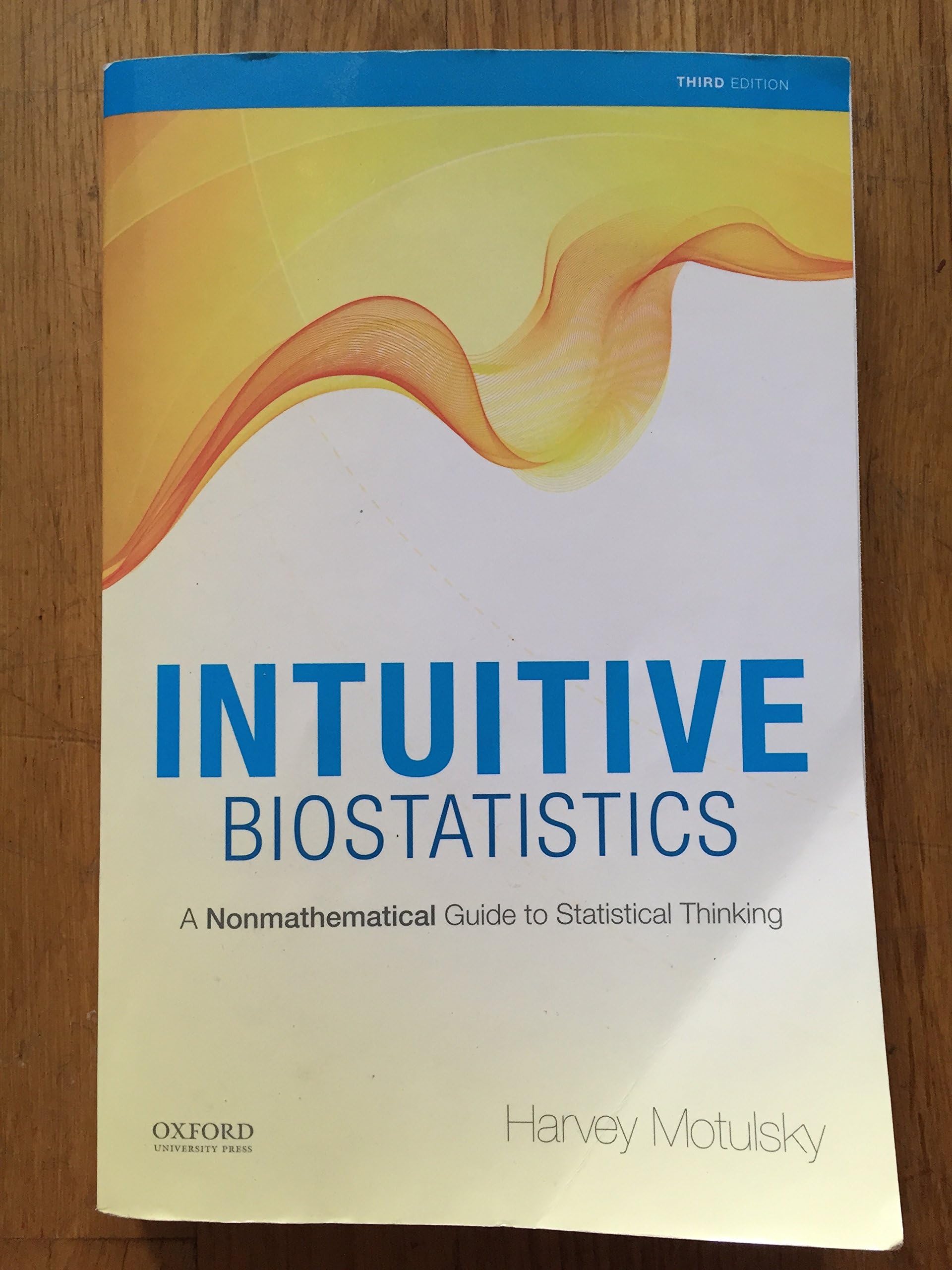
Intuitive Biostatistics: A Nonmathematical Guide to Statistical Thinking, 3rd edition
Product ID: 1700701
Thoroughly revised and updated, the third edition of Intuitive Biostatistics: A Nonmathematical Guide to Statistical Thinking retains and refines the core perspectives of the previous editions: a focus on how to interpret statistical results rather than on how to analyze data, minimal use of equations, and a detailed review of assumptions and common mistakes. With its engaging and conversational tone, this unique book provides a clear introduction to statistics for undergraduate and graduate students in a wide range of fields and also serves as a statistics refresher for working scientists. It is especially useful for those students in health-science related fields who have no background in biostatistics. CONTENTS Part A: Introducing Statistics 1. Statistics and Probability Are Not Intuitive 2. The Complexities of Probability 3. From Sample to Population Part B: Confidence Intervals 4. Confidence Interval of a Proportion 5. Confidence Interval of Survival Data 6. Confidence Interval of Counted Data Part C: Continuous Variables 7. Graphing Continuous Data 8. Types of Variables 9. Quantifying Scatter 10. The Gaussian Distribution 11. The Lognormal Distribution and Geometric Mean12. Confidence Interval of a Mean 13. The Theory of Confidence Intervals14. Error Bars PART D: P Values and Significance 15. Introducing P Values 16. Statistical Significance and Hypothesis Testing17. Relationship Between Confidence Intervals and Statistical Significance 18. Interpreting a Result That Is Statistically Significant 19. Interpreting a Result That Is Not Statistically Significant 20. Statistical Power21. Testing for Equivalence or Noninferiority PART E: Challenges in Statistics 22. Multiple Comparisons Concepts 23. The Ubiquity of Multiple Comparison24. Normality Tests25. Outliers 26. Choosing a Sample Size PART F: Statistical Tests 27. Comparing Proportions28. Case-Control Studies29. Comparing Survival Curves 30. Comparing Two Means: Unpaired t Test31. Comparing Two Paired Groups32. Correlation PART G: Fitting Models to Data 33. Simple Linear Regression34. Introducing Models 35. Comparing Models 36. Nonlinear Regression37. Multiple Regression 38. Logistic and Proportional Hazards Regression PART H The Rest of Statistics 39. Analysis of Variance 40. Multiple Comparison Tests After ANOVA 41. Nonparametric Methods42. Sensitivity and Specificity and Receiver-Operator Characteristic Curves 43. Meta-analysis PART I Putting It All Together 44. The Key Concepts of Statistics45. Statistical Traps to Avoid46. Capstone Example 47. Review Problems 48. Answers to Review Problems Review: An excellent statistics book - For over a decade, I have been searching for a clear, lucid guide to statistics that I can use in my research and share with my students. Finally, after combing through dozens of books, I can say I found an excellent book. Harvey Motulsky seems to have pulled off the trick of writing a book with high explanatory power that will not intimidate the busy undergraduate, graduate student, postdoc, or primary investigator who wants to learn the necessary information but does not want to drown in esoteric details, problem sets, or unhelpful information. As a practicing neuroscientist, I appreciate a guide that is informative but also a pleasure to read (I don't have time to read through the standard statistic texts I have come across). It is not surprising that Motulsky is also the CEO of GraphPad Software, the company that makes Prism. This software intuitively guides scientists into using the appropriate statistical tests for their data, and it is easily the best and most user-friendly statistical software on the market. I have used Prism for years and was unaware that Motulsky also wrote this book. Now I plan on recommending this book to my students and colleagues, and I purchased a copy for my office and lab. If you are a bioscientist intimidated by statistics (or feel like you could use a refresher after a long ago forgotten stats class), this book is a gem. Review: This is the best introductory book on statistics I have read - This is the best introductory book on statistics I have read. It is written for people who need to make sense of papers containing statistical reports, or for non-statisticians who conduct simple statistical analyses themselves. It covers a broad range of statistical procedures that are widely used in biomedical research. A particularly nice feature is the careful, clear explanations of how to interpret p values, confidence intervals and (unusually for an introductory textbook) false discovery rates. You won't find clearer explanations than those provided here! The book is full of sensible advice. I highly recommend it for graduate research students and researchers who need a basic, working understanding of statistics.
| Best Sellers Rank | #211,394 in Books ( See Top 100 in Books ) #3 in Biostatistics (Books) #56 in Biology (Books) |
| Customer Reviews | 4.5 out of 5 stars 94 Reviews |
M**R
An excellent statistics book
For over a decade, I have been searching for a clear, lucid guide to statistics that I can use in my research and share with my students. Finally, after combing through dozens of books, I can say I found an excellent book. Harvey Motulsky seems to have pulled off the trick of writing a book with high explanatory power that will not intimidate the busy undergraduate, graduate student, postdoc, or primary investigator who wants to learn the necessary information but does not want to drown in esoteric details, problem sets, or unhelpful information. As a practicing neuroscientist, I appreciate a guide that is informative but also a pleasure to read (I don't have time to read through the standard statistic texts I have come across). It is not surprising that Motulsky is also the CEO of GraphPad Software, the company that makes Prism. This software intuitively guides scientists into using the appropriate statistical tests for their data, and it is easily the best and most user-friendly statistical software on the market. I have used Prism for years and was unaware that Motulsky also wrote this book. Now I plan on recommending this book to my students and colleagues, and I purchased a copy for my office and lab. If you are a bioscientist intimidated by statistics (or feel like you could use a refresher after a long ago forgotten stats class), this book is a gem.
A**R
This is the best introductory book on statistics I have read
This is the best introductory book on statistics I have read. It is written for people who need to make sense of papers containing statistical reports, or for non-statisticians who conduct simple statistical analyses themselves. It covers a broad range of statistical procedures that are widely used in biomedical research. A particularly nice feature is the careful, clear explanations of how to interpret p values, confidence intervals and (unusually for an introductory textbook) false discovery rates. You won't find clearer explanations than those provided here! The book is full of sensible advice. I highly recommend it for graduate research students and researchers who need a basic, working understanding of statistics.
R**D
An unequivocally insightful approach to biostatistics
Intuitive biostatistics is a comprehensive overview of biostatistics. Instead of reading cover to cover, I have used this relatively detailed statistics text to review relevant sections as needed. Motulsky does not include mathematical equations. Rather, he focuses on interpreting statistical concepts, common pitfalls, and challenges the reader to think critically. Highly recommended for clinical, medical, and pharmaceutical professionals responsible for reviewing clinical data. Even for readers confident in their statistics knowledge, this is a great refresher. I have expanded my biostatistics acumen thanks to this book. This text is daily my go-to reference guide.
F**T
Slightly more Interesting than your usual statistics book
As much as I can like any statistics book, this one is pretty good for getting the ideas out to someone who does not want to read a dry book about math.
S**S
Good condition
Book like new and great price
T**D
I loved this book
I loved this book. I couldn't learn alot from my bio statistics professor as I have learnt from this book. This is really good book fro Biostats beginners. I recommend it for those who are embarking on bio-statistics concentration in healthcare system. The book helps you learn competency by competency and will make you ready for the future and advance biostatistics classes. Go and buy it - This is not that I want you to buy - this is just because I learned from it and if you want to learn from something - This is the book
G**N
Comprehensive reminder - significant rewrite on 1st and 2nd editions
Recommended by a science Professor, this book is a useful starting point for those seeking a better understanding of applied statistics. Covering a range of case studies from medical and science fields I'm enjoying revisiting the broad subject matter. Useful for both ends of the tail
K**T
Highly recommend
A great book every biologist should have. It is easy to understand, clear and even entertaining at times. After reading this book one would be able to perform the statistical analysis of most common types of biological data or at least to understand when to ask for the help of a statistician.
M**O
Imprecindible
Quien se dedique a la investigación científica y quiera COMPRENDER los PRINCIPIOS estadísticos necesarios para efectuar adecuadamente el análisis de resultados, debe poseer este libro,
G**R
Very good
Not that intuitive, I had to read the book
A**E
Sehr empfehlenswert
Allen, welche sich mit Statistik nicht ausschliesslich in mathematischer Form auseinandersetzen wollen, sei dieses Buch sehr empfohlen. Bei der Lektüre sind gewisse Kenntnisse in Kombinatorik und Wahrscheinlichkeitsrechnung jedoch sicherlich hilfreich.
M**K
Extremely useful
Any type of scientific discovery analysis that is rooted in large datasets requires a strong understanding of statistics. Statistics (especially for biologists) can be esoteric and difficult to approach...particularly if one does not have a good entry point. This wonderful book explains the basic concepts in a clear and accessible manner. It provides a good foundation to build upon and is essential for anyone in the fields of metabolomics or genomics who are not already trained biostatisticians.
C**S
Simples e direto, recomendo
Leitura fácil, bem objetivo e direto. Se voce precisa de conceitos básicos em Bioestatistica esse é o livro certo. Recomendado
Trustpilot
5 days ago
2 weeks ago