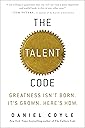
The Talent Code: Greatness Isn't Born. It's Grown. Here's How.
Product ID: 1524986
⚡Boosts skill acquisition 10x faster
🔥Ignites deep, lasting motivation
🧠Unlocks brain's myelin growth
Desertcart purchases this item on your behalf and handles shipping, customs, and support to Colombia.
🧩 Crack the code to greatness—because talent is grown, not born!
The Talent Code by Daniel Coyle reveals groundbreaking neuroscience behind skill mastery, showing how deep practice, ignition, and master coaching stimulate myelin growth in the brain to dramatically accelerate talent development. Drawing on global research from elite talent hubs, this book equips professionals, educators, and coaches with actionable tools to unlock and cultivate potential in any field.


| Best Sellers Rank | #11,347 in Books ( See Top 100 in Books ) #11 in Rugby (Books) #14 in Sports Coaching (Books) #14 in Popular Psychology Creativity & Genius |
| Customer Reviews | 4.6 out of 5 stars 4,587 Reviews |
K**K
Talent Is Developed, Not Innate: The Power of Deep Practice, Ignition, and Master Coaching
In his book The Talent Code, Coyle demonstrates that talent is not innate but is instead developed through a neurological process involving myelin, the insulation that wraps neural circuits and grows according to specific signals and practice patterns. He argues that superior performance or greatness is created by three interconnected elements—deep practice, ignition (motivation triggered by environmental signals), and master coaching—and that when these converge, even briefly, meaningful skill development accelerates dramatically. With this backdrop, readers set aside the nature versus nurture explanation for talent by recognizing that people across different fields develop extraordinary abilities not because they are genetically gifted but because they have tapped into this talent code through targeted, deliberate practice combined with powerful motivational triggers and expert guidance. Throughout the book, Coyle uses examples from talent hotbeds around the world—from Meadowmount Music School to Curacao’s baseball phenomenon to Spartak Tennis Club in Moscow to South Korea’s women’s golf program—to demonstrate that these processes are universal and accessible to anyone willing to engage in the uncomfortable work of reaching just beyond their current ability.
L**L
Loved this book
This book was such a fun, fast read! It is filled with examples that really drive home some important concepts related to learning a skill - any skill. Highly recommended!
V**J
Very good, but there are some frustrating contradictions
"I'm going to practice it a zillion million times," she said. "I'm going to play super good." "The Talent Code" by Daniel Coyle is a book on how to grow talent. The author is against the wisdom that talent is natural. The book is around the belief that talent come from Myelin. Myelin is the "insulation that wrap these nerve fibers and increases signal strength, speed, and accuracy." When the certain signal is sent down the nerve system, myelin wraps around the nerve fibre. The thicker the myelin, the better the signal. Thus, "skill is myelin insulation that wraps neural circuits and that grows according to certain signals." The book is divided into three parts of talent growing; 1. Deep Practice 2. Ignition 3. Master Coaching Contents Part 1: Deep Practice Chapter 1: The Sweet Spot This is the first chapter to familiarise us with the deep practice. Coyle wrote about Brazilian football (soccer) and why it is the world's talent hotbed. He had an amazing story of Edwin Link and how his unusual device transformed the training of the Air Force. Chapter 2: The Deep Practice Cell This chapter surrounds the idea of myelin and how it might be the holy grail to talent. It is very scientific. To sum it up, "deep practice x 10,000 hours = world-class skill." Chapter 3: The Brontës, the Z-Boys, and the Renaissance The author started with the Brontë sisters from England in the 1850s who wrote fantastic children books. He also wrote about the group of skaters by the name of Z-Boys and the guilds during the renaissance and how they produced highly talented people. Chapter 4: The Three Rules of Deep Practice This chapter, Coyle gives us three rules of Deep Practicing. 1. Chunk It Up 2. Repeat It 3. Learn to Feel It Part 2: Ignition Chapter 5: Prima Cues It is merely things that get you interested, that excite you and bring you passion. Coyle wrote on how the success of Se Ri Pak, a Korean golfer, had an impact on the next generation of female Korean golfers and how young Russian tennis players wanted to be the new Anna. "If she can do it, why can't I?" Chapter 6: The Curaçao Experiment The remote Caribbean island, Curaçao, did a miraculous work at producing lots of talented baseball players because the ignition sparked when an island hero, Andruw Jones, hit a home run. However, the real success of Curaçao is that it keeps motivational fire lit, Doyle tells you how they did it. Chapter 7: How to Ignite a Hotbed This chapter is about KIPP (Knowledge Is Power Program) by Mike Feinberg and Dave Levin. The story of success of KIPP is like a miracle but the core of it is to constantly ignite the students with just a word, college. No,... "COLLEGE!!" Part 3: Master Coaching Chapter 8: The Talent Whisperers Talent does not come alone, the talented people in their fields need a coach, a mentor, or a master. Coyle wrote about Herman Lamm, the originator and teacher of modern bank-robbing skill! He wrote about Hans Jansen, a cello teacher at Meadowmount Music School in Chicago and how he personalised his teaching method. There is also a wonderful story of John Wooden, a great basketball coach and his amazing coaching techniques. Chapter 9: The Teaching Blueprint The author elaborated the four virtues of teaching 1. The Matrix or a task-specific knowledge of the teacher (He wrote a nice story of Linda Septein who taught Jessica Simpson and Beyonce Knowles) 2. Perceptiveness - how to perceive students individually 3. The GPS Reflex - the just-in-time informative directives 4. Theatrical Honesty which is the ability to connect with students. Chapter 10: Tom Martinez and the $60 Million Bet This is a chapter about Tom Martinez, a retired junior college American football coach, and his teaching method on a promising young quarterback, JaMarcus Russell. ... I would like to compare this book to an ideal book: a book that is easy to understand, distinct, practical, credible, insightful, and provides great reading experience. Ease of Understanding: 8/10: The book is written in simple language albeit some scientific information. The structure is very simple with the three parts, Deep Practice, Ignition, and Master Coaching. Minor drawbacks are some uses of unnecessary ambiguous words such as Matrix, Threatrical Honesty, etc. but they are minor, though. Distinction: 7/10: There are many books on this subject already and it reminds me of a recent book, "Outliers" by Malcolm Gladwell and the two have some similarities and some differences. However, The Talent Code is excellent at instilling the knowledge of Myelin making us view talent from a different perspective. Practicality: 8/10: This book is practical especially in the field on Deep Practice. Daniel Coyle explained nicely on this issue and it is not difficult to implement it to our daily life. Chunk It Up, Repeat, and Learn to Feel It are pretty much straightforward and Deep Practice is the best part of the book because the other two, Ignition and Master Coaching are more difficult to implement. Credibility: 3/10: Although this is a very good book, it has a major flaw. This book is like a qualitative research. It is deep in the subject and in the examples and stories in the book. However, it lacks generalisation. You might say "That's the way it is" to a story but that might not be the way the rest are. There are some contradictions in the book as well. For example, in the Chapter 9, the author stated that teaching soccer is different from teaching violin. Teaching soccer must be free flowing because the soccer circuitry is "varied and fast, changing fluidly in response to each obstacle." So, the coach rather lets the players perform. On the other hand, the violinist has to be accurate, precise, and stable. The coach, thus, has to stop and make sure that the circuitry is correct. The argument is convincing and sensible until we noticed the way the legendary John Wooden, a basketball coach, coached. It's undisputed that basketball is more similar to soccer than violin that it requires fluidity in the game but Coyle wrote that John Wooden constantly issuing informative corrections of movements to players. He might not stop the game but he surely keeps correcting players, not letting them flow. Coyle wrote "[The soccer coach] occasionally smiles ot laughs or says oooooooo for a close play as a fan would. But he doesn't coach in the regular sense of the term, which is to say he doesn't stop the game, teach, praise, critique, or otherwise exert any control whatsoever." There are some other contradictions or, at least, an overlap. In the chapter 8, Coyle wrote that some coaches coach love or make the children love what they are doing. The quote from the research of Dr. Benjamin Bloom in the chapter is "Perhaps the major quality of these teachers was that they made the initial learning very pleasant and rewarding. Much of the introduction to the field was a playful activity, and the learning at the beginning of the stage was much like a game." However, in chapter 7, regarding KIPP, the process is not really similar, if not opposite. The new students will be introduced to "discipline" from the first day on everything; how to walk, how to talk, how to sit at a desk, how to look at a teacher or classmate who's speaking, and so on. Students, on the first day, sat on the floor without a desk because "...everything here at KIPP is earned. EVERYTHING is earned. Everything is EARNED." This is a much tougher game than the piano class in Dr. Bloom's research. Likewise, at Spartak, the tennis hotbed in Russia, they did not "play" tennis - they preferred the verb borot'sya - "fight" or "struggle." There are many minor contradictions and overlaps in this book and make it much less convincing and credible and much of them are in the parts of "Ignition" and "Master Coaching." Insightful: 7/10: Daniel Coyle had done a very good work with his interviews in the so-called talent hotbeds around the world. Those examples are backed with stories from those involved. However, more researches with less depth would be great to confirm the findings of the deep and insightful ones. Reading Experience: 6/10: At first, this book is very promising with the first part, "Deep Practice." It gives you intriguing knowledge and very practical methods. However, the book fades out in the later parts I discussed above. While the "Deep Practice" part is very scientific, the other parts are not as solid. The general theme of the whole book is nice but the contradictions can frustrate you. Overall: 6.5/10: This is a good book with a different perspective on how we look at talent. It will provide you with inspiration and sufficient guidelines to make you more talented in your fields. The Deep Practice part of the book is simply invaluable. The other two parts are not bad but some unclear messages might hold you back. (I have done this kind of review for some months; if any of you have a comment or suggestion, please do tell)
C**R
Inspiring in every way
I'll say it right away: Dan Coyle's book did much to inspire my quest to "crack the code" of writing. In fact, I named my own book and learning system The Writing Code: The Only Comprehensive Guide To Writing Well in All Fields (The Writing Code Series) . My Coyle-inspired quest transformed my approach to writing -- and to teaching writing to people of all ages and backgrounds. Years ago, when Dan Coyle started work on "The Talent Code," he called me looking for contacts with the baseball world of Curacao. I had just written Little League, Big Dreams , which featured the Curacao team in the Little League World Series. He told me he was trying to figure out the secret of talent "hot spots," and he was intrigued that such a tiny country could produce such talent. I didn;t really know what he was trying to do, but I was happy to help. When "The Talent Code" came out, it was just the book I was looking for. I had started teaching writing at Yale and SUNY-Purchase and I was working on a book about the 1963 March on Washington ( Nobody Turn Me Around: A People's History of the 1963 March on Washington was published in 2010). I had embarked on my own quest to bring my own writing to a higher level and to help my students transform their writing. I read everything I could about learning and the brain. And I started to develop a number of simple tricks to help students to write better and faster. Then Dan Coyle's book came out. I was blown away by his clear, lucid description of "deep practice" and "myelenation." These concepts supplied the missing elements of my own quest. The idea, in a nutshell, is this: We learn better when we break complex skills into their smallest parts, and then focus intensely on those pieces. As Coyle says, the old saying that "practice makes perfect" is not completely right. In truth, practicing the right way, with with total concentration -- and repeating simple actions, again and again -- is what makes the difference. So to master a skill like writing, we need to break it down, isolate each simple skill, and make each one interesting and usable. And we need to figure out a way to "burn" the skills into the brain. I brought that insight into my teaching and writing. What a difference it makes! Following the approach that Dan Coyle explains in this masterpiece, I found it much easier to apply -- and teach -- all of the essential skills of writing. With this system, almost anyone can master all the basic skills of writing in a fraction of the time you spend in school. And, as Dan Coyle suggests, it's fun. Because when you make progress, when you gain real mastery, you develop confidence and a desire to practice what you've learned. I hope this doesn't sound like a commercial. I just want to say how grateful I am for this book -- not just for me and my students, but for anyone who cares about learning. It's hard to imagine a more important book for education and the changing economy that depends so much on creativity.
A**E
Greatness Isn't Born - It's Grown
This brilliantly written book is one of the most impactful I have read this year. Author Daniel Coyle has done an outstanding job of taking research into myelin, a substance that insulates nerve cells, and turning that scientific breakthrough knowledge into a prescription for achieving greatness in a variety of fields, from music to athletics to business. Using powerful case studies, Coyle has identified three distinct key elements that determine how individuals achieve greatness: Deep Practice, Ignition, and Master Coaching. Deep Practice involves short burst of energy - perfecting, identifying errors, repeating. Each time an individual - violinist, tennis player, soccer player - engages in this kind of Deep Practice, the nervous system generates new layers of myelin to further insulate and streamline the flow of electrical energy within neural synapses. In order for an individual to have the motivation, persistence, and determination to engage in this level of Deep Practice, there needs to have been an Ignition event. In the case of Korean women who now dominate the LPGA, the igniting event was Se Ri Pak winning the McDonald's LPGA Championship in 1998, and becoming a visible symbol and role model for young Korean girls. Five years later - enough time for Deep Practice to have made a significant difference - Korean women began to dominate women's golf. The third key element is Master Coaching.. Mr. Coyle calls these master teachers "The Talent Whisperers." Common traits are patience, nurturing spirit and the ability to use years of observation and pattern recognition to know just the right word to say to encourage and motivate the person being coached. IConic UCLA coach John Wooden is cited as a prototype for this kind of Master Coach. The implications of these three key elements that lead to greatness are far reaching. They can be applied to the realm of parenting, teaching, coaching, and business leadership. This is a MUST READ book for anyone who aspires to greatness or to lead others in achieving greatness.
A**R
fascinating book
Great for any coach, mentor, teacher, or anyone who wants to learn a skill. It has lots of interesting details and stories
K**T
A Must Read For Those Concerned With Education! (A teacher's review)
We've all wondered what the "ingredients" are to become truly great at something, We've all ruminated on what seperates the average from the good from the great. As a teacher, I have spent many hours reflecting on the constitution of good teaching and good learning, both key things to understand in order to connect with students. Daniel Coyle's book, The Talent Code, points to three of the most important ingredients to greatness: deep practice, ignition (motivated passion), and good coaching. He also unveils for the general reading public a new, and quite maverick, theory of how the brain maximizes learning and memory: rather than the brain's synapses (connections between neurons) being the key to rapid recall and retention of information, Coyle suggests that the answer lies in myelin (a lipid based chemical that coats the synapse connections). myelin, Coyle suggests, makes neural connections stronger, and the stronger they get, the better and quicker our brains work. How myelin goes takes us back to the age-old maxim: use it or lose it. myeiin, like the synapse connections they protect, grow stronger based on repeated use. In the language of psychology, this amounts to the idea that the more one practices, the better one gets. But as Coyle notes, not just any old practice makes perfect. DEEP practice is the type of practice that finds the practicer struggling to work through a problem, correcting and monitoring herself as she goes until she gets better and better. So, it is not how much we practice, but how thoughtfully and reflectively we practice. The next section of The Talent Code is devoted to the idea of ignition, or, motivation. It almost goes without saying that to be great, one needs to be motivated to be great. In fact, one key ingredient of deep practice (that Coyle should have mentioned in this second section) is that deep practice can only take place in people who are so motivated that they can fail, try, fail better, try better, etc. That is what 'ignition' is about; it is not only about practice, but the desire to keep practicing and improving. Lastly, Coyle talks about what makes a master coach. A master coach, it turns out, is not one who is the most knowledgeable, the most inspiratioanl, or the toughest. Being a good coach is about the ability to foster and guide deep practice (and ignition) in pupils. If one cannot see the "big picture" of what a master should be and constantly guide students towards that vision, one can simply not be a good coach. Through each of these sections, journalist Coyle uses highly illuminating and engaging examples of his points. What is deep practice? Ask the players on the small island of Curacao, or the players at Brazillian soccer academies. What does optimal ignition look like? For that, we travel to the KIPP charter schools (where the key motivator is college, college, college). A master coach? We examine the likes of famed basketball coach John Wooden and reknowned cello instructor Hans Jensen. Not only is the book very insightful, but it is quite enjoyable. There is one major complaint I do have about this book - the author's quite myopic mentioning of myelin. Like someone who has stumbled upon the next great x, Coyle is quite over-the-top in his enthusiasm for myelin being the new great answer to the question of how we learn. Even many of the scientists he quotes temper their enthusiasm for myelin saying that myelin's link to learning is only tentative and hypothetical at this point. You'd never know it from Coyle's very non-tentative statements. Further, I found the chapter and numerous sections devoted to the myelin theory of learning are wholly irrelevant to the book's point. Whether myelin helps coat neural connections to make them faster and stronger is quite unnecessary to understanding that deep practice + ingition help us learn. While it is an interesting idea to think about, we do not need to see ignition as (Coyle's words) "nyecinizing" the brain: it works just as well to simply see it as igniting the passion required for success. Thus, about 35 pages of this book could have been left out without doing any damage to the author's points. Anyhow, all that aside, I STRONGLY reccomend this book to people, and particularly to educators concerned with how to better teach their students. Since reading this book, I have tried to incorporate some of the book's ideas about deep practice and effective coaching. While it is too early to see if these ideas have worked in the classroom, I can say that this book can't help but inspire all in the teaching profession (and those puzzling over how to learn better).
S**M
Talent Code Book Review
Daniel Coyle's The Talent Code, explores the origin and construction of talent in humanity. Within the roughly 200 pages of text, Coyle explores a variety of modern talent hotbeds, Brazilian soccer players for example, in an effort to isolate the factors behind greatness. Coyle begins his exploration by starting with the biological facilities possessed by all humans--the building of neural pathways through the addition of myelin, a compound that serves as insulation and thus allows the neuron to fire more effectively and efficiently. In this section, a section that breaks scientific expertise down into basic terminology, Coyle allows the reader to understand how practice literally makes perfect through the extended construction of improved neural pathways. Coyle then heads to the hotbeds themselves, observing the world's best becoming the best. First providing an analytical breakdown of their deep practice, and then expanding upon this explanation, Coyle breaks down genius and greatness into the combination of deep practice, practice in which students engage in their field of study in an intense, driven manner, a manner that allows them to expand their abilities rapidly, and the ignition of said practice. Deep practice does involve and in fact thrives off of frequent and repeated error, error that is corrected and built upon by master coaches. Yet such practice requires a key component: desire. Desire comes through an area that Coyle terms as ignition, something that lights a fire among the youth and creates a desire to be great. For example Anna Kornikova's early success in her tennis career ignited a desire for young, Russian girls to play professional tennis. Lastly, Coyle explores those behind talent hotbeds and everyday talent growth: Master Coaches/Teachers. He provides extensive examples of these individuals in action--not only describing their methods and pedagogy, showing them in action, but also digging deeper, demonstrating how they became who they are. The skills of the master, what he terms as a Matrix of skills, are the product of years and years of practice, of trial and error, of undergoing the very same deep practice in the method of instruction that their pupils undergo in terms of their desired craft. Overall, the text is a quick read, one that all teachers, coaches, and parents should invest in so that they can understand those they influence.
A**L
You'll get what you wanted and more
I read this book a while ago and it definitely affected my thinking. The book promises and overdelivers. Strong recommendation.
M**K
How to Learn
This book lays out how learning takes place and is retained with myelin. Now to try its concepts out in my own learning!
L**S
Lectura recomendadísima.
Una lectura muy amena e instructiva. Con numerosos ejemplos representativos.
D**C
very insightful and inspiring!
Although ideas like in Malcolm Gladwells' works (that teach us that 10,000 hours, identity and mentorship are more important than talent) are not totally new, this book is very inspiring through the real life examples and different angles it provides.
C**O
Esclarecedor
Great book!
Trustpilot
4 days ago
3 weeks ago