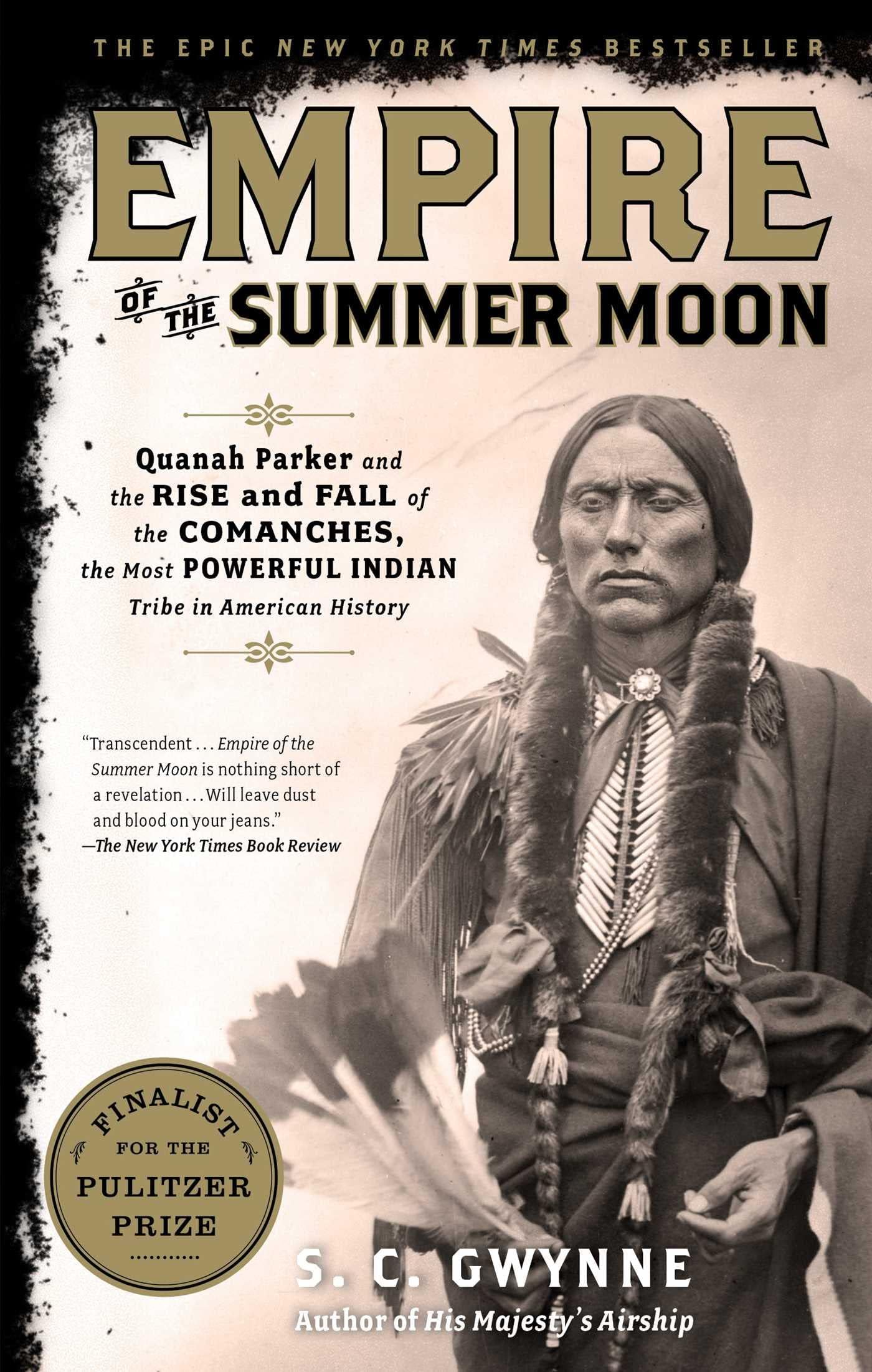
Empire of the Summer Moon: Quanah Parker and the Rise and Fall of the Comanches, the Most Powerful Indian Tribe in American History
Product ID: 1372497
Buy anything from 5,000+ international stores. One checkout price. No surprise fees. Join 2M+ shoppers on Desertcart.
Desertcart purchases this item on your behalf and handles shipping, customs, and support to Colombia.
*Finalist for the Pulitzer Prize and the National Book Critics Circle Award* *A New York Times Notable Book* *Winner of the Texas Book Award and the Oklahoma Book Award* This New York Times bestseller and stunning historical account of the forty-year battle between Comanche Indians and white settlers for control of the American West “is nothing short of a revelation…will leave dust and blood on your jeans” ( The New York Times Book Review ). Empire of the Summer Moon spans two astonishing stories. The first traces the rise and fall of the Comanches, the most powerful Indian tribe in American history. The second entails one of the most remarkable narratives ever to come out of the Old West: the epic saga of the pioneer woman Cynthia Ann Parker and her mixed-blood son Quanah, who became the last and greatest chief of the Comanches. Although readers may be more familiar with the tribal names Apache and Sioux, it was in fact the legendary fighting ability of the Comanches that determined when the American West opened up. Comanche boys became adept bareback riders by age six; full Comanche braves were considered the best horsemen who ever rode. They were so masterful at war and so skillful with their arrows and lances that they stopped the northern drive of colonial Spain from Mexico and halted the French expansion westward from Louisiana. White settlers arriving in Texas from the eastern United States were surprised to find the frontier being rolled backward by Comanches incensed by the invasion of their tribal lands. The war with the Comanches lasted four decades, in effect holding up the development of the new American nation. Gwynne’s exhilarating account delivers a sweeping narrative that encompasses Spanish colonialism, the Civil War, the destruction of the buffalo herds, and the arrival of the railroads, and the amazing story of Cynthia Ann Parker and her son Quanah—a historical feast for anyone interested in how the United States came into being. Hailed by critics, S. C. Gwynne’s account of these events is meticulously researched, intellectually provocative, and, above all, thrillingly told. Empire of the Summer Moon announces him as a major new writer of American history. Review: Vital Piece of History - One might be led from the book's subtitle to believe that "Empire of the Summer Moon" is primarily a biography of Quanah Parker or a history of the Comanche tribe. In a way it is, but "Empire" is actually much broader in scope. The Comanches of the western plains of Texas provide a departure point for Gwynne to discuss everything from the formation of the Texas Rangers to the abduction and ransom of white women by native tribes. Lesser writers than Gwynne, with so much ground to cover, end up flailing and ultimately failing, but he addresses each topic gracefully and in sufficient depth (with the possible exception of Quanah's own story, which seems tacked on at the end as a framing device). Yet it's easy to see Quanah's allure for the writer: Quanah is the offspring of a Comanche chief; Quanah's mother, Cynthia Ann Parker, is perhaps the most famous of the Comanche captives. Quanah's story thus dovetails perfectly with the broader history of the native interactions with white settlers. The Comanches, as Gwynne describes them, led simple lives, largely devoid of the art and spirituality of other tribes; they were incurious and unimaginative. Their salient features seem to have been their horsemanship and talent for waging war. While far more advanced cultures like the Mayans and Incas easily came under Spanish dominion, the Comanches held the Spaniards at bay, largely due to their ability to fight on horseback. Horses gave them speed, a major tactical advantage when battling Spanish or American troops who were forced to dismount before opening fire. One of the most fascinating sections of "Empire" is Gwynne's discussion of how mustangs came to the Spaniards and, as a result, ended up in America, where they were expertly captured and broken by the Comanches. And so it was the Spaniards who unwittingly provided the Comanches with the means to defeat them. This grasp of context sets Gwynne apart from other historians, along with his ability to show the historical implications of seemingly minor events. An indian raid on a homestead, for instance, leads to the abduction of a young girl who eventually gives birth to a son who will become a Comanche leader. A captain in the Texas Rangers eventually realizes that the only way to defeat the Comanches is to adopt their tactics and follow them into Comancheria, the vast arid plain where they live, virtually unexplored by whites. One can't help but draw parallels between the Comanches, who were early guerilla fighters in an inhospitable region, to our current struggles with terrorists in Afghanistan and elsewhere. With their brutal attacks on white settlers, the Comanches managed to grind westward expansion to a halt for a time. It was only leaders like Ranger Jack Hays and Colonel Ranald Mackenzie, learning the terrain and fighting the Comanches on their own terms, who had any consistent success against them. One major development was the adoption of the Colt revolver by rangers and soldiers, in itself an interesting story. It was only around 1850 that soldiers started using the revolvers, which enabled them to fire from horseback as the Comanches did. Prior to that point, the natives were able to unleash ten or more arrows for every shot the whites fired. The Hollywood image we have of the cowboy firing his six-shooter from a galloping horse, Gwynne points out, was a relatively late and short-lived development, but it did manage to turn the tide against the Comanches. But what truly sealed their fate was the destruction of the buffalo, which nearly led to their starvation and forced them onto the reservation, where the idea of farming was more alien to them than to nearly any other tribe. "Empire" is roughly chronological in structure, but Gwynne does jump back and forth when following a narrative thread. He has an instinct for the details that will most interest his readers, but above that he strives to help us imagine what life was like in nineteenth century Texas. We are given not just the facts but the sights and sounds, the taste of steaming buffalo liver or acrid stream water, the smell of the unwashed buffalo hunters. Gwynne's prose is consistently eloquent and engaging. He has his favorites--clearly Gwynne is drawn to Cynthia Ann's struggles and Quanah's ability to transform himself from warrior to businessman and tribal spokesman. The author seems to consider it a crime that Colonel Mackenzie has largely been lost to history. But Gwynne steers clear of biases, acknowledging that these were flawed individuals and that atrocities were commited on both sides. With "Empire," Gwynne does the work of a gifted excavator, unearthing long-buried artifacts from American history and demonstrating their value. Review: Historical, informative and disturbingly entertaining - The story of the American west never gets old. Nor does manifest destiny get easy to fathom. I enjoyed this read very much and feel the wiser for it.


| Best Sellers Rank | #2,941 in Books ( See Top 100 in Books ) #2 in Indigenous History #4 in Native American History (Books) #8 in U.S. State & Local History |
| Customer Reviews | 4.7 out of 5 stars 21,815 Reviews |
D**R
Vital Piece of History
One might be led from the book's subtitle to believe that "Empire of the Summer Moon" is primarily a biography of Quanah Parker or a history of the Comanche tribe. In a way it is, but "Empire" is actually much broader in scope. The Comanches of the western plains of Texas provide a departure point for Gwynne to discuss everything from the formation of the Texas Rangers to the abduction and ransom of white women by native tribes. Lesser writers than Gwynne, with so much ground to cover, end up flailing and ultimately failing, but he addresses each topic gracefully and in sufficient depth (with the possible exception of Quanah's own story, which seems tacked on at the end as a framing device). Yet it's easy to see Quanah's allure for the writer: Quanah is the offspring of a Comanche chief; Quanah's mother, Cynthia Ann Parker, is perhaps the most famous of the Comanche captives. Quanah's story thus dovetails perfectly with the broader history of the native interactions with white settlers. The Comanches, as Gwynne describes them, led simple lives, largely devoid of the art and spirituality of other tribes; they were incurious and unimaginative. Their salient features seem to have been their horsemanship and talent for waging war. While far more advanced cultures like the Mayans and Incas easily came under Spanish dominion, the Comanches held the Spaniards at bay, largely due to their ability to fight on horseback. Horses gave them speed, a major tactical advantage when battling Spanish or American troops who were forced to dismount before opening fire. One of the most fascinating sections of "Empire" is Gwynne's discussion of how mustangs came to the Spaniards and, as a result, ended up in America, where they were expertly captured and broken by the Comanches. And so it was the Spaniards who unwittingly provided the Comanches with the means to defeat them. This grasp of context sets Gwynne apart from other historians, along with his ability to show the historical implications of seemingly minor events. An indian raid on a homestead, for instance, leads to the abduction of a young girl who eventually gives birth to a son who will become a Comanche leader. A captain in the Texas Rangers eventually realizes that the only way to defeat the Comanches is to adopt their tactics and follow them into Comancheria, the vast arid plain where they live, virtually unexplored by whites. One can't help but draw parallels between the Comanches, who were early guerilla fighters in an inhospitable region, to our current struggles with terrorists in Afghanistan and elsewhere. With their brutal attacks on white settlers, the Comanches managed to grind westward expansion to a halt for a time. It was only leaders like Ranger Jack Hays and Colonel Ranald Mackenzie, learning the terrain and fighting the Comanches on their own terms, who had any consistent success against them. One major development was the adoption of the Colt revolver by rangers and soldiers, in itself an interesting story. It was only around 1850 that soldiers started using the revolvers, which enabled them to fire from horseback as the Comanches did. Prior to that point, the natives were able to unleash ten or more arrows for every shot the whites fired. The Hollywood image we have of the cowboy firing his six-shooter from a galloping horse, Gwynne points out, was a relatively late and short-lived development, but it did manage to turn the tide against the Comanches. But what truly sealed their fate was the destruction of the buffalo, which nearly led to their starvation and forced them onto the reservation, where the idea of farming was more alien to them than to nearly any other tribe. "Empire" is roughly chronological in structure, but Gwynne does jump back and forth when following a narrative thread. He has an instinct for the details that will most interest his readers, but above that he strives to help us imagine what life was like in nineteenth century Texas. We are given not just the facts but the sights and sounds, the taste of steaming buffalo liver or acrid stream water, the smell of the unwashed buffalo hunters. Gwynne's prose is consistently eloquent and engaging. He has his favorites--clearly Gwynne is drawn to Cynthia Ann's struggles and Quanah's ability to transform himself from warrior to businessman and tribal spokesman. The author seems to consider it a crime that Colonel Mackenzie has largely been lost to history. But Gwynne steers clear of biases, acknowledging that these were flawed individuals and that atrocities were commited on both sides. With "Empire," Gwynne does the work of a gifted excavator, unearthing long-buried artifacts from American history and demonstrating their value.
G**E
Historical, informative and disturbingly entertaining
The story of the American west never gets old. Nor does manifest destiny get easy to fathom. I enjoyed this read very much and feel the wiser for it.
B**R
Top notch history
A few months ago I watched the prequel to the Lonesome Dove series. I would rate the three part series 3 out of 5 stars. It wasn't great, but it was good enough to watch all three episodes. One of the things I look for in a series like that is how historical is it. Since much of the series dealt with the Texas Rangers, pre-Civil War, and their interactions with the Comanches (and Mexican bandits) I have to admit that I knew little. So, I was surprised when the Comanche chief (played by Wes Studi and one of the most interesting of the characters in the series) Buffalo Hump gathered together a large Comanche force and attacked Austin, Texas! Since I'd never heard of this I did a little research to see if it really happened. What I found was a reference to Empire of the Summer Moon-Quanah Parker and the Rise and Fall of the Comanches the most Powerful Indian Tribe in American History by S.C. Gwynne. I bought it and frankly had a hard time putting it down. Quanah Parker is the thread that the book revolves around but the book is about much more than that. The backdrop is what the author refers to as Comancheria, an area encompassing modern Texas, Oklahoma, parts of New Mexico, parts of Old Mexico, southern Colorado and southern Kansas. At the height of Comancheria (1836) approximately 20,000 Comanches in five major bands roamed free in their empire victimizing their neighbors, the Apaches, the Utes, the Navahos and any other tribe within range (except the Kiowa who were in alliance with the Comanche) as well as the Mexicans and Texans. Gwynne is an exceptional writer and he tells their story well, detailing the formidable military power the Comanches were and how they achieved that status. One US military observer rated the Comanche horse warriors as the finest light cavalry in the world and Gwynn gives the reader plenty of examples to make the case. We tend to think that the Texans and Mexicans would have had an advantage with their gun powder weapons over the Comanches with their bows and arrows. Prior to the advent of repeating rifles, post-Civil War this simply was not true. Pre-Civil War weapons were single-shot muzzle loading weapons that took time to reload, a difficult thing to do mounted in the middle of a battle. It was so difficult that the Texans who fought the Comanches probably the most often, fought dismounted, a serious mistake against Comanches who were excellent horse archers and could get off five arrows to a Texan's single shot. After giving the reader the fascinating background of the Comanche, Gwynne begins to weave the story of the Parkers into the bigger story of the Comanche Empire of the Summer Moon. (Summer Moon refers to the Comanche habit of raiding in the summer by the light of the moon. The term "Comanche Moon" is still used in Texas to describe a bright summer moon.) Back in 1836, shortly after the famous Battle of the Alamo during the Texas War of Independence against Mexico, the Parker family moved to the frontier fringes of civilization. They built a family fort in Comancheria which was a direct challenge to the warlike Comanches. The fort was certainly a good idea because it negated the Comanches mobility and Comanches would rarely attack a fixed position held by determined men whose long range rifles had the advantage. Well, on May 19th, 1836, ten of the sixteen men of the Parker clan were out in the cornfields. Eight women and nine children were inside the fort, but the armored gate was left wide-open. The remaining men were unarmed. Clearly, the Parkers, despite the fact they built a fort perceived little danger. They were horribly wrong despite the fact that the Comanches were known to be raiding near-by. On the morning of the 19th a large band of Comanches rode up to the fort. Rachel Parker, age seventeen, guessed they were "friendlies" another bad mistake, common enough though since telling one Indian from another must have been a challenge. It was probably safer to pray for the best but arm yourself for the worst until you knew for certain what you were up against. The raiding party consisted of Comanches and Kiowas and into this large group of fierce warriors walked Ben Parker, one of the six men in the fort. Ben was certainly brave, but also foolhardy. The raiders said they wanted a cow to slaughter and directions to a water hole even though their mounts were dripping wet clearly indicating the Indians knew exactly where they were. Ben said no to the cow offering instead other food. Remarkably, Ben went back into the fort and spoke to his brother Silas about how ridiculous the Comanches demands were regarding the water hole. Even more remarkably Ben gathered up some supplies and went back out to give them to the raiders even though Silas warned against it! Silas was on to something and some of the Parker clan but not all tried to make a get-a-way while the remaining men (not all) decided to make a stand although not a not a one was armed at the time. Ben Parker meanwhile was surrounded by the Comanches and horribly killed probably scalped while still alive. Silas would die too as would others in the ensuing chaos. This was only the beginning of the horrors inflicted on the Parkers. Gwynne does not pull any punches when he describes what happens to victims of the Comanches nor what the Texans did to Comanches once the tide of war began to turn. To say that frontier warfare was brutal is to understate just how brutal. The Comanche culture dictated brutality to captives (most of horse tribes were the same but Comanches were among the worse of the worst). They tortured the captive men to death, killed babies that cried too much and gang-raped captive women, sometimes to death, although they frequently made women and older children captive. They had been doing this for years and their targets more often than not were other Indians, notably the Lipan Apaches who they nearly exterminated. What happened to the Parkers was par for the course and as barbaric as what the Comanches practiced on fellow Indians (and they on them when they had the chance). Cynthia Ann Parker was a nine-year-old girl who was taken captive at the raid. She witnessed all that happened to her family. Cynthia Ann would spend the next twenty-four years as a Comanche eventually becoming a wife of a Comanche war chief. She would give birth to three children, one of whom was Quanah Parker, a half-breed who would rank along with Sitting Bull, Red Cloud, Crazy Horse and Geronimo as one the Indians who gave the US Army the hardest time in the 1870's. Cynthia was "rescued" in 1860 as the tide began to turn against the Comanches. But the fact is, by then, she did not want to be rescued and her story became a double-tragedy as she is forced to live among the whites and the culture she had long forgot. Quanah was twelve when his mother was "rescued" and father killed. His rise to war chief among the Comanches was remarkable for the fact he was a half-breed and after his father was killed a no-body among his band, the Quahadi Comanches (the word Comanche means "people"). Quanah was whatever else one might say about him was courageous, had a mind for strategy and tactics and as it turns out in the story a pretty savvy pragmatist and successful business man once the Comanches were forced to the reservation in present day Oklahoma. To say any more about this book would only serve as a spoiler and I don't want to do that. I thought I knew something about the Indian Wars but Empire of the Summer Moon opened my eyes to much. The book is rich in detail and packed with human interest stories regarding all the major players and many minor ones as well. The amount of research the author did was massive as the bibliography illustrates. As for Buffalo Hump and the raid on Austin, it never happened. What did happen is that Buffalo Hump a chief among the Comanches did mange to assemble a rather large "army" of Comanches. The raid that Buffalo Hump led is known in Texas as the Great Linville Raid and it took place in 1840. Buffalo Hump had a vision of driving the Texans into the sea. He led a force of 1,000 Comanches south of San Antonio killing and looting along the river lines that led to the Gulf of Mexico. The river part is in the TV series. In the TV series the town being destroyed by the rampaging Comanches is Austin, but historically it's probably Victoria and/or Linville. The Comanches rode through the surprised town of Victoria first, killed at least a dozen people before being driven off by rifle fire. Instead of closing in for the kill immediately which they could have done, the Comanches settled for looting concentrating on the horses and mules, the criteria for wealth among the Comanches. The Comanches did attack again but the delay had given the residents time to build barricades turning the town into a fort and thus discouraging the Comanches from getting to close to the long rifles of the Texans. The Comanches departed with two thousand horses and a young black girl who presumably became part of the tribe like Cynthia Ann had four years earlier. The Comanches continued their ride of terror, following Buffalo Hump's vision all the way to the sea and small town of Linville on the coast. The town's residents panicked (rightly so) and fled to boats in the harbor but not all got away. The usual was the killing of all the men and the gang-raping of all captive women. While the residents fled the Comanches discovered the town's warehouses and that's when the real looting took place. They took all they could carry of the white man's goods and then burned the town as the sea-borne residents watched helplessly. The town would never be rebuilt. Buffalo Hump then lost control of his "army." The fact of the matter is the Comanches were always, in those days, more interested in raiding and loot, than driving the Texans into the sea. It wasn't until much later than some of the Comanches realized they were in a fight for survival and a fight to keep to the old ways. So, at this point, the Comanches decided to pack it in a return to their sanctuaries and cash in on the loot something they always had done primarily with the Comancheros of New Mexico. They were dogged all the way back by the aroused Texas militia fighting the Battle of Plum Creek along the way. Among the pursuers were some Texas Rangers and after a war chief was killed the mounted Texans actually charged the Comanches rather than fight in the old dismounted fashion. This began a shift in the tactics of fighting of Comanches. The advent of the Colt revolver by the time of the Mexican War (1846-48) that the Texas Rangers would purchase in quantity (the US Army would not, rather shortsightedly) would eventually shift the balance of military power into the hands of the Texans. The repeating rifle (the Henry and Spencer would seal the deal by 1866). The raid was however, from the Comanche point-of-view a success. Only a few hundred head of horses were recovered. Comanche raids would continue until 1874, many led in the later years by Quanah Parker. Quanah was eventually beaten by Ranald S. Mackenzie, a contemporary of George Armstrong Custer. Ironically, Custer would become famous for losing the biggest disaster on the plains and Mackenize would be forgotten for being the most successful of the Generals who fought the plains tribes. This book is history how it's meant to be written. Empire of the Summer Moon Quanah Parker and the Rise and Fall of the Comanches, the most Powerful Indian Tribe in American History By S.C. Gwynne (Scribner, 2010) Twenty-two chapters, 371 pages including notes, bibliography and index
J**S
Good History of a Little Known Part of the West
This is history - well written, well researched and - if the History of the American West is to your interest - it's a wonderful story of the Comanche Nation, of its rise and fall and particularly about the saga of the pioneer woman Cynthia Ann Parker and her half-breed son Quanah who became the last and probably the greatest chief of the Comanche's. I venture to say, however, that anyone raised in and/or who has family roots in what was once entirely or partly Comanche Country regards from birth the Comanche one and all as thieves and brigands - to be feared and ostracized. And so I must confess I couldn't quite warm up to all the stories of bloody raids, of long marches, great horsemanship, exquisite torture, cruelty practiced on humans the Comanche wouldn't practice on animals, dirt, more dirt, buffalo dung, captives, dust, cold rain and a freezing whiteout from the North, the awful cold that drives everyone inside to the fireplace except the Comanche, wrapped in his buffalo robe outside tending the horses. So if you're not from Northern Mexico or Texas or Oklahoma, Kansas, Colorado or New Mexico - and that was the range of the Comanche - you can read this superb history with more objectivity than the rest of us. As for us? Well, I didn't realize that the Comanche were originally from Ute country in the Rockies and that they had early on adopted the horse from the Spanish and fanned out over the Great Plains putting to the wall the Apaches, Cherokees, Shawnee and the rest of the Plains Indians till they had their way; and it was not their way - or the highway. It was their way or death and defeat. And, yes, I had known they were great horsemen - the absolute best - and that they rode bareback and fought bareback. (Have you ever tried to ride bareback at a trot or gallop?) But what I didn't know - and learned from this excellent book - was that their chief pastime was war. They loved it! Also what I really didn't know was the story of Cynthia Ann Parker, kidnapped at nine and raised with the Comanche, married a Comanche warrior, loved him, had children by him and who, when "rescued" was more Comanche than white; nor had I known the wonderful story of her son Quanah the greatest Chief of the Comanche. At the end of the day had I learned a lot. (No, I couldn't read it in a day - that was merely a figure of speech) I appreciated the book. I appreciated the writing. And I can recommend it with a whole heart to all of you whether your grandfather came from Comanche country or not.
D**Y
Fascinating Account of the Powerful Comanche, "Bad Hand McKenzie', Texas Rangers and Quanah Parker
The author provides a very exciting and powerful account of the Comanche that literally ruled a large portion of Texas and parts of Oklahoma, pushing the Apache west to Arizona and stopped the expansion of the Spanish. The domination of their lands and their fierce ability to defend their expansive home lands provides them a long history of independence. The author notes in detail their savvy ability to live off land that seem relatively barren and harsh while having a reputation as one of the greatest fighters on horseback in the west with the ability to fire multiple arrows from any position on horseback. The author provides a rather frightening account of how severe the Comanche treated their foes, that seems extraordinary cruel. The author; however, stipulates that as harsh and cruel that it may seem, it wasn't much different from how other tribes treated their enemies. The fierceness and lighting strike abilities seemed to have a dramatic impact on western expansion in Texas and the book predominately centers on their final years on a collision course with Texans that although slow to expand into Comanche lands they do so through daringness and in some cases neglect. In the latter case, the Parker clan is a case in point as they build their own settlement on the furthest reaches of white homesteads on or in Comanche territory resulting in the capture of Cynthia Parker and several others while the male population does not survive. Cynthia becomes the mother of Quanah Parker. Fascinating parts of the book are descriptions of the Comanche cultural, different sub tribes, the fascinating landscapes of canyons, prairie and desolate areas that made up the Comanche territory and of course their dramatic ability to attack and defend. The story of Buffalo Hump's long campaign deep into the heart of settlements in Texas is incredulous as his band suffers little loss. Other aspects include a collision with the Texas Rangers in the 1830s and 40s led by Jack Hays who dared to enter Comanche territory with group of die hard men that the author seemingly describes as very unique and tough individuals, they sounds like a cross between mountain men and Hell's Angels on horseback. How these hardened individual could with stand campaigning in harsh climates with limited resources and very little in the way of compensation while enduring high casualties is quite amazing. Eventually, the collision includes the sudden appearance of the colt revolver that forever changes the art of warfare against the Comanche. Also of great interest is James Parker who searches for his niece, Cynthia Anne, without success in spite of the rumors of her existence that were actually true. Parker's relentless search was captured in the great John Wayne flick, "The Searchers" although the film captures a later time period. There is, of course, an in depth description of Quanah Parker who rose to become a chief and one of the most difficult bands to find and conquer. His collision course or lack of, with General Randal McKenzie is riveting as parker mystifies his pursuers repeatedly in canyons and high country eventually wearing out his pursuers for the time being. Although McKenzie's never stop campaigns caught up with many villages to destroy their materials, along with the buffalo hunters that destroyed the herds; he eventually subjugates the Comanche by eliminating their way of life. This follows Sheridan's typical plan, first used in the Shenandoah Valley, to remove subsistence and the ability to operate by capturing or killing their splendid mustangs. The last 100 pages center on the army's campaigns against the Comanche and tithe eventual adjustments made to reservation life. The author provides details on Parker's band that is one of the last to surrender to reservation life. What is unique about Parker is his personality, which is described as very positive, with the kind ability to share his resources and to get along well with virtually anyone native or white. He eventually serves as a broker between tribal members and the army and on his own, brings in Comanche that breaks away. He also had the unique ability to become friends with Mckenzie and Charles Goodright; the latter bring the great western cattleman who actually took possession of a large portion of Comanche land. Parker adapted many white ways, from living in a modest mansion to wearing stylish clothes, and he was able to barter with whites on behalf of the Comanche to obtain fees for cattle trespassing on reservation land bringing money into the tribe as well as establishing himself for many years as a modest cattle baron. This ability to arrange compensation was indicative of his smart intellect. Parker eventual is recognized as a central chief for the Comanche and serves in that capacity for many years. He even entertains many celebrities in the early 1900s like Theodore Roosevelt. Parker even represents his tribe in attempts to protect them from land deals that did not have the Comanche's best interests. One clash of culture that was fascinating was the description of group of Comanche that bring in a white woman captive to a town in an arranged barter for her release. The group was used to trading with the Comanchereos thus they arrive with their families for a great opportunity to purchase and exchange goods. However, once the town folk observe the physical condition of female captive; they turn on the Comanche. The Comanche are caught completely surprised totally unaware that the appearance of their captive would be considered harsh. The mini biography of General "Bad hand" McKenzie is also well detailed and makes you want to learn more about him as one of the most daring Indian campaigners. The break down of his health may have contributed to lack of recognition at the time of his death.
J**F
History that reads like a novel
The relationship between Native American tribes in the American West changed dramatically in the 17th Century with the rise of the Comanche. Prior to the Spanish colonization of Mexico, horses were unknown in the Americas. Over time horses that escaped Spanish farms and missions or were abandoned from expeditions began to breed and flourish in the high grasslands to the east and south of the Rocky Mountains. Although most tribes learned to domesticate horses, utilizing them for transportation, the Comanche learned to fight from the horses. Their strategy changed the power structure as a formerly non-important band of Native Americans began expanding their territory in what is now Texas, along with parts of Oklahoma, eastern Colorado and northern New Mexico. They pushed out Sioux, Paiute, Apaches and other tribes and their fierceness keep the Spanish and later the Mexicans from their territory. This book tells their story along with the story of early Texas history. After independence from Spain, the Mexican government found itself at struggling with its northern territories. Its missions in Texas were often being attacked by Comanche raiding parties, which eventually led to the Mexicans inviting American farmers into the area in hopes that they might create a buffer from the Comanche. What happened, instead, is that the Americans would seek and eventually gain independence from Mexico and form a new country, Texas, which then had to deal with the Comanche problem. The Comanche were a warring tribe. Their life consisted of raids, buffalo and horses. They did not settle into permanent villages but constantly moved. Unlike their northern neighbors, the Sioux and Cheyenne, the Comanche didn’t wear colorful bonnets of feathers, preferring a cap with buffalo horns. The women did the hard work, setting up camp and cooking and preparing the killed buffalo. The men were warriors and were fierce. They were brutal to their captives, whether from another tribe or Anglo-settlers, often torturing both men and women. Sometimes children would be spared and brought into the tribe, especially because the low birthrate among Comanche women (which probably came from their constant time on horses), but children of enemies were also often killed. Gwynne tells the story of the rise and fall of the Comanche by framing it around the Parkers, an early Texas family that set up a settlement in West Texas adjacent to Comanche territory. In the middle of a day in 1836, while the men were in the fields, a band of Comanche approached their homestead. At first they seemed friendly, then they began to kill and took as captives several women and children. One of the girls was Cynthia, who was nine. She witnessed the murder, rape and torture of several other family members. She would grow up among the Comanche and eventually marry one of the leading warriors. Their son (a half-bred), would be the last great warrior of the Comanche and the only Comanche to be chief over the whole tribe (the Comanche tended not to have a hierarchical structure as they lived in bands and when someone wanted to lead a “war party” he would recruit from the various bands enough warriors who would look to his leadership for that event). Later, Cynthia and her Native American daughter would be recaptured, but she never fully integrated back into American culture. The author points out that she had the misfortune to be “adopted” into two different cultures that were alien to what she knew (first into the Comanche life when she was nine and later back into a culture in which she’d forgotten when she was an adult). In addition to the Parker family, the book focuses on Cynthia’s son, Quanah. He led the last of the war parties and, when he realized that he could never hold back the white settlers and with the buffalo gone, led the tribe into a treaty. While on the reservation, he made a good life for himself as he raised cattle, but he was also very generous and when he died wasn’t wealthy. He was also a showman who enjoyed hosting guests to his home, which was quite the change from the young warrior that was feared by the U. S. Army along with other tribes. Gwynne makes that case that technology eventually bought about the Comanche downfall. While the Mexicans and early American settlers tried to fight with muskets and long rifles, these were not very good weapons for close combat with a mounted enemy. The Comanche warrior could shot 30 arrows in the time a person could reload a musket. But just like the horse gave them an advantage over other tribes, the use of repeating pistols and rifles brought an advantage first to the Texas rangers (who fought like the Comanche, from the saddle) and later to the United States Army. He also notes that the Comanche downfall was inevitable as their warrior culture wasn’t adaptable in a changing world. The two key groups at keeping the Comanche in check according to Gwynne were the Texas Rangers (who fought like the Comanche) and Ranald Slidell MacKenzie. MacKenzie, an army general, was much more successful but less known than Custer, another graduate from his era at West Point. Sadly, after serving on posts in the West, he ended his life in a mental institute. This was a fast read. Gwynne is a journalist and his writing reflects his ability to tell a story. Some of the parts about the Comanche treatment of captives may cause the squeamish nightmares, but overall I found the book fascinating.
J**Y
The Truth Is Stranger Than Fiction
This book has to be among the greatest nonfiction westerns written. At times, it will shock you but you won't want to put it down. The fact that it reads like a novel keeps it from feeling like a history lesson. Yet, it really happened and that's what's stunning! The kidnapping of child, Cynthia Ann Parker by the Comanches after the slaughter of family members is certainly harrowing. Yet, what happens after is riveting. She's accepted into the tribe while older relatives are treated brutally. Gwynne doesn't hold back telling what actually happened. There's no whitewashing the truth of the outrages from either side. He tries to explain the mindset even if it's hard to grasp in our day. The story of Quanah Parker, Cynthia's son who's separated from her when she's involuntarily returned to white society, seems like it was made for a movie. He becomes a leader of the Comanches and after their defeat successfully adapts to white culture. One can't help having mixed emotions about the fate of the Comanches. On one hand, they showed no mercy to either the white settlers or fellow Natives. However, it is sad to read about them relegated to the reservations as the buffalo disappeared. This is one of my favorite books. Perhaps it's not for the faint of heart but it's unforgettable.
W**Y
A Tale of The Comanches And More
A very good read about the rise and fall of the Comanches as well as other tribes. Good, but sad, for both sides, but especially the Native Americans. Yes, both sides were brutal in their wars, but S.C. Gwynne does a great job of showing positives and negatives, good/bad of the Native American way of life. It could be pretty gruesome at times, and you have to also feel sorry for the many buffalo and horses that were slaughtered. Only the last few chapters really honed in on Quanah Parker. The first part takes on the Comanches and their Comancheria land which pretty much encompassed a lot of west Texas into eastern New Mexico north into eastern Colorado and western Kansas. Of course, different tribes fought each other, but the Comanches, thanks to stealing/getting horses from the Spanish and Mexicans, became the best horsemen in battle. It follows the abduction of Cynthia Ann Parker and her becoming part of the Comanche tribe, who gives birth to Quanah, 1 of 2 sons, and a girl. During a battler, Cynthia Ann, is taken back into white civilization after many years with the Comanche, as she doesn't like it. Meanwhile Quanah escapes with his brother. Most of the book details the different sides battling across Oklahoma and Texas and how the chiefs of the different tribes handled western progress by the whites. At times the shear ferocity of Comanches as well as Kiowas and Cheyenne tribes would cause the western frontier expansion to retract back east, but not too far. The Civil War, actually brought somewhat of stagnant time for each side, then it picked up again, and with advancement in weaponry and some self-determined folks like Mackenzie, the tide eventually turned in the 1870s. Eventually Quanah become the chief of the Comanches though he was able to meld into American civilization after the fighting ended and from eyewitness accounts and what is in the book, was a most interesting and remarkable person. I still fill bad for the plight of the Native Americans. For those who are wanting to dive more into the other tribes of the Plains and West Coast, read "Bury My Heart At Wounded Knee", by Dee Brown.
K**R
Fascinating Read
Gwynne paints vivid pictures of the rise and fall of the commanches and gives great insights into how this transpired. Enjoyable and interesting account.
W**Y
Another good book to read
Great read
M**A
great book
great, educative and compelling read. Fantastic book, I could not stop reading and learnt so many things I did nto know and made connections that would nto occur to me. Extremely interesting.
S**O
Increíble libro de historia norteamericana
Una maravilla de libro.
A**R
Read This!
Such an interesting yet sad part of American history. This should be taught and studied in every high school or university history class.
Trustpilot
3 weeks ago
1 day ago