
Desertcart purchases this item on your behalf and handles shipping, customs, and support to Colombia.
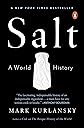
NEW YORK TIMES BESTSELLER | THE BOOK BEHIND THE VIRAL TIKTOK One tiny rock. One epic history. "A must-have for any serious cook or foodie."—Anthony Bourdain "This is a "wow!" book: roving, startling, engaging.” — Washington Post “Kurlansky finds the world in a grain of salt.”— New York Times Book Review An unlikely world history from the bestselling author of Milk! and Cod You’ll never look at salt the same way again. The only rock we eat, salt has shaped civilization from the very beginning, and its story is a glittering, often surprising part of the history of humankind. A substance so valuable it served as currency, salt has influenced the establishment of trade routes and cities, provoked and financed wars, secured empires, and inspired revolutions. Populated by colorful characters and filled with an unending series of fascinating details, Salt is a supremely entertaining, multi-layered masterpiece. Review: Great Book about the history of salt - I am a qualified Nutritionist and Naturopath and I appreciate reading books that are rich in meaningful information. I bought this book because I had increasingly noted that the concerns we have about table salt are unfounded. So I decided to do some research. To get a good handle on salt, I needed to go back in time (hence this book) to understand the use of salt throughout history, and then relate that to more recent studies that were conducted. There were as many studies claiming salts benefits and there are many claiming salt is bad. So that did not give me any confidence that everyone was singing from the same hymn sheet. Whenever I see conflicting study outcomes, I immediately look to see whether we are comparing apples with apples, and we were not. You see, there are actually 3 types of salt and one is very good and two are not so good. Most studies did not even point this out, or realised that we humans eat three very different types of salt. So let me try to make sense of this: I have certainly come to the conclusion that many others have already come to, that the benefits of eating generous amounts of the right salt to suit one’s taste is justified, and much better than being paranoid and limiting my intake. But we need to choose the right salt. What I did learn was that ocean salt is about 85% Sodium Chloride and the remaining 15% is this wonderful suite of over 84 minerals. The thing is, the salt processors remove the 15% part which is the really valuable portion, and sell it as Magnesium Oil. Once you understand that there are three types of salt (1) pure ocean salt (2) ocean salt with the 15% minerals removed and (3) tables salt being pure sodium chloride plus added free-flowing additives and iodine, then it all become very clear. If you eat the pure 100% sea salt you can have as much as you like (of course being sensible) whilst the others (#2 & 3) should be restricted. The 'bottom line' is that many people are not getting enough salt which causes dehydration, and this insufficiency of water in the human body has all sort of consequences such as thicker blood (ie blood with high viscosity) and reduced metabolic function caused by low body fluid levels. This can have all sorts of consequences such as fatigue, increased colds and flu's, and hundreds of other ailments as the body struggles to move fluid around efficiently. The old line that salt is high in sodium and sodium increases blood pressure is a very simplistic explanation and one wonders how the population was ever duped into believing it. Years ago before we had refrigeration we would store our meats in barrels of salt and we ended up consuming a lot of salt. Whilst not suggesting we go back to those times, I would suggest that for most healthy people that 5-8 grams of salt per day for an adult is fine and will not increase blood pressure. Only those on salt-restricted diets need to concerned about limiting salt. I have written a short paper about Salt and Magnesium Oil and some readers may like to download it to help understand the benefits of salt. You can download it here: https://drive.google.com/folderview?id=0B4XGKNybHkRkb1lZT2N3VTgyXzQ&usp=sharing Review: Salt... an engaging history - This book is well worth reading... as it gives a different perspective to world history... Salt... which for most of history has been an expensive commodity. The Gandhi history as it pertains to salt was especially helpful as most books skim over the reasons for the protests without clearly explaining them. However as you reach the end of the book you feel as if the author has reached his word limit and concludes without completing the work. Some of the concluding comments are on anti-caking agents (magnesium carbonate, calcium silicate and sodium hexacyanoferrate II) and additives (Fluoride & Iodine). [...] However the book fails to expand on any of this... cyanide? Not worthy of some explanation? Fluoride? Not even a mention of any controversy? It's effect on enzymes ie. cooking. Yet Iodine (much less controversial) gets a fair bit of attention. Go figure? The book fails to mention the one anti-caking agent that is probably the most common: aluminium. The book really ought to have included a bit more on coloured salts... which often have a magnificent taste... but instead it's jammed up at the end and disposed of in an almost cursory manner. Missing bits: It is intriguing that a book might be written about salt and the chemical formula is not drawn anywhere ie. NaCl (or Na+ Cl- in solution). Good detail... missed the punch line? The author misses the reason for fermentation... which is healthy because it donates many healthy bacteria to support the gut ie. it's an excellent probiotic. The dismissal of May butter while noting that it was reputed to have health properties was annoying. May is the month that spring occurs in the northern hemisphere... and that will also correspond with maximal Vitamin K2 production... which is almost certainly why butter has a reputation as a health food in this month. It was enjoyable to go for a ride around the globe... including a huge amount of detail on Chinese salt making... a country that so many authors skip when writing a book. Likewise the photos of some of these unusual slices of history were great eg. chinese drilling rigs which drilled to 4400 feet with only bamboo. Although you're left wishing there were even more of them. There was a fair bit of detail about cooking with salt: various historical recipes many of which helped capture the period under discussion brilliantly. The writing style was engaging throughout the book so you won't get bored. If you're curious you'll enjoy the book because you'll learn lots of stuff about salt you didn't know. :-)

| Best Sellers Rank | #97 in Books ( See Top 100 in Books ) #1 in Geology (Books) #1 in Rocks & Minerals #1 in Mineralogy (Books) |
| Customer Reviews | 4.3 out of 5 stars 4,415 Reviews |
A**R
Great Book about the history of salt
I am a qualified Nutritionist and Naturopath and I appreciate reading books that are rich in meaningful information. I bought this book because I had increasingly noted that the concerns we have about table salt are unfounded. So I decided to do some research. To get a good handle on salt, I needed to go back in time (hence this book) to understand the use of salt throughout history, and then relate that to more recent studies that were conducted. There were as many studies claiming salts benefits and there are many claiming salt is bad. So that did not give me any confidence that everyone was singing from the same hymn sheet. Whenever I see conflicting study outcomes, I immediately look to see whether we are comparing apples with apples, and we were not. You see, there are actually 3 types of salt and one is very good and two are not so good. Most studies did not even point this out, or realised that we humans eat three very different types of salt. So let me try to make sense of this: I have certainly come to the conclusion that many others have already come to, that the benefits of eating generous amounts of the right salt to suit one’s taste is justified, and much better than being paranoid and limiting my intake. But we need to choose the right salt. What I did learn was that ocean salt is about 85% Sodium Chloride and the remaining 15% is this wonderful suite of over 84 minerals. The thing is, the salt processors remove the 15% part which is the really valuable portion, and sell it as Magnesium Oil. Once you understand that there are three types of salt (1) pure ocean salt (2) ocean salt with the 15% minerals removed and (3) tables salt being pure sodium chloride plus added free-flowing additives and iodine, then it all become very clear. If you eat the pure 100% sea salt you can have as much as you like (of course being sensible) whilst the others (#2 & 3) should be restricted. The 'bottom line' is that many people are not getting enough salt which causes dehydration, and this insufficiency of water in the human body has all sort of consequences such as thicker blood (ie blood with high viscosity) and reduced metabolic function caused by low body fluid levels. This can have all sorts of consequences such as fatigue, increased colds and flu's, and hundreds of other ailments as the body struggles to move fluid around efficiently. The old line that salt is high in sodium and sodium increases blood pressure is a very simplistic explanation and one wonders how the population was ever duped into believing it. Years ago before we had refrigeration we would store our meats in barrels of salt and we ended up consuming a lot of salt. Whilst not suggesting we go back to those times, I would suggest that for most healthy people that 5-8 grams of salt per day for an adult is fine and will not increase blood pressure. Only those on salt-restricted diets need to concerned about limiting salt. I have written a short paper about Salt and Magnesium Oil and some readers may like to download it to help understand the benefits of salt. You can download it here: https://drive.google.com/folderview?id=0B4XGKNybHkRkb1lZT2N3VTgyXzQ&usp=sharing
M**R
Salt... an engaging history
This book is well worth reading... as it gives a different perspective to world history... Salt... which for most of history has been an expensive commodity. The Gandhi history as it pertains to salt was especially helpful as most books skim over the reasons for the protests without clearly explaining them. However as you reach the end of the book you feel as if the author has reached his word limit and concludes without completing the work. Some of the concluding comments are on anti-caking agents (magnesium carbonate, calcium silicate and sodium hexacyanoferrate II) and additives (Fluoride & Iodine). [...] However the book fails to expand on any of this... cyanide? Not worthy of some explanation? Fluoride? Not even a mention of any controversy? It's effect on enzymes ie. cooking. Yet Iodine (much less controversial) gets a fair bit of attention. Go figure? The book fails to mention the one anti-caking agent that is probably the most common: aluminium. The book really ought to have included a bit more on coloured salts... which often have a magnificent taste... but instead it's jammed up at the end and disposed of in an almost cursory manner. Missing bits: It is intriguing that a book might be written about salt and the chemical formula is not drawn anywhere ie. NaCl (or Na+ Cl- in solution). Good detail... missed the punch line? The author misses the reason for fermentation... which is healthy because it donates many healthy bacteria to support the gut ie. it's an excellent probiotic. The dismissal of May butter while noting that it was reputed to have health properties was annoying. May is the month that spring occurs in the northern hemisphere... and that will also correspond with maximal Vitamin K2 production... which is almost certainly why butter has a reputation as a health food in this month. It was enjoyable to go for a ride around the globe... including a huge amount of detail on Chinese salt making... a country that so many authors skip when writing a book. Likewise the photos of some of these unusual slices of history were great eg. chinese drilling rigs which drilled to 4400 feet with only bamboo. Although you're left wishing there were even more of them. There was a fair bit of detail about cooking with salt: various historical recipes many of which helped capture the period under discussion brilliantly. The writing style was engaging throughout the book so you won't get bored. If you're curious you'll enjoy the book because you'll learn lots of stuff about salt you didn't know. :-)
K**R
Who Knew Salt Could Be So Interesting
Mr. Our land my is a neck of a writer. The Herculean research for this topic shows through in chapter after chapter. This was a very interesting book and I highly recommend it to anyone that eats and travels.
K**H
Taking a love of Salt to its logical extreme
Salt is one of those things that turned up all over the place in my high school studies. It turned up in chemisty (sodium chloride), in biology (the amount of salt in our bodies and what we do with it), in history and English (check out the root of the word: "salary"). So sure, salt's important. But does it merit its own entire book about its history? Turns out the answer is both yes and no... I like these small, focused histories (as you've probably guessed if you've read any of the other reviews I've written). I've read many of them, including another one by Mark Kurlansky, Cod (which I rather enjoyed). So when I ran across Salt, I was certain I wanted to read it. I liked Kurlansky's style, and I already knew that the subject matter would be interesting. And it was. In Salt, Kurlansky walks through both the history of salt and the influence of salt on history, presenting a wide and varied picture of one of the [now] most common elements in our modern world. And he does this in the same engaging fashion that he used in Cod; although, with fewer recipes. So why not give it five stars? Well, it has a couple of noticable flaws that tended to detract a bit from the overall presentation. The first flaw was in the sheer number of historical snippets that were included. While I'm certain that salt has been important in the broad span of human history, there are a number of these historical anecdotes where he was clearly reaching to demonstrate the influence of salt. Salt may have been involved in these incidents, but it was peripheral at best, and the overall tone sounds too much like cheerleading. Cutting a few of these out would have shortened the book without detracting from the presentation at all. The second flaw was the meandering path that he takes through the history of salt. He generally starts early in history, and his discussion moves along roughly as history does as well; however, he has a tendency to wander a bit both forward and backward without effectively tying all of this together. I'd have preferred to either walk straight through history while skipping around the world (effectively comparing the use and influence of salt around the world) or to have taken more time to discuss why we were rewinding (effectively following one thread to its conclusion and then picking up another parallel one). To me it made the presentation a little too choppy. There have been other criticisms as well; for example, the chemistry is incorrect in a number of places, but if you're using this as a chemical reference, then you've got serious issues with your ability to library research. Of course, that begs the question of what errors are in there that we didn't catch. And it does tend to be a bit repetitive in parts; although, this could have been used to good effect if historical threads had been followed a bit more completely. While I had a few dings on the book, overall I liked it. The fact that I read it end-to-end and enjoyed the last chapter as much as the first is a testament to my general enjoyment of it. It wasn't the best book I read last year, but I'll certainly keep it on my bookshelf. So, back to my original question: does salt merit its own book? Yes, it does, but perhaps in a somewhat shorter form.
C**F
Great book, impressed how salt has a complex and rich history
Great book, impressed how salt has a complex and rich history. From valued in ancient history. invaluable in the middle ages, to being related to 50% of the chemicals produced today. Salt tax funded kingdoms and fueled wars. A rare book that ties history and progress in a enlightening, well written book
S**G
too many recipes
Unlike oil, salt and water are reusable and also among the most abundant elements on earth. There is no shortage of either one to last humanity through eternity. Except without energy, we just can't make good use of them. This has been the struggle throughout human history until about 100 years ago. Mark Kurlansky's book, Salt: a World History, tells the world's history from the angle of salt and I will never view this commodity substance the same. Earth has a huge amount of salt. Coastal places clearly have sea water. Inland areas usually have salt mines, sometime as big as a mountain, or salt lakes. Then there are brine springs all around the world. To extract salt from them, we need energy: to dig, to evaporate, to distribute. Historical major saltworks were usually at the location where all three were together: free flowing brine spring, big mountain of rock salt, or long coast lines; forest, coal mine, natural gas, or good weather for solar energy; and river, canal, or sea ports. All those places became major cities which, in turn, shaped most of our history. Until canning and refrigeration, salting was the only way to preserve food: meat, fish, dairy, and vegetables. Therefore it became the element for survival. Without salt, people could not preserve food and would starve when there was no harvest or the weather turned bad. Salt also won or lost wars. Soldiers needed food to fight; food needed salt. No salt, no rations, no soldiers, no winning. Surprising number of wars were decided by the control of salt. For the US civil war, Union controlled salt better than Confederacy and eventually won. Many of my favorite foods: smoked salmon, ham, bacon, kimchi, thousand-year egg, etc. came from the old days when salting foods was an everyday business. I learned that Chinese prefer to cook with already salted ingredients: soy sauce, dou-ban, dou-shi, zai-cai, etc. instead of sprinkling salt directly. I also learned how salt makes meat tender by breaking down the protein. This explains the working of curing meat, also why brining chicken makes them tasty. With cheap energy, salt will be the easiest problem to solve. And the solution is right in front of us: nuclear. Almost all nuclear plants require cooling and what better to use than sea water? Cooling with sea water is the same as heating them up, salt just comes out of that process. I cannot say this book is a page turner and all those ancient recipes became boring at the end. It surprised me many times with fresh angles and factoids unknown to me. Salt shaped much of human histories and has been largely forgotten, just like many of those cities used to thrive with saltworks. Next time I go to ChengDu, I would have a different perspective for the city.
R**K
nice salty taste...
I would not describe myself as a history buff, but I do genuinely enjoy learning about the past, especially when it is explored through a tangible lens. I am particularly drawn to histories told through objects. By tracing the story of a single item and its evolution, you gain insight into how nature and culture shaped it, and in turn, how that object shaped societies, economies, and the environment. This approach feels more grounded and often less influenced by overt bias. Salt does exactly this. By examining the mining, distribution, and consumption of salt, the book reveals how something so ordinary has profoundly influenced human civilization and the natural world. The scope of its impact is surprising, and the narrative makes the subject both informative and compelling. It is a fascinating read that demonstrates how even the most everyday object can carry an extraordinary history.
M**T
brilliant--the book you read and then want to share with everyone
That rare history book that takes on the world as it links the United States, Europe, Russia, China, the Middle East, Africa, South America, South Asia, East Asia through the astonishing history of salt. We should not be surprised--as we soon learn, certain salts are essential for human survival and therefore have affected all communities no longer wholly carniverous (the salt from beef, game, pork and poultry provides adequate amounts on its own). I don't know how Kurlansky accomplished all this research--and managed to make it fascinating, magnetic, and provide endless "aha!" moments in every chapter. You never know where the tale will take you next, yet once you arrive it seems so clear and obvious and yet so surprising and revealing. A book for everyone--those who love great stories, great writing, history, literature, cultural studies, science journalism, ecology, geography, political science...the list goes on. One warning--reading this book will make you an annoyance at dinners and cocktail parties because you won't be able to stop talking about this book! Better to make sure your friends and family all secure copies so they don't have suffer under lectures on How The World Really Works. Reading this review over, I realize it sounds as if it was written by a pal, the publisher or the author. Sorry--I just really loved this book and needed to enthuse. Download a free sample to see what I mean.
P**M
My favourite book by Mr. Kurlansky
I had not idea how much of our history and development as humans relied so much on salt. I bought this as a gift to my sister after reading it myself on Kindle and she loved it as well.
R**R
Historia alternativa
El libro intenta hacer una historia paralela, contandonos la evolución del uso y comercio de la sal, y el impacto de éste en la economía global del periodo. Interesante, merece la pena echarle un rato
E**Y
Salty
This was a great book that led me down a wormhole of food history books.
Z**L
Very good book
This book is like a very long article on salt. The history is overwhelming. I've been looking for a reference book like that and I don't know how I missed it. Arrived on time. I enjoy reading it. It's a book for general readers, don't have to be an academic to understand.
ビ**ル
Great read about civilisation
You want to read about salt? Wrong book. You want to read about how salt affected civilisations? You've come to the right place. A great in-depth read and analysis of human civilisation; empires grew and empires declined because of salt.
Trustpilot
3 weeks ago
3 weeks ago