Buy anything from 5,000+ international stores. One checkout price. No surprise fees. Join 2M+ shoppers on Desertcart.
Desertcart purchases this item on your behalf and handles shipping, customs, and support to Colombia.
⚡ Power your projects with precision and peace of mind!
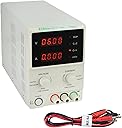
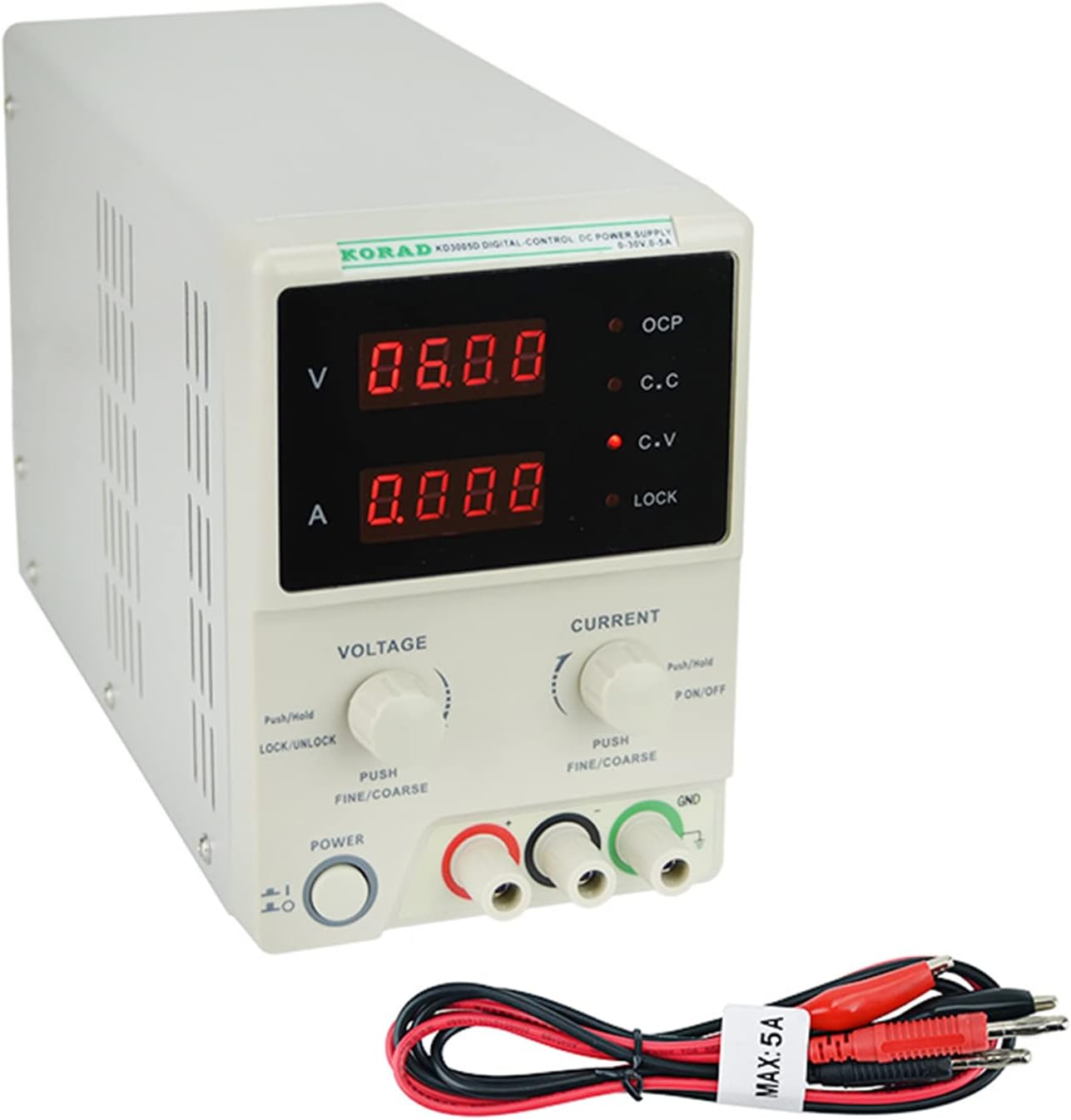
The KORAD KD3005D is a compact, lab-grade DC power supply offering adjustable 0-30V and 0-5A output with dual 4-digit LED displays. It features automatic switching between mA and A readings, built-in circuit protections, and a smart cooling fan that adapts to workload. Designed for professional and hobbyist use, it supports 110/220V input and includes safety features like panel lock and grounding, making it a reliable, long-lasting choice for precision electronics work.


| ASIN | B00FPU6G4E |
| Best Sellers Rank | #41,554 in Industrial & Scientific ( See Top 100 in Industrial & Scientific ) #24 in Lab Power Supplies #43 in Life Science Supplies |
| Brand | KORAD |
| Built-In Media | 5 Amp Test Leads, KD3005D Power Supplu, Power Cord, User Manual |
| Compatible Devices | Personal Computer |
| Connector Type | Banana Jack (DC Output), AC Plug (AC Input) |
| Connector Type Used on Cable | Banana Jack (DC Output), AC Plug (AC Input) |
| Cooling Method | Air |
| Current Rating | 5 Amps |
| Customer Reviews | 4.4 out of 5 stars 365 Reviews |
| Form Factor | Standalone |
| Global Trade Identification Number | 00022099136323 |
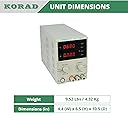
| Item Dimensions | 14 x 10 x 10 inches |
| Item Type Name | Power Supply |
| Item Weight | 9 Pounds |
| Manufacturer | Korad |
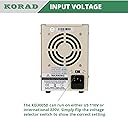
| Maximum Input Voltage | 121 Volts (AC) |
| Mfr Part Number | KD3005D |
| Minimum Input Voltage | 110 Volts |
| Model Name | KD3005D |
| Model Number | KD3005D |
| Output Wattage | 300 Watts |
| System Bus Connector Type | 6 Pin |
| UPC | 787721204039 |
| Unit Count | 1.0 Count |
| Wattage | 150.00 |
J**H
Nice supply for the price
Easy to use compact supply for the hobbyist bench. Actual dimensions are approximately 10.5" deep X 4.4" wide X 6.5" high... dimensions stated in the description are incorrect (may be that of the box). I bought 2 of the supplies so that I might work with circuits that require + and - voltages. The two units stack nicely and take up very little space on the corner of my workbench. While voltage metering is quite accurate, current readings may be a bit off on some units. In one test, I set up a 1 amp current limit on both supplies, and connected them to 3 ohm 5% power resistors. Current delivered to the two resistors, measured with a Tektronix DMM850 was quite close to the set value, measuring 1.003 amps from the upper supply in my stack and 0.994 amps from the lower unit...very accurate indeed! However, the *current reading* of the upper unit was not as accurate, indicating that the supply was putting out 1.062 amps, while the bottom unit was very close at an indicated 1.001 amps. This is perhaps not quite "lab grade" performance, but good enough for most hobby applications. I did discover one weak point in the protection scheme of the unit... while it is well protected against shorts and over temperature conditions, one must be very careful not to reverse connect to a battery capable of delivering much current. When charging and testing an 18 volt B&D battery pack, I accidentally reverse connected one unit and killed the output... it did not reset even with a power off cycle. A protection diode in the output of the supply had shorted, which did indeed protect the supply from distruction. After the diode, a 1N5480 was replaced, the unit functioned perfectly, but I might not have been so fortunate if I had reverse connected the supply to a higher current source, such as an automobile battery. Fyi, the protection diode is located on the front board very near the output terminals, so about 10-15 minutes of disassembly is required to get to it.
A**E
Perfect home supply
I looked at a lot of supplies and bought this one based on the reviews. As a retired engineer, I'm used to using the high-end stuff, but $500+ is a little much for home use. The $30-$50 units seemed too cheap and the reviews certainly reflect that. The first thing I did when I got this was to pull the cover off. I was impressed with the assembly. Good practice was used. The cables are laced (always a good sign of care being taken), the transformer is huge and the heat sinking looks good. I don't have access to a schematic, so there is no way to evaluate the design, but the innards look great. The controls exceeded my expectations and are very easy to use. The voltage displays in units of .01V and current in units of .001A. Of course, the accuracy is not that good (and doesn't need to be) but you can tweak the settings easily for fine control as needed. To adjust either, just turn the knob. Pressing the knob changes which digit it's changing (10's of volts, 1's of volts, 0.1's of volts or 0.01's of volts). Ditto for current. Note that the knob clicks but it isn't always perfect. So, for instance, to change a setting on the fly, I may select the next unit down and come at the new setting by using 10 clicks instead of one. I'll describe how to use the supply in constant voltage mode. True constant current mode is rarely used, so I won't spend any time on that. To start out, unhook all the outputs. The GND terminal is nothing more than earth ground carried though from the AC line card. It is usually good practice to connect the ground to whatever is consider "common". (Yes, I know about ground loops and the need to sometimes avoid them, but for digital work that is rarely an issue). For most of what we do, common is the "-" post, so hook it to ground. This is easy to do by using some hookup wire and making a jumper using the holes in the posts that you see when you unscrew them a little ways. Now turn on the supply and set the voltage to what you need (for example, 5.0V). Adjust the current to something you think is perhaps twice the expected current needed. This will help protect your circuitry in case something is hooked up wrong. If you now press and hold the current knob until the OCP light comes on, you will set the supply to shut down if the current limit is exceeded. If you don't do this and too much current is being drawn, the supply will enter constant current mode and just reduce the voltage to whatever is needed to push out the current set by the current limit adjustment. If this is caused by an incorrect hookup, you may at this point be frying your circuit. OCP will help prevent that by shutting down the supply. You may still end up blowing something out, but the chances are less. If the supply shuts down, you can start it up again by just tweaking the voltage knob a bit. After things are set up, press and hold the voltage knob until the panel lock comes on. This will prevent anyone (such as little curious hands) from accidently changing your settings. The meters are dual purpose. When you are turning a knob, they show the voltage or current limit setting. After a moment, they go back to reading out the current and voltage being output from the supply. I haven't evaluated parameters like regulation, accuracy, ripple, etc. If I see anything unexpected I'll update this post. Just remember the meters are not accurate to 4 digits but are pretty good (better than 1%). There is utility in having more resolution than precision. For instance, you may want to look for small current changes. My hat's off to the designers for setting them up this way. It is useful if you understand the limitations. I think it is good practice not to push any low priced supply to the design limit. I bought the 5amp model with the intention of never using it to supply more than a few amps. Current is the killer for supplies and being conservative will help it last a long time, I hope.
R**B
Excellent supply for users with higher current needs
This is a good supply if you need tight voltage control at substantial amperage with a current-limiting feature. Pros: - Really does adjusts from 0V to 30V in 1 mV (!!!) increments. - Output voltage matches my DMM very closely. - Easy to monitor the current drawn by your load to mA precision. This is a really nice feature. - Red LEDs are bright and easily visible even in sunlight. - The current-limiting feature is very nice. - (+) terminal is adjacent to (-) instead of GND. This is a personal preference, but I like this layout. Pushing the voltage control knob sets the power of ten to which the knob applies. This allows you to set the voltage very finely but also means you can go from 10 V -> 30 V instead of 10V -> 12V if you are not paying attention. (It tries to make you pay attention by flashing the digit that will change.) Personally I'd prefer a modeless control that adjusted output by +/- 100 mV per click to reduce the likelihood of user error, but if you don't make user errors you will love the ability have fine control over 5 decades. The supply has a beefy transformer and a fan. Linear supplies are not very efficient so they throw off a lot of heat. The airflow design is quite good, with fan placement designed to ensure airflow directly over the power transistors. I found the fan noise too much for my personal tastes. I measured 57 dB SPL (unweighted) with an iPhone aligned with back of unit and 43 dB @ 1 meter distance. (This was using Faber Acoustical's DB app on an iPhone, background level 38 dB.) Because I require the power supply to be on all the time and at arm's reach while I work, I had to return it. Doug at SRA Soldering Products thought my unit might have a faulty fan feedback circuit, but both my units (I bought two at the same time) behaved the same. Other users have said they aren't bothered by the fan noise, so I suspect I am just unreasonably demanding about fan noise. I measured the following power usage by the supply when driving a digital device that draws about 3.5W. Supply usage measured using a "Kill-o-Watt" power meter: device draws 160mA @ 20V (3.2W) supply draws 21W (15%) device draws 150mA @ 22V (3.3W) supply draws 24W (14%) device draws 140mA @ 24V (3.4W) supply draws 24W (14%) device draws 136mA @ 26V (3.5W) supply draws 24W (15%) device draws 133mA @ 28V (3.7W) supply draws 29W (13%) On and unloaded, the supply draws from 12W @0V to 16W @30V. Note I am only using < 5% of the maximum current output of the supply, not a good fit for a linear supply with a 5A rating. I probably should have purchased a passively-cooled supply with output current more in line with my needs. The supply is solidly constructed and well-designed for users with higher current requirements.
T**R
After a week of use it was still cool to the touch and started right back up on ...
I purchased this DC power supply specifically to build a silver refining electrolysis machine to refine old junk silver into .999 pure silver. So far I have refined over 200 oz's of silver with this power supply and have not any issues or problems. I ran this unit non stop for over a week and it worked flawlessly. After a week of use it was still cool to the touch and started right back up on the next batch of silver I refined. The unit arrived very quickly and was very well packaged. The box looked like it just came off the assembly line and right to my door! There are many different power supplies that are available, but I think this is probably the best value for your buck. Some of the feature I like with this power supply: 1. The best feature is that it has a cooling fan at the rear of the supply. This really helps keep internal components cool which is important if you are using it in a warm area with limited cooling. The fan is very quiet and will automatically adjust fan speed depending on the power load. This is one of the main reasons I chose this supply over many others. 2. The unit is easy to operate and comes with a decent instruction manual written in English. 3. The display is bright and easy to read your setting even from a distance. 4. The knobs to adjust the power settings feel good and solid. 5. It has a grounding connection which some other supplies do not have. 6. The unit shipped with alligator clips (3 feet) 7. Heavy duty single channel power supply with continuously adjustable voltage and current. 8. 120/220v selector switch in the back of the unit. If you are in the market for an adjustable DC power supply I highly suggest you give this product a try, you won't be disappointed! I expect that it will last for a very long time as it has proven itself already many times. If you have any questions please feel free to ask!
B**B
Surprisingly accurate
My unit checked out very close to my fluke 87V. It's easy to adjust and will do 5a constant with no problem. Great for the price.
M**Z
Good supply, cheap fan
I got this as my first power supply for use in hobby electronics, so the 30V and 5A is more than enough for me. Out of the box this supply weighs quite a bit due to the hefty power transformer inside, and seems to be made of quality parts considering the price. After taking some measurements the Voltage reading is on point but the current displayed tends to be slightly inaccurate. No big deal as this is something other reviewers have mentioned as well. For a couple months of minimal use the supply worked fine without problems... until I used it to power a circuit that drew just over 200mA at 10V. At this point is when you can expect the fan to switch on periodically to dissipate heat, that is if the fan is working as it should. The fan in this unit was not. Instead I could hear a buzzing noise coming from the fan as it tried to spin, but failed each time. A dead fan. All in all, this supply shows promise to be a good product. Unfortunately for me I didn’t catch this problem until after the return window expired, so now I’m left with the task of replacing the fan myself.
F**H
Perfect for what I need at home.
I'm very happy with this unit; it's a great value for the price. I have labs available when I need them; I mostly work from home on embedded systems firmware and this supply is ideal. I've had this in pretty much daily use for 2 months now. Apart from one concern (below) I'm quite pleased with it. I wound up taking the skin off to try and solve a problem. It confirmed what I already knew from other reviewers, namely that the construction isn't of super high quality. Internally the frame is constructed of fairly soft metal rails and it takes hardly any force to strip the screws that attach the skin to the frame. All the screws were provided and in place though one lock-washer was missing. The problem that lead to opening the unit up was that, after the first 10 or 12 times pushing the Voltage knob to switch the scale of adjustment the knob ran out of play (no tactile feedback). For a short while it worked if I gripped the rear of the unit and pushed hard. Finally there was nothing doing. After accessing the back of the front panel I balked at disassembling it but fortunately it turned out that the front knob is just a friction-fit on the post of the encoder. So instead of adjusting the encoder, I carefully pried the knob off, added a shim to the end of the encoder shaft that I trimmed from the sticky end of about 6 post-it-notes. That created enough clearance between the knob and the face of the front panel that it operates perfectly now and the fit of the knob on the shaft is still plenty tight. I checked the output voltage under a small load over voltage with an uncalibrated Fluke 189. The difference between the front panel reading and the Fluke it's generally within +/-0.5%. Front panel display has also been consistent with informal current measurements in the 3 mA +/- about 1% range. I deliberately tripped the overcorrect protection circuit and it works as advertised. Don't really have the facilities to make meaningful measurements of power on/off transients so I avoid this when a circuit is connected. Only one thing worries me. Every 2 to 10 hours or so it makes a short (~ one half second) buzzing sound; kind of a 60 Hz noise. I've never been able to react quickly enough to see if I can feel a vibration and I've never scoped the output when this happens. Haven't noticed the display fluctuate either but that could also be due to reaction time. Curious if anyone else has run across this. Will update in the future if I find anything significant about this.
W**S
Great Supply!
I've been using this power supply for almost a year now. I feel that I can now accurately comment on this device. Pros: - The user interface is very nice and easy to use and understand. - The constant current mode works very well. Works better than a Keithley power supply I use. - The banana plug outputs are of very good quality and seem like they will last a long time. - The banana to alligator clip leads provided with the supply are very good. - The fan kicks in at the right time and does a good job of cooling the unit. - Has a higher quality look to it when compared to the other power supplies within its price range. Cons: - The output voltage is very accurate at and above 1V, anything from 0-700mV has a margin of error or at least 10%. This is to be expected, but its something that should be mentioned. - The power supply does have a nasty little output voltage spike when being powered on. This wasn't a huge issue for me, but be warned. Overall, I would recommend this to anyone who is looking for a good reliable power supply for a low price.
N**Z
Excellent performance for a great price
The KORAD unit I received exhibited great performance, especially against its peers at similar price ranges. The first thing you'll notice when you pull it out of the box is, it's quite heavy. This is a good thing, the transformer inside the unit looks to be of good quality. The second thing you'll notice, if you apply an electronic load drawing the full 5 amps, is the unit will switch to constant current at 5A. The voltage may drop a little bit (few millivolts) but that's no big deal... you shouldn't run bench power supplies at full load anyways. I and a coworker tested the unit with an oscilloscope and a precise, calibrated electronic load. The voltage readout on the unit under load was bang on. The current readout was bang on. And the ripple, at ~30V drawing the full 5 amps, the maximum power for the unit... was 10 millivolts. This is amazing for such a low cost variable power supply. 10 millivolts ripple will allow you to power many high speed electronic systems with it, and it's cheap enough you can have multiple around to provide for various rails. Of course, it is outside the spec of some parts, but if you're developing with those parts, you will have the budget for more expensive gear to fit that spec. All in all, this is a VERY impressive hobbyist bench power supply, and I hope the quality never falls. They can charge double for this device, and it would still be worth it. I'm using it to power the 24v logic of the Teknic Clearpath SC servo system, and it works very well for that purpose.
V**7
Buena fuente
La caja venía golpeada no estaba bien asegurada pero la fuente está en buenas condiciones y funcionando al 100
S**E
Working good , fan rattle
Good power supply, working good , only the fan is noisy (it rattle at low load) it's the way the fan is driven i think
J**Y
Genial
Era más de lo que esperaba, súper bien y llegó antes de la fecha, en total 5 días de USA a MX
J**R
Exelente producto
Exelente producto. Buena calidad - precio. Alta presunción.
Trustpilot
4 days ago
2 months ago