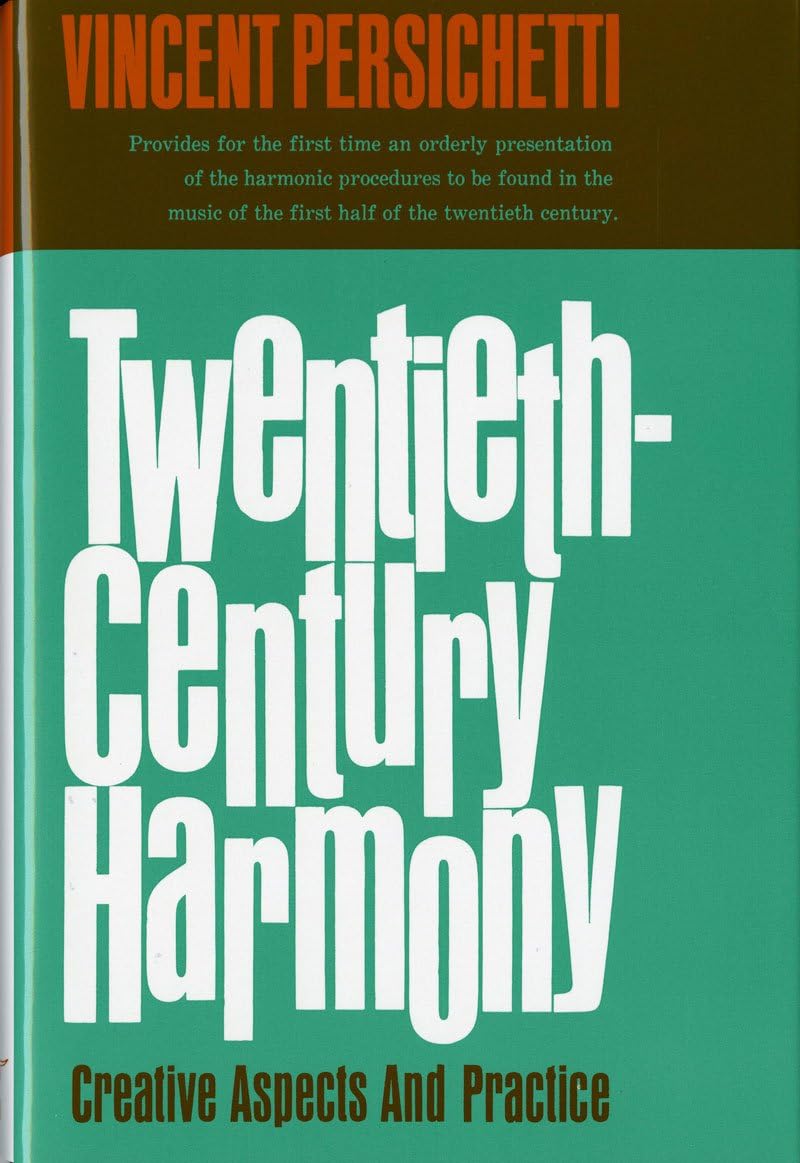
Twentieth-Century Harmony: Creative Aspects and Practice
Product ID: 11760664
🎼Comprehensive harmonic analysis
📚In-depth 20th-century music theory
✍️Practical composition exercises
Desertcart purchases this item on your behalf and handles shipping, customs, and support to Colombia.
🎶 Elevate your music theory game with the definitive guide to 20th-century harmony!
Twentieth-Century Harmony is a well-regarded textbook offering a clear, methodical exploration of harmonic procedures in early 20th-century music. Covering intervals, modes, chords, harmonic motion, and compositional techniques like polytonality and serialism, it includes practical exercises and examples from notable composers. Ideal for musicians with a basic understanding of harmony seeking to deepen their theoretical and compositional expertise.
| Best Sellers Rank | #74,570 in Books ( See Top 100 in Books ) #6 in Music (Books) #71 in Music Theory (Books) |
| Customer Reviews | 4.8 out of 5 stars 397 Reviews |
D**F
Good book!
This book is good for those who have some base in functional harmony and who want to understand the theory used in the construction of music in the first half of the 20th century. I don't think this book is intended as an introductory book on harmony at all. The author is clear and to the point. The book is well written and inspiring. Examples of topics include chords by seconds, all traditional tonal modes with several examples, mirror writing, added-note chords, multiple octave scales, clusters, 15th and 17th chords, etc. There are a lot of good examples taken from 20th century composers and some fun exercises at the end of each chapter to drive home the topics. I am very glad I bought this book.
M**R
Review of Persechetti's "20th Century Harmony"
This textbook is the most straightforward guide to theory I have come across. It very methodically goes through every element of modern "classical style" music, starting as simply as intervals, and making it's way through scales (with an emphasis on symmetrical and synthetic), chords (by thirds, fourths, seconds, etc), dynamics, embellishing tones, and key centers. The end of each chapter has a page or two of music writing prompts you can do to exercise the skills you just read about. I highly recommend it for anyone trying to learn about modern composers, or who is trying to become a composer him/herself
B**R
An Inspirational Textbook...is there such a thing?
Yes there is and this is it. Diving into the examples and exercises has advanced my knowledge of harmony and inspired my composing to reach for new heights.
V**S
Excellent work by Persichetti
This book presents the basics of harmony used by composers of the Twentieth Century. It is very well written, it is concise, systematic, all inclussive, with numerous musical examples. I believe, it should be introduced in music schools and conservatories as a supplement to the classical harmony traditionally taught there. With extended references ("Sourse Material") and Exercises ("Applications") at the end of each chapter the student of composition will certainly master modern music writing. It is perhaps the only book of its kind which is available to the scholars of music. Highly recommended! Vassilis Bakopoulos Composer
C**R
Mixed feelings
Persichetti's book is easy to read, not too wordy and with great musical examples (all written by him). However, it is more of a survey of the 20th century harmonic techniques and it states facts, without presenting the logic behind them. It is not as nearly as intellectually compelling as Schoenberg's treatise and if you really want to understand the logic behind all the stylistic currents in 20th-century harmonic writing, the ONLY great book is Schillinger's SYSTEM OF MUSICAL COMPOSITION. Ludmila Ulehla's book is another great resource, although not of the same caliber as Schillinger's.
M**N
Tough read. But worth the effort
Good delivery
S**L
Reunited with an old favorite textook
This is an item I used to own, and to use often. It is unlike most other harmony, orchestration, and counterpoint texts that I know in that it contains only examples composed by Persichetti to exemplify each topic. At the same time, however, each little section also cites an extensive list of musical examples, including putlishers' names and page numbers. In fact, I have often used these citations in discovering "new" composers or works that might appeal to me. Persichetti covers the range of 20th-century harmonic practice rather thoroughly, and makes useful mention, in passing, of rhythm and orchestration, where apt. I recommend this book to anyone who wants to know about harmonic practice in the 20C.
S**Y
Bought as gift
Personally, i dont understand a word. The person I bought the book for fell in love. Did not put it down for days. Great for young, self taught musician looking to gain greater understanding of music and improve quality of work.
G**D
クールな一冊
知人から良い本があるよ、と紹介され、購入し、手に取ってみると、おお、全て英語だぁ。Jazzの歴史そのものが他の国の文化なので、これは致し方ない。専門用語を調べながら、読み物として読んで行くと、意外に楽しい発見があった。 まず、楽譜があるので、音を出し、確かめることが出来る。 辞書を引く手間はあるものの、ちょっとボストンにある音楽院に行ってきた、気分で読めば、プチ留学感覚で楽しめるかもしれない。 日本にある、いわゆる和声学の本とは、全くハーモニーが異なるので、興味深い。
G**.
Ok
Lo comperato x un regalo
A**R
Excellent examples, perfect amount of prose writing
I read through and through many harmony books studying at this point, I'm only a quarter my way through this book, but it's on another level, and not because it's more difficult to read. It should be mandatory for anyone wishes to perform or compose. Excellent examples, perfect amount of prose writing. And insightful views on how to produce different sounds that are not found in other counterpoint books. It's probably the most valuable (in terms of content) composition book I own.
M**T
Best book for harmony in 20th century
I recomand this book everybody who is interested in the music of Debussy and later. Interesting examples and exercises, good quality of the edition. 5 stars.
J**O
La version Kindle es un timo!
Todos los textos vienen cortados, el final de las paginas nones y el principio de las paginas pares viene cortado. El libro esta con la rotación errónea. Es una fotocopia mal hecha, quien armo esta version esta loco si piensa que leeré un libro rotando la cabeza 90 grados. Tenia muchas expectativas de este libro, y esto demerita el contenido. Nunca había tenido problemas con versiones Kindle. Qué mal control de calidad Amazon! Quiero mi dinero de vuelta!
Trustpilot
2 weeks ago
2 days ago