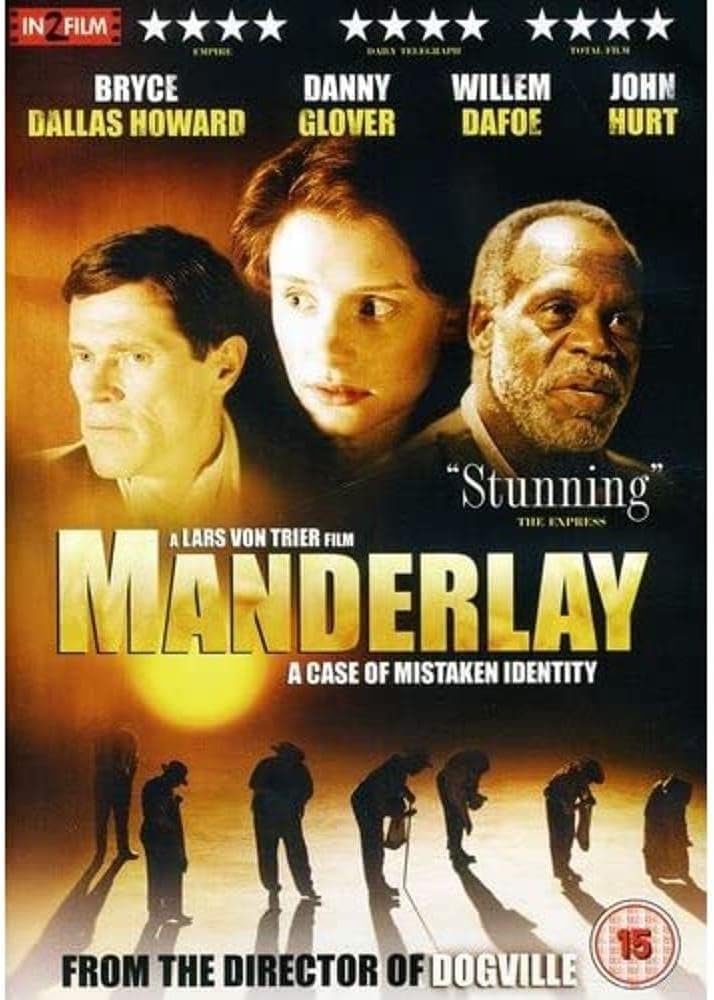
Manderlay
ID del producto: 80022483
Detalles
- FormatImport NTSC
- GenreDrama
- LanguageEnglish
- Runtime133 minutes
Buy anything from 5,000+ international stores. One checkout price. No surprise fees. Join 2M+ shoppers on Desertcart.
Desertcart purchases this item on your behalf and handles shipping, customs, and support to Colombia.
215 Review: LvT: "I'm suspicious of a system that allows for so many losers." - Phenomenal: von Trier rubs shoulders with Aeschylus and William Faulkner Manderlay consists of 8 'chapters'. It is part of a trilogy entitled 'USA: A Land of Opportunity'. It is set 70 years after the Southern War of Secession. It is filmed on a sound stage: there is something successfully Brechtian realized here; the dream of epic theater and de-oxymoronfication of the phrase Modern Tragedy. To the charge of the film's 'racism': Bjork, after filming Dancer in the Dark, called von Trier "an emotional terrorist'. Taking this comment meta-politically, Lars von Trier is hardly 'conservative'. In any sense. In any sense /whatsoever/. In fact, if the powers-that-be ('conservative' and 'liberal')were better attuned to this -and praise to the Lord that they are miserable philistines one and all- Manderlay would have been demonized and banned forthwith. Satires of 'Birth of a Nation' are not your typical movie-goer fare, but the ill-perceived 'racist' element in the film cannot be imputed to its Author: he is well beyond and above /just/ that, --creative sovereignty demands such independence from such vulgarities. "Is this movie depressive, being so tragic?" --Not at all. The other component of tragedy is the Satyr Play. Humor is ingeniously employed, with great intelligence by von Trier. You will walk away from this film laughing. Bitter, vicious irony has to find an outlet from resentment, and this is provided; oh so generously provided! (You'll just have to see the film;) [first lines] Narrator: It was in the year of 1933, when Grace and her father were heading southward with their army of gangsters. Events: Gangsters relocate from somewhere in Texas after a business sojourn which leaves them unwelcome upon their return: they end up outside the Manderlay plantation in Alabama, where a black is about to be lashed for an offense. The daughter of the gang boss is asked by a female plantation hand to help. They become involved. The Daughter invokes an oath made by her Father on her mother's deathbed. The business is divided equally: the Daughter receives half the manpower and oversees the 'emancipation' of the Manderlay slave hands. The Mistress of the plantation dies shortly after their arrival and intervention. The Daughter has the Lawyer draw up a contract/covenant. The four Whites of the Mistress' kin are obliged to serve as farm hands with the former slaves for the duration of one planting-harvest cycle, whence the profit from the cotton is to be distributed and both they --and the blacks-- are released from further obligation to remain. What follows cannot be discussed in-review, the dimensions of tragedy and intensely suggestive political suggestion (if not '/reaction/' ;) Lars Von Trier has created on 35mm is totally out of the scope of 21st century humanity's expectations and rationalizations, its desperate and compulsive meting-out-of and assignment-of meaning. The material gives solid grounding for so many interpretations and meditations that outlining the salient ones can only serve to blind the potential viewer to certain nuances and boundary-blendings that would be better perceived (and appreciated) by a naive pre-viewer understanding and perspective. What I can say is that the Father-Gangster Boss, the Card Sharp, and The 'Proud N---er' deserve especial attention while watching this film. [last lines] Narrator: America had proffered its hand, discreetly perhaps, if anybody refused to see a helping hand he really only had himself to blame. Further extensive reviews available at imdb: [...] In closing, a well formed insight from a reviewer found there: "Grace's color is extremely significant. Resonances with Faulkner's Intruder in the Dust and Absalom, Absalom can also be found in the simplicity of the white liberal Northerner's analysis and solution to race problems. In this sense, Von Trier's provocative film is perhaps above all else an indictment of American liberalism (or liberal individualism), domestically and globally. All of these aspects should be considered through the lens of his Brechtian alienation techniques. Otherwise, this turns out to be one of the most ignominiously racist films since Birth of a Nation." I would only add that the term 'American liberalism' as used above can be pruned for a more specific, descriptive meaning: What is meant, is the gun-diplomacy of Yanqui Liberalism. Or "Yankee", if you prefer the less colorful alternative to that appropriately loaded southern-latin construction. Not that Antebellum resentments and institutions are not given their properly due damnation by v. Trier as well, but praise where praise is due: Yanquilandia, not America per se, is where he sets his axe on this root of evil. And quite rightly so. Review: excellent and provocative - [Caution: some plot points revealed in this review.] Manderlay is yet another brilliantly transgressive, widely misunderstood film from Lars von Trier, who has made a name and a career out of messing with audience's heads, emotions, and expectations. The film is set at an Alabama plantation where, seventy years after the Emancipation Proclamation, slavery still thrives. The horrified Grace (Bryce Dallas Howard), who arrives in Manderlay after her escape from Dogville (the previous film in von Trier's trilogy), decides to "emancipate" the slaves, and establishes a system of democracy in which everyone is now "free." However, the former slaves simply trade one form of institutionalized oppression for another--a new system that calls itself freedom but under which nothing has really changed. Through the character of Grace, von Trier criticizes bleeding heart white liberals (and, during the 1800's, many abolitionists were white women like Grace, who often felt more pity than respect for slaves). Grace seems to be motivated to help the slaves by guilt, pride, or a sense of self-congratulation rather than a sincere desire to help them improve their lot. Thus von Trier mocks white liberals who advocate for human rights because doing so makes them feel better about themselves. This form of "help" continues to objectify underprivileged people and denies them any real agency. Hence, Grace teaches the freed slaves how to vote, but then disagrees with one of their verdicts. Again, she is less interested in allowing others to think for themselves than in forcing others to think like *her*. As in Dogville, von Trier shows how "good intentions" can backfire if not carried out with caution. Eventually, perhaps inevitably, Grace has come to adobt the rhetoric of the slaveowner, and in the last scene resorts to whipping the former slave whom she initially intended to "emancipate." This is not to say that von Trier is arguing that slavery is good, or that it should never have been abolished, or that all liberals are evil. Rather, von Trier uses this film to expose the complexity of America's racial hypocrisies. The Emancipation Proclamation technically "freed" slaves, yet Americans' ideologies about race were not changed. As a result, black people have continually struggled to survive in American society, as von Trier disturbingly reminds us in a montage of photos of impoverished and tortured black Americans which plays over the end credits. A group of people cannot really call themselves free if they are still imprisoned by racist institutions that deny them true subjecthood. This film also borrows many ideas from post-colonial theory, mainly the idea that a group of oppressed people remain oppressed as long as they are not able to act, think, or decide for themselves, which is precisely what happens in the film as a white woman attempts to "act in the best interests" of the black people of Manderlay. Grace views black people as a humanitarian cause rather than as individual subjects, and therefore does not encourage them to think for themselves or make their own mistakes. Once again, the film reveals some unpleasant truths about race in America. The film has undoubtedly caused controversy among many viewers (which, as many have pointed out, is exactly what von Trier intends). Viewers may be tempted to jump to conclusions or knee-jerk reactions while watching this film rather than thinking about it critically. Again, this is what von Trier, a great manipulator, wants from his audience--to shock and anger them. It is tempting to write Manderlay off as a racist film simply because, for example, it contains a scene in which a white woman whips a black man, and another scene in which the former slaves explain that they would rather be slaves than be free (or rather, live under Grace's version of freedom). However, the critical viewer will be able to see that von Trier endorses neither abuse of black people nor slavery in this film. Rather, he causes us to question racism in America and how efforts to eliminate it have been, unfortunately, mostly ineffective.
| ASIN | B000P1KTHI |
| Actors | Bryce Dallas Howard, Danny Glover, Isaach de Bankol, Michael Abiteboul, Willem Dafoe |
| Best Sellers Rank | #214,905 in Movies & TV ( See Top 100 in Movies & TV ) #30,489 in Drama DVDs |
| Customer Reviews | 4.2 4.2 out of 5 stars (180) |
| Director | Lars von Trier |
| Item model number | 5055002530227 |
| Language | English (Dolby Digital 2.0) |
| MPAA rating | Unrated (Not Rated) |
| Media Format | Import, NTSC |
| Number of discs | 1 |
| Package Dimensions | 7.1 x 5.42 x 0.58 inches; 3.53 ounces |
| Producers | Vibeke Windel v |
| Release date | January 5, 2010 |
| Run time | 133 minutes |
| Studio | IMPORTS |
| Subtitles: | English |
A**K
LvT: "I'm suspicious of a system that allows for so many losers."
Phenomenal: von Trier rubs shoulders with Aeschylus and William Faulkner Manderlay consists of 8 'chapters'. It is part of a trilogy entitled 'USA: A Land of Opportunity'. It is set 70 years after the Southern War of Secession. It is filmed on a sound stage: there is something successfully Brechtian realized here; the dream of epic theater and de-oxymoronfication of the phrase Modern Tragedy. To the charge of the film's 'racism': Bjork, after filming Dancer in the Dark, called von Trier "an emotional terrorist'. Taking this comment meta-politically, Lars von Trier is hardly 'conservative'. In any sense. In any sense /whatsoever/. In fact, if the powers-that-be ('conservative' and 'liberal')were better attuned to this -and praise to the Lord that they are miserable philistines one and all- Manderlay would have been demonized and banned forthwith. Satires of 'Birth of a Nation' are not your typical movie-goer fare, but the ill-perceived 'racist' element in the film cannot be imputed to its Author: he is well beyond and above /just/ that, --creative sovereignty demands such independence from such vulgarities. "Is this movie depressive, being so tragic?" --Not at all. The other component of tragedy is the Satyr Play. Humor is ingeniously employed, with great intelligence by von Trier. You will walk away from this film laughing. Bitter, vicious irony has to find an outlet from resentment, and this is provided; oh so generously provided! (You'll just have to see the film;) [first lines] Narrator: It was in the year of 1933, when Grace and her father were heading southward with their army of gangsters. Events: Gangsters relocate from somewhere in Texas after a business sojourn which leaves them unwelcome upon their return: they end up outside the Manderlay plantation in Alabama, where a black is about to be lashed for an offense. The daughter of the gang boss is asked by a female plantation hand to help. They become involved. The Daughter invokes an oath made by her Father on her mother's deathbed. The business is divided equally: the Daughter receives half the manpower and oversees the 'emancipation' of the Manderlay slave hands. The Mistress of the plantation dies shortly after their arrival and intervention. The Daughter has the Lawyer draw up a contract/covenant. The four Whites of the Mistress' kin are obliged to serve as farm hands with the former slaves for the duration of one planting-harvest cycle, whence the profit from the cotton is to be distributed and both they --and the blacks-- are released from further obligation to remain. What follows cannot be discussed in-review, the dimensions of tragedy and intensely suggestive political suggestion (if not '/reaction/' ;) Lars Von Trier has created on 35mm is totally out of the scope of 21st century humanity's expectations and rationalizations, its desperate and compulsive meting-out-of and assignment-of meaning. The material gives solid grounding for so many interpretations and meditations that outlining the salient ones can only serve to blind the potential viewer to certain nuances and boundary-blendings that would be better perceived (and appreciated) by a naive pre-viewer understanding and perspective. What I can say is that the Father-Gangster Boss, the Card Sharp, and The 'Proud N---er' deserve especial attention while watching this film. [last lines] Narrator: America had proffered its hand, discreetly perhaps, if anybody refused to see a helping hand he really only had himself to blame. Further extensive reviews available at imdb: [...] In closing, a well formed insight from a reviewer found there: "Grace's color is extremely significant. Resonances with Faulkner's Intruder in the Dust and Absalom, Absalom can also be found in the simplicity of the white liberal Northerner's analysis and solution to race problems. In this sense, Von Trier's provocative film is perhaps above all else an indictment of American liberalism (or liberal individualism), domestically and globally. All of these aspects should be considered through the lens of his Brechtian alienation techniques. Otherwise, this turns out to be one of the most ignominiously racist films since Birth of a Nation." I would only add that the term 'American liberalism' as used above can be pruned for a more specific, descriptive meaning: What is meant, is the gun-diplomacy of Yanqui Liberalism. Or "Yankee", if you prefer the less colorful alternative to that appropriately loaded southern-latin construction. Not that Antebellum resentments and institutions are not given their properly due damnation by v. Trier as well, but praise where praise is due: Yanquilandia, not America per se, is where he sets his axe on this root of evil. And quite rightly so.
S**L
excellent and provocative
[Caution: some plot points revealed in this review.] Manderlay is yet another brilliantly transgressive, widely misunderstood film from Lars von Trier, who has made a name and a career out of messing with audience's heads, emotions, and expectations. The film is set at an Alabama plantation where, seventy years after the Emancipation Proclamation, slavery still thrives. The horrified Grace (Bryce Dallas Howard), who arrives in Manderlay after her escape from Dogville (the previous film in von Trier's trilogy), decides to "emancipate" the slaves, and establishes a system of democracy in which everyone is now "free." However, the former slaves simply trade one form of institutionalized oppression for another--a new system that calls itself freedom but under which nothing has really changed. Through the character of Grace, von Trier criticizes bleeding heart white liberals (and, during the 1800's, many abolitionists were white women like Grace, who often felt more pity than respect for slaves). Grace seems to be motivated to help the slaves by guilt, pride, or a sense of self-congratulation rather than a sincere desire to help them improve their lot. Thus von Trier mocks white liberals who advocate for human rights because doing so makes them feel better about themselves. This form of "help" continues to objectify underprivileged people and denies them any real agency. Hence, Grace teaches the freed slaves how to vote, but then disagrees with one of their verdicts. Again, she is less interested in allowing others to think for themselves than in forcing others to think like *her*. As in Dogville, von Trier shows how "good intentions" can backfire if not carried out with caution. Eventually, perhaps inevitably, Grace has come to adobt the rhetoric of the slaveowner, and in the last scene resorts to whipping the former slave whom she initially intended to "emancipate." This is not to say that von Trier is arguing that slavery is good, or that it should never have been abolished, or that all liberals are evil. Rather, von Trier uses this film to expose the complexity of America's racial hypocrisies. The Emancipation Proclamation technically "freed" slaves, yet Americans' ideologies about race were not changed. As a result, black people have continually struggled to survive in American society, as von Trier disturbingly reminds us in a montage of photos of impoverished and tortured black Americans which plays over the end credits. A group of people cannot really call themselves free if they are still imprisoned by racist institutions that deny them true subjecthood. This film also borrows many ideas from post-colonial theory, mainly the idea that a group of oppressed people remain oppressed as long as they are not able to act, think, or decide for themselves, which is precisely what happens in the film as a white woman attempts to "act in the best interests" of the black people of Manderlay. Grace views black people as a humanitarian cause rather than as individual subjects, and therefore does not encourage them to think for themselves or make their own mistakes. Once again, the film reveals some unpleasant truths about race in America. The film has undoubtedly caused controversy among many viewers (which, as many have pointed out, is exactly what von Trier intends). Viewers may be tempted to jump to conclusions or knee-jerk reactions while watching this film rather than thinking about it critically. Again, this is what von Trier, a great manipulator, wants from his audience--to shock and anger them. It is tempting to write Manderlay off as a racist film simply because, for example, it contains a scene in which a white woman whips a black man, and another scene in which the former slaves explain that they would rather be slaves than be free (or rather, live under Grace's version of freedom). However, the critical viewer will be able to see that von Trier endorses neither abuse of black people nor slavery in this film. Rather, he causes us to question racism in America and how efforts to eliminate it have been, unfortunately, mostly ineffective.
M**L
As described
As described. Need universal dvd player
L**R
It's like watching a filmed stage production
Have you ever watched a PBS filmed version of a stage production with sparse sets. Well that is what this is like. The acting and story line keep the narrative going. Bryce Dallas Howard could save just about anything just with her lovely presence (as in "Lady in the Water"). The director could have set the story in a Russian estate after the serfs had been freed and avoided the racist overtones of freed African Americans being unable to outgrow their roles. There are more tactful ways of dealing with the subject of humans being conditioned to acceptance of inhumane situations. Heck, this could have been done as a science fiction type film with a class of drone workers who can't move on after being freed. The abomination of human slavery and its reality in the American South is just too serious to be made into an allegory or ironic stage play right now. Especially in light of the recent rise of ultra-right wing racists in the United States. The theme of being exploited until you are numb and powerless is cruel especially when afixing it to a people who have been beaten down with it in reality; no matter what the twist ending is.
N**Y
If you enjoyed Dogville you will like this film. If you don't know anything about either... you must appreciate theater for starters. Not a conventional movie in any sense.The story and ideas develop in a traditional way but the style is more akin to the theater. A lot is left to the imagination... there are no sets!
C**A
Diría qué bueno, bonito y barato. Ha cumplido mis expectativas y rápida entrega. Gracias.
S**R
« Manderlay » constitue une sorte de suite - indépendante - de « Dogville ». La mise en scène est identique : décors invisibles, simplement tracés au sol, lumière artificielle etc. Lars von Trier y développe un message à la fois corrosif et très subtil. Face aux sujets traités, l'esclavage, la démocratie à l'américaine, la transmission des systèmes de valeurs, von Trier ne prend finalement pas parti : il montre la complexité des choses, rien n'est noir ni blanc (c'est le cas de le dire). Il se concentre de manière particulièrement convaincante, comme dans « Dogville », sur les comportements, les réactions humaines face aux circonstances. Le message est féroce par rapport à des attitudes que l'on pourrait qualifier de « droits l'hommistes » ainsi que vis à vis du modèle démocratique occidental, lors que son application sombre dans la simple posture idéologique, déconnectée du réel. En ce sens, certaines scènes sont particulièrement réussies : celle au cours de laquelle l'héroïne décide de faire couper les arbres du « jardin de Mam », symboles du bon plaisir de la propriétaire esclavagiste, mais qui en fait protégeaient efficacement la plantation des tempêtes de sable (avec les dégâts que l'on imagine lors de la tempête qui suivra) ; celle au cours de laquelle « l'heure qu'il est » est mise au vote (sic) qui témoigne de l'absurdité de certaines dérives des sociétés postmodernes. Le scénario pointe aussi, de manière critique, l'attitude historique des Américains vis à vis des noirs. Le personnage principal, celui de Grace Margaret Mulligan (Dallas Bryce Howard remplace Nicole Kidman pour le tenir), passif dans Dogville se transforme en figure très active, une véritable chef d'orchestre d'une idéologie des bons sentiments. Dallas Bryce Howard et Isaac de Bankolé, dans les deux rôles principaux sont très bons. Probablement leur meilleur rôle à tous les deux.
A**O
Dopo Dogville, incentrato sulla cattiveria dell'essere umano, Lars Von Trier sposta l'obbiettivo sulle forme di governo dell'essere umano in un glorioso attacco all' "esportazione" della democrazia. Film che deve essere visto per tutti coloro che hanno ammirato Dogville ma anche per chi non ama Von Trier. Il DVD contiene inoltre contenuti speciali interesanti e la consegna è stata impeccabile.
D**N
"Manderlay" is the sequal to "Dogville", which ended with Grace (Nicole Kidman) getting a brutal revenge on her captors and fleeing Dogville. "Manderlay" begins with Grace (now Bryce-Dallas Howard) arriving at the Manderlay plantation, where slavery still exists, 70 years after it had been legally abolished in Alabama. The mistress of the house (Mam, played by Lauren Bacall, who played Ma Ginger in "Dogville") dies as the movie begins and Grace frees the slaves. Manderlay remains, like its namesake Manderley (in "Rebecca"), haunted by the presence of its former matriarch and her shadow never truely leaves the house. "Manderlay" expores the issue of freeing a captive-bred bird - it's not designed to live in the outside world - and how this issue applies to the freed slaves. Dallas Howard gives an excellent performance and you soon stop wondering how Kidman would have played each scene. Other excellent performances come from Ruben Brinkman and Danny Glover. The staging of "Manderlay" is the same as that of "Dogville" - a sound-stage with a very minimalist set and painted lettering to designate what things are and painted lines to indicate walls. It works exceptionally well and the very clever use of lighting and wind-machines brings more life to the movie than you would get in a theatre using a similar staging of the story. The lack of set gives the actors a real challenge and their performance shines through. Not a light film for Sunday-afternoon viewing - "Manderlay" is dark and bitter and leaves a lasting impression.
Trustpilot
Hace 5 días
Hace 3 semanas