
Descargar la aplicación


Servicios al cliente
Sobre nosotros
Copyright © 2025 Desertcart Holdings Limited
Descargar la aplicación
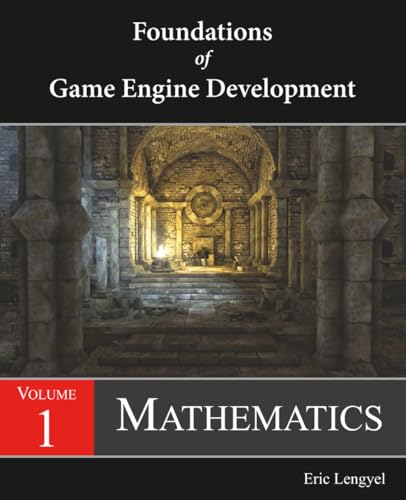


Buy Foundations of Game Engine Development, Volume 1: Mathematics 1 by Lengyel, Eric (ISBN: 9780985811747) from desertcart's Book Store. Everyday low prices and free delivery on eligible orders. Review: Very useful guide/info for rasterized render engines! - Incredible book! Loved all the algebra and the break down of variables, integers, and float values, excelent book for somone who just want to understand how render engine in games work that being a rasterized render engine as a posed to raytraceing which is not covered in this book but trust me 1 step at a time is better. Review: Great for practitioners - A dense yet intuitively presented guide to some of the trickiest bits of vector math one is likely to come across during game development, with a brief but fascinating discursion into Lengel’s real passion — geometric algebra — at the end. I suspect an aspiring game developer would get fatigued quickly by this book. It would not make a good introduction to the math involved in games. This is a great book for people who regularly *use* vector math, but want to really *understand* it at a deeper level.
| Best Sellers Rank | 189,340 in Books ( See Top 100 in Books ) 375 in Software Design & Development 379 in Computing & Internet for Professionals 1,023 in Computing & Internet Programming |
| Book 1 of 2 | Foundations of Game Engine Development |
| Customer reviews | 4.7 4.7 out of 5 stars (242) |
| Dimensions | 19.05 x 1.19 x 23.5 cm |
| Edition | 1st |
| ISBN-10 | 0985811749 |
| ISBN-13 | 978-0985811747 |
| Item weight | 422 g |
| Language | English |
| Print length | 200 pages |
| Publication date | 11 Sept. 2016 |
| Publisher | Terathon Software LLC |
A**T
Very useful guide/info for rasterized render engines!
Incredible book! Loved all the algebra and the break down of variables, integers, and float values, excelent book for somone who just want to understand how render engine in games work that being a rasterized render engine as a posed to raytraceing which is not covered in this book but trust me 1 step at a time is better.
B**N
Great for practitioners
A dense yet intuitively presented guide to some of the trickiest bits of vector math one is likely to come across during game development, with a brief but fascinating discursion into Lengel’s real passion — geometric algebra — at the end. I suspect an aspiring game developer would get fatigued quickly by this book. It would not make a good introduction to the math involved in games. This is a great book for people who regularly *use* vector math, but want to really *understand* it at a deeper level.
A**R
The last chapter - advanced algebra - delves into things like why the cross product is defined like it is
As a game technology student, this book has helped me a lot in creating a math library from scratch, and also in a deeper understanding of linear algebra. The last chapter - advanced algebra - delves into things like why the cross product is defined like it is, and why determinants are defined like they are. The book generally gives clear logic of where proofs and concepts come from, and it provides great illustrations of these concepts. Overall, this book has given me a better intuition on the mathematics behind game engines.
A**R
good quality small enough to take were ever you go ...
the first Math book that is not intimidating! good quality small enough to take were ever you go but bursting with info and the print quility is good! i plan to get the whole collection as there released.
J**N
Excellent!
Very good printing quality, organization and scope. Perfect to learn the math required for game engines (2D & 3D).
T**M
Just amazing
Really helped me learn a lot, and was surprisingly simple to understand! Totally recommend for people interested in the math behind games.
A**R
Five Stars
Great resource to get into modern game engine mathematics!
A**R
Excellent
Fantastic resource for 3D mathematics for games. Highly recommend! :)
C**N
di positivo ha che concentra in poche pagine, circa 180 reali, molti concetti e formule che altrimenti si trovano difficilmente esposte in modo altrettanto chiaro e conciso. La parte codice è solo discreta, nel senso che presenta solo le primitive (metodi per calcolare proiezioni, intersezioni etc) ma nessun esempio reale all'opera. Dato il tiro di "game development" almeno qualche esempio base sarebbe stato utile, come anche qualche declinazione più reale (invece di fermarsi a intersezioni piani-rette, perché non affrontare quelle mesh-raggio?) Ma tutto sommato raccomandato.
N**E
Will order the rest of the series!
J**L
Es un libro extraordinario, muy útil y práctico si conoces la materia para tener como referencia. A mi parecer está muy condensado como para aprender los fundamentos, pero como referencia es genial.
P**Y
Updated again...removed my speculative errata see the books official website for errata Update: I have read this book all the way through a couple times now and some sections I have read repeatedly. Over those readings I have come up with some good and not so good points about the book so here they are...in no particular order... The good: 1) This book is like a Lego set for 3D math. It starts with some basic pieces, then uses those pieces to build interesting 3D math parts, then uses those large pieces to build even more exotic math. Then it breaks them all down, and puts them back together to build Grassman/geometric algebra. 2) The book can be educational on multiple levels, meaning that on first glance it is introducing basic stuff that you see in every book, but upon rereading I found an entire new level of detail that I missed on the first pass that aided insights to the underlying topics. 3) All the stuff in the original review below. update...the books official website now has errata (thank you) Not so good: 1) Some of the questions in the exercises refer to material that hasn't been introduced yet. Like question 7 in chapter one refer's to planes which aren't introduced until chapter 3. There are a few place in the book this happens. Not that big a deal but still... 2) The book doesn't introduce things like converting a projection to a matrix, instead it is left as an exercise, but later in the book it uses the answer to that exercise like it was introduced. There a handful of places where the expertly crafted dialog that builds between the author and the reader break down because things like this. No matter how you slice it, this is still a 5 star book. Original review: Well edited, easy to read, and easy to follow. I'm looking forward to the next volume. This is the kind of book that keeps me passionate about computer graphics by presenting current up to date material without a bunch of redundancy. It also offers a tantalizing look into grassman/geometric algebra complete with enough implementation details to start putting the theory to use. I'm hoping the author will continue to explore this area in the other volumes of the book. (using the wedge operator with sphere's in particular) If there is anything I didn't really care for its that I felt like I was being led somewhere with the overall structure of the book and the code listings that it includes. But at the end of the book it seemed like some of these ideas were either just dropped or left up to the reader to conjure from the tables. The author recommends reading chapter 3 for experienced readers, but I would suggest starting in chapter 2, if you start falling asleep go to chapter 3 if you are lost go back to chapter 1, if chapter 1 is confusing then...segmentation fault, core dumped
A**R
Easy to read and clear. Handy book to have.
Trustpilot
Hace 1 mes
Hace 1 día