Some deliveries may take a little longer than usual due to regional shipping conditions.

Descargar la aplicación


Servicios al cliente
Sobre nosotros
Copyright © 2025 Desertcart Holdings Limited
Descargar la aplicación
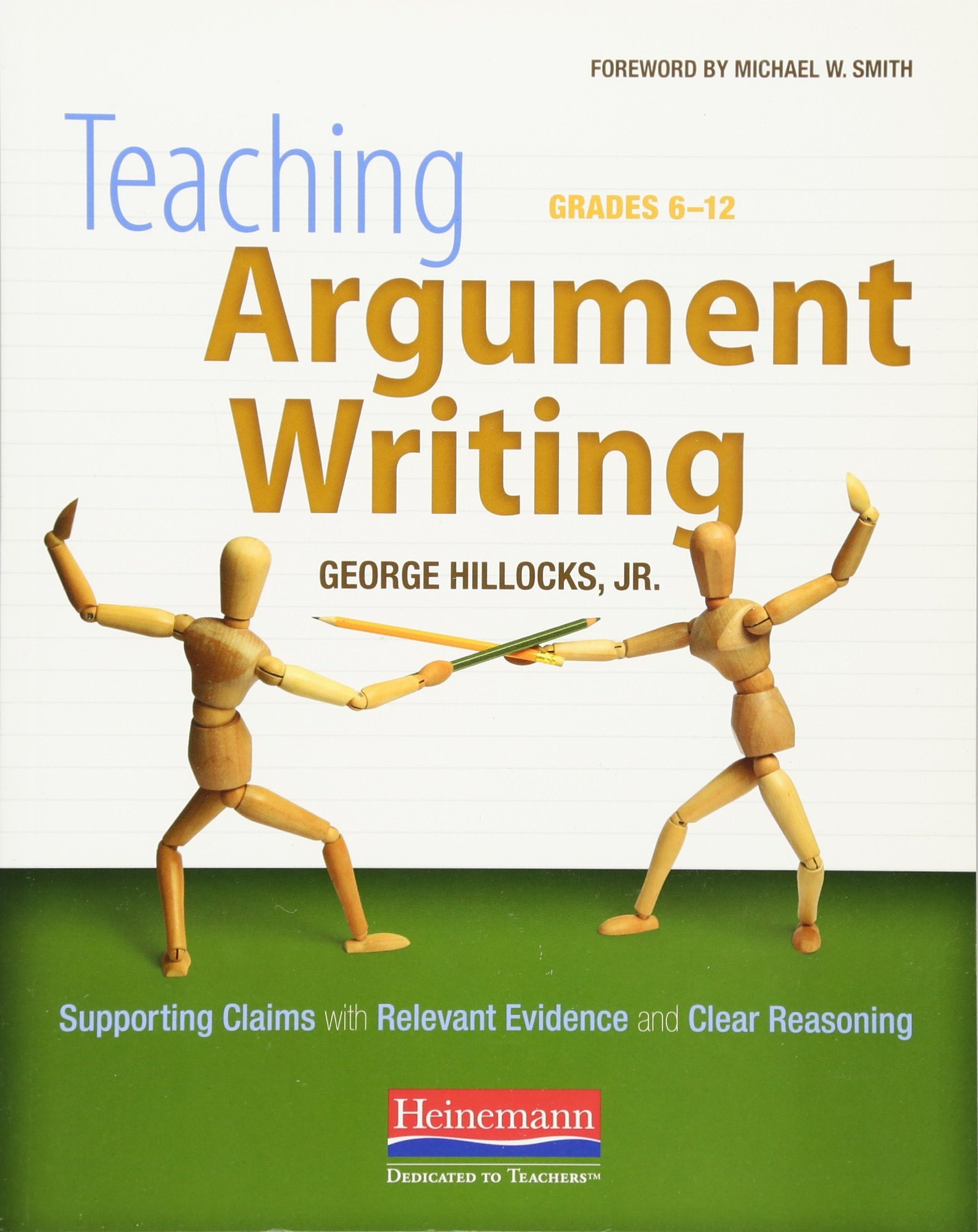
desertcart.com: Teaching Argument Writing, Grades 6-12: Supporting Claims with Relevant Evidence and Clear Reasoning: 9780325013961: Smith, Michael, Hillocks Jr, George: Books Review: Loaded with Lesson Plans - If you aren't a fan of inquiry yet, this book should do the trick. Hillocks shows how you can use questions, curiosity, and discussion to teach students the finer points of argument. It's no understatement to say that your existing persuasive unit will pale by comparison to goings-on in this book. It's an eye-opener (not to mention a mind-opener!). Written for Grades 6-12, the book follows a progressively more difficult agenda. Hillocks starts with the basics of argument writing, including "whodunit" cartoons for arguments of fact. Kids scrutinize the drawings of murder scenes and draw conclusions based on visual details, trying their ideas out in group discussions. Such "fun" work is teaching them the relationships between evidence, claims, "warrants" or rules (e.g. "As a rule, when people fall down stairs, they drop what they are carrying to save themselves."), and conclusions. The mystery solving is followed by writing exercises, wherein the conclusions of the students are carefully justified in paragraph form. Hillocks provides a chart to ensure that all elements of good argument writing are logged. From here, Hillock moves to simple arguments of judgment (he uses examples of what makes a good school mascot and what makes a good leader) and simple arguments of policy (here the students gather data on gum chewing). The latter example is especially good because the students do not simply jump on-line to cut and paste (yes, and sometimes plagiarize) material. Instead, students create their own data by interviewing the principal and custodians on the reasons for forbidding gum on school grounds plus its costs in time and money. They also create a survey to find out why students stick gum under chairs and desks or throw it on the floor. Invested? I guess! And it's so much better than the dreary Google search method of research. You'll think so, too, as you read Hillocks account of the students wrestling data into a logical, coherent form in an attempt to change the principal's mind. In the second part of the book, Hillocks moves to more complex arguments of judgment. Using transcripts from classes along with ready-to-go handouts, he shows how students grappled with developing criteria about such abstract terms as "courage" and "freedom of speech." Numerous scenarios are provided, complete with instructions on how to use them and how it went in Hillocks' classes. To wrap up, he takes the skills students hone in argument writing and shows you how they can be applied to literary analysis. This final chapter is regrettably brief, but if you consider it a "bonus" chapter and remind yourself that the goal of this book is to focus on writing argument, you feel no reason to complain. It's popular to say that technology is the key to changing education in the future, but I see technology is a mere tool. What will really change teaching and make it relevant to kids is work like this. Updating technology, then, takes a backseat to updating teachers. This book is a classic example of one way you can do that. If you're a teacher -- the most important technology in any classroom -- you owe it a look. Review: Persuasive writing is not argumental writing - When I looked at the CCSS for my English classes, I was concerned to see that students needed to be able to write solid arguments. I had taught persuasive writing, but arguments, no. After reading the book, I know that these two areas are not the same! Argument involves thinking and not just amassing piles of research by others that seems to prove a point. Actual thinking for themselves and reasoning out an issue which can go either way and backing it up with warrants that are in turn backed up or supported is real argument. As pure coincidence (believe it or not) I also bought two of Lawrence Treat's Crime and Puzzlement books and was amazed to find that George Hillocks Jr. uses these in his beginning argument classes! Hillocks's cover states that the book is for grades 6-12, and mostly, I agree. There are some cases discussed that I do not think work for junior high students in my area, but that is not really an issue as he provides plenty of ideas with his other examples and ample fodder for me to create or find my own cases.
| Best Sellers Rank | #830,135 in Books ( See Top 100 in Books ) #1,148 in Language Arts Teaching Materials #1,400 in Reading & Phonics Teaching Materials #6,789 in Education (Books) |
| Customer Reviews | 4.6 out of 5 stars 109 Reviews |
K**C
Loaded with Lesson Plans
If you aren't a fan of inquiry yet, this book should do the trick. Hillocks shows how you can use questions, curiosity, and discussion to teach students the finer points of argument. It's no understatement to say that your existing persuasive unit will pale by comparison to goings-on in this book. It's an eye-opener (not to mention a mind-opener!). Written for Grades 6-12, the book follows a progressively more difficult agenda. Hillocks starts with the basics of argument writing, including "whodunit" cartoons for arguments of fact. Kids scrutinize the drawings of murder scenes and draw conclusions based on visual details, trying their ideas out in group discussions. Such "fun" work is teaching them the relationships between evidence, claims, "warrants" or rules (e.g. "As a rule, when people fall down stairs, they drop what they are carrying to save themselves."), and conclusions. The mystery solving is followed by writing exercises, wherein the conclusions of the students are carefully justified in paragraph form. Hillocks provides a chart to ensure that all elements of good argument writing are logged. From here, Hillock moves to simple arguments of judgment (he uses examples of what makes a good school mascot and what makes a good leader) and simple arguments of policy (here the students gather data on gum chewing). The latter example is especially good because the students do not simply jump on-line to cut and paste (yes, and sometimes plagiarize) material. Instead, students create their own data by interviewing the principal and custodians on the reasons for forbidding gum on school grounds plus its costs in time and money. They also create a survey to find out why students stick gum under chairs and desks or throw it on the floor. Invested? I guess! And it's so much better than the dreary Google search method of research. You'll think so, too, as you read Hillocks account of the students wrestling data into a logical, coherent form in an attempt to change the principal's mind. In the second part of the book, Hillocks moves to more complex arguments of judgment. Using transcripts from classes along with ready-to-go handouts, he shows how students grappled with developing criteria about such abstract terms as "courage" and "freedom of speech." Numerous scenarios are provided, complete with instructions on how to use them and how it went in Hillocks' classes. To wrap up, he takes the skills students hone in argument writing and shows you how they can be applied to literary analysis. This final chapter is regrettably brief, but if you consider it a "bonus" chapter and remind yourself that the goal of this book is to focus on writing argument, you feel no reason to complain. It's popular to say that technology is the key to changing education in the future, but I see technology is a mere tool. What will really change teaching and make it relevant to kids is work like this. Updating technology, then, takes a backseat to updating teachers. This book is a classic example of one way you can do that. If you're a teacher -- the most important technology in any classroom -- you owe it a look.
S**Y
Persuasive writing is not argumental writing
When I looked at the CCSS for my English classes, I was concerned to see that students needed to be able to write solid arguments. I had taught persuasive writing, but arguments, no. After reading the book, I know that these two areas are not the same! Argument involves thinking and not just amassing piles of research by others that seems to prove a point. Actual thinking for themselves and reasoning out an issue which can go either way and backing it up with warrants that are in turn backed up or supported is real argument. As pure coincidence (believe it or not) I also bought two of Lawrence Treat's Crime and Puzzlement books and was amazed to find that George Hillocks Jr. uses these in his beginning argument classes! Hillocks's cover states that the book is for grades 6-12, and mostly, I agree. There are some cases discussed that I do not think work for junior high students in my area, but that is not really an issue as he provides plenty of ideas with his other examples and ample fodder for me to create or find my own cases.
C**X
Teaching Argument Writing--A Must-Have Book for Teachers in Creating Critical Thinkers and More Powerful Writers
I recently attended a conference related to the new and upcoming "Common State Core Curriculum." One of the presenters recommended this book, saying that any teacher charged with teaching argument writing should definitely take a look at this book. It was fabulous. In the beginning it clearly outlines the Toulman Model for writing arguments. The author makes a reading/writing connection throughout the book. This book is packed with easy-to-incoporate ideas, starting from the ground up and building from the basics. Already I have loads of new ideas for how I might better teach this type of writing with my students. It's written in a fashion that will make modifying these ideas to fit my students' needs very easy to do. I give this book my highest of recommendations.
M**S
A Great Resource
This is a great resource to start you off with teaching argument writing to students who may have had little to know prior experience with this type of writing. I like that it starts off with an engaging way of introducing the idea and gives suggestions throughout for how to make things more challenging or more accessible depending on your students abilities. I would recommend this to any teacher who needs ideas on how to approach teaching argument writing. The one thing that would have made this a five for me would have been if the examples that were shown throw out the book were included as an appendix at the end so that worksheets, etc. could be made of them but other than that a really great book.
A**R
Great Source
From cover to cover, this book is packed with suggestions and applications for the teaching of argument writing on the middle and upper levels. Have already pulled information and put material into a presentation that I will make in several schools in the fall to help adapt this valued source in the teaching of this area in the CORE CURRICULUM. The information in this text may even make for an all-day workshop. Suggesting to NSULA National Writing Project to purchase one for each school that we are working with the next two years through the i3 grant. Great and quick service delivered, along with a valuable and quality resource.
U**J
Best book on the subject
Simply put, you have to buy this book if you want to really learn how to teach Argument Writing to middle or high schoolers. Step by step, real-life examples and the best researcher in the field - oh yeah, he can also write so it's an enjoyable read. Buy it, read it, implement his suggestions and your students writing will soar.
S**L
Lesson Material Given
As schools move into the Common Core Standards, we will need to teach different things in different ways than before. This book not only helped me see what Common Core calls for in my academic area of English, but it gave plenty of information, scenarios, material to actually use in teaching lessons, without having to "reinvent the wheel." I will also be able to adapt some of the material in my drama classes, which for me is an added bonus.
R**T
I am using this book as a Bible for Argument ...
I am using this book as a Bible for Argument Writing. The teacher that left my position left some BIG shoes to fill. However, she used this book and I did not know this until I passed out the first assignment. My 8th graders promptly told me that they did it last year. Yea!!! I'm on the same path as the last teacher!!!
Trustpilot
Hace 5 días
Hace 2 meses