We remain fully operational. Our teams are working around the clock to ensure your deliveries continue safely.

Descargar la aplicación


Servicios al cliente
Sobre nosotros
Copyright © 2025 Desertcart Holdings Limited
Descargar la aplicación
Buy anything from 5,000+ international stores. One checkout price. No surprise fees. Join 2M+ shoppers on Desertcart.
Desertcart purchases this item on your behalf and handles shipping, customs, and support to Colombia.
🔌 Stay Powered, Stay Ahead — Never Miss a Beat!
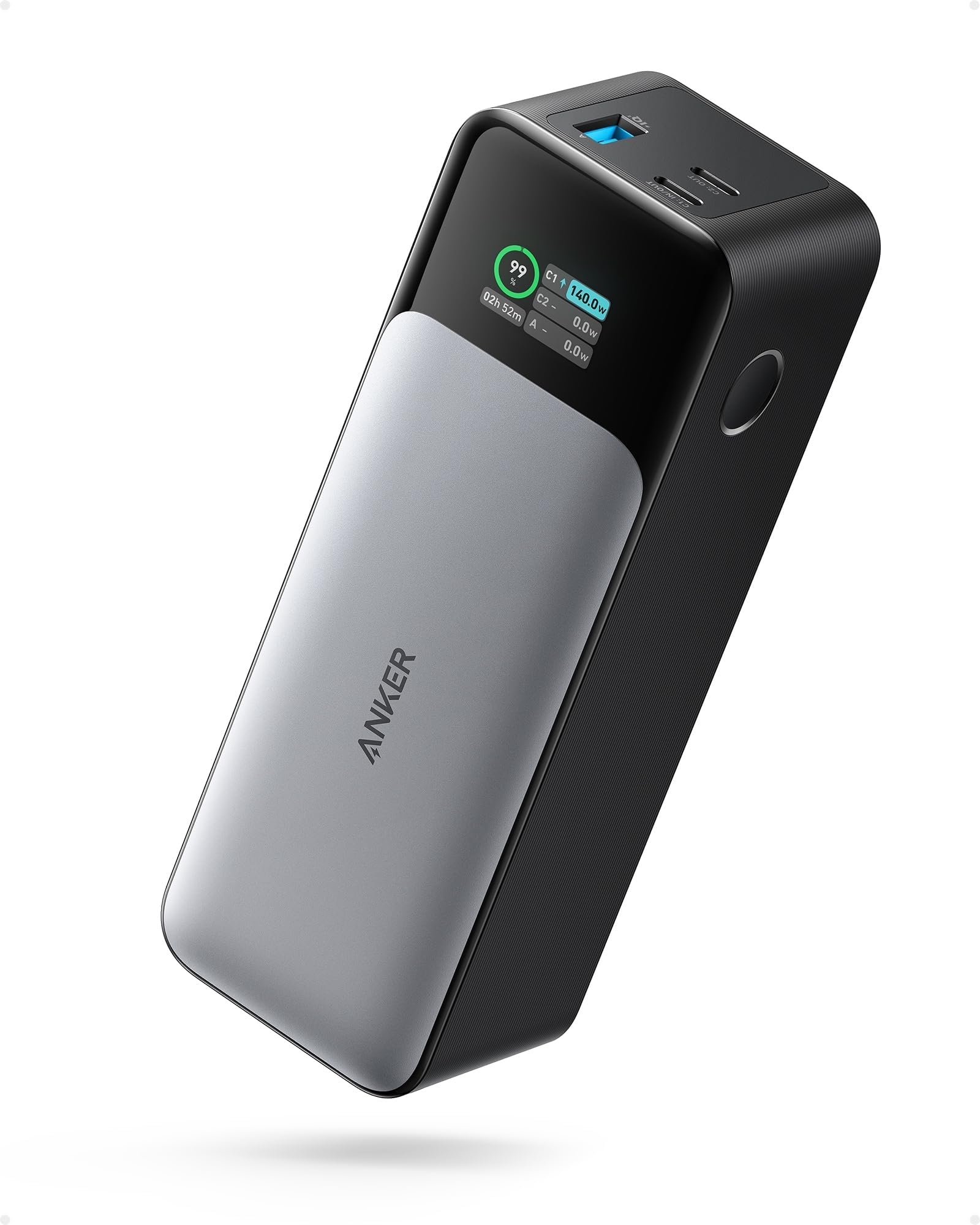
The Anker 737 Power Bank delivers a massive 24,000mAh capacity with ultra-fast 140W charging across three ports, featuring a smart digital display for real-time power insights. Compact and TSA-approved, it’s engineered for professionals who demand reliable, high-speed charging for laptops, smartphones, and more—keeping you connected and productive wherever you go.


| ASIN | B09VPHVT2Z |
| Amperage | 5 Amps |
| Antenna Location | Phone |
| Battery Capacity | 24000 Milliamp Hours |
| Battery Cell Type | Lithium Ion |
| Battery Charge Time | 52 minutes |
| Battery Weight | 65 Grams |
| Best Sellers Rank | #1,298 in Cell Phones & Accessories ( See Top 100 in Cell Phones & Accessories ) #103 in Cell Phone Portable Power Banks |
| Brand | Anker |
| Color | Black |
| Compatible Devices | Laptop, Smartphone, iPhone 16/15/15 Plus/15 Pro/15 Pro Max, iPhone 14/13 Series, Samsung, MacBook, Dell, AirPods |
| Compatible Phone Models | MacBook Air 2020, Samsung S22/S21/S20, iPhone 15/14/13/12 series |
| Connector Type | USB Type A, USB Type C |
| Customer Reviews | 4.4 4.4 out of 5 stars (16,767) |
| Global Trade Identification Number | 00194644098728 |
| Is Electric | No |
| Item Dimensions | 6.13 x 2.14 x 1.95 inches |
| Item Dimensions L x W x Thickness | 6.13"L x 2.14"W x 1.95"Th |
| Item Weight | 1.4 Pounds |
| Manufacturer | Anker |
| Model Number | A1289 |
| Number of Batteries | 1 Lithium Polymer batteries required. |
| Number of Outlets | 3 |
| Number of Ports | 4 |
| Other Special Features of the Product | Digital Display, Fast Charging |
| Portable | No |
| Power Source | Battery |
| Reusability | Rechargeable |
| UPC | 194644098728 |
| Unit Count | 1.0 Count |
| Voltage | 5 Volts |
| Warranty Description | 24-month stress-free warranty |
| Warranty Type | Limited |
G**N
Solid Charging Bank
Still going strong! This bank has been a blessing. It has powered my MacBook Pro Max, cameras, video equipment, and cell phone. I love digital readouts. I mean it could have a couple of extra charging points, but it's a great value; reliable, sturdy, easy to use, and performs.
W**Y
Awesome, Fully Meets My Expectations
This is an awesome device. After some quick tests I can say it fully meets my needs and expectations. Yes, it is expensive, and at $150 I didn't think I could justify it. I got it on sale for $100 and I believe it was definitely worth it. The display is fantastic and really provides all the information you need in order to know what is going on with the inputs and outputs. My main use will be for charging the 50wh battery in my Surface Pro 8. The Anker 737 will charge it at a 55w rate via either of the two Thunderbolt ports (the supplied Microsoft charger is rated at 60w through the Surface connector), and it appears that the conversion efficiency is about 80%, meaning that it can fully charge the Surface and have capacity left over to charge a phone or two. (An interesting note about conversion efficiency based on some quick tests and calculations: If I charge my Surface Pro 8 from my Jackery 300’s PD port, it takes about 60wh to fully charge the 50wh battery. It appears that the Anker 737 will need to supply almost 70wh to fully charge the 50wh battery. If I connect the Microsoft AC adapter to the Jackery 300’s AC port and charge the Surface that way, it requires about 90wh to fully charge the 50wh battery. The more up and down conversions you do, the more you lose.) The supplied cord is rated for 140w and is 60cm long (NOT 6 cm as some have said), or about two feet. I had limited success with pass-through charging, YMMV. I connected a 45w charger and the Anker started charging at 42w. Then I connected a phone, which started charging at 10w, but the input to the Anker then dropped to an identical 10w. A different charger and a different load might give different results, I don't know. Others have complained about having difficulty charging DJI batteries. Here's what I think is going on (my best guess, anyway): I have the Mini 2 battery charging hub and three batteries. The hub appears to be happiest with an input of 12v, 1.5a. (The supplied DJI charger is rated at 9v, 2a and 12v, 1.5a.) USB-C PD 3.1 does not appear to support 12v, and when connected to the hub, the hub and the Anker can't seem to negotiate an 18w charging rate at 9v. HOWEVER, when I connect the hub to the Anker's USB-A port using the supplied DJI cable all is well and the hub charges at 18w. Some users have panicked over the USB-A port showing 0.1a with no load connected. Anker explains this on their support page (which takes some digging to find). 1. Make sure Trickle Charge mode is off (tap the button twice). 2. Wait two minutes after disconnecting a load from the USB-A port. 3. Relax. Some users have experienced less than expected charging rates. Not all USB cables are created equal. (In fact, back in the early days of USB-C there were some cables that didn’t meet the standard and were risky to use.) Make sure your cable supports the rate your device requires. I bought a six foot, 140w Anker cable to go along with the 737. That, plus the cable supplied with the 737, should meet all my needs.
M**S
Big. Heavy. Powerful
I needed a charger that would reload my iPad Pro. I have a couple of quite powerful battery packs, but the best of them struggled even to maintain the iPad charge at the same level (though it does well in recharging my iPhone). So, more power needed. This battery is a chunk, It’s big and heavy. When I first got it, the booklet advised putting it on charge right away and, yes, that is needed. The display showed it at only 16% of full charge out of the box. I put it on a regular 3amp (about 15w) charger and the display usefully, if rather disappointingly, predicted it would take about 16 hours to full charge (It did start at 99 hours immediately, but then it got its act together and gave a more manageable timeframe though the timing does bounce around a bit). I left it on charge overnight and it was 100% the next day, so I’m guessing around 12 hours from 16% to 100%. I would have preferred faster, preferably a lot faster. But Est Quod Est… In my first trial at using the battery to charge my iPad the iPad was at 83% and the battery at 100%. It charged the iPad up to 100% in maybe 45 minutes which ran the battery down to 92%. So a 17% iPad charge resulted in an 8% run down on the battery, About a 2:1 ratio. That implies I should get two whole iPad charges out of one full battery charge and the charging should take about 6*45min or about 4.1/2 hours. Not too bad. Again. I would have preferred more charge for a shorter time. But this was only my first pass at calibrating the charging capability of this battery, so we’ll see how it pans out in the longer term. In the meantime, I really like the display. It shows the current draw, predicts charging time and shows the current charge level of the battery—all very useful metrics. It is chunky and quite heavy, which somewhat detracts from its portability, but more powerful batteries are always bigger and heavier. That’s just the way it is. My interim judgement is that it’s a plus and assuming it is able to reliably deliver charges to my iPad for a good number of battery recharge cycles, I will be happy I got it. I may update these metrics after I’ve run it for a while, but for now: recommended.
A**E
Best power bank
One of the best chargers out there, charges multiple devices quickly, long lasting, easy to carry around only down side it’s a little heavy but other than that great power bank best one I had by far
K**I
GREAT for most use cases
I've had a lot of power banks, upgrading with each new standard to try to keep up with charging rates my various devices will accept, and use these banks heavily. I use these for smartphones, earbuds, powering USB-powered devices (lights, tools, etc.) on the go, and laptops. I use it to supplement my Dell Precision M7750 Mobile Workstation - it has a Xeon processor and NVIDIA RTX 5000 graphics card, so it's a very stout, power-hungry laptop, and this power bank is able to extend the off-grid usage of the laptop by about 100%. However: In order to power the laptop with either a PD-to-Dell barrel adapter OR with a PD cable, I find I have to cold boot the laptop connected to the power bank in order for the power bank and laptop to negotiate a power rate that both the power bank and laptop will accept. Providing I do not disconnect the power bank from the laptop, the power bank will happily keep the laptop running until it is drained, then the laptop will draw from its internal battery pack. If I hotplug the power bank to the already-booted laptop, it will not negotiate a power level that the laptop will accept, and the power bank will start to draw a trickle charge from the laptop. I notice that the Anker Anker Prime 6-in-1 USB C Charging Station behaves in the same exact way, but as I do not have any other brand PD power supplies to test, nor do I have a PD sniffer/multimeter yet, I am unable to discern whether Anker or Dell is at fault. The power bank will not charge the internal battery when connected to a charger, but other devices are drawing current. Cons of this power bank: * Problems negotiating appropriate charge rates when hotplugged to Dell Precision laptops * Pass-through is supported, but will _not_ charge internal battery when passing through! (IMHO this is a massive flaw) Pros of this power bank: * it will display the current draw of the connected devices * It will display the exact %age of power remaining (and estimated time it will run the connected devices) * It will display ETA to full charge when charging * Eliminates need to use USB multimeter to test questionable cables (see: will display charge rates to connected devices) * shows number of equivalent full cycles the battery pack has done (good for assessing battery cell aging) Overall it's a great pack, but due to the Dell incompatibility issue and the poorly-implemented pass-through charge prompt me to deduct a star - a first for my rating of an Anker product. If you're going to implement pass-thru charging, implement it _properly_.
S**T
Beast of Power Bank for Laptop Owners!(Owned for almost 4 months) UPDATE
The main reason for purchasing this is to charge my M1 MacBook Pro and 2017 12.9 Inch iPad Pro simultaneously. When I originally got the power bank I charged it back up to full capacity. I ran into a few minor issues with the charging of my iPad Pro in terms of speed but it has calmed down as of late. I've run quite a few tests to see what it's capable of. UPDATE Anker 737 Test Results Charge iPhone XR, 2017 12.9 iPad Pro, M1 MacBook Pro: iPhone XR: 78% iPad Pro: 58% MacBook Pro: 70% Recharge Speed on RavPower 90watt 2 port charger: 10 minutes: 18.72% 20 minutes: 35.17% 30 minutes: 51.05% 40 minutes: 66.35% 50 minutes: 81.17% 1 hour: 96.37% Finish at: 1:03:18 Charging MacBook Pro: Finish at: 100% Remaining Capacity: 23% Charging iPad Pro and MacBook Pro: iPad Pro: 49% MacBook Pro: 78% Charging iPhone XR and iPad Pro: iPhone XR: 100% iPad Pro: 100% Remaining Capacity: 42% Charging MacBook Pro after 80 percent charge on Anker 737: MacBook Pro: 93% Charging Anker 737 after 35 minutes and charging iPad Pro: Anker 737: 62% iPad Pro: 100% Remaining Capacity: 13% Charging Anker 737 after 25 minutes and charging Nintendo Switch: Anker 737: 45% Nintendo Switch: 100% Remaining Capacity: 17% Charging MacBook Pro after 50 minute charge on Anker 737: Anker 737: 84% MacBook Pro: 100% Remaining Capacity: 12% Charging iPhone XR and MacBook Pro: iPhone XR: 98% MacBook Pro: 94% Charging iPhone XR, Nintendo Switch, and MacBook Pro: iPhone XR: 92% Nintendo Switch: 70% MacBook Pro: 86% Charging iPhone XR, Nintendo Switch, and iPad Pro: iPhone XR: 100% Nintendo Switch: 100% iPad Pro: 100% Remaining Capacity: 2% Charging MacBook Pro and Docked Mode Switch: MacBook Pro: Yes Docked Mode Switch: No Charge Power Bank for 10 minutes: iPhone XR: 86% Charge Power Bank for 20 minutes: Nintendo Switch: 88% Charge Power Bank for 30 minutes: iPad Pro: 81% Charge Power Bank for 40 minutes: MacBook Pro: 84% Anker 737 Powerbank Switch Dock + phone test: Anker 737 Percentage Used: 36% Anker 737 Percentage Remaining: 64% Time spent charging iPhone XR to full: 1: 1:53:28 Switch Dock time when using Anker 737: 6:11:37 Pass through Charging Test: 5 minutes: Anker 737 10.97% iPhone XR 10% 10 minutes: Anker 737 20.93% iPhone XR 16% 15 minutes: Anker 737 30.38% iPhone XR 23% 20 minutes: Anker 737 39.66% iPhone XR 29% 25 minutes: Anker 737 48.76% iPhone XR 36% 30 minutes: Anker 737 57.64% iPhone XR 43% 35 minutes: Anker 737 66.39% iPhone XR 50% 40 minutes: Anker 737 74.98% iPhone XR 57% 45 minutes: Anker 737 83.35% iPhone XR 63% 50 minutes: Anker 737 91.64% iPhone XR 69% 55 minutes: Anker 737 97.55% iPhone XR 75% 1 Hour: Anker 737 99.30% iPhone XR 80% When Anker 737(Just over an hour) is finished iPhone XR 80% It does come with a short 140 Watt USB C Cable to charge the power bank but it does NOT come with a wall charger to power it. Pros - Recharges quickly with a 100 Watt or higher charger(sold separately) - Recharges laptops at full speed and can trickle charge two high-end laptops - Smart display indicates tons of useful information such as battery percentage and wattage charging - Small enough to fit into a backpack Cons - Expensive($149.99) - Doesn't come with a wall charger - Occasionally has issues charging 2017 iPad Pro Overall, if you have a high-end USB-C laptop such as the 16-inch MacBook Pro, this is the best choice to go for in the sub-$200 range. Your laptop will thank you later
S**M
Major Disappointment
I usually love Anker products, but this one is a complete disappointment. The ports are unreliable and frequently don’t work, so I have to keep switching between them just to find one that will charge. Even when it does start charging, it often stops after a few minutes, and I’ll come back to see the battery only increased by about 10%. The only upside is that when recharging the device, it charges very quickly with my 140W Anker charging block. Unfortunately, the constant reliability issues make this charger frustrating to use and not worth the money. I recommend skipping this model and going with one of Anker’s other chargers instead. Update- I still would not reccomend this but anker did provide me with refund so I would say the customer service it great!
M**Y
**UPDATED Review: October 2025 - It works!**
**UPDATE October 2025** I previously purchased this power bank to run a Resmed AirMini travel CPAP using a USB-C power converter cable. That battery did indeed not power up my CPAP, no matter what I tried. After noticing that several other people WERE able to get their AirMini CPAP's working with this power bank, I decided to give it another try even though Anker Customer Support could not help me get it working with the first unit. I took a chance and purchased this again and this one now DOES power my AirMini. The only thing I can guess is that I received a very early firmware version that could not correctly negotiate the power voltage/wattage/amperage and as a result, would immediately shut down. The unit I just purchased however, does work and it works well. I have now used it and was able to run my CPAP for 2 nights (~6.5 hrs/night) of use out of one charge with about 1-2 hours of CPAP use remaining CPAP before it needs to be charged. I can't convey how excited this makes me. However, it has been almost 2 years since my initial purchase and review, so I suspect this product will soon be put out to pasture. I am just glad I managed to get a reasonable price and finally get an informative display power bank to run my CPAP so I know exactly how much charge is left. Better late than never. Thank you Anker! - - Original Review - - Summary - Will not power a Resmed AirMini, but otherwise is a great power bank. The bad: This power bank is great if you just want to charge electronic devices. However, if like me, you are trying to find the largest possible amount of power at or under the TSA approved limit for batteries that will power a travel CPAP, this is not it. I currently have a Renogy power bank (https://www.amazon.com/Renogy-72000mAh-Portable-Generator-Technology/dp/B0791WDZTW/ref=sr_1_2_sspa?keywords=renogy&qid=1706802910&sr=8-2-spons&ufe=app_do%3Aamzn1.fos.f5122f16-c3e8-4386-bf32-63e904010ad0&sp_csd=d2lkZ2V0TmFtZT1zcF9hdGY&psc=1) that has a massive 266wh capacity, but it is large and heavy and disallowed on domestic US airlines. It's also not something you would want to lug around for long, but works great as a backup if power goes out. It powers my Resmed Airsense 10 using a 12v cigarette adapter and my AirMini just fine using a 20v USB-C power supply (https://www.amazon.com/dp/B0BV1J88GV?psc=1&ref=ppx_yo2ov_dt_b_product_details). I was hoping this power bank would be the small and light unicorn for travel that would run my Resmed AirMini. When plugging the AirMini into the power bank using the 20v USB-C power supply however, the light on the AirMini flashes once and goes dark. I tried both ports, tried plugging the 20v PSU into the power bank first, then the AirMini as well as the other way around. Nothing could get the power bank to supply any power for more than a momentary blip. This is confusing, especially when Anker makes other power banks that DO work with my 20v PSU/AirMini combination. For example, this power bank (https://www.amazon.com/dp/B0B9XHR6BG?psc=1&ref=ppx_yo2ov_dt_b_product_details) works perfectly, but I was hoping to make use of the charge display on this unit as well as the slightly larger capacity, faster charge times and smaller size. Otherwise the power bank is great. The good: It charged stunningly quickly using the Anker 67 watt GaN charger over USB-C. The display that shows how much power is being utilized both on charge and discharge is fantastic. You can see exactly how much power you have at a given moment as well as the draw any device is making on the battery. This will help you manage power between recharges far more effectively than a few blinking lights ever could. It is however more expensive than older versions from Anker that will accomplish the same thing for less money.
Trustpilot
Hace 2 meses
Hace 1 semana