Some deliveries may take a little longer than usual due to regional shipping conditions.

Descargar la aplicación


Servicios al cliente
Sobre nosotros
Copyright © 2025 Desertcart Holdings Limited
Descargar la aplicación
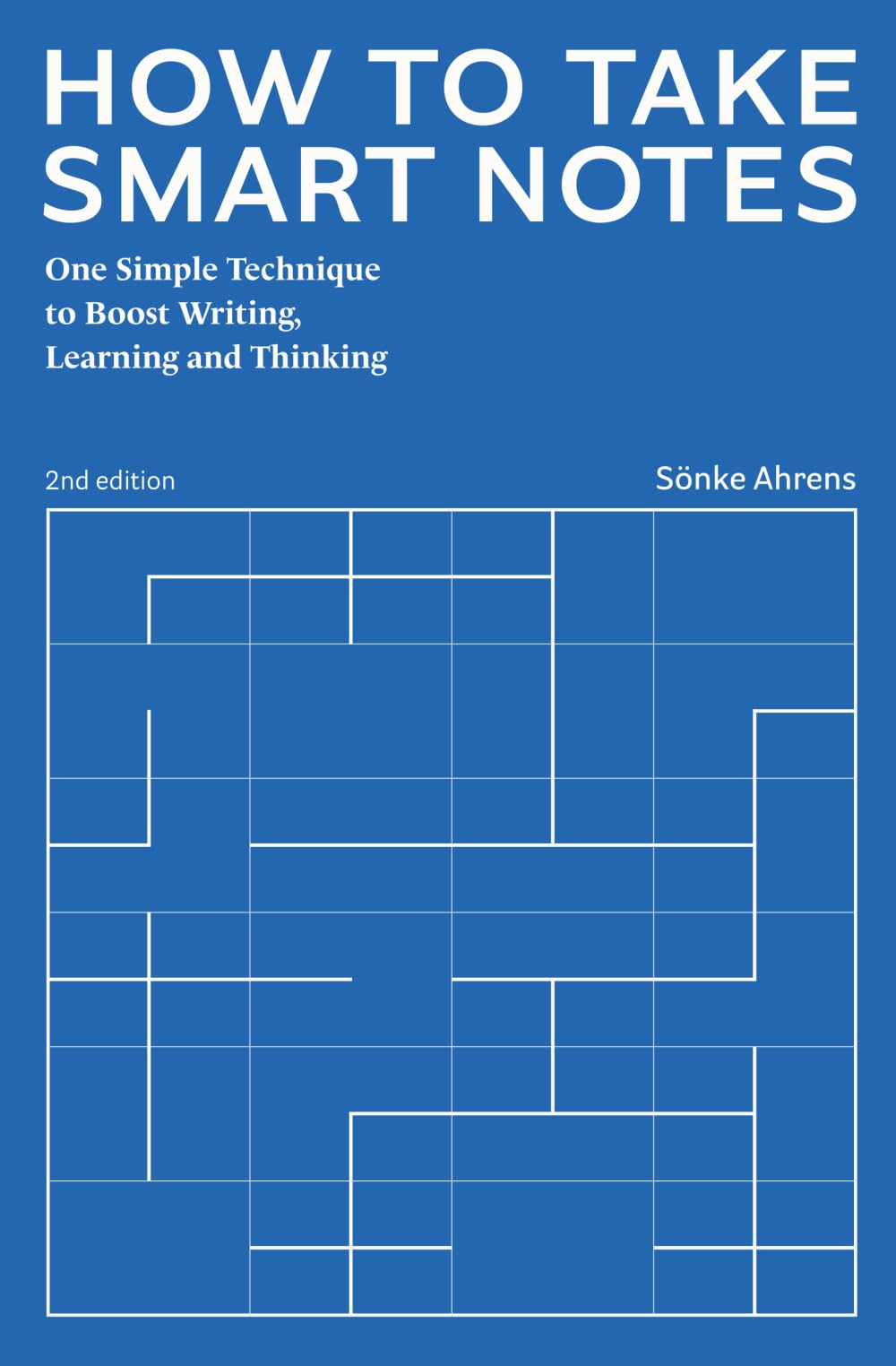
desertcart.com: How to Take Smart Notes: One Simple Technique to Boost Writing, Learning and Thinking: 9783982438801: Ahrens, Sönke: Books Review: A great motivations to start Zettelkasten methods - How to Take Smart Note presents the Zettelkasten (slip-box) method as a note-taking system, which encourages an universal simple note format and an interconnected note storage and retrieval system. This method was pioneered by Niklas Luhmann. This book consists of three parts: - What is Zettelkasten method? This part explains the basic concepts and the practical skills (know-how) of note-taking using Zettelkasten method including how to separate different types of notes (fleeting notes, literature notes and permanent notes), how to use slip-box in writing and research etc. The focus is on what to do and how to do. - The Four Underlying Principles: This part focus on the principles underlying the Zettelkasten method. Zettelkasten method is not simply a skill for note-taking but also a set of principles and mindsets underlying reading, writing, critical thinking and research. To better use of Zettelkasten note-taking system, one should understand why it works. The principles introduced in this part helps the reader to understand what it really matters in note-taking, reading, writing and research. The reader can then adopt the Zettelkasten method with flexibility, allowing the benefits of using this method more obvious. For many, adopting Zettelkasten method would be a paradigm shift in their habits and perspective towards learning and thinking itself. - The Six Steps to Successful Writing: This part moves beyond Zettelkasten method itself and discusses the suggestions and steps of academia writing and research. These steps also follow the similar principles underlying the self-centered research principles. and the five elements of effective thinking. These suggestions are embedded in the design of Zettelkasten system which helps us to separate different tasks, to focus on understanding while reading, to develop ideas with connections, and to share insights with others. The author advocated that Zettelkasten method would lead to successful in non-fiction writing, learning, and academia research. Review: Insight is the Purpose of Consuming Content - Ahrens extols the Zettelkasten method of notetaking that Niklas Luhmann used to produce a huge catalog of original writing (books and articles) over his lifetime. Luhmann kept atomic notes where each note captured a single idea, often in response to what he was reading. He then connected the idea to other existing ideas that were related. Finally he used a set of connected notes on a given topic to create a book or article. I found the Ahrens support for the Zettelkasten method convincing. Enough so that I am incorporating it in my own life. The book gave me a new perspective of why I capture notes on content I consume. It is not so much to memorize the content but to incorporate the ideas in my own life somehow. The notes are meant to help with my own insights on the material. It is important to recognize that the atomic notes represents your interests, rather than a regurgitation of something you read, heard or saw elsewhere. So you are inherently invested (i.e., passionate) in your notes. The Zettelkasten method is actually a tool for thinking and organizing your original ideas, so that when the time comes for you to write any sort of content (thesis, book, documentary, YouTube video, and such), much of the writing is done. You spend your time filling in gaps in your arguments, organizing your ideas for coherency, editing and proofreading. In other words, your Zettelkasten system already contains your future output! Zettelkasten is a useful tool for writers, academics, lawyers, students, and content creators (anyone who wants to deliver their original ideas on a given topic for others to consume). Whatever I am consuming from other creators does not go wasted because of poor memory. I now record my thoughts and ideas in a single database (along with another database to record info about the resources that sparked my ideas). I use a digital database tool for this. I am eager to see how the connections will grow and the content I will create professionally. That content springs forth when I start to see the breadth of the connections I make! My big gain from using this system is the ability to focus on what I am ready to focus on. I don’t need to focus narrowly on 1 project at a time. I can have ideas percolating and writing many different stages of development all at the same time. If I am stuck on one project, I can work on something else. Lastly, I can trust the system as a container for ideas and inspiration and future work. It reminds me of Getting Things Done (GTD), where you build a system without any open loops where information, work, to dos, and so on can escape. If I use an idea from my catalog to create content, I don’t need to spend any time trying to recall which resource sparked the idea, nor do I need to spend a ton of time finding supporting evidence to back up my idea because I have already built those relationships in the system.
T**E
A great motivations to start Zettelkasten methods
How to Take Smart Note presents the Zettelkasten (slip-box) method as a note-taking system, which encourages an universal simple note format and an interconnected note storage and retrieval system. This method was pioneered by Niklas Luhmann. This book consists of three parts: - What is Zettelkasten method? This part explains the basic concepts and the practical skills (know-how) of note-taking using Zettelkasten method including how to separate different types of notes (fleeting notes, literature notes and permanent notes), how to use slip-box in writing and research etc. The focus is on what to do and how to do. - The Four Underlying Principles: This part focus on the principles underlying the Zettelkasten method. Zettelkasten method is not simply a skill for note-taking but also a set of principles and mindsets underlying reading, writing, critical thinking and research. To better use of Zettelkasten note-taking system, one should understand why it works. The principles introduced in this part helps the reader to understand what it really matters in note-taking, reading, writing and research. The reader can then adopt the Zettelkasten method with flexibility, allowing the benefits of using this method more obvious. For many, adopting Zettelkasten method would be a paradigm shift in their habits and perspective towards learning and thinking itself. - The Six Steps to Successful Writing: This part moves beyond Zettelkasten method itself and discusses the suggestions and steps of academia writing and research. These steps also follow the similar principles underlying the self-centered research principles. and the five elements of effective thinking. These suggestions are embedded in the design of Zettelkasten system which helps us to separate different tasks, to focus on understanding while reading, to develop ideas with connections, and to share insights with others. The author advocated that Zettelkasten method would lead to successful in non-fiction writing, learning, and academia research.
S**P
Insight is the Purpose of Consuming Content
Ahrens extols the Zettelkasten method of notetaking that Niklas Luhmann used to produce a huge catalog of original writing (books and articles) over his lifetime. Luhmann kept atomic notes where each note captured a single idea, often in response to what he was reading. He then connected the idea to other existing ideas that were related. Finally he used a set of connected notes on a given topic to create a book or article. I found the Ahrens support for the Zettelkasten method convincing. Enough so that I am incorporating it in my own life. The book gave me a new perspective of why I capture notes on content I consume. It is not so much to memorize the content but to incorporate the ideas in my own life somehow. The notes are meant to help with my own insights on the material. It is important to recognize that the atomic notes represents your interests, rather than a regurgitation of something you read, heard or saw elsewhere. So you are inherently invested (i.e., passionate) in your notes. The Zettelkasten method is actually a tool for thinking and organizing your original ideas, so that when the time comes for you to write any sort of content (thesis, book, documentary, YouTube video, and such), much of the writing is done. You spend your time filling in gaps in your arguments, organizing your ideas for coherency, editing and proofreading. In other words, your Zettelkasten system already contains your future output! Zettelkasten is a useful tool for writers, academics, lawyers, students, and content creators (anyone who wants to deliver their original ideas on a given topic for others to consume). Whatever I am consuming from other creators does not go wasted because of poor memory. I now record my thoughts and ideas in a single database (along with another database to record info about the resources that sparked my ideas). I use a digital database tool for this. I am eager to see how the connections will grow and the content I will create professionally. That content springs forth when I start to see the breadth of the connections I make! My big gain from using this system is the ability to focus on what I am ready to focus on. I don’t need to focus narrowly on 1 project at a time. I can have ideas percolating and writing many different stages of development all at the same time. If I am stuck on one project, I can work on something else. Lastly, I can trust the system as a container for ideas and inspiration and future work. It reminds me of Getting Things Done (GTD), where you build a system without any open loops where information, work, to dos, and so on can escape. If I use an idea from my catalog to create content, I don’t need to spend any time trying to recall which resource sparked the idea, nor do I need to spend a ton of time finding supporting evidence to back up my idea because I have already built those relationships in the system.
K**S
Note taking, Zettelkasten, learn the system.
The guy. The book. The system. Based on Niklas Luhmann system. Learn to take notes with everything.
J**N
I wish I had this book years ago
This is one of the best books I've ever read. I've felt like something has been missing my whole life whenever I try to study something. I would take extensive notes about whatever I read, but the notes end up being disorganized and not readily usable for my work. This book provides a concise framework about how to write about what I study, how to readily apply and use that newly gained information, and how various pieces connect to each other (sometimes in unexpected ways which bring about new discoveries). I'm noticing tremendously increased productivity, and I discover new connections every day in my work that previously didn't connect for me. I wish I had this book in school. I will actually be using this book as early as possible with my kids so they have this throughout all of their years of education.
K**Y
Good but Dense
There’s a lot of good information here but it is extremely dense. It’s primarily aimed at academic writers and I assume most of them would be able to get through it. Not a good choice for a hobbyist I don’t think.
R**S
Fill in the Boxes
It is really important to read the Afterword and the Appendix in Sonke Ahrens' HTTSN, and the warning is warranted because those went almost unnoticed in my Kindle version. So make sure you don't miss it. There, Ahrens summarizes his own experience with the Slip-Box method he advocates about all through his book and provides a practical example extracted from Niklas Luhmann's own Slip-Box (he who actually invented it and first used it as a storage of ideas for his prolific intellectual life.) The whole book itself is an example of how to distil ideas into fleeting and literature notes, elaborate them into permanent notes and then combine them in a publishable manuscript. These are Ahrens' contributions to the method, because Luhmann's notes, as I've later researched, were much more fluid and without rigid categories. Anyway, it is amusing to see how Ahrens compares and contrasts the ideas of people as diverse as Charlie Munger, Warren Buffett, Mihaly Csikszentmihalyi, Nassim Taleb, Carol Dweck and Daniel Kahnemann among many others. But if it were just for that, HTTSN would be just another motivational book with a catchy subtitle and filled with second-hand, recycled ideas. What makes it stand out, imho, is first, Ahrens' genuine interest in expanding his reader's independent and creative thinking and, second, his equally empathetic critiques to the linear, compartmentalized structure of the traditional educational/academic systems. Indeed, that remitted me to Yacov Hecht's Democratic Education, as it puts curiosity and effortless engagement to the center of the learning experience, but maybe with a little more order and structure, which at least to me was quite comforting. Ahrens devotes a good chunk of HTWSN to the functioning of the human mind based on recent studies, and heavily advocates in favor of an external structure and memory to help both store and retrieve ideas while also freeing up the mind of the heavy load of unused memories. He also emphasizes the importance to keep it all simple and engaging (which naturally remitted me to John Dewey's 'play'.) Even though Ahrens does not make reference to Schiller's On the Aesthetic Education of Man, I couldn't avoid remembering it from my Philosophy of Art classes, and that made a nice new note in my own Obsidian Slip-Box. As nice as the example of Abraham Wald's insight about which parts of the RAF airplanes should get reinforced armour. I immediately recognized Taleb's survivorship bias from Fooled by Randomness, but Ahrens' example is certainly much more poignant because it takes the concept to its root. I enjoyed HTTSN much more than I was expecting. It is a quite simple book, but as Ahrens puts it, simple is not necessarily easy. He uses the case of Malcolm McLean inventing the containership in the 1950s to illustrate how simplicity may be hard to implement, but I think the power of this image goes much beyond: to make this simple system work, you need to fill in the boxes, and fill in them nice and well.
G**S
The Case for Daily Note-Taking
While you may have gladly left note-taking behind after graduating high-school or college, developing a daily note-taking habit is more beneficial than ever. As artificial intelligence tools become mainstream, performing research and writing tasks that once required deep thought, the ability to think critically and develop original insights becomes increasingly rare and valuable. If you believe, as I do, that writing is the medium through which understanding develops, then building a system to capture and retrieve our fleeting thoughts becomes essential. Niklas Luhmann's slip-box method, or Zettelkasten, offers exactly this: an external memory that frees your mind to focus on deeper thinking and creativity rather than merely remembering ideas. In an age of information overload, being intentional about what we consume matters more than ever. We've all fallen victim to mindless scrolling, losing hours to social media algorithms designed to capture our attention. But the real waste isn't the scrolling itself, it's consuming information without processing it. As Sönke Ahrens writes in "How to Take Smart Notes", "Not learning from what we read because we don't take the time to elaborate on it is the real waste of time." The slip-box method transforms passive consumption into active learning by forcing us to articulate ideas in our own words and connect them to what we already know. Imagine having every meaningful insight from years of reading, conversations, and experience instantly available when you need it, whether writing a proposal, solving a problem, or starting a new project. Instead of facing the blank page with nothing but pressure, you'd have a reservoir of interconnected ideas waiting to be developed. That's the power of maintaining a collection of permanent notes. Don't wait to start building this resource. As the saying goes: "The best time to plant a tree was 20 years ago. The second-best time is now."
O**L
re-note taking
A straight forward book that helps you rethink how you take notes. Short but long last chapter. It’s the same as a facebook author product without the equipment.
Trustpilot
Hace 3 semanas
Hace 2 meses