We remain fully operational. Our teams are working around the clock to ensure your deliveries continue safely.

Descargar la aplicación


Servicios al cliente
Sobre nosotros
Copyright © 2025 Desertcart Holdings Limited
Descargar la aplicación


🚀 Elevate your network game with GS105E — where pro flexibility meets plug-and-play ease!
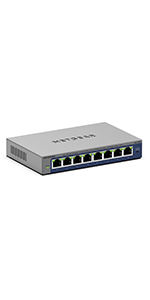
The NETGEAR GS105Ev2 is a 5-port Gigabit Ethernet smart managed switch designed for both novices and pros. It offers advanced VLAN configuration options, ProSAFE lifetime protection, and a durable metal build. Perfect for expanding home or small business networks, it delivers reliable, high-speed connectivity with effortless setup and silent operation.




| ASIN | B00HGLVZLY |
| Best Sellers Rank | #6 in Computer Networking Switches |
| Brand | NETGEAR |
| Built-In Media | dvd |
| Case Material Type | Plastic |
| Color | 5 port |
| Compatible Devices | Monitor |
| Customer Reviews | 4.7 out of 5 stars 2,299 Reviews |
| Data Transfer Rate | 1000 Megabits Per Second |
| Global Trade Identification Number | 10606449101512 |
| Included Components | dvd |
| Interface | RJ45 |
| Item Dimensions L x W x H | 3.7"L x 3.9"W x 1.06"H |
| Item Weight | 0.56 Pounds |
| Manufacturer | Netgear |
| Mfr Part Number | GS105E-200NAS |
| Model Number | GS105E-200NAS |
| Number of Ports | 5 |
| Platform | Not Machine Specific |
| Product Dimensions | 3.7"L x 3.9"W x 1.06"H |
| Switch Type | Managed |
| UPC | 606449101515 |
| Unit Count | 1.0 Count |
| Upper Temperature Rating | 122 Degrees Fahrenheit |
| Voltage | 12 Volts |
| Warranty Description | Lifetime |
M**K
Lots of VLAN configurability, stable performance
A professional network engineer might scoff at this "prosumer"-grade switch, but it does actually have a fair bit of flexibility in regard to its VLAN configuration, and you get a lot of bang for your buck. I bought it so I could connect two Internet gateways (a cable modem and an optical network terminal) to my router's single WAN port and two virtual LANs to my router's single LAN port. Despite the two passes that packets need to take through this switch on their way between the Internet and my LAN devices, I can still download the latest Chromium sources from Google at over 100 MiB/s (average over the course of a 2-GiB+ download) through my gigabit Internet link, so I know the switch matrix is doing a good job at keeping the crossing flows from colliding. To pull off having two gateways connected to one WAN port on my router, I have two 802.1Q-tagged virtual interfaces configured on my router's WAN interface with distinct tags that I assigned as the PVIDs of the two switch ports that the gateways plug into. Each of those two switch ports is configured to pass the traffic of its respective VLAN untagged since the cable modem and the ONT are not expecting 802.1Q-tagged Ethernet frames. Then the switch port that is connected to my router's WAN port is configured as a member of both of the gateway VLANs and is configured to pass their traffic with tags so that my router can run its two virtual interfaces on its one WAN port. That switch port has its PVID set to a throwaway VLAN (of which no other ports are members) so that any untagged traffic coming from the router's WAN port will be thrown away and will not leak to the remaining five switch ports that connect my internal LAN. Those other five switch ports, which I use for my LAN, are members of two more VLANs, one of which is set as their PVID, meaning any untagged traffic they receive gets assigned into that VLAN, and also they are configured to pass any traffic on that VLAN in untagged frames. The other VLAN is for my isolated Internet-of-Things network so I can have remote Wi-Fi access points hosting a dedicated SSID just for my IoT devices. The LAN switch ports are configured to pass traffic on the IoT VLAN using tagged frames, so the IoT network is "invisible" to other switches and hosts unless they intentionally connect to it. The router's LAN port runs both the default (untagged) interface for the trusted VLAN and also an 802.1Q-tagged virtual interface for the IoT VLAN, and those two interfaces are addressed on separate subnets with some firewall rules to prevent IoT devices from connecting to trusted devices, but trusted devices can connect to IoT devices (to command them, read status, etc.). The reason I described my complex setup here is so you could get an idea of how much flexibility this switch offers. Sure, it may not have the kind of Cisco-esque management console that network engineers are trained to endure/love, but the switch's web interface is actually shockingly capable of configuring almost any bizarre VLAN arrangement that you can imagine. And there are actually three other VLAN configuration modes that I did not even describe: a basic port-based mode, an advanced port-based mode, and a basic 802.1Q mode. (I use the advanced 802.1Q mode.) As far as the physical build of this switch goes, it looks and feels exactly as you would expect a Netgear desktop switch to look and feel if you are at all familiar with them. It's a sleek metal slab with a line of Ethernet ports along the front edge and a 12V DC barrel jack on the rear. Each port has two LEDs that show link speed/status and activity, so you get your typical blinkenlights show. The 12V input is nice because it allows me to put this switch on my 12V battery backup along with my router and my two gateway devices. The four devices will easily run for many hours in a power outage. As for reliability, I have never had this switch hang or lose performance with prolonged use. It runs silently for months to years with no intervention required. It just works, even despite the crazy configuration I gave it. I have no complaints at all.
N**M
Perfect & Powerfuml Switch for non tech folks
This is a perfect switch if you want to expand your home or small business network. If you want to plug in multiple devices to your existing network then this device is for you. I am giving this product a 5 stars for the reason below: 1. Plug and Play. Absolutely no programming or setup required. 2. Percect device for novices users and non IT/computer users like me. Again...no setup required. Just plug in your devices and you will be automatically connected to your LAN. 3. Excellent quality build. The entire unit looks and feel high quality. Case is metal and device is heavy. No cheap plastic and lightweight feel. 4. Netgear is a reliable and makes excellent switches. I have a 10/100Mbs 5 port netgear switch that I bought in 1999 to use in my college dorm to get multiple computers to a single network port in my dorm. I still have this switch 18yrs later and it is still 100% operational. In matter of fact I bought this 8 port to replace my 18yrs old switch. I am only upgrading because i wanted 1000Mbs speee and more ports. Some misc tips for novices/non tech folks. 1. If your house is built after 2004 and was originally wired for telephone lines throughout your house then you already probably got either cat5e or cat6 cables installed already. Electrician will use cat5e/cat6 cables to wire your house for telephone use because they are just as cheap as regular telephone line and more readily avaiable. Therefore, no need to run ethernet cables. Just pull apart your telephone wall plates and verify. I hope this review helps.
M**.
Port mirroring/sniffing on a budget
It's an 8-port gigabit switch with all the standards, and does its job on that front. Reasonably sized, fast as far as I can tell, sturdy metal case, nice looking, just like all "Pro" Netgear switches have been for many years. What this one has that others don't are management features that you usually need to spend WAY more to get. In particular, though, you can set it up to mirror traffic from one port to another, which is absolutely critical if you want to use Wireshark or the like to sniff packets between two devices that can't run a packet sniffer. Port mirroring is not something most people need, but if you *do* then this switch does exactly what you need, it does it well, it does it in a tiny package, and it does it for hundreds of dollars less than most managed switches. The absolute perfect tool for budget network debugging or (in my case) for taking out into the field to put between two things and figure out what's not working.
M**.
2016 Best home office network switch
After a few exchanges, I’ve finally found the best home office network switch and I’m excited to share my findings: The NETGEAR ProSAFE GS108E 8-Port Gigabit Web Managed Switch and here’s why. 8-Ports: Spend the extra cost and reserve it for the future, you may not have use for the extra ports now, but you will eventually. I ended up buying two of these GS108E’s and already found use connecting additional devices (wired is always better than WiFi). Build Quality: The fact that this is fanless and energy efficient (max <4.08W + auto power-down) is huge in my books, not to mention the sleek compact metal case for desktop or wall mounting. I found both TP-link and Linksys to be quite annoying with their power supplies – both brands seem to be using a low quality plug that emits an extremely high pitch noise. Price: The Unmanaged NETGEAR ProSAFE GS108 8-port kicks off at $44.21 ($34 after current rebate), which is an absolute deal compared to the GS105 5-port ($42) and the “low quality” TP-link 8-port ($24). Remember, you get what you pay for! The Managed GS108 8-port (from the intro) starts at $52.26 ($37.26 after current rebate) is a no brainer for the extra “$13' from TP-link, and for an extra “$3' to get managed is a great deal. The managed is nice to have for future use, but the unmanaged is still sufficient. Web Managed: The GS108E Plus (managed) has a very simple and easy to use web interface. Not that I’m using any of the managed functions / controls just yet, but it again will be reserved in the future for i.e. setting priority on ports for home TVs, VoIP; rate limiting; vlan; etc.. See my full review @ [...]
I**D
You need to understand how to set it up and the manufacturer instructions are not very good on this
We bought this Netgear GS105Ev2, firmware version 1.6.0.3, to work as an inline packet sniffer. It was cheaper than the purpose built inline sniffers, which were running about $100. It does work as a sniffer, but there are some non-obvious setup steps. It does work as a span port or mirror port device. You need an inline packet sniffer when you need to see the network traffic to troubleshoot, but can not, or should not, install a packet sniffer on the device you are trying to troubleshoot. IoT things are a prime example. To start, you need to get into the switch’s management interface. I used the web interface. Assuming the switch is in it’s default configuration, plug your computer into any port and configure your network card with an IP of 192.168.0.238 and a subnet mask of 255.255.255.0. None of the other settings need be set. Go to http://192.168.0.239 in any web browser. Enter the password (default: password). Please change the password if you plan on using this as a normal switch. These instructions assume the device whose traffic you want to capture is plugged into port 1 and the sniffing device, such as a laptop, will be plugged into port 5. I highly advise you label these. Because most laptops can’t capture more than about 80Mbps, under System → Management → Port Status, sent port 1 to 10M Full. Apply. Failure to do this can result in missing some traffic. Second, go to VLAN → Port Based → Advanced. Enable it. Apply. Create a VLAN 1 with ports 1, 2, 3, and 4 as members. Leave out port 5. Apply. This will reduce the broadcast traffic, which is mostly noise, sent to port 5. You will still see all the broadcast traffic that is sent to port 1. Finally, go to System → Monitoring → Mirroring. Set Mirroring to enable and Destination Port to 5. In the port check boxes, check only port 1. Apply. From now on, you plug the device whose traffic you want to capture into port 1, plug the cable from your main switch/router into port 2, 3, or 4, and plug your sniffer laptop into port 5. The laptop does not require an IP address (and won’t be able to talk on the network either). The switch will retain the settings if power cycled. You will also need two additional network cables to run this as a packet sniffer (not supplied). Update: It seems a modern laptop, not running much else, and using tshark to capture the packets can handle 1 Gbps rate. If these conditions are true, skip lowering port 1’s speed and leave it at auto. In testing, if you do lower port 1’s speed, you will get some “bad tcp” (tcp.analysis.flags filter in wireshark; the black lines). This is due to the lower speed. Leaving the speed at auto seems to almost completely eliminate that problem.
P**Y
Great switch for a simple network or VLAN environment
Great little switch. I bought the five-port model, and it's a nice small size that tucks behind keyboards and monitors no problem. I bought it specifically because I needed VLAN support, so while you can use it as a single-network switch, it also functions great in a multi-VLAN environment. Configuration is through a web GUI. The switch comes up at IP 192.168.0.239 by default, and I had trouble getting to the web GUI at this address until I downloaded Netgear's ProSAFE utility (free from their web site) and used it to connect to the switch and upgrade to firmware 1.4.0.6. Since upgrading firmware, I've had no trouble connecting to the switch. (If you don't need VLAN support or don't know what it is, you can skip this paragraph). In my network, I deployed over 20, with 5-7 VLANs untagged and tagged (802.1Q) depending on location. For example, we have port 1 configured with VLAN 1 (default) untagged and as PVID, and VLANs 20-70 tagged on an uplink to a larger distribution switch; ports 2-4 offer the needed VLANs untagged, and port 5 offers a subset of the VLANs tagged to a Ubiquiti wireless access point (for multiple wireless network access). You can configure VLANs four different ways, but as a Cisco/Juniper guy, I found the 802.1Q/Advanced path most familiar and capable for the project. With 20+ deployed, no DOAs, and no problems after several weeks. Solid little switch.
J**F
Just what I needed.
Probably a bit overkill to order the 8-port GS108Ev3 instead of the 5-port, but the price difference wasn't significant and I like having spare ports if needed later on. I bought this switch specifically to set up a couple of VLANs for work laptops to keep them off the primary network. So for right now, it's configured with a trunk port, 3 ports on VLAN1 for her work stuff, 3 ports on VLAN2 for my work stuff, and one leftover port on VLAN3 for switch administration and... I dunno, whatever else. I do wish Netgear would improve their configuration interfaces on these switches. I have their MS108EUP switch as well, and the config UI is so much nicer! But it's no big deal, usually you're just setting everything how you want it and rarely, if ever, going back to mess with it. As with most Netgear products, build quality is solid and I can expect this switch to last until the last remaining 1GbE device is retired from my network. Which will probably be a while.
G**H
Great for the office - recommend for heavy duty work environment.
Simple to use - just plug in and it works. We use these all over the office. I like the PRO series, as they are managed, and work great with the office PC's and PHONE systems. You connect them right into the network, they link up and work. Built to last!
Trustpilot
Hace 2 semanas
Hace 2 semanas