We remain fully operational. Our teams are working around the clock to ensure your deliveries continue safely.

Descargar la aplicación


Servicios al cliente
Sobre nosotros
Copyright © 2025 Desertcart Holdings Limited
Descargar la aplicación


🔥 See the unseen. Fix the future. 🔍
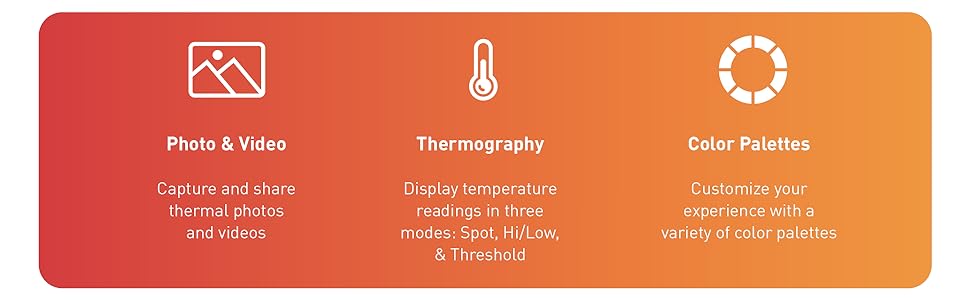
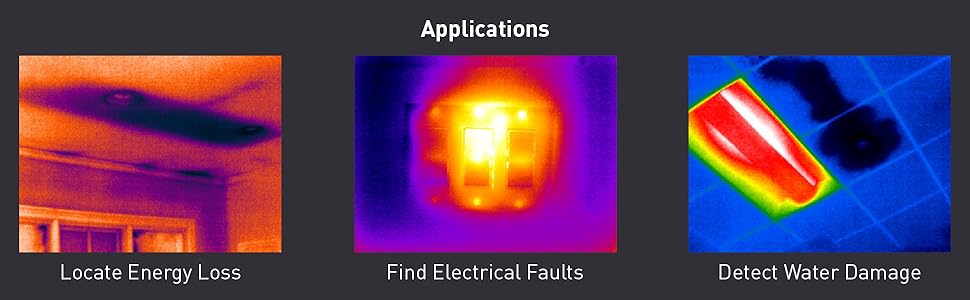
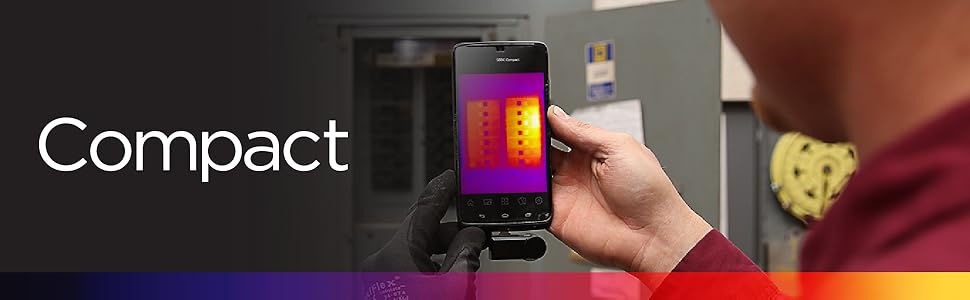
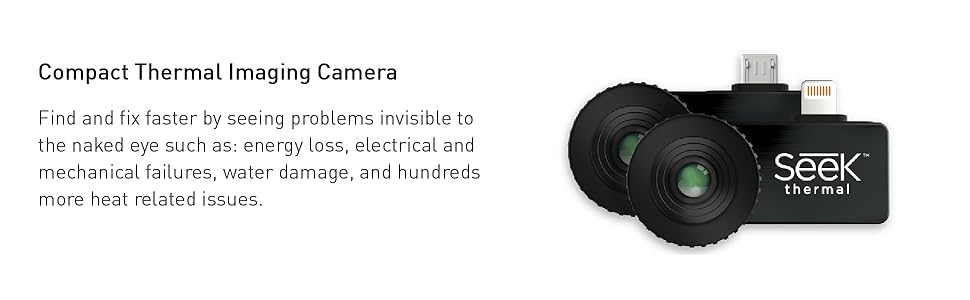
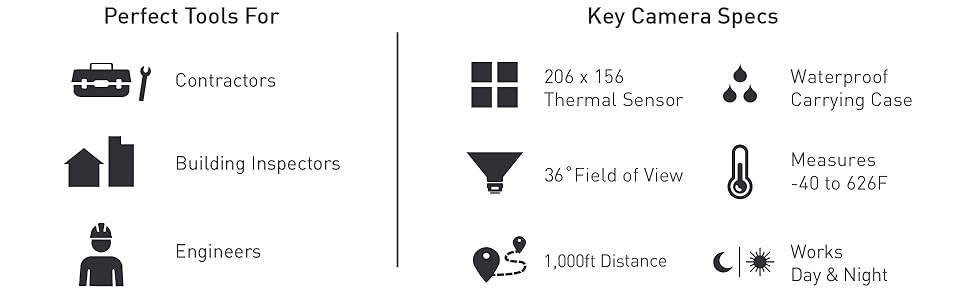
The Seek Thermal Compact is a cutting-edge Android-compatible thermal imaging camera featuring a 206x156 sensor, 36° field of view, and manual focus dial. It plugs directly into your smartphone’s MicroUSB port, requires no batteries, and comes with a waterproof carrying case. Ideal for professionals and DIYers alike, it detects heat-related issues like energy loss and water damage with 9 color palettes and multiple thermal modes, capturing both photos and videos at 9 frames per second. This compact, rugged device empowers users to uncover hidden problems quickly and efficiently, making it a must-have tool for modern home and jobsite diagnostics.
| ASIN | B00NYWAHHM |
| Aperture Modes | manual |
| Autofocus | No |
| Best Sellers Rank | #88,920 in Industrial & Scientific ( See Top 100 in Industrial & Scientific ) #57 in Thermal Imagers |
| Brand | Seek Thermal |
| Built-In Media | 206 x 156 Thermal Sensor, Waterproof Case Included |
| Camera Flash | no flash |
| Color | Black |
| Continuous shooting speed | 9 FPS |
| Customer Reviews | 3.8 out of 5 stars 1,300 Reviews |
| Effective Still Resolution | 32000 Pixels |
| Exposure Control Type | Manual |
| File Format | jpg, mp4 |
| Focal Length Description | Short focal length millimeters |
| Focus Type | Manual Focus |
| Global Trade Identification Number | 00855753005136, 05915903757935 |
| Image stabilization | No image stabilization |
| Item Type Name | Thermal imaging camera. |
| Item Weight | 0.23 Pounds |
| Light Sensitivity | High |
| Manufacturer | Seek Thermal |
| Maximum Focal Length | 9 Millimeters |
| Media Type | Image, Video |
| Model Name | UW-AAA |
| Real Angle of View | 36 Degrees |
| Sensor Type | Thermal |
| Shooting Modes | Spot Temperature, High-Low Modes, Temperature Threshold Mode |
| UPC | 855753005136 785497786490 |
| Unit Count | 1.0 Count |
| Video Capture Format | MP4 |
| Video Capture Resolution | 206 x 156 |
| Viewfinder Type | LCD screen |
| Warranty Description | 1 Year Warranty for Manufacturer Defects |
| Water Resistance Level | Waterproof |
| Zoom Type | Fixed |
R**G
Thrilled with the results I see so far
My experience with this *Seek Compact* version of the camera put my fears to rest and I'm thrilled! In 2020 I air-sealed my attic & basement rim joists. I then discovered that exterior insulation (under the vinyl exterior) was poorly installed. I looked at 6 more houses in other communities and found the same result...i.e. look "under the hood" of your house and you're likely to find crummy workmanship that reduces your energy efficiency. I want to kill drafts and save $$ heating/cooling my house (and my kids houses). Where to focus my effort? A thermal camera would help, but I can't afford a pro camera. So for 2-3 weeks I read dozens of reviews on affordable thermal cameras. This Seek camera stood out due to the many favorable reviews. I favored the Seek over its nearest competitor because Seek has the higher pixel count. I did hesitate 'cuz of reviews reviews saying: image quality is terrible; the camera won't work unless you register; the camera steals information. But some excellent reviews addressed these issues for me, so now I'll add my experience. It may help others who'll consider this for future purchase APP ACCESS TO PHONE: I did NOT need to give the Seek app access to my phone. I did NOT need to register the camera. Here's what I did. I dug up my 2014 LG G3 phone (no SIM card). I charged it, connected to a guest network, snapped the camera into the phone port and I installed the Seek Thermal app. Pop-up windows appeared asking for access to camera, photos, mic. **I denied access**. To my delight, the thermal camera image nevertheless appeared and I was quickly seeing images! Yes the Seek focus knob is a little tricky. It requires patience. When you change the focus knob you need to wait 2-4 seconds for the image to update. If you're not patient the focus knob could appear to be useless. I also adjust my range further/closer to the target of interest as part of my focusing process. Well, in less than 5 minutes I was getting the hang of it and could easily recognize my thermal images. This was especially true when I switched the color palette. For me, 'amber' screen images were very clear. Here's the limitation in my strategy. Because I denied app access on my phone I couldn't save thermal images as I walked around my house. For many uses that doesn't matter. Looking for a hot, or cold or wet spot? There it is - problem identified and you never needed to grant the app phone access or register the camera. But if you're surveying areas in your house like I am (for work when Spring returns) it could be cumbersome to record/diagram/inventory all the needs. You probably already saw that I attached pictures to this review, so yes, took the next step and gave the Seek app access to storage on my old LG G3. Then I could walk around cataloging areas that need work. When I stopped using the camera I disconnect it from the phone, powered off my G3 and put them both in a drawer. CAMERA FIT: I bought the older micro USB style. It snapped into my phone and is a very rugged connection. There's no danger of the camera falling out even if I shake the phone. It would require dropping the camera or solidly smacking the phone on something to dislodge the camera. I did have to remove the hard-shell case and rubber cover from my LG phone to fit the camera, but this is a minor issue. BATTERY LIFE: I agree that the camera is a battery drain. I walked around with the camera on for ~30 minutes and my phone battery went from 98% to 62%. Your experience will differ. For sure my 5+ year old G3 phone battery is nowhere near its original 3000mAh. May be best for you to guess you'll get an hour of power before your phone will need juice. Temperature accuracy: I brought a pot of water to boil on my stove and viewed thru the Seek compact camera. The imaging spot jumped around due to the rigorous boiling, and was reporting temperatures of 207-210 degF. Or, when I image a person, the camera shows readings of 96-97 degF. These are both more than good enough for the current and expected work I plan with this camera. IMAGES (attached) One pic is my fireplace. You can see logs in the fireplace. The heart-shaped glow centered above the fireplace is a hanging wreath at room temp (bright). You can see the horizontal mantle, the candles on the mantle and even draped decoration. Lower left corner reading of 78F is the edge of a charging plug. Another picture is of my front door - poor insulation around the door perimeter. The door window showed 57F. I have clear heat-shrink plastic insulation covering this window. The thin plastic insulation might be invisible to the Seek camera and it might be reading the temperature of the inside surface of that window. The high temp reading in the lower right corner is from an adjacent heat register. 3rd picture shows exterior wall next to my kitchen sink. Can you see the dish-drying rack, a coffee filter cone and a wall plug and power cord on the right? What troubles me is the dark blob that's about in the center of the pic. It's . the light/disposal switches. Even though I previously insulated that plate with 'foam pads' from a big box store and later w/Great Stuff, it's still really cold. The cold even 'flows' down the wall and chills my sink counter. The Seek compact reveals that there's ~6" x 4" section in the wall cavity that's missing insulation. The camera revealed 3 other exterior wall outlets in my kitchen with the same missing insulation defect. 4th picture is a section of exterior wall. Maybe you can ID what it shows without my description and then decide for yourself if the image quality from the camera is useful. I'm very happy with the performance/price ratio. Its' working really well and I anticipate getting lots of data that will direct my work to make my house more comfortable, less costly, and more environmentally green. Thanks again to the positive detailed reviews from people before me. Good luck to those of you considering this Seek compact camera..
G**O
Unbelievable value
I've been using thermal imagers professionally for about 30 years. This Seek unit isn't anywhere close to a state-of-the-art military/tactical, laboratory or commercial unit today. But, for a cheap, tiny plug-in for the bottom of my new Android phone, it's extremely impressive - I would have thought it had been delivered from an alien spaceship less than 10 years ago (By comparison, I've been expecting real smartphones since before the Apple Newton). I haven't really used its new near-price competition, the new FLIR C2 or the 2nd gen FLIR One extensively yet, but I'm far more impressed with this unit than the first generation FLIR One (iPhone 5 caddy form factor). Last year, I was impressed enough with the original FLIR One that I nearly bought an iPhone 5 just to get one (as much as I like and respect FLIR, I'm glad I decided to procrastinate). First, the image resolution: if you're used to multi-megapixel digital photo cameras, forget about it - that's not what you're getting with the Seek, or any other thermal in a price range less than a Tesla (or two or three, or twenty). Thermal is about 20 years behind that, dollar for dollar (image worse than the first Nikon digital I bought back in '93-'94). However, the resolution is about four times what you'd get with the 1st gen FLIR One's Lepton imager. The Seek image is very, very pixelated, and the long time constant video averaging requires one to hold it it very steady or the image will smear (think 1/4 - 1/2 second hand-held still exposure steady on a conventional camera). Unlike FLIR's visual/thermal overlay (patented MSX), Seek requires you to swipe back and forth between the thermal and the camera's visual camera images in the app. You can capture visual or thermal, or half and half, but not one on top of the other. The result is a better thermal image and a better visual image on the Seek that may not look quite as good as the FLIR's MSX overlay as a captured snapshot. Some of my colleagues think the FLIR MSX approach is better at this price point. I disagree for now, but I can understand their argument. Having a pretty low general opinion of the current state of what passes for software engineering, and even lower of Android apps, I can say that the Seek app is better than most Android apps I've used, especially at this level of maturity and adoption (its adoption isn't even a rounding error compared to a Google app). It installed cleanly on my new Moto G 2nd gen with Lollipop (the cheapest smartphone platform I could find that might support it, as my previous Nexus 4 would not). It hasn't crashed or locked-up, and it cleanly sends captured images to G-mail or Bluetooth. The visual/thermal swap feature is useful, as are the various color palates ("Iron" looks cool on ads, and in reports, but I've always used gray scale for serious work). I don't like the inability to set gain or freeze the AGC (something the new FLIR's app can apparently do), but I can live with that at this price point (for the time being). Thermal differential sensitivity in a low contrast scene seems to be pretty good - I'll take Seek's claim of about 0.1 degrees C as about right. I don't expect this to be a calibrated radiometer, or to use it as a substitute for a high quality imager for point medical screening, so I'm not going to get wrapped-up with actual vs. reported temperature values in the app (and no one wants to read a discourse on emissivity variations). I hope Seek (and FLIR) will have emissivity adjustments and calibration methods in the not-too-distant future (and some education, as I see a lot of misunderstanding and inflated expectation in some of the posts/reviews). As a usability note: I lucked out with the Moto G 2nd gen; it wasn't listed as "supported" when I bought it, although the 1st gen G was, as was the Moto X, 1st and 2nd gen. I also lucked out that the USB is oriented in a way that the Moto's visual camera is pointed in the same direction as the Seek, so that a back-and-forth overlay or split is easy. Not sure I'd be quite as happy if I found that I had to use one of the extension USB cables to orient it with one hand, while holding the phone with the other. Finally, the imager comes with a cute, really well-designed and constructed hard little carrying case. I can thrown it in my briefcase, backpack or cargo pant pocket, and not even think about it. Nice touch! Bottom line: for those with a realistic understanding of the current state-of-the-art, this is amazing. If you want to get into the world of thermal imaging at a really reasonable price point, or you're just looking for a cool toy that's about the same price as a high-end 802.11 AC router, it's worth giving this a try. If you wait six months or a year, there will probably be something better. But, you'd probably still be using a typewriter and a Western Electric phone if that was the #1 consideration.
A**R
Junk... from start to finish...
This was a huge let down. I wanted to love this product but it really disappointed me. Just to be clear, I am reviewing the most expensive variant, the UQ-AAA Compactpro for Android (the one with the red color around the lens). I want to be clear on this because it could be easy for someone to think my comments are related to the cheaper versions... since they look so similar. I have a Note 9, so I knew I needed a high end (not the cheap ones you can find) adapter to go from the device's Micro-USB to the newer USB-C that the newer phones have. I also knew I didn't want to be constantly taking my heavy duty case off the phone, so the adapter made tons of sense all around. While inconvenient, that was really on me and not the product. However, I went through 3 different adapters and couldn't get it to work with my high end Note 9 (product fail #1) despite the website indicating that with an adapter, USB-C phones should work. Plan B was to use my perfectly working Note 4 which has a Micro-USB port. So after taking the Otterbox case off, it took forever for the app to recognize the camera (product fail #2) with a phone that was supposedly fully compatible. When it did, the picture quality was really bad. It was very hard to make out any shapes or outlines unless the temperature gradient was significant (like a human, animal, heat vent, etc.). I came to realize that the missing "visible spectrum" lens that the Flir competitor uses is actually very needed here to make out objects in homes. Let me be clear THE PICTURES THIS COMPANY POSTS ON THE DESCRIPTION IN AMAZON ARE NOT REAL. I think that's my biggest gripe, are these blatantly misleading pictures that SEEK is using on the Amazon product pages. It shows very clear electical panels and industrial looking ductwork pictures with the temp gradient as well. YOU WILL NOT GET THAT QUALITY OF PICTURE. Without the second camera lens that the Flir product has, you only get blobs of color for 70 percent of the time. Once I had resigned myself to the lackluster picture... the next day the camera stopped giving correct temperatures. So now I have a really bad picture with temp readings that are complete nonsense. For example, I was attempting to see how much heat I was losing out of my gas fireplace, so I looked at it through the camera. It was telling me that the tile around the fireplace was 5-15 degrees farenheit (yes... I double checked to make sure it didn't mysteriously flip to celcius) but those temperatures weren't possible. It was about 38 degrees outside and 65 degrees inside, so there was no way for the reading to be correct. I moved it over to my hand and it showed about 80 degrees farenheit, but when I went back to the fireplace it went back to 15 degrees. I tried it on my son's room and everything in there hovered around 40-50 degrees, which again wasn't right. I reinstalled the app but nothing changed. I mean it's great in theory to have a -40 to 600 degree range, but when the product can't execute at room temperature who really cares about that right? I reached out to the manufacturer website and emailed them. Their response was the final straw that told me to send it back. They told me to check my security settings on my phone to make sure there wasn't an issue (didn't bother to explain to me what settings they were even referencing) and if not then to "talk to Amazon because it sounds like you may have a defective camera". Ya think? Since when does the manufacturer tell me to take it up with the store instead of fixing/replacing their product??? I was done with this company at that point. I packaged the camera up and sent it back less than a week after I received it. Piece of junk. Pros: - Its small and comes with a carrying case. Ok... that's it. That's all I can come up with. While it does have other potential advantages over the comparable Flir model, one of that matters because it doesn't actually work well. Cons: cons: -Horrible picture quality, even in the $365 top of the line model. - The app is absolute trash. It's not user friendly and is essentially one big sales pitch to get you to buy something else. - Temperatures are bogus and misleading - Website compatibility information is trash and isn't correct. Don't buy this product! I'll be purchasing a Flir top model once Amazon credits my account for the return. I should have gone with the industry leader to begin with.
H**O
Surprisingly good for the price
The Seek Thermal Compact and Seek Thermal XR are amazing devices with low prices that bring thermal imaging within reach of an entirely new audience. I have used both and would only recommend the XR with its much narrower 20 deg field of view for uses such as augmenting a scope. The standard Thermal Compact with its 36 degree field of view is great for general use and a much better choice. Pros: 206 x 156 resolution (actual pixels in thermal sensor chip, much more than its closest competitor). Wide measurement range: -40 to +626 deg F. (much wider than its closest competitor). Powered from your phone, lasts as long as your phone battery. Software features multiple color palettes, still and movie modes. You can have spot/high-low/or selectable temperature emphasis shown. Cons: Cost savings are achieved by using a different lens material than high quality cameras. Appears to be less sensitive to small temperature differences than expensive cameras. No adjustment to calibrate for emissivity, making this more of a hobbyist device than a professional tool. Side by side display with visible/IR images in same frame is not as useful as competitor's overlay. This device does what it advertises and for a great price. Unfortunately some people who buy it will have unrealistic expectations fostered by TV show images of people moving inside buildings, etc. (those are fake). The surface temperature indicated is affected greatly by the material doing the emitting of the infrared. Shiny materials emit the worst and at some point become mostly reflectors/mirrors, leaving you trying to measure the "color" of a mirror. Don't bother buying this device to see inside buildings or cars. Ordinary window glass is completely opaque to far infrared. We can use IR to measure temperature because the amount of IR emitted is directly related to temperature, but it's related to a lot of other things too. Professionals can train for years to interpret IR images, and the answer to "can I see moisture in my roof" and similar questions must be a resounding "maybe". Most importantly, for a good image there must be a difference of temperature across the scene to provide contrast. If you live somewhere that the inside and outside temperatures are almost the same, don't expect to see the rafters in your ceiling. On the other hand when it's below zero outside and 70 degrees inside you will get a very good picture of where your insulation is weak. If you have a use for it, or $200 to spend on a fun toy, the Seek is a great value. If you don't have a real use for it, unless you are a serious imaging geek you may tire of it fairly quickly.
J**R
Great unit but glitchy video
I found this unit on sale at Low es hardware for about 200. The unit works great for most things. In the correct mode it will take a dual picture with your phone camera and the thermal camera however because they are not perfectly aligned and not of the same quality the pictures will not be perfect. I have not tested the flir yet but it has both thermal and regular camera to make sure the images are perfectly aligned. The first problem I found is that the thermal picture is fuzzy but this is easy to adjust. The camera lense has to be manually twisted to give a nice focused picture. I found one critical problem with this unit(minus 2 stars). When you are using the unit the shutter will activate about every 1 second causing the image to stop and wait for maybe 1/10 of a second. This is not horrible except for it constantly clicks on then off. When taking video this becomes a problem because for several frames the image is frozen and then when it unfreezes the video jumps. Attached if the video of the problem. I exchanged my unit for another one to try to resolve the issue but it had the same problem.
J**S
Very Pleased With Purchase - Works Great with Galaxy Note 8 Running Android Oreo
I read quite a few reviews here before purchasing, got the Seek Thermal Compact imager with some uncertainties, but have been VERY HAPPY with my purchase. The Seek Thermal Compact works VERY WELL with my Galaxy Note 8 phone. I've had no problems with the phone quickly detecting the device inserted into the USB-C port via an adapter or in using the app (see the official Seek answer in the Questions section here on which adapters work-I got recommended Weduda brand). My only regrets are that the device is not offered with a USB-C connector and that it takes some practice to learn how to focus the thermal image: you need something with good contrast to focus effectively and I often look around for something a similar distance away to focus on before taking a picture of the area that I want. The side-by-side optical image vs. thermal image part of the app works OK and allows you to simultaneously take separate optical vs. thermal images of an area with one screen tap to help you remember later what the thermal image is all about-taking notes is highly recommended, too! Only problem is that thermal image is quite a bit telephoto as compared to my standard Note 8 camera magnification and the two images are off-center relative to one another as the thermal camera is mounted on the opposite end of the phone (top) as compared to the Seek device plugged into the USB-C port via an adapter at least 6-inches away from the Note 8 camera lens. I got the device to hunt for a roof leak and because of the app's automatic color range adjustment, it's quite sensitive detecting areas that are a few degrees cooler than their surrounding due to water evaporation. Thermal images do seem a little noisy and if you don't look out for stray fingers at the periphery of camera view, a hot little finger inadvertently left in lens view can distort the color differences you want to capture as the heat of a finger puts everything else at the bottom of the thermal scale in a normal ambient environment. As another reviewer pointed out, if you stand someplace in barefeet for a couple of minutes, the device is sensitive enough to see the thermal footprints you left when you move away from the spot! Besides homing in on my leaky roof problem with the device, I'm sure that I'll find plenty of uses for checking for thermal leaks in our insulation come the winter months and trust that the device will more than pay for itself when used in that regard. I have several infrared thermometer guns but they don't come close to giving you the big picture as this device literally does, while also allowing you to view difficult to reach places like vault ceilings - the Seek Thermal Compact is accurate to within 0.5 to 1.0 deg F of the best-selling thermal gun that I got on Amazon when tested on a number of objects around the house - and this is without any adjustment for thermal emissivity, which you can only do on the much more (~2x) expensive Thermal Compact Pro. I got the Compact version vs. the XR version for the Compact's 36 degree field of view vs. the much more limited 20 degree view offered by the XR - and Seek's own literature recommends the Compact or the Pro for use inside a house over the XR. Otherwise, in a tight space, you could find yourself unable to get back far enough to take in the big picture - but you can usually move closer to narrow the field of view if needed. The attached pictures show simultanous thermal/optical photos of a water leak area in our bedroom ceiling and also of our cat on the family room floor. The fifth picture, taken from further away in the bedroom, shows how some part of the leak seems to run down a seam in the sheetrock before it exits into our bedroom below! Last picture is wife sleeping in bed with only arms and head outside of covers. So, great thermal imager for its price (and if used with the right USB-C adapter and up-to-date Android phone). P.S. Seek should make the compact plastic carrying case big enough to hold the imager when a USB-C to micro adapter is attached. The fit of the Weduda adapter is very tight-which is good-you don't want the Seek device to fall off your phone! But once you have the USB-C adapter on the thermal imager, it no longer fits in its nice little plastic carrying case. What I did instead was cut a larger slot out of the box the imager came in so I can store and carry the imager with USB-C adapter always attached. Bit afraid I'll damage or wear out the connector/imager is I am constantly trying to attach and remove the USB-C adapter. Better yet, for future purchasers, Seek should make a device with a straight USB-C connector. Get with the times!
V**D
Useful tool for electronics work
Thermal cameras are quite helpful in electronics work, to spot an overheated component on a PCB or observe general operating temperatures. This camera holds its own quite well, and for this purpose is a good value compared to the higher end models. Resolution is excellent for a camera in this price range, frame rate and overall performance are good, and the design of the Android app is OK, if a bit spammy. As noted in other reviews, the app does request a lot of rather spurious looking Android permissions, and refuses to run if you don't grant them. A quick security monitoring session reveals that it does generate a bit of traffic to "phone home" servers, probably accumulating usage stats and such. It does not seem to routinely transmit photos or personal content to the servers, though the license agreement seems to imply that the company might claim the right to do that. The Android version requires a phone with a MicroUSB port, if you have a newer phone with USB-C you must use an adapter that supports USB-OTG (many of the cheaper adapters do not.) Another potential caveat on Android is that on some phones the USB port faces the wrong way, so you get a thermal selfie cam. You want the narrower side of the MicroUSB toward the screen of the phone. Not a problem with USB-C as it's generally reversible, though some of the cheap adapters might not be wired correctly for that. There are also a couple of interesting projects developing Windows and Linux drivers, some of which use software processing to enhance the image well beyond stock quality. Sophisticated users might take a look.
D**D
Great value compared to pro cameras. Better than expected
I was a little unsure about the value and quality of the product before I ordered it. Mostly I was worried about it being poor quality because of the low price compared to professional IR cameras. After I spent some time using it in different situations, I' very happy with it and really enjoy using it. First of all, the quality of the sensor and sensitivity exceeds my expectations. It really picks up very small differences in temperature. For example if you stand on the ground barefoot for 10 seconds and walk away, the camera will see your 'heat footprint' on the ground! It will visually show warmer areas very clearly that would be impossible to feel with your hands. But also very large differences and very high temperatures are no problem. You can aim it at a pan while you are cooking and it will show the heat pattern well. You can even overlay a temperature measurement spot which is pretty accurate. Since it works based on hear radiation, not on visible light, it doesn't matter if you are in bright daylight or in total darkness. You this camera sees it temperature, not light. Apart from being a cool thing to have, it has many very good uses. For example you can see where electrical devices produce heat, you can see where windows, door or walls have leaks that let heat or cold air through. It is very helpful seeing if there are wasteful electronic devices that produce wasted heat even when turned off. If you aim it at your tires after you drive, it will show you if the wheels need alignment based on the heat pattern on the tire. You can check if electrical wires get hot with use. You can see animals or people in complete darkness. I got the Android version and using it with a Galaxy S5. It works perfectly without any issues. Plug in the camera, start the app, that's it. You can takes stills and video. Overlay temperature and slide between the normal camera and the IR camera. The resolution of the camera is limited but since we are looking at temperature, a lower resolution is totally fine. The photos and videos are saved to your normal image gallery. You can also share them directly from the app. So far no crashes or issues. The only thing I noticed is when looking at a photo and then wanting to switching back to the IR camera, it is better to use the phone's 'back' button rather than the app's [X] button. It sometimes doesn't activate the camera if you use the X. It will drain your battery much faster than normal use of the phone which is expected as it needs to power the external camera. You can't charge the phone and have the IR camera connected as they use the same USB port. The camera comes with a small protective case which is very useful! Overall I'm really happy with it. I think it's a great quality camera for the relatively low price and an excellent value compared to professional alternatives. It works well and it works all the time, no issues here on my Galaxy S5.
Trustpilot
Hace 2 meses
Hace 2 semanas