We remain fully operational. Our teams are working around the clock to ensure your deliveries continue safely.

Descargar la aplicación


Servicios al cliente
Sobre nosotros
Copyright © 2025 Desertcart Holdings Limited
Descargar la aplicación
Buy anything from 5,000+ international stores. One checkout price. No surprise fees. Join 2M+ shoppers on Desertcart.
Desertcart purchases this item on your behalf and handles shipping, customs, and support to Colombia.
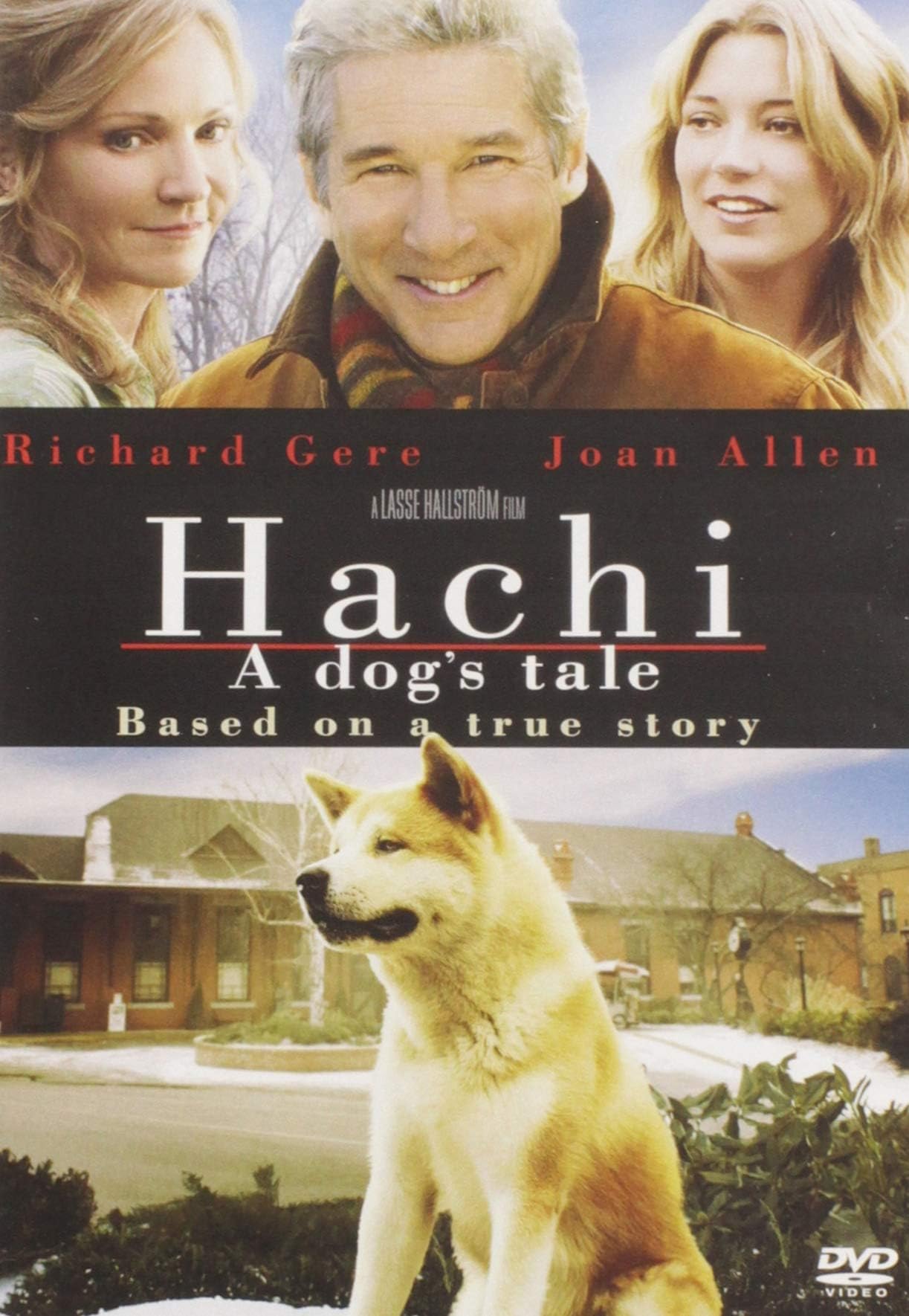
Product Description From Academy Award®-nominated director Lasse Hallström (2000, The Cider House Rules) comes HACHI: A DOG?S TALE, a film based on one of the most treasured and heartwarming true stories ever told. Golden Globe winner Richard Gere (2002, Best Actor in a Musical or Comedy, Chicago) and Academy Award® nominee Joan Allen (2000, Best Actress, The Contender) star in this inspiring true story. desertcart.com Based on a true story from Japan, Hachi: A Dog's Tale is a moving film about loyalty and the rare, invincible bonds that occasionally form almost instantaneously in the most unlikely places. College professor Parker Wilson (Richard Gere) finds a young Akita puppy that's been abandoned at the local train station, and he's instantly captivated by the dog. Assuming the dog's owner will return to the train station to claim him in the morning, Parker takes the puppy home overnight. But when no one comes to get the dog, Parker convinces his wife, Cate (Joan Allen), to welcome him as part of the family. He dubs the puppy Hachiko--Hachi, for short--because of the Japanese symbol for good luck that's hanging from his collar. Hachi is a somewhat peculiar dog that refuses to learn to fetch or master other people-pleasing tricks, but he is a faithful companion and friend to Parker, alerting him of potential dangers and accompanying him to the train station each morning and meeting him there after his return trip each evening. An unforeseen event will continually test Hachi's devotion. This film is neither overwrought nor sappy; it is heartfelt and immensely powerful despite its tendency to drag in a few places. Prepare to be moved to tears by this beautiful, seemingly simple film--it's about so much more than just the relationship between a man and his dog. --Tami Horiuchi Review: An unforgettable tale of animal love and loyalty - Hachi: A Dog’s Tale (2009) is a true dog story. No, no — not a bad movie, it’s a great movie, a truly great movie. Truly, and true to the real-life story of a Japanese Hachi-Ko who lived in an earlier century. Truly a dog story, because it is all about a dog, not just about the people who lived with the dog, as most “dog stories” are. If you love dogs, the images of Hachi are irresistible. And a truly great movie, for many reasons. The imagery is simply gorgeous. The acting superb, all around. The musical score hauntingly unforgettable. The screenplay well paced, avoiding over-sentimentality in a story that has to bring tears to the eyes of any red-blooded person. It is a movie that works on many levels. For its purely sentimental plot about a dog who never gave up loving his master, it conveys the story effectively such that any child can enjoy. (And the plot is framed by the telling of the young boy who has grown up hearing the story, and now is telling it to his classmates at school.) This is where its charm as a true dog story is unparalleled. On another level, it is a re-make of the Japanese film (1987) entitled Hachiko Monogatari, which is based more literally upon the life of the original Hachi-Ko. The Japanese film interprets his life story as a morality tale, in sombre tones of reproach for all the failures of human actors who fail Hachi in some way. The American re-make inverts the dark tone, translating it into a kinder, gentler tale. Love abounds in the life of this dog. Half of the film depicts the joyous companionship of the music professor and his dog. The professor and his wife enjoy a happy, loving marriage, and secondary characters are also portrayed in warm tones. An interesting technique is to visualize Hachi’s perspective towards humans in nearly colorless images, whereas the human perspective contrasts in full color. We see Hachi lying in his back yard while the professor’s wife tends to her garden. Hachi watches her. He rolls over onto his side, seeing her image with gravity on one side. Then rolls onto his back, seeing her completely upside down. Is this just to drive home the issue of contrasting viewpoints as it relates to the morality of this tale? Or is it also to reveal how an uncritical mind accepts reality, as Hachi sees it, and not just as a human mind expects to see it? There is a critical scene at the center of the movie, where a Japanese guru-figure reads briefly at the graveside, speaking of a philosophy of unconditional love and unconditional acceptance. I cannot help but see the morality of this film in the context of this scene, which is probably too fleeting (my only criticism of the film). Hachi accepts unconditionally what his master can give to him, limited as it has to be; he sees life just as it is. But Hachi loves totally and gives himself without limitation. The professor too accepts Hachi’s unwillingness to play fetch, no matter how much he wishes for his dog to make him happy in this token way — until the final day, when Hachi seems to have forewarning of his master’s death, and he begs him to stay home and cavorts with him, fetching ball for the first and only time. When the professor falls in an apparent heart attack, he drops that ball he has been holding. At this deeper level, in my understanding of the story, there is again the failing of secondary human characters to fully engage Hachi, in the unconditional terms portrayed in the relationship of Hachi and his master. After her father’s death, the professor’s daughter sincerely offers Hachi a home, but she cannot fulfill her commitment completely. Her family has to come first. At least she has the understanding to give Hachi her permission to leave, to live on the streets, free to live out his own imperative. And so do others, allowing Hachi to do what he has to do. The shift of seasons through the years, the flow of life, passes gently. Only the hotdog stand owner comes close to standing by his promise to look after the dog as Hachi pursues his lonely life, waiting. So Hachi waits, for 10 years, and only in his final moments of transcendental imagination experiences his reunion with the man whom he has always loved and will always love. It is easy for me to transpose Hachi’s morality tale to my own life. I have never lived with a dog, but with many cats. The meaning is the same. Animals are capable of an unconditional love which humans find difficult to emulate. We can only go so far in devoting our lives to them, as they devote themselves to us. It is with that knowledge, and that ultimate regret, that I will leave the rest unspoken. Review: All the more special because it is based on true story - This film is wonderfully shot, includes subtle symbolism in the scenes (hint: look at the train station decorations and time on the clock near the very end of the movie) and is probably the most pure, simple and emotional movie I have ever seen. I don't understand why this great film was not promoted more and/or did not get a good solid American release. I would not even have known about it unless I saw it on the New Releases for Blockbuster. It was filmed in early 2008, released in Japan in August 2009 ..... then simply placed on the "Direct to DVD" market here in the USA. I never heard anything about this movie even being made until stumbling across it by chance luck. A great and well done movie like this deserved better promotion and press treatment. It is a shame because many people may miss out on this film. I can only guess that budget over runs and limited financing left no money in the budget for advertising after the filming was done ? Anybody know ? Or are American audience now only fascinated with fancy CGI visual effects "eye candy" and no story ? In either case ... This movie deserved and still deserves more attention ! So on to the movie itself ... A tough guy like me does not usually get choked up over movies, but here is one I can recommend to you that will probably touch you. It is based on a true story from Japan ... although this version with Richard Gere has been shifted to USA. Basically this is the story if you don't already know it. WARNING SPOILER BELOW ........ ......... ............ .......... A college professor had a dog that was loyal to him. Each day it would follow him to the train station where he left for work. The dog would run around and do whatever all day long. But at 5:00 in the evening the dog was always back at the train station to meet his owner. This went on for years, One day the dog was waiting at the train station, but the professor never showed up. The professor had died of a heart attack at the school campus that day. For the next 9 years, the dog kept waiting and looking for it's owner at the train station everyday. Other people would try to take the dog home, but every time the dog would run away and return to the train station trying to wait for the professor. He became a local legend and the other people at the train station each day would bring the dog food and water to take care of him since the dog refused to leave his post. Eventually 9 years later the dog died, still sitting at the train station watching the people get off every train, looking for his owner. Today in Japan where this really happened they have a bronze statue of the dog sitting in the train station as a tribute to that kind of loyalty. ......... .......... ......... ......... END OF SPOILER I suppose the reason I found this particular story touching enough to even put a lump in my throat was two reasons .. 1) I have always thought there is something innocent and pure about an animals loyalty and affections that is rare in humans. 2) When I was young and walking to elementary school, my friend had a dog named Pal. He would follow us when we walked the 2 miles to school. He would wait for us all day long. I can remember sitting in classes and looking out the window and seeing that dog under a tree looking at the school building and waiting for us to get out. When we got out of class in the afternoon he would be all excited and come running to meet us and follow us home again. This went on for around 2 years as I recall. But one day when we got out of school, the dog was all excited to see us and came running across the parking lot. We started yelling "NO PAL. STOP" But it did not help. Pal ran in front of a school bus in the parking lot. Now being older and wiser, I look back at this story from childhood and think .......... Yes, it is a cute story about boys and their dogs growing up together. But the real world is not the 1800 or early 1900s of farmhouses, dirt roads and horse & buggies anymore. The world is an urban , mechanized jungle that is dangerous for loosely roaming animals. If people really care about their animals they should not let them run around loose all day long to get hit by cars or other dangers. This is one of those rare movies you see in life that will leave an impression. Well done to everybody who worked on this project !

| ASIN | B0031RAOVY |
| Actors | Cary-Hiroyuki Tagawa, Erick Avari, Joan Allen, Richard Gere, Sarah Roemer |
| Aspect Ratio | 1.85:1 |
| Best Sellers Rank | #3,860 in Movies & TV ( See Top 100 in Movies & TV ) #369 in Kids & Family DVDs |
| Customer Reviews | 4.8 4.8 out of 5 stars (20,314) |
| Director | Lasse Hallstrom, Lasse Hallström |
| Is Discontinued By Manufacturer | No |
| Item model number | 043396321403 |
| Language | Unqualified |
| MPAA rating | G (General Audience) |
| Media Format | DVD |
| Number of discs | 1 |
| Producers | Bill Johnson, Richard Gere, Vicki Shigekuni Wong |
| Product Dimensions | 7.5 x 5.25 x 0.5 inches; 2.4 ounces |
| Release date | March 9, 2010 |
| Run time | 1 hour and 33 minutes |
| Studio | Sony Pictures Home Entertainment |
| Subtitles: | English |
J**S
An unforgettable tale of animal love and loyalty
Hachi: A Dog’s Tale (2009) is a true dog story. No, no — not a bad movie, it’s a great movie, a truly great movie. Truly, and true to the real-life story of a Japanese Hachi-Ko who lived in an earlier century. Truly a dog story, because it is all about a dog, not just about the people who lived with the dog, as most “dog stories” are. If you love dogs, the images of Hachi are irresistible. And a truly great movie, for many reasons. The imagery is simply gorgeous. The acting superb, all around. The musical score hauntingly unforgettable. The screenplay well paced, avoiding over-sentimentality in a story that has to bring tears to the eyes of any red-blooded person. It is a movie that works on many levels. For its purely sentimental plot about a dog who never gave up loving his master, it conveys the story effectively such that any child can enjoy. (And the plot is framed by the telling of the young boy who has grown up hearing the story, and now is telling it to his classmates at school.) This is where its charm as a true dog story is unparalleled. On another level, it is a re-make of the Japanese film (1987) entitled Hachiko Monogatari, which is based more literally upon the life of the original Hachi-Ko. The Japanese film interprets his life story as a morality tale, in sombre tones of reproach for all the failures of human actors who fail Hachi in some way. The American re-make inverts the dark tone, translating it into a kinder, gentler tale. Love abounds in the life of this dog. Half of the film depicts the joyous companionship of the music professor and his dog. The professor and his wife enjoy a happy, loving marriage, and secondary characters are also portrayed in warm tones. An interesting technique is to visualize Hachi’s perspective towards humans in nearly colorless images, whereas the human perspective contrasts in full color. We see Hachi lying in his back yard while the professor’s wife tends to her garden. Hachi watches her. He rolls over onto his side, seeing her image with gravity on one side. Then rolls onto his back, seeing her completely upside down. Is this just to drive home the issue of contrasting viewpoints as it relates to the morality of this tale? Or is it also to reveal how an uncritical mind accepts reality, as Hachi sees it, and not just as a human mind expects to see it? There is a critical scene at the center of the movie, where a Japanese guru-figure reads briefly at the graveside, speaking of a philosophy of unconditional love and unconditional acceptance. I cannot help but see the morality of this film in the context of this scene, which is probably too fleeting (my only criticism of the film). Hachi accepts unconditionally what his master can give to him, limited as it has to be; he sees life just as it is. But Hachi loves totally and gives himself without limitation. The professor too accepts Hachi’s unwillingness to play fetch, no matter how much he wishes for his dog to make him happy in this token way — until the final day, when Hachi seems to have forewarning of his master’s death, and he begs him to stay home and cavorts with him, fetching ball for the first and only time. When the professor falls in an apparent heart attack, he drops that ball he has been holding. At this deeper level, in my understanding of the story, there is again the failing of secondary human characters to fully engage Hachi, in the unconditional terms portrayed in the relationship of Hachi and his master. After her father’s death, the professor’s daughter sincerely offers Hachi a home, but she cannot fulfill her commitment completely. Her family has to come first. At least she has the understanding to give Hachi her permission to leave, to live on the streets, free to live out his own imperative. And so do others, allowing Hachi to do what he has to do. The shift of seasons through the years, the flow of life, passes gently. Only the hotdog stand owner comes close to standing by his promise to look after the dog as Hachi pursues his lonely life, waiting. So Hachi waits, for 10 years, and only in his final moments of transcendental imagination experiences his reunion with the man whom he has always loved and will always love. It is easy for me to transpose Hachi’s morality tale to my own life. I have never lived with a dog, but with many cats. The meaning is the same. Animals are capable of an unconditional love which humans find difficult to emulate. We can only go so far in devoting our lives to them, as they devote themselves to us. It is with that knowledge, and that ultimate regret, that I will leave the rest unspoken.
M**R
All the more special because it is based on true story
This film is wonderfully shot, includes subtle symbolism in the scenes (hint: look at the train station decorations and time on the clock near the very end of the movie) and is probably the most pure, simple and emotional movie I have ever seen. I don't understand why this great film was not promoted more and/or did not get a good solid American release. I would not even have known about it unless I saw it on the New Releases for Blockbuster. It was filmed in early 2008, released in Japan in August 2009 ..... then simply placed on the "Direct to DVD" market here in the USA. I never heard anything about this movie even being made until stumbling across it by chance luck. A great and well done movie like this deserved better promotion and press treatment. It is a shame because many people may miss out on this film. I can only guess that budget over runs and limited financing left no money in the budget for advertising after the filming was done ? Anybody know ? Or are American audience now only fascinated with fancy CGI visual effects "eye candy" and no story ? In either case ... This movie deserved and still deserves more attention ! So on to the movie itself ... A tough guy like me does not usually get choked up over movies, but here is one I can recommend to you that will probably touch you. It is based on a true story from Japan ... although this version with Richard Gere has been shifted to USA. Basically this is the story if you don't already know it. WARNING SPOILER BELOW ........ ......... ............ .......... A college professor had a dog that was loyal to him. Each day it would follow him to the train station where he left for work. The dog would run around and do whatever all day long. But at 5:00 in the evening the dog was always back at the train station to meet his owner. This went on for years, One day the dog was waiting at the train station, but the professor never showed up. The professor had died of a heart attack at the school campus that day. For the next 9 years, the dog kept waiting and looking for it's owner at the train station everyday. Other people would try to take the dog home, but every time the dog would run away and return to the train station trying to wait for the professor. He became a local legend and the other people at the train station each day would bring the dog food and water to take care of him since the dog refused to leave his post. Eventually 9 years later the dog died, still sitting at the train station watching the people get off every train, looking for his owner. Today in Japan where this really happened they have a bronze statue of the dog sitting in the train station as a tribute to that kind of loyalty. ......... .......... ......... ......... END OF SPOILER I suppose the reason I found this particular story touching enough to even put a lump in my throat was two reasons .. 1) I have always thought there is something innocent and pure about an animals loyalty and affections that is rare in humans. 2) When I was young and walking to elementary school, my friend had a dog named Pal. He would follow us when we walked the 2 miles to school. He would wait for us all day long. I can remember sitting in classes and looking out the window and seeing that dog under a tree looking at the school building and waiting for us to get out. When we got out of class in the afternoon he would be all excited and come running to meet us and follow us home again. This went on for around 2 years as I recall. But one day when we got out of school, the dog was all excited to see us and came running across the parking lot. We started yelling "NO PAL. STOP" But it did not help. Pal ran in front of a school bus in the parking lot. Now being older and wiser, I look back at this story from childhood and think .......... Yes, it is a cute story about boys and their dogs growing up together. But the real world is not the 1800 or early 1900s of farmhouses, dirt roads and horse & buggies anymore. The world is an urban , mechanized jungle that is dangerous for loosely roaming animals. If people really care about their animals they should not let them run around loose all day long to get hit by cars or other dangers. This is one of those rare movies you see in life that will leave an impression. Well done to everybody who worked on this project !
G**L
Excelente película si te gusta el género y buen servicio de entrega.
S**S
Hachiko. Film stupendo. Ma che dico, meraviglioso, toccante, indimenticabile. Chi ama gli animali e in particolar modo i cani non puo' restare impassibile davanti a questa storia. Sceneggiato alla perfezione e recitato perfettamente da Richard Gere e Joan Allen. Un film che è un colpo al cuore. Com'è noto, la storia è basata su fatti realmente accaduti ma ciò che il regista e l'intero cast sono riusciti a fare al meglio è trasmettere le emozioni non solo dei personaggi umani ma anche dei protagonisti a quattro zampe, si perché Haci lo vediamo cucciolo, poi adolescente e anziano. Ho pianto come un bambino durante la lunga straziante sequenza finale. Haci che si addormenta e rivede il suo amato padrone. Pochi film riescono ad emozionarmi così tanto. Potessi darei 10 stelle. Grande plauso va anche alla colonna sonora, una musica bellissima e struggente che tocca l'anima di chi ama la natura e gli animali tutti. Il messaggio potente che questo film ci lascia è che l'amore tra un cane e il proprio padrone può essere indissolubile e superare perfino i confini dell'esistenza terrena. Ed io ci credo, credo che nell'aldilà potremo ritrovare in Dio anche le creature che ci hanno fatto compagnia in questa vita. Qualità video e audio eccellenti. Spedizione velocissima.
T**.
Ein Film der nach einer wahren Geschichte entstanden ist.
S**I
Excellent picture quality and quick delivery by Aum Entertainment. Great experience.
こ**き
良い話です
Trustpilot
Hace 3 semanas
Hace 2 semanas