We remain fully operational. Our teams are working around the clock to ensure your deliveries continue safely.

Descargar la aplicación


Servicios al cliente
Sobre nosotros
Copyright © 2025 Desertcart Holdings Limited
Descargar la aplicación


Buy anything from 5,000+ international stores. One checkout price. No surprise fees. Join 2M+ shoppers on Desertcart.
Desertcart purchases this item on your behalf and handles shipping, customs, and support to Colombia.
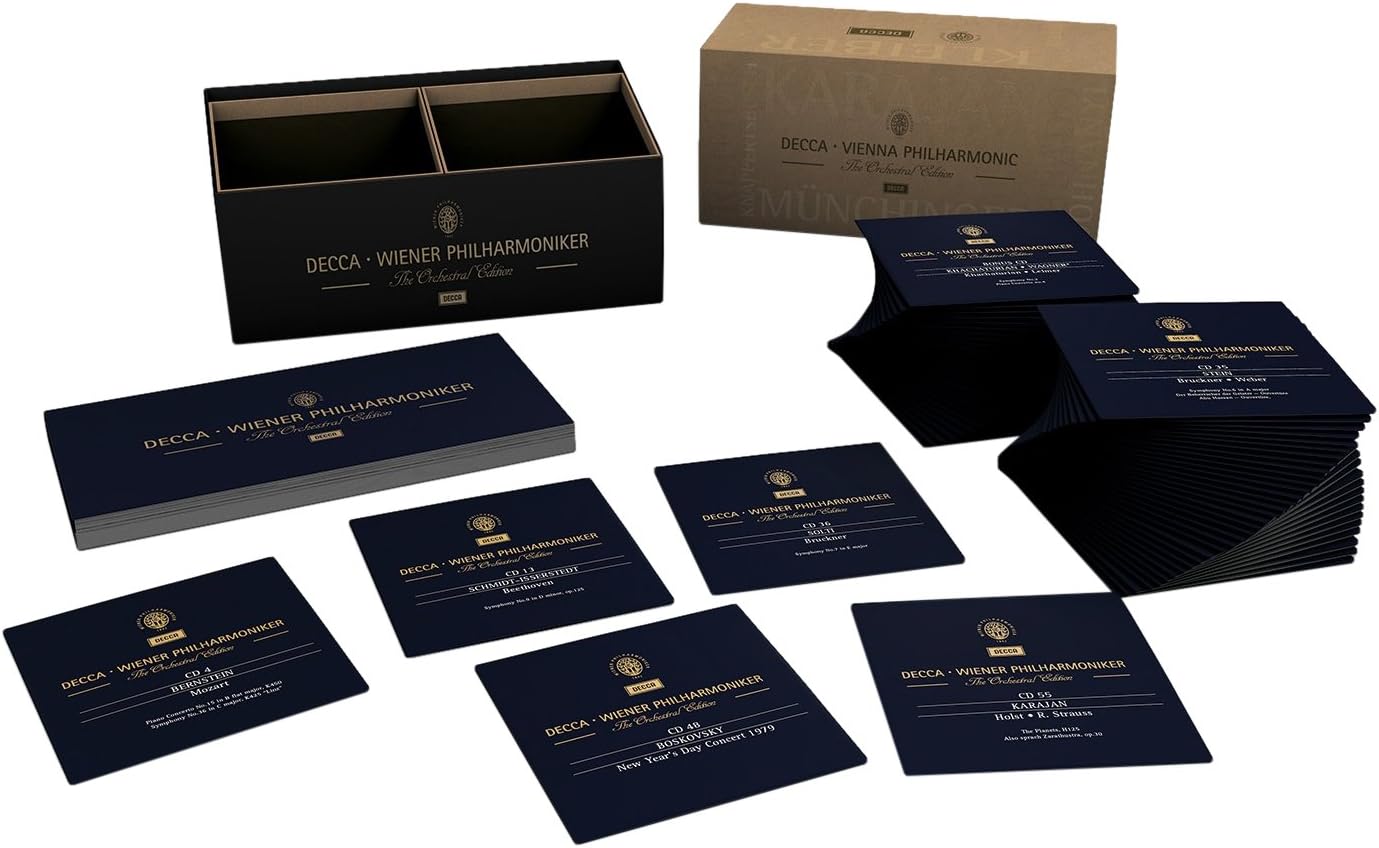
Product Description PRESENTATION & PACKAGINGChampagne style box - lift off lid, with luxury gold-wrap outer box;Black and gold CD wallets, with recordings arranged chronologically by composer, starting with Haydn and ending with Khachaturian and Kodály); 200pp softcover perfect-bound book, approx. 200mm x 110mm, landscape orientation. FIVE essays are provided, each of approx. 1500 words, respectively by Dr. Silvia Kargl of the Wiener Philharmoniker Historisches Archiv, by long-term Decca producers Christopher Raeburn, Erik Smith and John Culshaw, and by Paul Moseley/Raymond McGill of Decca;All note content in English, German and Japanese.The book presents the majority of the original album sleeves, as well as photographic images, contracts and even letters, all of which together offer a comprehensive overview of the Decca-WP relationship across several decades.Designed and art directed by UMGIs Matt Read, whose work for Decca includes the remarkable Solti / Ring Deluxe Edition of 2012 and the Britten Complete Works of 2013, among many others. Conductors including: Abbado, Bernstein, Boskovsky, Boult, Bohm, Chailly, Dohnányi, Dorati, Haitink, Karajan, Kertesz, Kondrashin, Khachaturian, Kleiber, Knappertsbusch, Krauss, Krips, Kubelik, Maazel, Mehta, Monteux , Münchinger, Reiner, Schmidt-Isserstedt, Schuricht, Stein, Solti, Szell, WalterPianists: Gulda, Backhaus, Curzon, Ashkenazy, Schiff THE PROPOSITION64 CDs of orchestral and concerto recordings, starting 64 years ago, handsomely presented and imaginatively curated. A document of a label-orchestra relationship, of famous venues and of the art of classical recording. Few labels can claim to be so associated with a city as inextricably as Decca is with Vienna. No history of classical recordings would be complete without a chapter documenting how both Decca and the WP worked to perfect the art of recording in the citys great concert halls, most notably in the famous Sofiensaal. Classic Recordings:Bruno WALTER Mahler Das Lied von der Erde (1952)Erich KLEIBER - Beethoven Eroica Symphony (1959)Pierre MONTEUX Haydn Recordings (1960)Herbert von KARAJAN - Beethoven, Holst and Richard Strauss RecordingsKarl BÖHM - Bruckner Symphony No. 3 (1970) & Symphony No. 4 (1974), Four Last Songs (Lisa Della Casa, 1953)Sir Georg SOLTI - Verdi Requiem (1968)Zubin MEHTA - Mahler Symphony No. 2 (1975) Sir Charles MACKERRAS and Richard CHAILLY - Janácek RecordingsClemens KRAUSS Richard Strauss RecordingsGeorge SZELL - Beethoven Egmont (1970)Willi BOSKOVSKY Johann Strauss / New Year s Concert (1979) Includes THREE complete symphonic cycles:BEETHOVEN Monteux, Kleiber, Schmidt-Isserstedt, Solti, AbbadoBRAHMS Mehta, Schuricht, Böhm, KerteszBRUCKNER Mehta, Abbado, Solti, Stein, Maazel, Böhm (this is WPs only complete Bruckner cycle, recorded 1965-1974) 5 Perspectives producers, archivists and record executives from Vienna and London. Dr. Silvia Kargl (WP Archivist) documents the orchestras unparalleled tradition. Three essays by the three great Decca producers Christopher Raeburn, Erik Smith and John Culshaw add the perspective of engineers, producers and executives, while Raymond McGill (Catalogue Consultant) and Paul Moseley (MD Decca Classics) tell it from today s viewpoint.A document of a tradition. As long-term Decca producer Christopher Raeburn summarises: There is a definite tradition in Viennese playing and interpretation as exemplified by the Vienna Philharmonic, and the collaboration with DECCA has done much to preserve this quality. Review To my ear, in the right conditions and with the right conductor, it is the best orchestra in the world... --John Culshaw, Decca ProducerThe glory of this version stems from the quality of the playing, its refinement in every department, the glow of tone encouraged by the acoustic of the Sofiensaal, Decca's regular venue in Vienna, and the flexible, lyrical style which comes naturally to Viennese performers. --Gramophone (original review) on Mahler Symphony No. 2 (MehtaThe VPO plays with towering commitment and the recording further helps to convey the sense of the music's vaulted splendour. --Gramophone on Bruckner Symphony No. 4 (BöhmThe glory of this version stems from the quality of the playing, its refinement in every department, the glow of tone encouraged by the acoustic of the Sofiensaal, Decca's regular venue in Vienna, and the flexible, lyrical style which comes naturally to Viennese performers. --Gramophone (original review) on Mahler Symphony No. 2 (MehtaThe VPO plays with towering commitment and the recording further helps to convey the sense of the music's vaulted splendour. --Gramophone on Bruckner Symphony No. 4 (BöhmThe glory of this version stems from the quality of the playing, its refinement in every department, the glow of tone encouraged by the acoustic of the Sofiensaal, Decca's regular venue in Vienna, and the flexible, lyrical style which comes naturally to Viennese performers. --Gramophone (original review) on Mahler Symphony No. 2 (MehtaThe VPO plays with towering commitment and the recording further helps to convey the sense of the music's vaulted splendour. --Gramophone on Bruckner Symphony No. 4 (BöhmThe glory of this version stems from the quality of the playing, its refinement in every department, the glow of tone encouraged by the acoustic of the Sofiensaal, Decca's regular venue in Vienna, and the flexible, lyrical style which comes naturally to Viennese performers. --Gramophone (original review) on Mahler Symphony No. 2 (MehtaThe VPO plays with towering commitment and the recording further helps to convey the sense of the music's vaulted splendour. --Gramophone on Bruckner Symphony No. 4 (Böhm Review: Opened it to find a most beautiful presentation box - Just received the purchase this afternoon. Opened it to find a most beautiful presentation box! The contents of this box is truly extraordinary. The conductors listed are indeed the finest in the recording history of this great orchestra. The individual cardboard paper sleeves are dark with gold lettering. The book is gorgeous as well. A very sophisticated box on every level. This is very nostalgic, as I grew up listening to the conductors included in this collection. A world renown orchestra as well! Listening to cd #61 which contains Janacek. A marvelous recording. Treat yourself to this beautiful testament of great artistry that is the VIENNA PHILHARMONIC, I have several box sets but none have moved me the way this box does. Review: Great Classical Collection - I am still working my way through this collection and thoroughly enjoy it. The sonics are fine and the performances so far wonderful. Years ago when CDs first came out the high prices limited most collections. Now one can easily afford the best music the world has ever created. With pop given over to low quality streaming we can keep the wonders of inexpensive great classic music out own secret. Compared to most low cost collections the packaging is a cut above.
| ASIN | B00M8PBQT4 |
| Best Sellers Rank | #648,359 in CDs & Vinyl ( See Top 100 in CDs & Vinyl ) #96,859 in Classical (CDs & Vinyl) |
| Customer Reviews | 4.6 4.6 out of 5 stars (39) |
| Date First Available | August 13, 2014 |
| Is Discontinued By Manufacturer | No |
| Label | Decca |
| Language | English |
| Manufacturer | Decca |
| Number of discs | 65 |
| Product Dimensions | 5.59 x 0.39 x 4.92 inches; 3.53 ounces |
P**B
Opened it to find a most beautiful presentation box
Just received the purchase this afternoon. Opened it to find a most beautiful presentation box! The contents of this box is truly extraordinary. The conductors listed are indeed the finest in the recording history of this great orchestra. The individual cardboard paper sleeves are dark with gold lettering. The book is gorgeous as well. A very sophisticated box on every level. This is very nostalgic, as I grew up listening to the conductors included in this collection. A world renown orchestra as well! Listening to cd #61 which contains Janacek. A marvelous recording. Treat yourself to this beautiful testament of great artistry that is the VIENNA PHILHARMONIC, I have several box sets but none have moved me the way this box does.
K**R
Great Classical Collection
I am still working my way through this collection and thoroughly enjoy it. The sonics are fine and the performances so far wonderful. Years ago when CDs first came out the high prices limited most collections. Now one can easily afford the best music the world has ever created. With pop given over to low quality streaming we can keep the wonders of inexpensive great classic music out own secret. Compared to most low cost collections the packaging is a cut above.
C**N
WOW!
WOW! Great to have these recordings, however would have liked other recordings included. Beggars can't be choosers I suppose
K**L
Desert Island box set
Disclaimer: I have not yet heard all of this box set yet. I have sampled about 30% of the music so far and on the basis of that sampling I strongly recommend this magnificent collection of wonderful performances by a preeminent world class orchestra. A look at the description of the contents of this set will reveal a wide selection of musical works by many composers. And direction of the orchestra by some of the world's most respected conductors. Much of the standard classical repertoire is here along with many lesser known orchestral pieces by Russian and Eastern European composers. The performances include some fascinating vocal pieces in additional to the strictly orchestral works. The packaging is very high quality and sturdy. The book is a valuable informative resource and guide to the original recordings contained in the set including album cover art. This is a great addition to any music lover library. If you buy it you will keep it and take it to that desert island with you. Highly recommended.
T**E
Five Stars
This is a real treasure trove of magnificent recordings!
R**L
Great collection.
You get a lot for your money with this wonderful CD collection.
P**T
One of the great music collection.
Good set. I recommend every classic music lovers
F**V
The symphonies were excellent -- performance-wise and sound-wise
I agree with the previously posted review of this magnificent box set. I've been progressing through the discs in no particular order, though I did start out with disc number 1, which presented three Haydn symphonies, two of my favorites -- the "Surprise" and the "Clock" -- conducted by Pierre Monteux, a French conductor not known for Haydn interpretations. The symphonies were excellent -- performance-wise and sound-wise. It proved an inviting start through the journey that is this stellar box set. (By the way, the third Haydn symphony on disc 1 is the "London" conducted by Karajan in March, 1959, a time when that conductor was not known for the oddities that plague his later digital era recordings.) Highlights abound through this set. Notable are the two Mahler "Das Lied von der Erde" recordings, both essential, one by Bruno Walter and the other by Leonard Bernstein. I've long cherished both on LP and now it's good to have them on CD. There are also complete symphony sets of Beethoven, Brahms, and Bruckner by notable conductors as Monteux, E Klieber, Schmidt-Isserstedt, Solti, and Abbado in the Beethoven; Mehta, Schuricht, Böhm, and Kertész in the Brahms; and Abbado, Böhm, Maazel, Solti, Mehta, and Horst Stein in the Bruckner. The music ranges from the classical period with generous samplings of Haydn, Mozart, and Cherubini, through the Romantic period -- Schubert, Schumann, Mendelssohn, Liszt, Wagner, Mahler, into the twentieth century with works from Sibelius, R Strauss, Holst, Schoenberg, Berg, Bartok, Boris Blacher, and Korngold. As well, for those who enjoy it, there is quite a generous dose of "light Viennese classics" from the likes of Eduard Strauss, Johann Strauss I and II, Joseph Strauss, and Nicolai. And so much more. Most remarkable, though, is that every recording I've sampled -- and thus far that has included some two dozen of the discs -- proved wonderful. (The pizzicato string movement of Tchaikovsky's Fourth Symphony under Maazel was stunning!) You can't really go wrong with this eclectic set, whether you're new to classical music and are looking for a good sampler collection, or whether you're an old hand at this and want to fill gaps in an already well established collection -- someone like me. Everyone is sure to find much to revel about in this set of Wiener Philharmoniker discs. (I'm looking forward to hearing Mehta's reading of Franz Schmidt's Symphony No. 4 and Gottfried von Einem's "Philadelphia Symphony", both on CD 39.) Did I mention that all five of Beethoven's Piano Concerti are included, too? Featuring Ashkenazy, Gulda, and Curzon! And Dvorak's Ninth is represented in two recordings, one by Kertész, the other by Kondrashin. And the 109 page booklet accompanying the set and providing information on the recordings and artists and cover art and recording process is a real plus to the collection. About my only complaint is that the booklet fits so well into its special pocket in the box shell that I have just a bit of trouble extracting it. But the content makes any struggle well worth the trouble. So, what are you waiting for? If you enjoy classical music and want to hear it from the instruments of some of the best musicians who ever gathered to make a band -- the Wiener Philharmoniker -- and what a band it is! -- you gotta get this. Me? I think I'll listen next to Mackerras's reading of Janáček's "Taras Bulba". Or maybe Solti's go at Elgar's "Enigma Variations". Or ... Did I mention that the biggest problem you'll have with this set is deciding what to listen to next?
U**R
I have found that these box sets produce gems you would not thought of buying. Or introduces you to composers you have not heard before, or different interpretations by conductors of the past you have missed. Some of you may think, I have some of these CDs, I will not buy this box, but there are those of us, who may have half the box but will still buy it. Also, the box is cheap, just over a pound a CD. (BELOW MY REVIEWS OF THE CDs). The tough cardboard gold coloured lid covers the entire box. Some of the conductors names stand out because it looks as if gold dust has been sprinkled over the great names.The wording is in black. The box is black and made of tough cardboard, with the name Decca: Wiener Philharmoniker- The Orchestral edition printed on it. Can we expect a opera Edition? There are two gold boxes inside the main box, you can pull them out individually. This is a different concept where the box set is concerned, where the sleeves are placed inside them. Overall the box is sophisticated looking, it has style and that is what makes it stand out. Yet the box is not too large, or long. The sleeves are black with the Decca: Wiener Philhamoniker in Gold. Below CD number, conductor, composer and music to be played in white, on the back are the track numbers and music. The CD is a dull gold colour, with lettering in black, CD number, conductor and composer. The 195 page booklet has a thin cardboard cover, but inside, the Index of works. For example, Adam. Giselle-Karajan. CD 43, track number 1-19. Pictures of conductors, orchestra, musicians, soloists in black and white, also some in colour photographs. The music: CD number, conductor, track numbers, recording date and location, and pictures of the CD sleeves. Essays: Decca and the Philharmonic. 125 years of the VPO by John Culshaw. The Vienna Philharmonic Exclusively with Decca. Recording with the Vienna Philharmonic Orchestra. Decca in Vienna. Translated into German. The sound. All I can find is 'partly remastered' on the publicity sticker, placed on the plastic covering the box. But this does not explain which ones are remastered, but you can tell after listening to them. They are MONO, Stereo or DDD, after all this is Decca and they are renowned for good sound. I have only placed MONO, not Stereo next to the music to be played. There are bonus's in this box set. There is no CD ROM with translations, nor are there any in the booklet. But you can find them on www.deccaclassics.com/vpo so the booklet states at the back. History in this box set. I bought this Decca Vienna Philharmonic 64 CD set, celebrating the 64 year old collaboration with Decca, so it becomes a companion with the Berlin Philharmonic 100 year collaboration with DGG. This set contained Furtwangler and Nikisch (1855-1922) CD's. He changed conducting completely, and has had an influence even up to the present. Hungarian Nikisch,(not in this box set) was a mentor of Boult and Reiner who taught Bernstein, also he was the only role model for Furtwangler (not in this box set) who inspired Abbado, Metha and Von Karajan. (See my review, Furtwangler's Legacy- Membran 107 CDs). Nikisch was a role model for Monteux who taught Maazel, but the Hungarian conductor also inspired fellow countrymen, Szell, Kertesz and Solti. Nikisch was the major influence on Clemens Krauss who was friendly with R. Strauss. Also, when Wilhelm Backhaus (1884-1969) was a boy, his talent was spotted by Athur Nikisch. The pianist studied at the Leipzig Conservatory, then took private lessions with D' Albert in Frankfurt. As a boy of 10 his parents took him to hear both of Brahms piano concerto's performed by D'Albert and conducted by BRAHMS! Hans Knappertsbusch (1885-1965) assisted Siegfried Wagner, and Hans Richter at Bayreuth. The latter had conducted the premiere of the Ring cycle in 1876 at Bayreuth, two symphonies by Brahms, two by Bruckner and one by Dvorak and Elgar. Clemens Krauss conducted the Premiere of Richard Strauss's Die Liebe der Danae and wrote the Libretto for Richard Strauss's Capriccio. Bohm knew R.Strauss very well and the composer dedicated his opera Daphne to him. Kirsten Flagstad (1885-1962) a Norwegian, took over from Frieda Lieder in 1935 at the Met, and became an overnight success in Die Walkure as Sieglinde. Flagstad sung the Premiere of the Four Last songs with conductor Furtwangler, after the composer R.Strauss died.(recording released by Testament) Bruno Walter was an assistant conductor under Mahler. So as you can read there is a lot of History in this box set. I shall go across the page, placing the composer first, date recorded. Put MONO where I can. The rest are Stereo or DDD. Music, conductor, then reviews and comments, plus CDs that might be useful to you. I have reviewed most of the CDs, a few I have left out. HAYDN: (1959) Symphony No 94 'Surprise', No 101 'The clock', cond Monteux. He turns his genial eye on a genial composer. There is a delicious Andante in the Surprise and the final is played with vigor. The second movement of the Clock is swift. Symphony 104 cond Von Karajan. There is plenty of earthy energy in the outer movements. (1974) Missa brevis Sancti Jonnis de Deo. Kleine Orgel Messe No 7.Cond Munchinger's performance is good, and Ameling in the Bendictus is appealing. (1967) Die Schopfung Part 1. Had Haydn not lived 19th century music would not have followed the course it did. He was the first to realize the symphonies potential, also he extended the Sonata's form and virtually created the String quartet. But the composer was the first to use folk music and dancing in his serious and religious works. (If interested read my review of The Haydn edition 150 CDs- released by Brilliant). Part 2. Die Schopfung. Spoorenberg, Ameling, Krenn, Krause. A fine performance from Munchinger who has rarely conducted with such electric tension. The soloists are good. MOZART: (1966) Piano Concerto No 15 K 450. In the concerto Bernstein enjoy's himself as if he was on holiday. Symphony No 36 K 425 " Linz". Bernstein piano and conductor.(1964). Somehow in this performance there is a carefree quality that we hear from Bernstein in the Concert Hall. Piano concerto No 23 K 488. Piano Concerto No 27 K 595.Cond Szell, Piano Curzon.(1962) The conductors tempi is swift and Curzon plays with finesse. Clarinet Concerto K622. Flute and Harp Concerto K 299 Cond Munchinger.(1959). Refinement and beauty of tone and phrase are a hall mark, throughout, and Munchinger provides a most sensitive accompaniment. Symphony No 40 K550 Cond Von Karajan.(1991) LIVE. Requiem cond Solti. In a new edition by H.C. Robbins Landon. Auger, Bartoli, Cole, Pape. Prayers are said during this Mass to commemorate the 200th anniversary of Mozart's death. Swift tempi and singers are outstanding. (Read my review Von Karajan 1938-1960 117 CDs collection. Membran.) BEETHOVEN:(1960) Symphony No 1 and 6.(1958) Cond Monteux. The conductor steers an ideal course, not underestimating neither the weight, nor making the music heavy. (1968 and 1968) Symphony No 2 and 4.(1966). Cond Schmidt-Isserstedt. Tempi swift in the movements that require it. (1956) MONO Symphony No 3.Cond Erich Kleiber father of Carlos. (1954) Leonora Overture No 2 & 3. Fidelio Overture.Very fast tempi. Cond Clemens Krauss. (1958)Symphony No 5 and 7.(1958) Solti gives a big bold reading of the No 5, tense but not neurotic and a really joyful account of the final. In the 7th the conductor is immensely powerful and brings out the dancelike qualities of the music. (1968) Symphony No 8 cond Abbado. Swift tempi.(1969) BRUCKNER: No 1 symphony ( Linz edition 1866) Cond Abbado. BEETHOVEN:(1965) Symphony No 9. Cond Schmidt-Isserstedt. Sutherland, Horne, King and Tavela. A ninth to live with. By far the best singing. It is the conductors intensely beautiful performance of the slow movement which more then anything else wins you over to this performance.(1951) MONO. Piano concerto No 1- Piano, Gulda.(1953) BRAHMS: Piano concerto No 1 piano Wilhelm Backhaus. Cond Bohm. A fine performance by Backhaus, who saw Brahms conduct his two concerto's when a boy of 10.(1971) BEETHOVEN: Piano Concerto No 3 & 4 Cond Stein. Gulda- Piano.(1957) BEETHOVEN: Piano Concerto No 5. Cond Knappersbusch. Curzon- piano. The recording, one of Decca's earliest stereo issues. Curzon is a refined, thoughtful reading of the Emperor. Swift tempi from Knappersbusch. (1958)TCHAIKOVSKY: Piano Concerto No 1 Cond Solti. Curzon, as always, plays thoughtfully and intelligently. Solti's opening is quick which suits Curzon. A fine recording. A gem. (1995) DDD. BEETHOVEN: String Quartet in F minor, op 95. Arranged for string orchestra by Gustav Mahler. BRAHMS: Piano Quartet in G minor op 25. Orchestrated by Arnold Schoenberg. Cond Dohnanyi. (1969) BEETHOVEN: Complete incidental music to Egmont. Pilar Lorengar, Wussow narrator cond Szell. His conducting is superb. The whole given a flowing dramatic impact. Lorengar sings movingly. SCHUBERT:(1969) Symphony No 8. "Unfinished'. Cond Krips. A gentle, glowing performance.(1974) Rosamunde: Incidental music. Rohangiz Yachmi contralto. A magical first choice. Admirable freshness and good contribution from the soloist. Munchinger at his best.(1967) WEBER: Preciosa overture. SCHUMANN: Genoveva overture. CHERUBINI: Anacreon Overture. SCHUBERT:(1981) Symphony No 9 'the great.' One of Solti's happiest and most glowing of all his Many CD's. An outstanding version. (1993) LIVE. MENDELSSOHN: Symphony No 4. "Italian'. Its melodies Dance and tempi are swift. Cond Solti. (1979) No 3 'Scottish'. Athalie. (1976) The first Walpurgis Night. Litowa-Mezzo. Labenthal tenor. Krause baritone. Cond Dohnanyi (1969) SCHUMANN: Overture, Scherzo and Finale. Symphony No 1 'Spring'. Symphony No 2. Cond Solti. A magnificent performance of Schumann's No 2, the composers least popular symphony. Glows with Viennese warmth. BRAHMS:(1976) Symphony No 1 Cond Metha. He brings substance to the symphony. WAGNER: Parsival Prelude Act 1. BRAHMS: (1953) MONO Symphony No 2 Cond Schuricht. Fast tempi. One of the best versions around. As a conductor Schuricht (1880-1965) was considered a master conductor like Klemperer and Knappertsbusch.(1952) Piano Concerto No 2. Piano- Backhaus. Cond Schuricht. He usually conducted second tier orchestras and was of a retiring nature, and he did not record a lot. BRAHMS: Symphony No 3. Cond Bohm who made a mess of it, too slow.(1953) RICHARD STRAUSS: Four last Songs. Lisa della Casa with her creamy beautiful soprano was a radiant Straussian.(1951) WEBER: Preciosa Overture. Oberon Overture. Cond Bohm. (1973) BRAHMS: Symphony No 4. (1973) Variations on a theme by Haydn.(1970) SCHUBERT: Symphony No 5. Cond Kertesz(1960) BRAHMS: Hungarian Dances. DVORAK: Slavonic dances. (1956) R. STRAUSS: Till Eulenspiegels Lustige Streche. (1960) Tod und Verklarung Cond Reiner, who was a marvellous conductor of these dances and renowned for his Richard Strauss records. (1961) DVORAK: Symphony No 9. Cond Kertesz. He drowned in 1973. Symphony No 9 Cond Kondrashin. A great conductor of Shostakovich symphonies. One can judge two great conductors and how they interpret the Dvorak No 9 symphony. BRUCKNER:(1973) Symphony No 2. (1872 Haas edition) Cond Stein. This conductor understands Bruckner. (1970) Symphony No 3 (1889 version; ed Nowak) and (1973) No 4 cond Bohm.(1974)Symphony No 5 cond Maazel. Beautifully played. (1972) Symphony No 6. Cond Stein. Nobly wrought performance. Stein brings imagination and feeling to this work. Stunning. (1965) Symphony no 7 & (1967) Symphony 8. (1890 Nowak edition) cond Solti. The Vienna Phil play with great fervour and incisiveness. Symphony No 9 cond Metha. Moments of considerable power in Metha's reading and playing of great splendour. The EMI box set conducted by Jochum is considered the best of the Bruckner sets, along with Furtwangler; (the best recorded 1942-1944 CDs) Von Karajan is also highly rated. LIZST: Les Preludes.(1968) SIBELIUS: Symphony No 4. (1966) Symphony No 7. Tapiola. The most impressive of Maazel's Sibelius cycle, the 4th comes closer to the mystery of this music since Beecham.(1964) TCHAIKOVSKY: Symphony No 4 cond Maazel.Quick tempi. The finale simply explodes. TCHAIKOVSKY: Swan Lake suite. (1961) The Nutcracker suite. (1965)Sleeping Suite. Cond Von Karajan. How ballet should be conducted. (1961) ADAM: Gieselle. Act 1, Act 2. Cond Von Karajan. Lovingly played, a reading of beauty and elegance. J. Strauss 11. Die Fledermaus-ballet music. Verdi: Othello ballet music. KNAPPERTSBUSCH: Vienna Holiday. MONO.Not slow, quite bubbly. Clemens KRAUSS 1951 New York concert. BOSKOVSKY: Johann Strauss Concert. BOSKOVSKY: New Year's Day Concert 1979. OVERTURES of Old Vienna. Cond Boskovsky. Clemens Krauss performances, plus Boskovsky and Knappertsbusch versions of J. Strauss, come from the Decca label and are justly famous and well loved. Boskovsky conducted the New year concert for 25 years. VERDI: Requiem. Sutherland, Horne, Pavarotti, Talvela. An extrovert performance. (1961) WAGNER: Rienzi, Der Fliegende Hollander Overture. Tannhauser overture- Bacchanale. Siegfried Idyll. Gotterdammerung. Trauermarch. Siegfried's Funeral march. cond Solti. Many of us grew up with Solti's ring cycle. You might be interested in (Richard Wagner great recordings 40 CDs- 30 pounds. It has Janowski's Ring cycle, one of the best. The set is devided into Complete operas, opera excerpts and Arias, Orchestral works and Transitions.Read my Review). (1956) Wesendonck Lieder. Lohengrin-Einsam in truben Tagen. Parsifal Ich sah das kind an seiner Mutter Brust. Die Walkure Du bist der Linz. Cond Knappertsbusch.(1957) MAHLER: Kindertotenlieder. Lieder eines fahrenden Gesellen. Cond Boult with Flagstad. The voice is magnificent, helped by splendid accompaniment. The only Ring Cycle recorded with Flagstad as Brunnhilde, is the La Scala, Milan, 1950 version, conducted by Furtwangler. This set can be obtained cheaply from Brit Amazon. (1975) MAHLER: Symphony No 2 cond Metha. Cortrubas, Ludwig. In the late 1970's this was considered one of the finest versions of the symphony. I like the Mahler 9 symphonies conducted by Bernstein with the VPO DVD. Solti and Levine CDs. I am sure others have a different opinion. (1952) Das Lied von der Erde. 3 Ruckert -Lieder. Ferrier contralto, Patzak tenor cond Bruno Walter. This is the famous Vienna 1952 recording. At this time Ferrier was ill, and she got through this recording on sheer guts. The last of the Ruckert Lieder, Um Mitternacht, was an all or nothing effort, with Walter in tears and the soloist in excruciating pain. Within 17 months she died from Cancer. (1966) Song of the Earth. King and Fischer-Dieskau, cond Bernstein. Naturally his tempi suits the music , but probably a Contralto is better then a baritone in Das lied von der Erde. HOLST:(1961) The Planets. Von Karajan has turned this English score into an international one. The conductor is a revelation. He turns Venus into one of ardour instead of one of mysticism. Mars becomes a terrifying movement. (1959) R.STRAUSS: Also sprach Zarathustra. This recording was used in 2001: Space odyssey. That is to say, its opening. R. STRAUSS:(1953) MONO Don Quixote. Fournier Cello, Morawec viola. Cond Clemens Krauss. Aus Italien. (1951) Sinfonia domestica.(1952) MONO Le Bourgeois gentilhomme- suite. Cond Clemens Krauss. He knew the composer extremely well and wrote the libretto for R. Strauss's opera Capriccio.(1978) Ein Heldenleben.(1978) Four last songs.(1986) LIVE.DDD. DVORAK: Piano Concerto in G Minor. Andreas Schiff- piano.(1979) BARTOK: Two portraits. The first portrait is used as the first movement of the first violin concerto. (1977) The Miraculous Mandarin.(complete ballet) cond Von Dohnanyi.(1979) DDD. SCHOENBERG: 6 Orchestra-Lieder.(1973) BERG: Symphonies Pieces from the opera Lulu. Lulu suite. STRAUSS: Salome-final scene. Anja Silja soprano. Silja at her most committed. As Salome she sounds like a 16 year old girl. Cond Dohnanyi.(1980) DDD. JANACEK: Sinfonietta and Taras Bulba.(1979) Orchestra Suite. From the Cunning Little Vixen, arr Talich. Cond Mackerras. He is a expert on this composer and has edited some of his works. The opening of the Sinfonietta is amazing. You could obtain Janacek's operas Jenufa, Katia Kabanova and the Cunning little Vixen cond Mackerras. However, there are versions on Bluray. (1997) DDD. JANACEK: Glagolitic Mass. Cond Chailly. Not as good as Mackerras's version, unfortunately not in this set. The work is an exuberant hymn to life and his pantheistic belief. ZEMLINSKY: Psalm 83. KORNGOLD: Passover Psalm. Known for his opera Die Todt Stadt composed when he was 23 years old. A good DVD recording is by the Orch Phil de Strasbourg, with Angela Denoke and Torsten Kerl cond Jan Latham-Koenig. He also composed music for Hollywood and films with Errol Flynn. (1962) KHACHATURIAN: Spartacus-excerpts. Gayaneh-excerpts. Conducted by the composer. REFERENCES: Lebrecht,N. The Maestro Myth.1997. Pocket Books. Penguin guide 1976. Ewen, D. The complete book of Classical music. 1978. Robert Hale. London.
A**R
Die Wiener Philharmoniker - das wahrscheinlich beste Orchester der Welt, in wunderbaren Aufnahmen mit Dirigenten wie Karajan, Münchinger, Bernstein, Szell, Solti, Monteux, Schmidt-Isserstedt, Kleiber, Krauss, Abbado, Böhm, Mehta, Stein, Dohnanyi, Krips, Schuricht, Kertesz, Kubelik, Maazel, Knappertsbusch, Boskovsky und vielen Anderen. Einzig Seiji Ozawa vermisse darin. In 65 CDs finden sich Werke von Adam, Bartok, Beethoven, Berg, Blacher, Brahms, Bruckner, Cherubini, Dvorak, Einem, Elgar, Haydn, Heuberger, Holst, Janacek, Khachaturian, Kodaly, Komzak, Korngold, Lehar, Leimer, Liszt, Mahler, Mendelssohn, Mozart, Nicolai, Reznicek, Schmidt, Schoenberg, Schubert, Schumann, Sibelius, Smetana, Eduard Strauss, Johann Strauss I und II, Josef Strauss, Richard Strauss, Tchaikovsky, Verdi, Wagner, Weber, Zemlinsky und Ziehrer. Sehr guter Klang - auch die älteren Aufnahmen werden perfekt wiedergegeben, Hintergrundrauschen nur bei entsprechender Lautstärke. Super Preis-Leistungsverhältnis. Daher: Ein absolutes Muss für jeden Klassik-Fan! Erik Smith: "Für diejenigen unter uns, die schon einmal mit den Wiener Philharmonikern zusammengearbeitet haben, wurde deren Spiel zu einem Maßstab musikalischer Exzellenz. Es hat eine besondere Qualität, die zur Essenz der Musik vordringt, - eine Qualität, die einem am deutlichsten in ihrem Fehlen bewusst wird, wenn man Wien verlässt und irgendein anderes Orchester hört." John Culshaw schrieb einmal: "Alle Mitglieder der Wiener Philharmoniker sind auch Mitglieder des Orchesters der Wiener Staatsoper, aber umgekehrt gehören nicht alle Mitglieder des Orchesters der Wiener Staatsoper den Philharmonikern an. Ein Philharmoniker zu werden, ist eine große Ehre, und die Standards und Bedingungen der regelmäßigen Vorspiele sind sehr streng. Es gibt kein Mittelding, keinen Kompromiss bei den Wiener Philharmonikern." Und Christopher Raeburn meinte: "Zufälligerweise hörte ich 1949 in Salzburg die Wiener Philharmoniker zum ersten Mal, als sie unter Wilhelm Furtwängler Die Zauberflöte spielten. Das Spiel und der Klang des Orchesters hinterließen solch einen starken Eindruck bei mir, dass ich auf der Stelle beschloss und mir wünschte, irgendwann mit dem Orchester zu arbeiten. Sie sind das individuellste und charakteristischste Orchester der Welt."
M**C
This box contains a part of the Wiener Philharmoniker's legacy. Many CDs or performances are classified Reference by many reviewers. For the artists, for the choice of works and for the quality of sound, greatly recommanded. Decca: Wiener Philharmoniker: The Orchestral Edition (64 CD Set)
S**A
La Wiener Philharmoniker Edition è una bellissima idea editoriale della Decca che intende festeggiare con 64 CD i 64 anni di sodalizio artistico con questa mitica orchestra. È infatti proprio grazie alle mitiche registrazioni effettuate nella Sofiensaal di Vienna (andata distrutta da un incendio nel 2001!) che il suono Decca divenne sinonimo di alta qualità di ripresa audio. Alta qualità anche per i primissimi concerti registrati e qui rappresentati da alcuni CD, che seppure monofonici sfoggiano un suono superlativo. Seppure l'occasione celebrativa si prestava ad una specie di poutpourri, la Decca ha invece scelto la strada di una certa organicità, raccogliendo ben tre cicli sinfonici completi, quelli di Beethoven, Brahms e Bruckner, seppure scegliendo direttori diversi per ogni sinfonia (più sotto ho stilato la lista completa, o quasi, dei lavori contenuti in questo box con i rispettivi interpreti). Ovviamente ci sono anche moltissimi altri lavori oltre ai tre cicli sopra citati, e qui, un pò per non annoiarvi troppo e un pò per non istancarmi a scrivere tante parole, mi limito a citare i CD più importanti e rappresentativi di questa collezione. Le sinfonie di Beethoven 2,4 e 9 dirette negli anni '60 da Schimdt-Isserstedt, la 1 e la 6 dirette da Monteax, la 8 da Abbado giovanissimo, la 5 e la 7 dirette da Solti sempre negli anni '60 e soprattutto l'Eroica nella mitica direzione di Erich Kleiber. Tutte bellissime versioni, con il picco massimo nella terza appunto, e soprattutto ogni registrazione davvero rara perché quasi completamente scomparsa dal mercato da decenni. Rara a trovarsi e molto bella la quarta sinfonia di Brahms diretta da Kertész poco prima di morire ancora così giovane (tanto che le variazioni su tema di Haydn sono state finite di registrare senza direttore!). Ancora Kertész per la nona di Dvorak (che poi registrerà anche con la London Symphony per il ciclo integrale), versione ormai introvabile da anni e anni. La 36 di Mozart diretta da Bernstein, in una versione di circa 20 anni precedente la mitica registrazione del ciclo integrale delle ultime sinfonie per la DG, Lenny che si siede anche al piano per il concerto numero 15, altro suo mozartiano cavallo di battaglia. Di Mahler Bernstein qui dirige anche i Das Lied von der Erde, nella versione con due voci maschili, King e Fisher-Diskau, davvero bella e particolare. Ma forse irraggiungibili sono i Das Lied, altra versione qui contenuta, con Bruno Walter sul podio e la grandissima Kathleen Ferrier, stroncata pochi anni dopo da neoplasia incurabile. È quest'ultima una incisione monofonica, del 1952, ma di grande pregio tecnico oltre che di inestimabile valore artistico. Sempre di Mahler da segnalare la splendida seconda sinfonia diretta da Zubin Mehta e da sempre considerata al vertice della discografia (e scelta peraltro dal pubblico per l'edizione di pochi anni fa delle sinfonie di Mahler "The People Choice" della Universal) Rarissima l'incisione del secondo concerto per piano di Brahms di Backhaus con Schuricht sul podio (incisione mono inizio anni '50 e non inclusa nel recente cofanetto monografico su Backhaus) e davvero bella. Così come altra perla rara sono gli ultimi quattro Lieder di Strauss con la Della Casa guidata da Böhm in una incisione monofonica degli anni '50. In definitiva questo box raccoglie moltissime registrazioni, storiche degli anni '50 e '60 (ma per la maggioranza stereofoniche) a testimonianza del grandissimo livello artistico raggiunto dai Wiener Philarmoniker, forse allora la migliore orchestra del mondo, e del grande livello tecnico raggiunto dalla Decca nella tecnica di registrazione. Alcune registrazioni (ma non è dato a saperlo esattamente sul libretto..) sono state appositamente rimasterizzate ad alta definizione audio 98 Khz, altre lo erano già (quelle uscite alcuni anni da per la serie Decca Legends) ma quasi tutte sono splendide registrazioni storiche ad alta qualità. Molto elegante la snella confezione del box di cartoncino, con finiture dorate sul coperchio e i nomi di alcuni dei direttori a "sbalzo" e con i brillantini i rilievo (con un certo effetto "ricchi premi e cotillon" delle feste di Capodanno) ....ma soprattutto belle, eleganti e pratiche le confezioni in cartoncino dei singoli CD, alloggiati in due vaschette da 32 posti. No, le copertine non sono "original jackets" ma lo splendido libretto di accompagnamento contiene le foto originali di ogni disco e molte altre belle fotografie storiche. No, non mi chiedete in che lingua è scritto...di certo non in Italiano....ma questa volta, oltre alle classiche tre lingue europee, compare anche il giapponese! Buono il prezzo di vendita, appetibile per i collezionisti incalliti che troveranno dentro questo box molte rarità. Per l'eccellente livello tecnico di registrazione e il sublime livello artistico anche i "neofiti" potranno però trovare in questo box straordinarie occasioni di ascolto di capolavori di musica eseguita a livelli di riferimento assoluto. Cinque stelle e...buon ascolto a tutte e tutti voi.... Brani contenuti nel cofanetto Vienna Holiday Hans Knappertsbusch New Year Concert 1951 Hilde Gueden (soprano) Clemens Krauss, Josef Krips Overtures of Old Vienna Willi Boskovsky New Year Concert 1979 Willi Boskovsky Adam: Giselle Herbert von Karajan Bartók: Two Portraits Op. 5 Erich Binder (violin) Christoph von Dohnányi The Miraculous Mandarin, Op. 19, Sz. 73 (complete ballet) Christoph von Dohnányi Beethoven: Symphony No. 1 in C major, Op. 21 Pierre Monteux Symphony No. 2 in D major, Op. 36 Hans Schmidt-Isserstedt Symphony No. 4 in B flat major, Op. 60 Hans Schmidt-Isserstedt Symphony No. 3 in E flat major, Op. 55 'Eroica' Erich Kleiber Leonore Overture No. 2, Op. 72a Erich Kleiber Leonore Overture No. 3, Op. 72b Erich Kleiber Fidelio Overture Op. 72c Clemens Krauss Symphony No. 5 in C minor, Op. 67 Sir Georg Solti Symphony No. 7 in A major, Op. 92 Sir Georg Solti Symphony No. 8 in F major, Op. 93 Claudio Abbado Symphony No. 9 in D minor, Op. 125 'Choral' Joan Sutherland (soprano), Marilyn Horne (contralto), James King (tenor), Martti Talvela (bass) Hans Schmidt-Isserstedt Piano Concerto No. 1 in C Major, Op. 15 Friedrich Gulda (piano) Karl Böhm Piano Concerto No. 2 in B flat major, Op. 19 Vladimir Ashkenazy (piano) Zubin Mehta Piano Concerto No. 3 in C minor, Op. 37 Friedrich Gulda (piano) Horst Stein Piano Concerto No. 4 in G major, Op. 58 Friedrich Gulda (piano) Horst Stein Piano Concerto No. 5 in E flat major, Op. 73 'Emperor' Clifford Curzon (piano) Hans Knappertsbusch String Quartet No. 11 in F minor Op. 95 'Serioso' orch. Mahler Christoph von Dohnányi Egmont Incidental Music, Op. 84 George Szell Berg: Lulu-Suite (Five Symphonic Pieces) for soprano and orchestra Anja Silja (soprano) Christoph von Dohnányi Brahms: Piano Concerto No. 1 in D minor, Op. 15 Wilhelm Backhaus (piano) Karl Böhm Piano Concerto No. 2 in B flat major, Op. 83 Vladimir Ashkenazy (piano) Bernard Haitink Piano Quartet No. 1 in G minor, Op. 25 orch. Schoenberg Christoph von Dohnányi Symphony No. 1 in C minor, Op. 68 Zubin Mehta Tragic Overture, Op. 81 Zubin Mehta Symphony No. 2 in D major, Op. 73 Carl Schuricht Piano Concerto No. 2 in B flat major, Op. 83 Wilhelm Backhaus (piano) Carl Schuricht Symphony No. 3 in F major, Op. 90 Karl Böhm Symphony No. 4 in E minor, Op. 98 István Kertész Variations on a theme by Haydn for orchestra, Op. 56a 'St Anthony Variations' Following Kertész’s death on 16 April 1973 this was completed without a conductor on 14 May 1973 István Kertész Bruckner: Symphony No. 1 in C minor Claudio Abbado Symphony No. 2 in C Minor Horst Stein Symphony No. 3 in D minor ‘Wagner Symphony' Karl Böhm Symphony No. 4 in Eb Major 'Romantic' Karl Böhm Symphony No. 5 in B flat major Lorin Maazel Symphony No. 6 in A major Horst Stein Symphony No. 7 in E Major Sir Georg Solti Symphony No. 8 in C minor Sir Georg Solti Symphony No. 9 in D Minor Zubin Mehta Cherubini: Anacréon Overture Karl Münchinger Dvorak: Symphony No. 9 in E minor, Op. 95 'From the New World' Kirill Kondrashin Symphony No. 9 in E minor, Op. 95 'From the New World' István Kertész Piano Concerto in G minor, Op. 33 András Schiff (piano) Christoph von Dohnányi Elgar: Enigma Variations, Op. 36 Sir Georg Solti Haydn: Symphony No. 94 in G Major 'Surprise' Pierre Monteux Symphony No. 101 in D major 'The Clock' Pierre Monteux Symphony No. 104 in D major 'London' Herbert von Karajan Mass, Hob. XXII: 7 in B flat major 'Kleine Orgelmesse' Karl Münchinger The Creation Erna Spoorenberg soprano (Eva) / Elly Ameling soprano (Gabriel) / Werner Krenn tenor (Uriel) / Tom Krause, baritone (Raphael) / Robin Fairhurst, bass (Adam) Wiener Philharmoniker, Wiener Staatsopernchor, Karl Münchinger Holst: The Planets, Op. 32 Damen des Wiener Staatsopernchors, Herbert von Karajan Janacek: Sinfonietta Sir Charles Mackerras Taras Bulba Sir Charles Mackerras The Cunning Little Vixen - Suite arr. Václav Talich Sir Charles Mackerras Glagolitic Mass Eva Urbanová (soprano), Marta Benacková (mezzo), Vladimir Bogachov (tenor), Richard Novák (bass), Thomas Trotter (organ) Slovak Philharmonic Choir, Riccardo Chailly Khachaturian: Spartacus (excerpts) Aram Khachaturian Gayane (ballet highlights) Aram Khachaturian Symphony No. 2 'The Bell' in e minor Aram Khachaturian Kodály: Variations on a Hungarian Folksong 'The Peacock' Sir Georg Solti Variations on a theme of Paganini, Op. 26 Sir Georg Solti Korngold: Passover Psalm and Op. 30: Andante Eva Urbanová (soprano) Slovak Philharmonic Choir, Riccardo Chailly Leimer: Piano Concerto No. 4 Kurt Leimer (piano) Robert Wagner Piano Concerto No. 4 Liszt: Les Préludes, symphonic poem No. 3, S97 Zubin Mehta Mahler: Kindertotenlieder Kirsten Flagstad (soprano) Sir Adrian Boult Lieder eines fahrenden Gesellen (4 songs, complete) Kirsten Flagstad (soprano) Sir Adrian Boult Symphony No. 2 in C minor 'Resurrection' Ileana Cotrubas (soprano), Christa Ludwig (contralto) Zubin Mehta Das Lied von der Erde Kathleen Ferrier (contralto), Julius Patzak (tenor) Bruno Walter Rückert-Lieder (5 songs, complete) Kathleen Ferrier (contralto) Bruno Walter Das Lied von der Erde James King (tenor), Dietrich Fischer-Dieskau (baritone) Mendelssohn: Symphony No. 4 in A major, Op. 90 'Italian' Sir Georg Solti Athalie - incidental music, Op. 74 Die erste Walpurgisnacht, Op. 60 Mozart: Piano Concerto No. 15 in B flat major, K450 Leonard Bernstein (piano) Leonard Bernstein Symphony No. 36 in C major, K425 'Linz' Leonard Bernstein Piano Concerto No. 23 in A major, K488 Clifford Curzon (piano) George Szell Piano Concerto No. 27 in B flat major, K595 Clifford Curzon (piano) George Szell Clarinet Concerto in A major, K622 Alfred Prinz (clarinet) Karl Münchinger Flute & Harp Concerto in C major, K299 Werner Tripp (flute), Hubert Jellinek (harp) Karl Münchinger Symphony No. 40 in G minor, K550 Herbert von Karajan Requiem in D minor, K626 Arleen Auger (soprano), Cecilia Bartoli (mezzo), Vinson Cole (tenor), René Pape (bass) Konzertvereinigung Wiener Staatsopernchor, Sir Georg Solti Schmidt, F: Symphony No. 4 in C major Zubin Mehta Philadelphia Symphony, Op. 28 Zubin Mehta Schoenberg: 6 Lieder for soprano and orchestra, Op. 8 Anja Silja (soprano) Christoph von Dohnányi Schubert: Symphony No. 8 in B minor, D759 'Unfinished' Josef Krips Incidental music to Rosamunde, D797 Pilar Lorengar (soprano), Klaus-Jürgen Wussow (narrator) Karl Münchinger Symphony No. 9 in C major, D944 'The Great' Sir Georg Solti Symphony No. 5 in B flat major, D485 István Kertész Schumann: Genoveva Overture Karl Münchinger Overture, Scherzo, and Finale, Op. 52 Sir Georg Solti Symphony No. 1 in B flat major, Op. 38 'Spring' Sir Georg Solti Symphony No. 2 in C major, Op. 61 Sir Georg Solti Sibelius: Symphony No. 4 in A minor, Op. 63 Lorin Maazel Symphony No. 7 in C major, Op. 105 Lorin Maazel Tapiola, Op. 112 Lorin Maazel Smetana: Má Vlast Rafael Kubelík Strauss, J, II: Die Fledermaus: Ballet Music, Act 2 Herbert von Karajan Champagner-Polka, Op. 211 Willi Boskovsky Wiener Blut Waltz, Op. 354 Willi Boskovsky Neue Pizzicato-Polka Op. 449 Willi Boskovsky Liebeslieder-Walzer, Op. 114 Willi Boskovsky Explosions Polka, Op. 43 Willi Boskovsky Wiener Bonbons Walzer, Op. 307 Willi Boskovsky Persischer Marsch, Op. 289 Willi Boskovsky Waldmeister: overture Anton Karas (zither) Willi Boskovsky Graduation Ball arr. Dorati Willi Boskovsky Strauss, Josef: Heiterer Muth, Polka Francaise, Op. 281 Willi Boskovsky Strauss, R: Vier letzte Lieder Lisa Della Casa (soprano) Karl Böhm Also sprach Zarathustra, Op. 30 Herbert von Karajan Don Quixote, Op. 35 Pierre Fournier (cello), Ernst Morawec (viola) Clemens Krauss Aus Italien, Op. 16 Clemens Krauss Symphonia Domestica, Op. 53 Clemens Krauss Le Bourgeois Gentilhomme, Op. 60 Clemens Krauss Ein Heldenleben, Op. 40 Sir Georg Solti Vier letzte Lieder Kiri Te Kanawa (soprano) Sir Georg Solti Salome: Dance of the Seven Veils Sir Charles Mackerras Tchaikovsky: Piano Concerto No. 1 in B flat minor, Op. 23 Clifford Curzon (piano) Sir Georg Solti Symphony No. 4 in F minor, Op. 36 Lorin Maazel Suite No. 3 in G major, Op.55 Lorin Maazel Swan Lake, Op. 20 Suite Herbert von Karajan The Nutcracker Suite, Op. 71a Herbert von Karajan Sleeping Beauty, Op. 66: Ballet Suite Herbert von Karajan Verdi: Otello: Ballet Music Herbert von Karajan Requiem Joan Sutherland (soprano), Marilyn Horne (contralto), Luciano Pavarotti (tenor) Martti Talvela (bass) Wiener Staatsopernchor, Sir Georg Solti Wagner: Parsifal: Prelude to Act 1 Zubin Mehta Rienzi Overture Sir Georg Solti Der fliegende Holländer: Overture Sir Georg Solti Tannhäuser: Overture Sir Georg Solti Tannhäuser: Venusberg Music (bacchanale) Sir Georg Solti Siegfried Idyll Sir Georg Solti Kinderkatechismus Sir Georg Solti Götterdämmerung: Siegfried's Funeral March Sir Georg Solti Wesendonck-Lieder (5) Kirsten Flagstad (soprano) Hans Knappertsbusch Einsam in trüben Tagen (from Lohengrin) Kirsten Flagstad (soprano) Hans Knappertsbusch Ich sah das Kind an seiner Mutter Brust (from Parsifal) Kirsten Flagstad (soprano) Hans Knappertsbusch Du bist der Lenz (from Die Walküre) Kirsten Flagstad (soprano) Hans Knappertsbusch Weber: Preciosa, Overture J279 (Op. 78) Karl Münchinger Euryanthe Overture Horst Stein Invitation to the Dance, Op. 65 Horst Stein Der Beherrscher der Geister, J122: Overture Horst Stein Abu Hassan Overture Horst Stein Zemlinsky: Psalm 83 'Gott! Schweige doch nicht' Slovak Philharmonic Choir, Riccardo Chailly Wiener Philharmoniker
聴**聞
すでに著名なカスタマーのかたのレビューが掲載されていますので、違った角度からこのCD Box setについてふれてみます。 近年のWiener Philharmonikerの収録はMusikverein Grossersaalで行われるものがそのほとんどです。Musikverein Grossersaalは天井が非常に高く、また前後に長い会場で、壁面には驚くほど豊富な装飾が並んでいるために反射音は分散され、演奏音はどこから来るのかわからないほどで、天国から響いてくるかと思うほど美しく響きます。しかし収録をかんがえますと、残響時間が非常に長いために、次々と音が重なってゆく一方で、明瞭な初期反射がとらえにくい会場です。現地で聴くまでは、再生音からは天井が非常に高く、また前後に長く、壁面の反射分散処理が徹底した空間なのだと気付くまでに少々手間取ります。収録はかなり厄介で、弱点を補うためにDeutsche Grammophonレーベルの収録では数十本の釣りマイクを用いたマルチマイク・セッティングでマルチチャンネル収録をおこない、音響処理を加えたものになっているようですから、Wiener Philharmonikerのすっきりとした音をテュッティでも濁らないように収録することは容易ではないようです。 このCD Boxは、焼失してしまったSofiensaalでおこなわれた、三本のマイクロフォンをT字型に配置したDECCAツリー方式に、数本のマイクをくわえた収録からなっており、Wiener Philharmonikerの響きを実によく捉えている点で貴重なものです。Sofiensaalはオーストリア皇帝フランツ・ヨーゼフ1世の母であるゾフィー大公妃にちなんだゾフィエン・バート・ザールという温泉を模した温水プールです。バート(Bad)とは温泉のことですが、膨大な光熱費がかかるためにプールとしては使用されず、舞踏会場として使用されていましたが、のちにDECCAのスタッフが録音会場に適していることを発見してウイーンでの収録の拠点になり、このCD Box setなどが出来る収録専用会場となったわけです。最新のデジタル録音機材でDECCAのような収録を行うにはMusikverein Grossersaal以外の収録会場が必要ですが、現在のウイーンでは得られないようです。Sofiensaalは火災焼失後に再建され、昔のような外観で、名称もSofiensaalを引き継いでいますが、ホテル・レストラン・スポーツジムなどを併設した複合商業施設になりました。 このCD Box setの中にはDECCAがSofiensaalを収録の本拠とする前に使っていた、王宮内にあるRedoutensaalでの収録が少数含まれています。Redoutensaalは壁面の音響分散処理が少々気になり、大きさもやや小ぶりに聴こえます。ベーム指揮の魔笛 ASIN: B0000042E9, ハイライトASIN: B017TA96B2、とかE.クライバー指揮のフィガロの結婚 ASIN: B00000JXZB, またはASIN: B002A32HK6もRedoutensaalが収録に用いられています。 ウイーンのKaerntner RingにあるWiener Philharmonikerショップのショーウインドウに、このCD Box setと同じ金色の意匠ですが、30 cm角のとても大きなボックスの商品が飾ってあるのに気づきました。調べてみますとWiener Philharmoniker [12 inch Analog] Limited Edition, Import. ASIN: B00NCBDVNMでした。LP六枚組のBox setで2015年2月17日に発売されていることがわかり、このCD Box setと対にしてもっていたくなり、注文しました。楽しめます。そちらのカスタマー・レポートに詳細を記しました。
Trustpilot
Hace 1 mes
Hace 2 semanas